The Index Investor
April 2020
Tactical Asset Allocation Implications of Our Forecasts
Forecast Logic
Forecast Pre-Mortem Analysis
Combining and Extremizing Forecasts to Improve Predictive Accuracy
Feature Article: COVID's Impact in 2023: Trends, Uncertainties, Scenarios, and Forecast Probabilities
High Value Information Observed Last Month
Critical System Thresholds/Tipping Points Analysis
Appendix: Anticipatory Thinking and Forecasting Methodologies
Current Macro Forecast
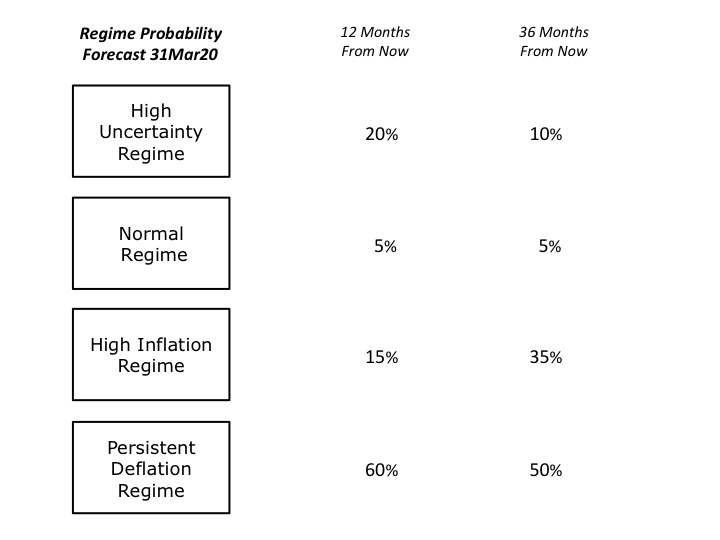
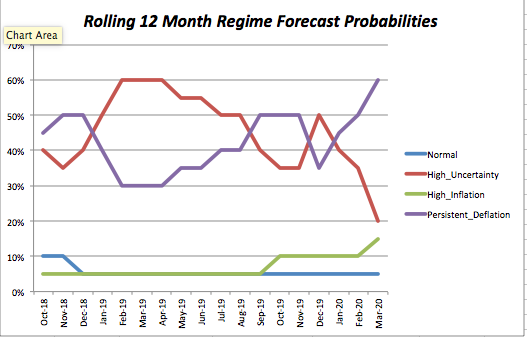
The key driver of the change to our forecast was the exponential and increasingly global impact of COVID19 on aggregate demand over the past month. The combination of an unprecedented collapse in demand and the very high levels of debt that prevailed before the coronavirus pandemic began is a recipe for deflation.
We also increased the probability of entering the high inflation regime over the next 12 months, from 10% to 15%. The logic here is driven by the unprecedented shock to global supply chains that COVID19 has wrought, along with central banks' monetization of equally unprecedented government deficits. If the economy takes longer to recover from the supply shock than from the demand shock (a big “if”), price increases could result, particularly if supplies of food and other goods in high demand are constrained. The danger is that these shortages and price rises (along with monetization of huge government deficits) could cause people to lose faith in the future value of a currency, and drive them to both further increase their demand for scarce goods and flee from their currency into other currencies or hard assets (e.g., gold, property, timber).
While at present this scenario seems very unlikely, it is critical to keep in mind that in periods of elevated uncertainty social learning and copying substantially increase, which makes the dominant narrative (i.e., the prevailing conventional wisdom) exponentially more fragile. As John Maynard Keynes noted in the middle of the Great Depression, “The state of confidence…is a matter to which practical men always pay the closest and most anxious attention.”
We did not make any changes to our 36-month forecast probabilities this month.
We continue to believe that the Persistent Deflation regime is most likely over this time horizon for three reasons.
The first is the increasing headwinds that were restraining aggregate demand growth before the devastating arrival of the COVID-19 pandemic. These headwinds included population aging, weak productivity growth, declining labor share of GDP, high levels of both inequality and debt, and the growing threat of job displacement as increasingly capable automation and artificial intelligence technologies are deployed.
The second reason is the unprecedented demand and supply shocks that are now hammering what was already a weakening economy that was struggling to service very high levels of debt, even at record low interest rates.
The third reason, which we explain in much greater detail in this month's feature article, is our conclusion that financial market valuations have not fully priced in the difficulties that lie ahead in the struggle to recover from COVID19, and how critical uncertainties are likely to evolve.
Portfolio Allocation Implications of Our Forecast
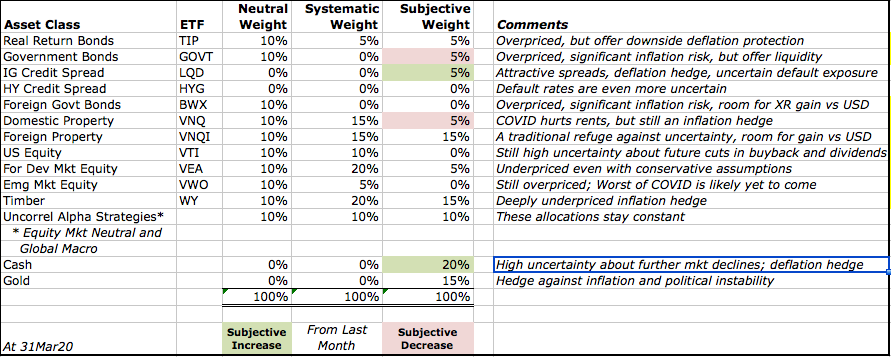
We take two approaches to deriving the tactical asset allocation implications from our analyses. The first takes a systematic approach, and is based on relative asset class valuations. Our starting point is our “neutral” model portfolio, which is equally weighted across nine broad asset classes, and also includes a 10% allocation to alpha strategies (equity market neutral and global macro) that are designed to have a low correlation to returns on broad asset classes. Based on asset class valuations, we systematically vary the asset class weights (but not the active strategy weight), increasing from 10% to 15% when an asset class is likely undervalued, and 15% when it is very likely undervalued. In the case of overvaluations, we go to 5% and then into cash, if there are no undervalued asset classes with room for an increase. In effect, this replicates the systematic rebalancing strategy we used for 15 years in our previous model portfolios.Based on subscriber requests, this month we are re-introducing a feature from the previous version of The Index Investor: Tactical Asset Allocation Implications from our analyses.
The second tactical approach is based on our subjective view not only of current asset class valuations, but also of the implications of the broader macro trends and uncertainties that we analyze each month. Importantly, this subjective view reflects our primary goal of avoiding large downside losses, rather than seeking large upside gains.
Two final notes: First, with respect to US fixed income, we include credit products (investment grade and high yield) in the same asset class as government debt, and will shift into the former when their valuations become attractive. Second, we regard gold not as a separate asset class to be held long-term, but rather as a complement to cash, into which we shift in periods of substantial overvaluation across multiple asset classes.
More information about our investment beliefs, including our core philosophy, approach to asset allocation (including our model portfolios and their long-term track record), and views on various approaches to active and passive management can all be found here.
Here is our latest asset allocation view:
Forecast Logic: Quantitative Indicators
Implications of the Most Recent Three Month Asset Class Returns
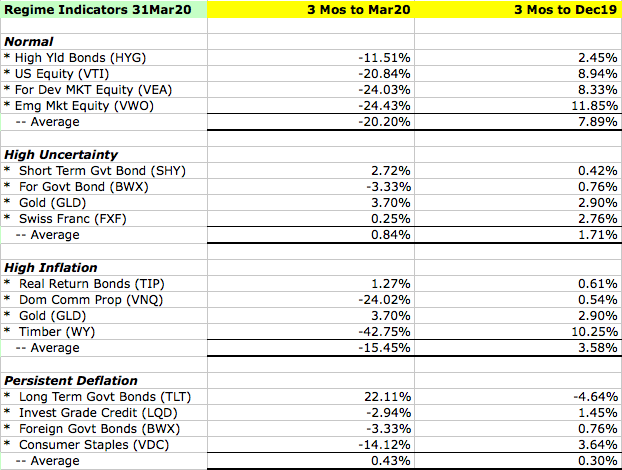
Our quantitative forecast methodology focuses on the level and change in three-month returns, over the most recent and previous three-month periods, for those asset classes, which should perform best under different regimes (in this sense, our regimes can be regarded as macro factors). We assume that relatively higher returns are associated with more widely held investor beliefs in the probability that a given macro regimes will develop in the future.
Over the last three months, there has been a relative strengthening of investors’ belief that the normal times regime lies ahead.
Asset Class Valuation and Momentum Indicators (@31Mar20)
| Asset Class (ETF) | Valuation | 1 Month Return | Conclusion |
| US Real Return Govt Bond (TIP) | Likely Overvalued* | (1.76%) | Decreasing Overvaluation |
| US Nom Return Govt Bond (GOVT) | Likely Overvalued* | 3.11% | Increasing Overvaluation |
| US Investment Grade Credit (LQD) | Likely Undervalued* | (6.30%) | Increasing Undervaluation |
| US High Yield Credit (HYG) | Likely Overvalued* | (9.98%) | Decreasing Overvaluation |
| US Commercial Property (VNQ) | Very Likely Undervalued* | (19.27%) | Increasing Undervaluation |
| US Equity (VTI) | Likely Overvalued* | (13.90%) | Decreasing Overvaluation |
| Foreign Devel Mkt Equity (VEA) | Very Likely Undervalued* | (15.20%) | Increasing Undervaluation |
| Emerging Markets Equity (VWO) | Likely Overvalued* | (17.06%) | Decreasing Overvaluation |
| Timber (WY) | Almost Certainly Undervalued* | (33.45%) | Increasing Undervaluation |
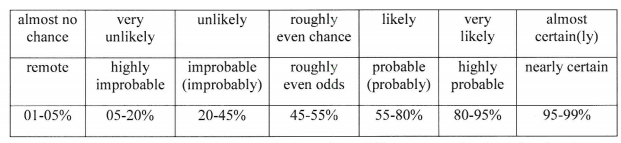
Note: The language we use to describe our estimated likelihood of asset class over or undervaluation is based on US Intelligence Community Directive 203 on Analytic Standards, which includes the following table:
Market Stress Indicators (@31Mar20)
| Market Stress Indicator | This Month vs Last Month |
| Asset Class Returns Autocorrelation (this month versus last month). Higher autocorrelation is an indicator of higher market stress. | .76 vs .21 last month. This indicates a very sharp increase in the level of market stress. |
| Economic Policy Uncertainty Index (how many days over the last 30 was index in top quartile of values since 1985?). A higher number equals more market stress. | On 27 days last month the index was in the top quartile of daily values since 1985 (the 97th percentile of all rolling 30-day periods). This is a huge increase from last month, indicating much more market stress. |
| AAA Rated Bonds Spread over 10 Year Treasury Yield (month end). Higher spreads indicate rising concern about market liquidity. | 2.03% (93rd percentile since 1983), vs 1.52% last month. |
| BB Rated Bonds Spread over 10 Year Treasury Yield (month end). High spreads indicate increasing credit risk. | 6.41%, (94th percentile) up from 3.32% last month. A very substantial increase. |
| Gold Price per Ounce in US Dollars (month end). Rising gold prices are an indicator of increasing market uncertainty and stress. | $1,604 vs $1,626, up 2.9% from last month. At the end of 2017, we estimated the “disaster premium” in the gold price was 47% (see our methodology in the Appendix). At the end of last month it was 71%. (see our methodology in the Appendix). |
New Qualitative Evidence
Based on our qualitative analysis of accumulated and new evidence, we are more pessimistic about the future than those investors whose trades have driven recent returns on different asset classes. We continue to believe that three years from now the most likely outcome is that the global macro system will be in the persistent deflation regime.
This conclusion is based on three critical assumptions.
First, we don’t believe that investors fully appreciated the increasing strength and implications of the headwinds weakening global aggregate demand growth before the arrival of COVID19, and the difficulty in weakening and reversing them.
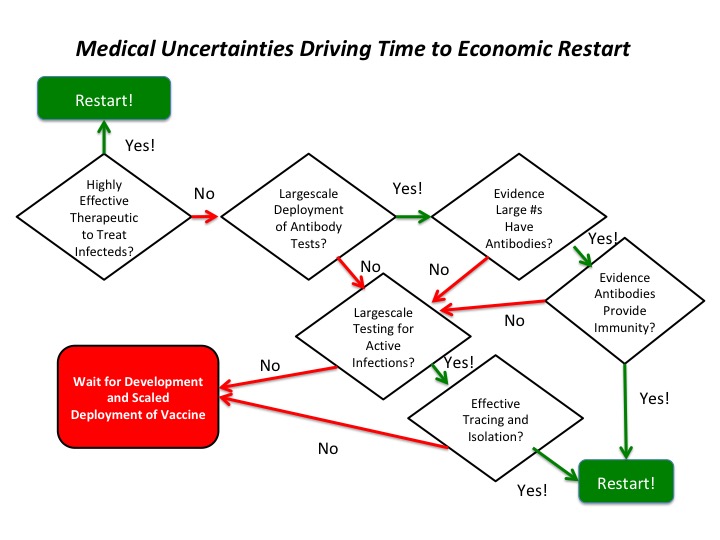
Second, we don’t believe that financial market prices fully reflect the medical obstacle that COVID19 still presents that must be overcome (and the length of time that could take) before the economy can be significantly restarted. Put differently, there are still substantial tail risks. The following chart maps them out:
Pre-Mortem Analysis
One of the most important forecasting disciplines is to ask yourself why your forecast could be wrong. Dr. Gary Klein’s research has shown that a very powerful and insightful way to do this is via a “pre-mortem analysis.” This method asks you to assume that it is a point in the future, and your forecast has been proven wrong (or your strategy or company has failed). You are then asked to look backward from this imagined point in the future, to explain why you failed, what you missed, and what you could have done differently to avoid your fate.
The pre-mortem method takes advantage of the fact that humans reason much more concretely and in more detail when explaining the past than they do when trying to forecast the future.
So let us assume that it is one year from now, and our current forecast has turned out to be wrong.
How did this happen? What developments did we fail to anticipate?
- A number of world leaders – Xi Jinping and Donald Trump, and to a lesser extent Vladimir Putin and Ali Khamenei are all facing sharply weakened economies and declining political popularity. History teaches us that this can lead to increased “foreign adventurism” to distract the public from worsening domestic conditions, as a nation rallies around its leader in a period of heightened external conflict. Should a “kinetic” conflict develop between China and the United States, or Iran and Israel, Saudi Arabia, and/ or the US, or between Russia and one or more European countries (e.g., due to a Russian incursion into the Baltics), it would generate a very sharp increase in uncertainty that would likely accelerate the already sharp COVID-19 economic slowdown. Given given high debt levels, this would very likely accelerate the arrival of the Persistent Deflation Regime.
- A supply side shock of some type – beyond the disruption of global supply chains caused by COVID-19 -- could produce a sudden increase in inflation – the most likely scenario being a reduction in oil supplies due to a prolonged kinetic conflict between Iran and the US. A less likely cause could be major crop failures.
- Another route to the high inflation regime (repeatedly noted by Bridgewater’s Ray Dalio) would be a sudden loss of confidence in the US dollar relative to other currencies (driving up import prices), perhaps because of deficit monetization and policy paralysis if a severe downturn continues without meaningful policy reform to increase productivity and growth and reduce inequality. However, this would also require that there was relatively more confidence in another currency, with the Euro being the most likely candidate. This currently seems unlikely, given both the Eurozone’s economic and political situation, and the prospect of an intensifying conflict between the West and China. However, if confidence collapsed in all major currencies, a sharp increase in inflation would lead to a dramatic rise in the price of gold.
Note: Combining Our Forecasts with Others From Other Sources and Extremizing the Result Should Increase Your Predictive Accuracy
Research has found that three steps can improve forecast accuracy. The first is seeking forecasts based on different forecasting methodologies, or prepared by forecasters with significantly different backgrounds (as a proxy for different mental models and information). The second is combining those forecasts (using a simple average if few are included, or the median if many are). The final step, which significantly improved the performance of the Good Judgment Project team in the IARPA forecasting tournament, is to “extremize” the average (mean) or median forecast by moving it closer to 0% or 100%.
Forecasts for binary events (e.g., the probability an event will or will not happen within a given time frame) are most useful to decision makers when they are closer to 0% or 100% than the uninformative “coin toss” 50%. As described by Baron et al in “Two Reasons to Make Aggregated Probability Forecasts More Extreme”, forecasters will often shrink their probability estimates towards 50% to take into account their subjective belief about the extent of potentially useful information that they are missing.
When you average multiple forecasters’ estimates, you are including more information, which should increase forecast confidence and push the mean estimate closer to 0% or 100%. However, this doesn’t happen when you use simple averaging. For this reason, forecast accuracy is increased when you employ a structured “extremizing” technique to move the mean estimate closer to 0% or 100%.
You can download an extremizing model from our website to use when combining the forecasts you use in your decision process.
The extremizing factors in our model are those that the Good Judgment Project found maximized the accuracy of combined forecasts. Note that the extremizing factor is lower when average forecaster expertise is higher. This is based on the assumption that a group of expert forecasters will incorporate more of the full amount of potentially useful information than will novice forecasters.
Feature Article: COVID's Impact in 2023: Trends, Uncertainties, Scenarios, and Forecast Probabilities
As a former student of Shell’s Pierre Wack, I have long appreciated the value of scenarios as a way of reasoning about a range of possible and plausible future outcomes driven by interacting trends and uncertainties. As a humble veteran of the Professor Philip Tetlock’s Good Judgment Project, I also know the power (and ego risks) of making forecasts that include specific probability estimates for verifiable outcomes. And above all, over 40 years I have seen time and again that complex adaptive systems generate a non-linear distribution of tail risks that are usually underestimated (in likelihood, speed, and impact), if they are recognized at all.
With those caveats in mind, this month I will build on a number of our previous Index Investor feature articles (e.g., “Global Macro Risk Dynamics in the 2020s and Beyond”, “The Next Downturn: How Different, How Deep? How Long?”, and “What Do We Know About Escaping the Persistent Deflation Regime?”) to provide some specific forecasts about the impact of the COVID19 pandemic on what the world will look like in 2023.
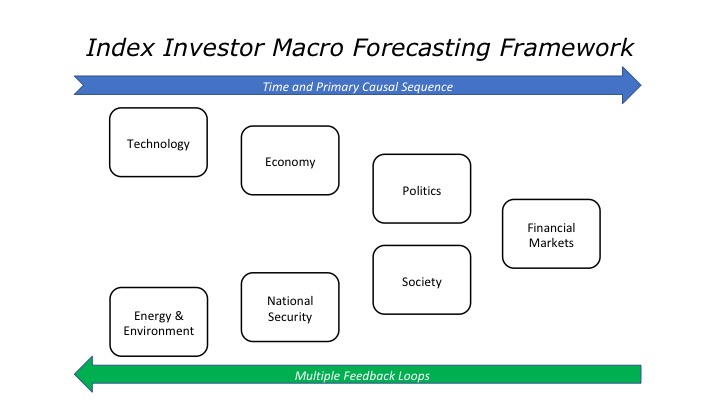
As a reminder, as we have often described in The Index Investor, our approach to global macro forecasting assumes that the changes we eventually observe in asset class valuations and returns are the end result of a roughly chronological process (albeit one with many feedback loops).
At the earliest stage of this process there are changes in technology and in the areas of energy and the environment (which also includes health related wildcards like disease and pandemics).
These fundamental drivers have a significant impact on subsequent changes in the economy and national security, which in turn affect social and political outcomes.
In taking this approach, our goal is to better capture the roles of time and speed, and to make second and third order consequences (and important forecasting questions) easier to discern.
At the end of December 2019, our recommended asset allocation was already highly defensive, based on our conclusion that rising stresses in many areas would eventually produce a sharp and very likely extended downturn in the global macro system.
Technology
• Poorly performing (but increasingly expensive) education systems, which slowed labor productivity growth and strengthened employers’ incentive to invest more in rapidly improving automation and artificial intelligence technologies. This limited wage growth and contributed to increasing inequality.
• In developed countries, the rising cost of health and social care systems that were struggling to effectively and efficiently serve populations that were both aging and suffering from a rising number of chronic ailments (e.g., diet and obesity related hypertension and type 2 diabetes).
Energy and the Environment
• Emission reductions in western nations were being more than offset by increases in China and other nations, resulting in accelerating changes in average global temperatures, rainfall, storm intensity, and other effects whose negative impact (in terms of both velocity and impact) was still highly uncertain.
• The marginal cost of producing traditional forms of fossil energy (e.g., the energy return on energy investment) was rising, while the full suite of technologies (e.g., grid control, utility scale battery storage, market design, etc.) needed for widespread deployment of cost effective solar electricity generation was not yet mature, and there was still considerable popular resistance to increased use of nuclear generation.
Economy
• A variety of forces were increasing downward pressure on aggregate demand growth, leading to a state of “secular stagnation”. These included (1) An aging population; (2) Declining labor share of GDP; (3) Worsening income and human capital inequalities; (4) Weak productivity growth; (5) Rising marginal cost of fossil fuel production; and (6) High debt levels, whose sustainability in an era of slow growth depended on the maintenance of historically low interest rates.
National Security
• Worsening relations between China and the United States, and, to varying degrees, between China and other nations.
• Slowing growth and very high levels of debt in China’s economy, which was very likely creating increasing pressures on the Xi Jinping regime, with very unpredictable consequences.
• Accelerating weakening of the European Union (e.g., Brexit).
Society
• Growing economic pressures on, and the shrinking size of the middle class in many developed countries.
• Even stronger pressures on the growing working class, as evidenced by a range of economic and social indicators, including disintegrating social networks, withering institutions, and rising “deaths of despair”.
• In many countries, growing alienation, falling confidence in traditional institutions (except the military), and intensifying popular anger at increasingly detached and ineffective elites.
Politics
• Rise of Left and Right Populism, growing polarization, and increasingly bitter political conflict in many developed countries, as traditionally stabilizing center left and right parties lost support.
• Growing evidence that governments were incapable of addressing critical issues, due to a combination of weakness in policy development, gridlock in policy debates due to interest group competition, and the increasing ineffectiveness of ossifying public sector bureaucracies in policy implementation.
Financial Markets
• Extremely high valuations across most asset classes, especially ten years into the post-2008 expansion, due to over-reliance on monetary policy and low interest rates to stimulate economies suffering from worsening structural problems.
• Very high government, personal, and corporate debt levels, with much of the latter provided outside the banking system, via high yield bonds, leveraged loans held in Collateralized Loan Obligation (CLO) structures, and credit hedge funds. Compounding the problem, a significant portion of this relatively illiquid corporate debt was held in vehicles (e.g., Exchange Traded Funds) that promised investors daily liquidity, which increased the risk of cascading market panic and debt deflation in a downturn.
At the end of December 2019, we here at The Index Investor were waiting for the arrival of the proverbial straw that would break the camel’s back. Instead, we got a boulder, in the form of a global coronavirus pandemic.
In the following sections, we will assess the potential impact of COVID19 on the key uncertainties we identified in our January 2020 feature, “Global Macro Risk Dynamics in the 2020s and Beyond.” This will include probability forecasts for specific questions related to the broad uncertainties we identified, and probability forecasts for the scenarios that could be produced by the interaction of these uncertainties.
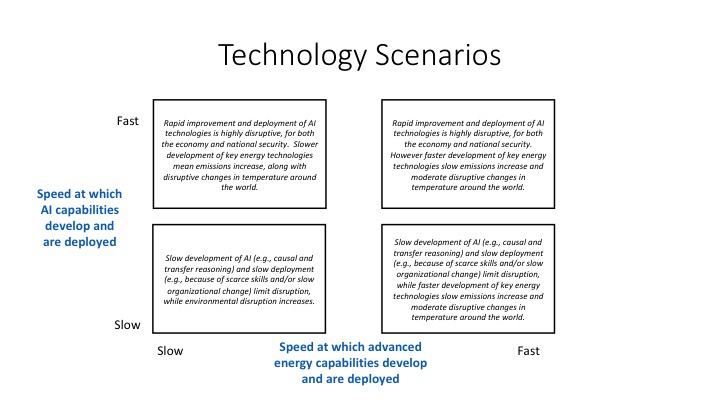
As you will see, the scenarios that follow are consistently presented, so that the most benign outcome is in the lower left quadrant, and the most challenging is in the upper right quadrant.
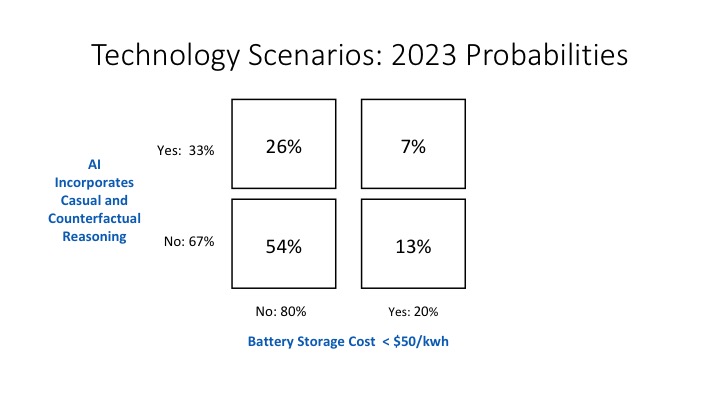
Technology: The two uncertainties driving these scenarios are:
(1) The speed at which artificial intelligence capabilities (possibly enhanced by quantum computing technologies) develop and are deployed (e.g., their deployment will increase the speed at which many activities and processes are carried out, and may also, depending on the rate at which education systems improve, require fewer human workers).
a) Forecasting Question: What is the probability that, by the end of 2023, AI will have acquired a general capacity for causal and counterfactual reasoning that can easily be applied in evolving (non-stationary) environments? This will almost certainly lead to much more widespread deployment of AI. Outcome test: both Gary Marcus and Judea Pearl (two leading authorities in this area) will agree that these capabilities have been developed.
b) Impact of COVID19: Minimal on development. However, if there are still many people unemployed in 2023, if this goal is reached its actual deployment could be constrained.
c) Forecast: 33%. The achievement of this goal will very likely be based on significant departures from the currently dominant paradigm in AI, which is based on neural networks and deep learning. Instead it will require substantial development in symbolic representation and manipulation, which are not areas that today receive nearly as much funding as the dominant paradigm.
(2) The speed at which advanced energy technologies (e.g., batteries and other energy storage, grid control, solar, and carbon capture) are developed and reach a level of cost effectiveness that allows them to be effectively deployed at scale without sharply increasing consumer energy prices.
a) Forecasting Question: What is the probability that the capital cost per kilowatt-hour of utility scale battery storage will be less than or equal to $50 by the end of 2023. Based on recent research, this is the threshold required in order for combined solar/storage electric generation to begin to displace significant amounts of fossil fuel and nuclear generation capacity (see, “Storage Requirements and Costs of Shaping Renewable Energy Toward Grid Decarbonization”, by Ziegler et al).
b) Impact of COVID19: Minimal, unless subsequent rounds of government stimulus spending accelerates the deployment of alternative battery storage technologies.
c) Forecast: 20%. Cost projections for utility scale battery storage forecast best-case capital costs of about $170/kwh by 2025 (“Cost Projections for Utility-Scale Battery Storage” by NREL and “The New Rules of Energy Storage” by McKinsey). However, other, though less mature, storage technologies (e.g., flow and solid state batteries) have the potential to deliver substantially lower costs.
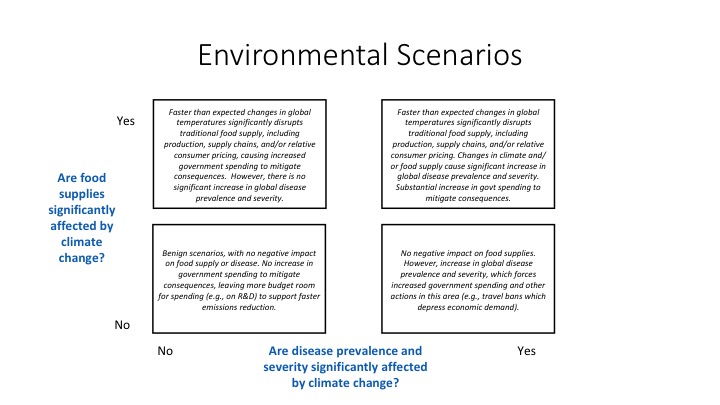
(1) Whether food supplies are significantly affected by climate change.
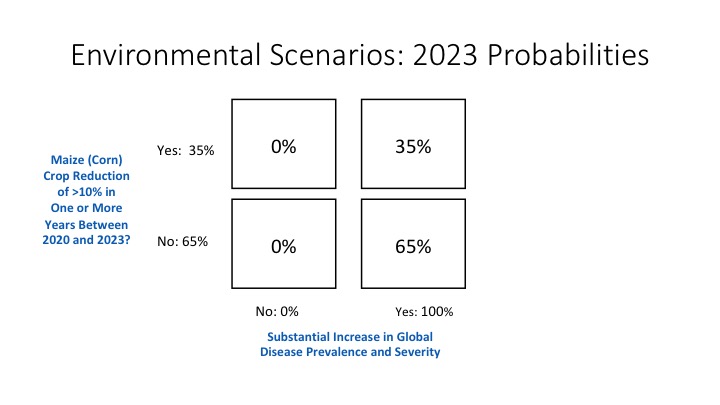
a) Forecasting Question: What is the probability that maize (corn) production in the world’s four largest producing countries (US, China, Brazil, and Argentina) will experience a decline of 10% or more at any time between 2020 and 2023?
b) Impact of COVID19: Slow global recovery from the coronavirus pandemic should reduce the annual increase in emissions and, in the absence of increased solar activity, global warming.
c) Forecast: In “Future warming increases probability of globally
synchronized maize production shocks”, Tigchelaar et al find that if average global temperature increases by 2 degrees Celsius versus the 1850-1900 baseline, there will be a 7% chance each year that corn production in the world’s four larges producers will decline by more than 10%. Below 2 degrees, the probability is estimated to be minimal. In its most recent Decadal Forecast, the UK Met Office estimates that there is a 10% chance that the increase in global temperature versus the 1850-1900 baseline will exceed 1.6% by 2024.
Conservatively, assume that the annual probability of a 10% production decline equals 7% x 10% or about (rounding up) 1% per year. This leads to a probability of not experiencing a crop production decline is therefore 1-(.994), or about 4%.
However, NASA projects that the 2020 to 2025 solar cycle will be the weakest in the last 200 years, which could lead to lower than average temperatures that could also cause crop losses (e.g., see, “Do Sunspot Cycles Affect Crop Yields?”, by Vernon Harrison of the US Department of Agriculture, which found annual falls in Illinois and Nebraska corn yields of between 8% and 10% during years of low solar activity). Based on this limited solar data (which does not include the impact on maize output in China, Brazil, and Argentina), I increase the annual probability of a 10% decline in annual maize production between 2020 and 2025 to 10%. This increases the cumulative probability of a decline of 10% or more in annual maize production in any year between 2020 and 2023 to 35%.
(2) Whether infectious disease prevalence and severity are significantly affected by climate change.
a) Forecasting Question: Will the world experience a substantial increase in global disease prevalence and severity between 2020 and 2023?
b) Impact of COVID19: It has increased the probability to 100%.
c) Forecast: 100%
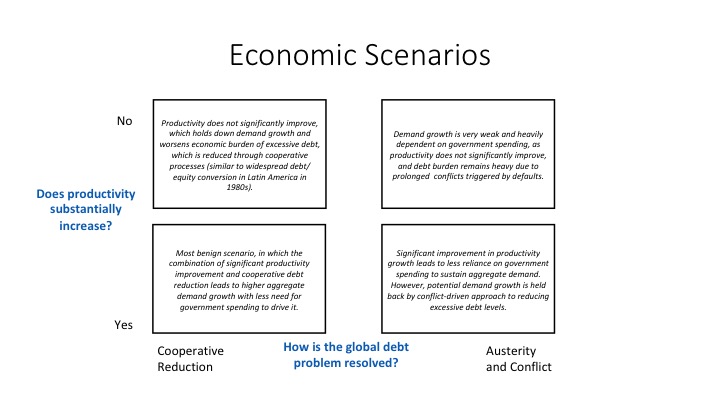
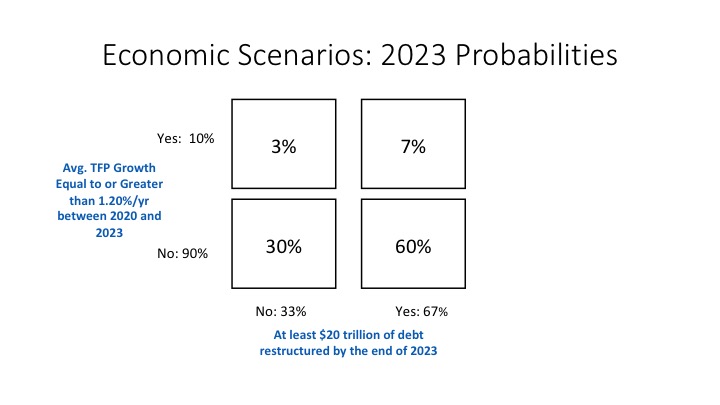
(1) Whether and to what extent the average rate of productivity growth increases.
a) Forecasting Question: Given an aging population and (in the absence of immigration) shrinking workforce, increasing productivity growth is critical to raising living standards. Between 2009 and 2018, US total factor productivity growth averaged 0.84% per year, compared to 1.19% in the previous decade (based on OECD data). What is the probability that between 2020 and 2023, average US total factor productivity growth will equal or exceed 1.20% per year?
b) Impact of COVID19: Thus far, the arrival of COVID19 has been a massive negative shock to productivity, due to quarantining and the implosion of global demand. Between 2020 and 2023, its impact on productivity will depend on how soon productivity reducing factors like quarantines and social distancing are reduced, how fast both aggregate supply and demand recover, and the changes that are made to economic processes (e.g., home vs. office working, government support for innovation, industry structure, regulations, etc.).
c) Forecast: 10%. There is considerable tail risk associated with the time required to develop and deploy an effective coronavirus vaccine, which could result in intermittent social distancing. The slow recovery of the economic demand and employment could also result in constraints on the deployment of productivity increasing automation and artificial intelligence technologies if they were likely, on a net basis, to destroy jobs. To a substantial degree, this depends on the extent to which the US education system improves its results, since more capable workers speed the absorption across the economy of productivity increasing innovations. Unfortunately, there are substantial institutional barriers to improving US education results, and base rate data suggests they will not be significantly overcome before 2023, even in the wake of a dramatic increase in remote learning after COVID198 arrived.
(2) How the global debt problem (including governments’ off balance sheet liabilities for future pension and healthcare costs) is resolved.
a) Forecasting Question: Before COVID19 arrived, there were many signs that excessive debt had become a significant driver of weakening aggregate demand growth, which, (along with central bank monetary policy) had in the short term led to extremely low interest rates that made the growing debt burden sustainable. Based on Bank for International Settlements (BIS) data (the IMF has another debt dataset), at the end of September 2019, Emerging markets nations owed USD $57 trillion in debt (15 government, 29 non-financial corporate, and 14 household), while advanced countries owed $124 trillion (47, 43, 34). In total, this amounted to $181 trillion in debt, or 2.1x global GDP of USD $86 trillion.
Assume the average nominal interest rate on this debt was around 6.5% (say, 3.0% real) annual interest payments alone on this debt mountain required about 12% of global nominal GDP. And since, before COVID19, real global GDP was only growing at about 3% or so per year, the world was already very close to the threshold of the “debt trap” (where the real interest rate is greater than the real growth rate) in which outstanding debt would grow uncontrollably. Commentators like William White (formerly of the BIS and now at OECD) believed that these global debt levels had reached a level where prospective economic growth could not sustain them, and that massive restructuring (e.g., via write-offs and/or debt/equity conversions) would be necessary to return to the global economy to a health and sustainable growth path.
In light of this, here is our forecast question: By the end of 2023, at the global level, will at least USD $20 trillion dollars in individual, corporate, and emerging market debt (of all kinds) have been restructured (including write-offs, extensions, and debt/equity conversions)? Note that this amounts to about 15% of emerging markets plus advanced non-financial corporate and household sector debt. In comparison, in the case of the 1980s Latin American debt crisis, private lenders wrote off or converted to equity about 33% of the debt they were owed.
b) Impact of COVID19: The pandemic has dramatically increased government issuance of new debt (and to a lesser extent corporate issuance). Much of this newly issued new government debt has been monetized by central banks and held on their books. The sharp reduction in global demand has almost certainly made it extremely difficult or impossible for borrowers to service a substantial – but as yet unknown – portion of the global debt load.
c) Forecast: 67%. Fundamentally, there are only four ways to solve the problem of excess debt: (1) Grow your way out of it. Given the headwinds already facing global aggregate demand before COVID19, and its negative impact, this approach is very unlikely to succeed. (2) Impose prolonged austerity to facilitate debt repayment. In today’s political environment, this would very likely be suicidal. (3) Inflate it away. This only works when debt has a relatively long average maturity, and is denominated in the currency of the country trying to inflate away its debt. For a substantial portion of outstanding global debt, these conditions do not hold. In addition, imposing high inflation on an economy after the COVID19 shock would almost certainly have negative social and political consequences. That leaves (4) writing off, converting to equity, or otherwise restructuring a portion of outstanding debt to reduce the burden it imposes on the economy, and free up funds to stimulate spending and renewed economic growth.
On the other hand, it is undeniable that creditors have a substantial amount of political power, and will likely try to use it to minimize debt write-downs. However, as we have seen in Japan, avoiding debt restructuring keeps alive many so-called “zombie” companies whose continued existence tends to depress productivity growth.
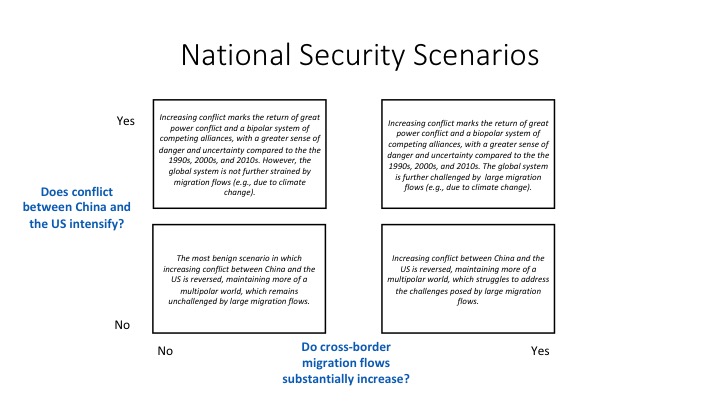
(1) Whether the China-US conflict intensifies.
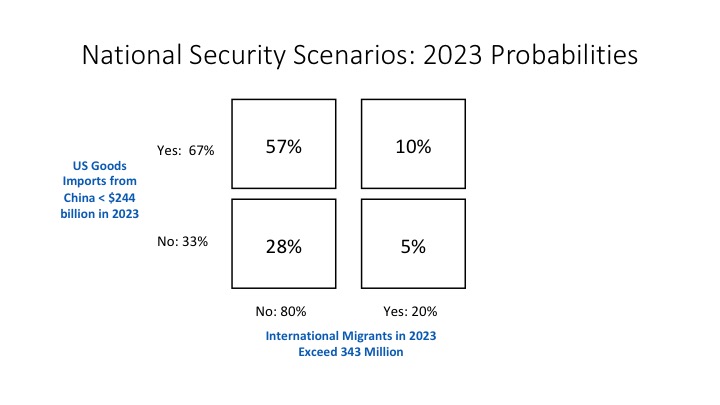
a) Forecasting Question: While there are many dimensions of the US-China conflict, one of the easiest to measure is trade in goods. Over the five years ended in 2019, the US spent an average of $488 billion per year on goods imported from China. If the conflict between the two nations intensifies, these flows should shrink. Hence, our forecasting question is this: In 2023, will US imports from China (expressed in 2019 dollars) be less than $244 billion (i.e., 50% lower than the five year average)?
b) Impact of COVID19: The pandemic has increased distrust between the US and China, and should also convince many companies to shorten their supply chains and produce more previously imported goods in the United States. Worsening relations between the two nations, and increasingly onerous Chinese regulatory requirements (e.g., sharing of intellectual property) had already spurred the movement of production out of China and into other Asian countries (e.g., Vietnam). Worsening US-China relations after COVID19 should accelerate this trend.
c) Forecast: 67%. If this forecast turns out to be wrong, the most likely reason will be a change in both nations’ leadership. However, this would also require a substantial change in many policies China has put in place in recent years (which may not be politically possible, even for a new leader). It would also require reversal of US attitudes towards China, which in recent years have considerably hardened across the political spectrum.
(2) Whether cross-border migration flows substantially increase.
a) Forecasting Question: Between 2010 and 2019, international migration flows (as estimated by the UN, in their “International Migrant Stock” database) grew at a compound rate of 2.92% per year, with the number of migrants reaching 272 million in 2019. Will the number of international migrants in 2023 exceed 343 million (compound growth of 6% per year between 2019 and 2023)?
b) Impact of COVID19: If the pandemic has a substantial impact on countries in Africa, the Middle East, Latin America, and South Asia, it will very likely increase motivations to migrate.
c) Forecast: 15%. COVID19’s effects will almost certainly increase resistance to inward migration in nations many migrants seek to reach (e.g., because of fears of importing disease, and/or continuing high unemployment in a still weak economy). Border conflicts will very likely increase, which will discourage large-scale migrant flows.
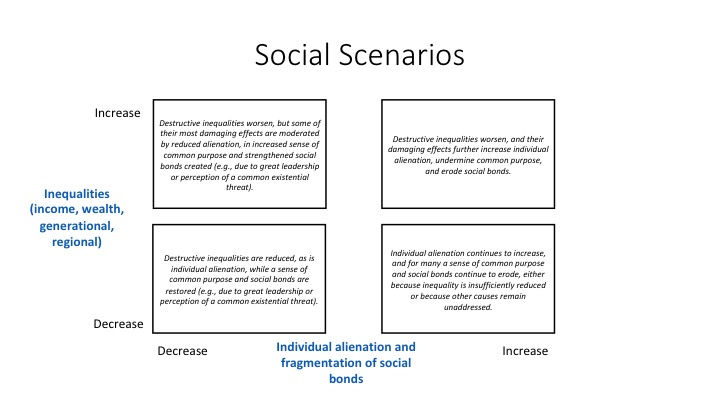
(1) Whether income, wealth, generational, and regional inequalities decrease or increase.
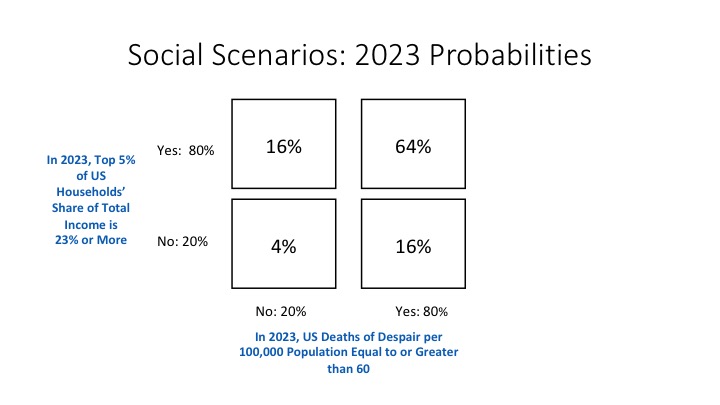
a) Forecasting Question: Based on Census data, in the United States the top 20% of Households earned 44% of Household Income in 1980. The top 5% earned 17%, and the next 15% earned 27%. By 2018, the top 20% share was 52%, with the top 5% share 23% and the next 15% share 29%. It is interesting to note that almost all (five out of six percent) of the increase in the top 5%’s share came between 1980 and 2000, with just another 1% increase coming between 2000 and 2018. This suggests that the financialization of the economy may have had a bigger impact on the top 5%’s income share than did globalization and the growth of “winner take all” technology-driven markets since 2000.
Our forecasting question is this: In 2023, will the top 5%’s share of US income still be equal to or greater than 23%?
b) Impact of COVID19: Extended weak economic growth would very likely cause declines in asset values, reducing capital gains, interest, and dividend income of the top 5%, and in some cases, their labor income as well. Lower earners will also suffer income losses. Tax rates on top earners will almost certainly increase if the Democrats win the White House and both houses of Congress. Even if this doesn’t occur, a tax increase is likely, given the amount of debt being incurred by the US government to fund its response to COVID19.
c) Forecast: 80%. First, because of their political donations, top earners will be able to effectively resist calls for much higher taxes. Second, COVID19 will very likely cause a great reduction in incomes in the middle and lower quintiles of the US income distribution than it will at the top. This may even result in an increase in the top 20% and 5%’s share, despite absolute declines in their income.
(2) Whether the level of individual alienation and fragmentation of social bonds and cohesion decreases or increases.
a) Forecasting Question: The Social Capital Project of the Joint Economy Committee of the US Congress (JEC) has created a data set measuring annual “Deaths of Despair” per 100,000 population. The theory advanced by Anne Case and Angus Deaton (in their book, “Deaths of Despair and the Future of Capitalism”) is that these deaths are closely related to the deterioration of prevailing social and psychological conditions. The JEC report on “Long Term Trends in Deaths of Despair” found that, “In 2000, there were 22.7 deaths of despair per 100,000 Americans — not that different from the 1970 rate of 21.5. By 2017, the rate had doubled to 45.8 per 100,000.” In 2018 it dipped slightly to 45.3. Between 2009 (the first year after the Great Financial Crisis) and 2018, Deaths of Despair per 100,000 at a compound annual rate of 4.5%.
Our forecasting question is this: In 2023, will the rate of Deaths of Despair, as measured by the JEC, be equal to or greater than 60 per 100,000? This number assumes that the rate grew by 4.6% per year through 2019, and then increased by 50%, to 6.75% per year, between 2019 and 2023.
b) Impact of COVID19: The social distancing and quarantining required to combat the coronavirus pandemic, and its likely economic aftermath, will probably further weaken many people’s social bonds and worsen their psychological stress and mental health.
c) Forecast: 80%.
(1) Whether political polarization increases or decreases.
a) Forecasting Question: There is evidence that worsening political polarization (what some have called “the cold civil war”) has had a significant negative impact on investment, output, and employment in the United States (see, “The Political Polarization Index” by Marina Azzimonti of the Federal Reserve Bank of Philadelphia). For example, the Philadelphia Fed’s monthly “Partisan Conflict Index” had an average value of 94 between its start in January 1981 and December 2007. However, between January 2008 and December 2015, its average increased to 130, indicating rising partisan conflict. Azzimonti’s research has shown that this increased uncertainty, which in turn contributed to the slow recovery from the Great Recession). Most recently, between January 2016 (the start of the last presidential campaign) and February 2020, the index average rose even higher, to 167. At the end of February 2020, it stood at 151.
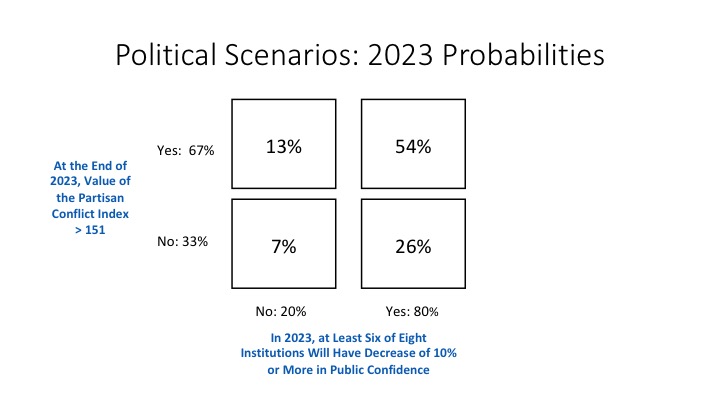
Our forecasting question is this: Between February 2020 and the end of December 2023, will the average value of Partisan Conflict Index be greater than 151?
b) Impact of COVID19: It is not obvious how COVID19 will affect partisan conflict in the United States. We have already seen such conflict over the way the pandemic has been handled thus far. A key question is whether conflict will intensify during and after the November election, as it did in the lead up to and years since the 2016 election. It seems likely that, regardless of who wins in November, much will depend on the effectiveness of America’s evolving response to COVID19 between now and December 2023.
c) Forecast: 67%. For a growing number of people, in recent years their political orientation has evolved from one of many identifies to a meta-identity that is more closely correlated with other identities (e.g., class, race, gender, geographic location, the sector in which one works, religion, consumer preferences, etc.) than ever before. This suggests that a higher degree of partisan conflict is now “hardwired” into the American political system, and indeed into the culture itself. It is possible that, as was the case in America after 9/11 or New Orleans after Katrina, a very effective national response to COVID19 could reduce political polarization, at least for a time. But it seems unlikely.
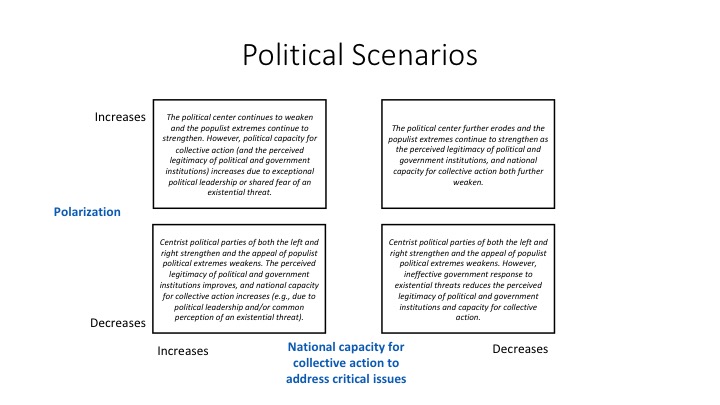
(2) Whether national capacity for taking collective action to address critical issues increases or decreases.
a) Forecasting Question: National capacity for taking effective national action in the face of potentially existential threats is not only a critical element of national power, but also a key driver of public respect for and belief in the institutions of government and society more broadly. COVID19 is currently testing this capacity in many nations.
Each year, Gallup polls Americans’ confidence in various institutions. In 2019, the percentage expressing “a great deal” or “quite a lot” of confidence in different institutions was a follows: (1) The Presidency 38%; (2) Congress 11%; (3) Medical System 36%; (4) Banks 30%; (5) Big Business 23%; (6) Public Schools 29%; (7) TV News 18%; and (8) Organized Religion 36%.
Our forecasting question is this: In 2023, will at least six of these institutions see an decrease of 10% or more in the percent of people expressing a great deal or quite a lot of confidence in them?
b) Impact of COVID19: Institutions’ response to COVID19 will have a very substantial, and likely lasting impact on the public’s confidence in them, and thus on national capacity for collective action in the face of future threats.
c) Forecast: 80%. Popular frustration with various institutions has been increasing since the number of COVID19 cases began to exponentially increase. If this forecast turns out to be wrong, it will be due to (a) the election in the United States of a broadly acceptable centrist government, (b) that placed in positions of leadership practical leaders of acknowledged competence, integrity, and empathy, who collectively worked to (c) enact and implement policies that addressed the deep structural problems that, before COVID19, led to a recognized increase in “secular stagnation.”
There is still a very high degree of uncertainty about how the COVID19 crisis will evolve, and the impact it will have on the global macro system, broadly defined.
Through the use of trend and scenario analysis, as well as specific forecasting questions, this article has provided a structured framework for evaluating the uncertainties that underlie the high level of anxiety about the future that most of us feel today.
The conclusions that emerge from this analysis are neither as bad nor as good as they could be.
Between 2020 and 2023, it seems unlikely that we will see the deployment and scaling of substantially improved artificial intelligence and efficient utility scale battery storage technologies, both of which would have disruptive impacts on employment.
In the area of the environment and health, the global pandemic that we previously cited as a critical uncertainty has arrived. The other major uncertainty is a possible disruptive reduction in food supplies due to environmental changes. This could increase food prices and trigger social and political unrest. The specific forecasting question focused on a fall of 10% or more between 2020 and 2023 in the production of maize/corn, the world’s largest grain crop. We believe this is more probable than most people realize, in part because of the impact of the impending low solar cycle on global temperatures.
In the critical area of the economy, we conclude that the probability of a significant increase in average productivity growth between now and 2023 is, unfortunately, low. If the focus of governments’ response to COVID19 remains returning the economy to the December 2019 status quo ante, any victory won will be Pyrrhic, as that economy was facing multiple headwinds that were intensifying a “secular stagnation” that eventually would have triggered a global crisis. If the economy is to recover (with attendant social and political benefits), government interventions must address the deeper root causes at work. But there is, as yet, no sign that this is going to happen.
Compared to our bleak outlook for productivity growth, we are more confident that we will see substantial debt restructurings, equity conversions, and write-offs. However, due to the political power of creditors, we forecast that, as a percentage of total debt, the amount restructured will likely fall well short of the 33 percent of debt that was restructured to resolve the Latin American debt crisis and restore healthy growth. As a result of this policy failure, high debt levels will likely remain a structural drag on economic growth and slow or block recovery from the COVID19 shock.
In the area of national security, we conclude that conflict between the US and China will continue to increase. The good news is that the lingering effects of COVID19 in China are likely to restrain its external ambitions, and perhaps eventually trigger a change of leadership.
We also conclude that stricter (and more conflict laden) control of developed nations’ borders will ultimately limit the international migration flows (and domestic disruption in destination countries) that the devastating impact of COVID19 would otherwise likely trigger.
With respect to social uncertainties, we do not expect a reduction in current levels of inequality in the United States. We also expect that COVID19 will accelerate the fraying of the social fabric, and result in an increase in deaths of despair. Social pressures will likely intensify.
Politically, the net result of all these developments is likely to be increased polarization and partisan conflict (supercharged by what promises to be a uniquely bitter presidential campaign), as well as further declines in public confidence in many institutions. Together, these developments will further sap national capacity for collective action.
The bottom line is that we believe that investors (and the valuations to which their beliefs give rise) are currently over-optimistic, and have not given sufficient weight to a scenario in which recovery from the COVID19 shock will be far more difficult, and take much longer than many now believe.
Finally, two caveats are in order.
The first is that these forecasts must be updated in light of new high value information, including high likelihood indicators and surprises. We will do that, and update these forecasts in future issues.
The second is that the accuracy of a forecast is usually increased when it is combined with other forecasts that are based either on a different methodology and/or different information inputs. As always, we strongly recommend that forecasts made by The Index Investor be combined with those obtained from other sources.
High Value Information Observed In March 2020
In our model of the complex global macro system, change drivers are arrayed across a roughly chronological process (albeit one with many feedback loops), in which technological and environmental changes precede changes in the economy and national security, which in turn lead to changes in society and politics, all of which produce the effects we observe in investor behavior and financial market valuations and returns.
In our methodology, we classify new information as significant and highly valuable if either it (1) is an “indicator”, which reduces our uncertainty about the value of a parameter in our mental model for making sense of the dynamic macro system, or (2) it is a “surprise” which increases our uncertainty about either the range of potential values for a parameter or the structure of our model. With respect to indicators, the higher our priori probability is for a regime, the more we look for indicators that it will not occur, and the lower our prior probability for a regime, the more we look for indicators that it will occur. Put differently, we tend to look for high value indicators that disconfirm our prior views.
| New Technology Information: Indicators and Surprises | Why Is This Information Valuable? |
| “A New Infection Alarm System on Your Smartphone” by Rosenbach and Schmundt in Der Spiegel | COVID19 will undoubtedly accelerate the development and deployment of health related wearables and apps. These will likely reflect different privacy preferences and regulations around the world. This article is an example of a European approach, which is at one end of the privacy scale, while China’s approach is at the other. Expect US companies to fall somewhere in between. “In the debate over the deployment of digital technologies to help combat the spread of novel coronavirus, a new European approach has been developed in the hopes of diffusing fears of far-reaching surveillance via so-called ‘tracking apps.’ In recent weeks, a team of around 130 people from 17 institutes, organizations and companies in Europe has developed a technology that is intended as an alternative to the tracking technologies used in some countries in Asia. These technologies are sometimes applied against the will of users and some of them can enable other users to identify those who have become infected with the virus. “But the project PEPP-PT, which stands for Pan-European Privacy Protecting Proximity Tracing), seeks to avoid those pitfalls. The plan calls for users to voluntarily download an app which will inform them if they have recently been in the proximity of someone who subsequently tested positive for coronavirus and who also uses the app. That is the extent of the information that will be supplied: You were near someone who was later confirmed to be a carrier of the virus.” |
| “China and Huawei propose reinvention of the internet”, by Gross and Murgia in the Financial Times | “China has suggested a radical change to the way the internet works to the UN, in a proposal that claims to enable cutting-edge technologies such as holograms and self-driving cars but which critics say will also bake authoritarianism into the architecture underpinning the web. “The telecoms group Huawei, together with state-run companies China Unicom and China Telecom, and the country’s Ministry of Industry and Information Technology (MIIT), jointly proposed a new standard for core network technology, called “New IP”, at the UN’s International Telecommunication Union (ITU). “The proposal has caused concerns among western countries including the UK, Sweden and the US, who believe the system would splinter the global internet and give state-run internet service providers granular control over citizens’ internet use.” |
| “Multi-Agent Reinforcement Learning for Problems with Combined Individual and Team Reward”, by Seikh and Boloni, from the University of Central Florida | SURPRISE “Cooperative multi-agent problems are prevalent in real world settings such as strategic conflict resolution and coordination between autonomous vehicles… “Such problems can be modeled as dual-interest: each agent is simultaneously working towards maximizing its own payoff (local reward) as well as the collective success of the team (global reward)… “Learning multi-agent cooperation while simultaneously maximizing local rewards is still an open [technical] challenge” … The authors present “a novel cooperative multi-agent reinforcement learning framework that simultaneously learns to maximize the global and local rewards.” It substantially improves results compared to existing methods. |
| “Learning Compositional Rules via Neural Program Synthesis”, by Nye et al | SURPRISE “Many aspects of human reasoning, including language, require learning rules from very little data. Humans can do this, often learning systematic rules from very few examples, and combining these rules to form compositional rule-based systems. “Current neural architectures, on the other hand, often fail to generalize in a compositional manner, especially when evaluated in ways that vary systematically from training. “In this work, we present a neuro-symbolic model which learns entire rule systems from a small set of examples. “Instead of directly predicting outputs from inputs, we train our model to induce the explicit system of rules governing a set of previously seen examples, drawing upon techniques from the neural program synthesis literature". |
| “Is The Juice Worth The Squeeze? Machine Learning In and For Agent-Based Modeling”, by Dahlke et al | Along with development of causal and counterfactual reasoning capabilities, we believe that the integration of agent based modeling and deep learning has the potential to deliver very substantial improvements in the areas of understanding, explaining, predicting, and controlling the behavior of complex adaptive systems. Hence we carefully track surprises and indicators of progress in this area. In this paper, the authors “conduct a systematic literature review and classify the literature on the application of ML in and for ABM according to a theoretically derived classification scheme. We do so to investigate how exactly machine learning has been utilized in and for agent-based models so far and to critically discuss the combination of these two promising methods. “We find that, indeed, there is a broad range of possible applications of ML to support and complement ABMs in many different ways, already applied in many different disciplines. We see that, so far, ML is mainly used in ABM for two broad cases: First, the modelling of adaptive agents equipped with experience learning and, second, the analysis of outcomes produced by a given ABM.” |
| “Deep Agent: Studying the Dynamics of Information Spread and Evolution in Social Networks”, by Garibay et al | SURPRISE In the US, the Defense Advanced Research Projects Agency (DARPA) “Computer Simulation of Online Social Behavior” (SocialSim) program aims to “ develop innovative technologies for high-fidelity computational simulation of online social behavior. SocialSim focuses specifically on information spread and evolution.” DARPA notes that, “Current computational approaches to social and behavioral simulation are limited in this regard. Top-down simulation approaches focus on the dynamics of a population as a whole, and model behavioral phenomena by assuming uniform or mostly-uniform behavior across that population. Such methods can easily scale to simulate massive populations, but can be inaccurate if there are specific, distinct variations in the characteristics of the population. “In contrast, bottom-up simulation approaches treat population dynamics as an emergent property of the activities and interactions taking place within a diverse population. While such approaches can enable more accurate simulation of information spread, they do not readily scale to represent large populations. SocialSim aims to develop novel approaches to address these challenges.” This paper “explains the design of a social network analysis framework, developed under DARPA’s SocialSim program, with novel architecture that models human emotional, cognitive and social factors… to uncover the underlying dynamics that explain the inner workings and reasons for the selection and diffusion of information in online social platforms.” It develops “a multi-resolution simulation at the user, community, population, and content levels.” |
| “Knowledge Graphs”, by Hogan et al | This paper provides “a comprehensive introduction to knowledge graphs, which have recently garnered significant attention from both industry and academia in scenarios that require exploiting diverse, dynamic, large-scale collections of data” … A knowledge graph is “a graph of data intended to accumulate and convey knowledge of the real world, whose nodes represent entities of interest and whose edges represent relations between these entities.” Use of knowledge graphs “opens up a range of techniques than can be brought to bear for integrating and extracting value from diverse sources of data.” |
| “A scalable pipeline for designing reconfigurable organisms”, by Kriegman et al | SURPRISE But for the arrival of COVID19, this would have been (and still should be) a much bigger story. For the first time, a team has produced “living robots” – that is, living, programmable organisms. Not only does this raise a host of ethical issues, but it also makes so-called “grey goo” risks posed by advancing nanotechnology – either from accident or intentional misuse – one step closer. “Most technologies are made from steel, concrete, chemicals, and plastics, which degrade over time and can produce harmful ecological and health side effects. It would thus be useful to build technologies using self-renewing and biocompatible materials, of which the ideal candidates are living systems themselves.” “Thus, we here present a method that designs completely biological machines from the ground up: computers automatically design new machines in simulation, and the best designs are then built by combining together different biological tissues.” “This suggests others may use this approach to design a variety of living machines to safely deliver drugs inside the human body, help with environmental remediation, or further broaden our understanding of the diverse forms and functions life may adopt.” |
| COVID19 has highlighted many shortcomings in national healthcare and educational systems | In healthcare, the poor integration of the social care (nursing homes, assisted living, home health supports), particularly for the elderly, and the healthcare (preventative, chronic, and acute medical care) has become painfully apparent, with many COVID19 deaths in the social care system. The “traditional” healthcare system has also faced challenges. Yet here the contrast between different national healthcare systems is also painfully apparent, and will likely lead to reforms (yet in some countries, like the US, political conflicts that pre-date COVID19 may still block them, with very unpredictable medium term political effects). In education, the need to rapidly move to remote learning has highlighted the consequences of previous system design decisions. For example, systems that utilize a common curriculum have found it easier to switch to online learning. But even there, COVID19 has highlighted the need to change processes, staff skills, and structures. For example, a wholesale shift to remote learning has created an unprecedented opportunity to leverage the skills of most talented teachers, with other teachers focusing on supporting small groups and individual students. Yet that is running headlong into union contract provisions and K12 cultural norms. If COVID19 forces an extension of remote learning, it will raise even more difficult issues related to education staffing levels, facility needs, and budget reallocations. |
| | |
| | |
| | |
| | |
| New Energy and Environment Information: Indicators and Surprises | Why Is This Information Valuable? |
| “Evaluating the mineral commodity supply risk of the U.S. manufacturing sector”, by Nassar et al | SURPRISE “Trade tensions, resource nationalism, and various other factors are increasing concerns regarding the supply reliability of nonfuel mineral commodities. This is especially the case for commodities required for new and emerging technologies ranging from electric vehicles to wind turbines. In this analysis, we use a conventional risk-modeling framework to develop and apply a new methodology for assessing the supply risk to the U.S. manufacturing sector. Specifically, supply risk is defined as the confluence of three factors: the likelihood of a foreign supply disruption, the dependency of U.S. manufacturers on foreign supplies, and the ability of U.S. manufacturers to withstand a supply disruption. The methodology is applied to 52 commodities for the decade spanning 2007–2016. The results indicate that a subset of 23 commodities, including cobalt, niobium, rare earth elements, and tungsten, pose the greatest supply risk”… “This subset includes commodities that have a high degree of production concentration in countries that may become unable or unwilling to supply to the United States, are mainly imported from other countries, and are consumed in economically important manufacturing industries that may be less able to withstand a price shock that may result from a supply disruption.” |
| “The Green Swan: Central banking and financial stability in the age of climate change” by the Bank for International Settlements | “Integrating climate-related risk analysis into financial stability monitoring is particularly challenging because of the radical uncertainty associated with a physical, social and economic phenomenon that is constantly changing and involves complex dynamics and chain reactions. Traditional backward-looking risk assessments and existing climate-economic models cannot anticipate accurately enough the form that climate-related risks will take.” “These include what we call ‘green swan’ risks: potentially extremely financially disruptive events that could be behind the next systemic financial crisis.” |
| “Alternative Foods as a Solution to Global Food Supply Catastrophes”, by Baum et al | “Analysis of future food security typically focuses on managing gradual trends such as population growth, natural resource depletion, and environmental degradation. However, several risks threaten to cause large and abrupt declines in food security. For example, nuclear war, volcanic eruptions, and asteroid impact events can block sunlight, causing abrupt global cooling. “In extreme but entirely possible cases, these events could make agriculture infeasible worldwide for several years, creating a food supply catastrophe of historic proportions. This paper describes alternative foods that use non-solar energy inputs as a solution for these catastrophes. “For example, trees can be used to grow mushrooms; natural gas can feed certain edible bacteria. “Alternative foods are already in production today, but would need to be dramatically scaled up to become the primary food source during a global food supply catastrophe. Scale-up would require extensive depletion of natural resources and difficult social coordination. "For these reasons, large-scale use of alternative foods should be considered only for desperate circumstances of food supply catastrophes. During a catastrophe, alternative foods may be the only solution capable of preventing massive famine and maintaining human civilization.” |
| “Are Economists Getting Climate Dynamics Right and Does It Matter?”, by Dietz et al | SURPRISE “We show that several of the most important economic models of climate change produce climate dynamics inconsistent with the current crop of models in climate science. “First, most economic models exhibit far too long a delay between an impulse of CO2 emissions and warming. Second, few economic models incorporate positive feedbacks in the carbon cycle, whereby carbon sinks remove less CO2 from the atmosphere, the more CO2 they have already removed cumulatively, and the higher is temperature. “These inconsistencies affect economic prescriptions to abate CO2 emissions. Controlling for how the economy is represented, different climate models result in significantly different optimal CO2 emissions. A long delay between emissions and warming leads to optimal carbon prices that are too low and too much sensitivity of optimal carbon prices to the discount rate. “Omitting positive carbon cycle feedbacks also leads to optimal carbon prices that are too low. We conclude it is important for policy purposes to bring economic models in line with the state of the art in climate science.” |
| | |
| | |
| | |
| | |
| | |
| | |
| | |
| | |
| | |
| New Economic Information: Indicators and Surprises | Why Is This Information Valuable? |
| Before the COVID19 pandemic exploded, former GE CEO Jack Welch died on 1Mar20. | Welch was GE’s CEO from 1981 to 2001. Thanks to age and experience, I have a very keen view of his legacy. Reg Jones’ leadership of GE was based on a bureaucratic, planning based model that began to break down in the late 70s. Welch brought a more agile approach that in many ways was appropriate for the more dynamic environment he faced in the 80s and 90s. He was also one of the leading figures in the “financialization” of US (and then global) capitalism during these decades. At the beginning, there was, indeed, a lot of corporate waste, and rooting it out – through LBOs or more aggressive GE style management – made sense. So too did Welch’s attempt to shake up a GE culture that had become overly bureaucratic. Innovations like GE’s Crotonville education center really did add a lot of value. But as always, initially successful ideas were taken too far. By the time Welch handed the reins of GE to Jeff Immelt in 2001, those excesses were already apparent, far beyond GE (as we wrote then in The Index Investor). Things got even worse in the 2000s and 2010s, and global democratic capitalist systems are paying the price today, just as Jeff Immelt did at GE. As is often the case, Welch’s legacy is mixed, and again reminds us that successful ideas too often lead to hubris, which inevitably leads to nemesis. Unfortunately, we never seem to learn this lesson. Today, calls for “stakeholder” instead of “shareholder” capitalism abound, as the cycle begins yet again (e.g., see, “The Illusory Promise of Stakeholder Governance” by Bebchuk and Tallarita) |
| “Coronavirus and Macroeconomics”, by Fornaro and Wolf | “The consensus is that the coronavirus will cause a negative supply shock to the world economy, by forcing factories to shut down and disrupting global supply chains. But how deep and persistent is this supply disruption going to be?” “In a traditional Keynesian approach, employment and output are determined by aggregate demand In turn, aggregate demand depends positively on productivity growth. The reason for this is that faster productivity growth boosts agents’ expectations of future income, inducing them to spend more in the present. This effect gives rise to a positive relationship between productivity growth and employment… “In reality, productivity growth is at least in part driven by firms’ investment. In turn, investment decisions depend on aggregate demand – when demand is strong, the return from investment tends to be high; weak aggregate demand, conversely, depresses firms’ incentives to invest. This effect gives rise to a positive relationship between productivity growth and aggregate demand… “The supply-demand doom loop: the initial negative supply shock depresses aggregate demand. But now, lower demand induces firms to cut back on their investment, which generates an endogenous drop in productivity growth. Lower productivity growth, in turn, causes a further cut in demand, which again lowers productivity growth. This vicious spiral, or supply-demand doom loop, amplifies the impact of the initial supply shock on employment and productivity growth.” Monetary and fiscal policy interventions are intended to avoid this doom loop by stimulating aggregate demand, including investment, which should in turn raise productivity, and trigger a virtuous economic recovery loop. Yet the effectiveness of monetary policy is now constrained by very low interest rates (i.e., the zero lower bound liquidity trap). That leaves fiscal and structural policy to ride to the economy’s rescue. But there are catches here too. If fiscal policy doesn’t stimulate employment and consumption growth, investment spending is unlikely to recover. Moreover, productivity growth is also constrained not just by the level of investment, but also by other factors such as poorly performing education systems. Finally, productivity growth is unlikely to trigger higher spending if there is no expectation on the part of workers that it will translate into higher wages. Unfortunately, this is just what has been happening in recent years, as the labor share of GDP has been falling, and real wages have stagnated while labor productivity has increased, albeit far more slowly than in the past. |
| There were many stories noting that COVID19 could not have arrived at a worse time, given high debt levels (relative to GDP) around the world and the increasing drag they have imposed on aggregate demand growth (e.g., see, “Indebted Demand” by Mian et al) | See, for example, “The Seeds of the Next Debt Crisis”, by John Plender, FT, 3Mar20, and “Coronavirus and Debt: A Toxic Mix”, by Ung Tran, FT, 11Mar20. As we noted in our August 2019 feature article (“The Next Downturn: How Different? How Deep? How Long?”, and our December 2019 feature (“What Do We Know About Escaping the Persistent Deflation Regime?”), and as William White, former head of the BIS’ Monetary and Economic Department has also emphasized, there are only four ways out of the debt crisis we face. Ideally, a company or country can grow its way out. That seems highly unlikely after a global shock of unprecedented magnitude. Moreover, before COVID19 arrived, many economies were already facing increasing headwinds that were depressing growth rates. These included ageing populations, declining labor shares of GDP, worsening inequality, weak productivity growth, and those heavy debt loads. Debts can also be repaid by imposing painful austerity that cuts spending on goods and services for an extended period of time (e.g., the “lost decade” in Latin America after that region’s debt crisis in the 1980s). Today, this approach would be counterproductive economically and almost certainly politically suicidal. A third option is reducing the real value of debt through high inflation. However, that assumes that (a) the debt explicitly carries a nominal, not real interest rate; (b) it is denominated in the currency experiencing high inflation; and (c) it has a sufficiently long maturity to realize substantial benefits from prolonged inflation. For a substantial portion of the world’s debt, these conditions don’t apply. That leaves the last option, widespread write-downs, write offs, and/or conversion of debt into equity. It has happened before (e.g., the London Debt Agreement of 1953, which cut West. Germany’s post-war debt by 46%, and limited future debt service payments to no more than 3% of export earnings). It is almost certain that these will be needed again. As was done in the case of the Latin American debt crisis, such write downs may be facilitated by government issuance to creditors of very long term zero coupon bonds and waivers of mark to market accounting rules. See also, “Corporate debt burdens threaten economic recovery after COVID-19: Planning for debt restructuring should start now”, by Becker et al |
| “Public spending at the effective lower bound: The significance of sustainability risks”, by Battistini and Callegari | In this post on VoxEU, the authors summarize a paper they wrote in April 2019 for the European Central Bank (“Dynamic Fiscal Limits and Monetary-Fiscal Policy Interactions”). As global governments undertake unprecedented debt financed fiscal stimulus to counteract demand collapse triggered by the COVID19 pandemic, the sustainability of sovereign debt has never been more important. The authors note that in their model, “a government honours its obligations if it is able to do so. In other words, public debt is sustainable whenever it is below the government’s maximum ability to repay. This is its fiscal limit. Technically, the fiscal limit is computed as the present discounted value of all current and future maximum primary surpluses” [current government revenue less current expenses, not including interest or debt repayment]. For this reason, for any given forecast for future primary surpluses, declining real interest rates increase the amount of debt they can support without triggering investor fears about sustainability and the likelihood of restructuring or default. On the other hand, rising real rates (as would be the case in a deflation) would have the opposite effect. However, “there is no such thing as one fiscal limit; stochastic shocks instead create a distribution of fiscal limits that is state-contingent because new shocks arrive every period and, therefore, the distribution shifts every period.” |
| As a result of COVID19, it is now almost certain that the US (and other nations) will face a public pension funding crisis that is much broader, much deeper, and will arrive much sooner than previously forecast. | Major investment losses and an extended period of low interest rates (which increase the discounted present value of future benefit liabilities) have decimated defined benefit plans’ funding ratios. Eventually, this will very likely lead to what will almost certainly be a protracted and bitter political conflict between four unpalatable alternatives: (1) Much higher taxes to pay promised benefits while rebuilding plan assets; (2) Instead of increased taxes, deep cuts in other public spending to allow for much higher employer pension contributions; (3) A federal bailout of plans across the nation that would likely cost close to $1 trillion; or (4) widespread municipal bankruptcies that, based on recent court decisions, if not previous law, sacrifice the theoretically senior claims of municipal bond investors in order to facilitate higher pension plan contributions by public sector employers. |
| Before COVID19 arrived, the Chinese economy was already facing increasing headwinds because of ageing, falling productivity (because of years of capital misallocation to lower return investments – e.g., funding the property bubble and excess industrial capacity), rising debt levels, and a worsening trade conflict with the United States. | The coronavirus pandemic, especially if it drags on, will create further problems for China, and knock on negative impacts in other countries. For example, COVID19 will accelerate the restructuring of global supply chains away from China. It will also almost certainly reduce China’s imports of commodities, and, in the absence of new swap lines with the US Federal Reserve, very likely lead to sales of China’s stock of US Treasuries to obtain the dollars needed by local companies to repay dollar borrowings in the face of a rapidly strengthening US dollar exchange rate. Of course, this also means that defaults on foreign and domestic debts are very likely to increase, which runs the risk of triggering a classic debt deflation. |
| In the wake of the global COVID19 shock, two factors could lead to a prolonged period of weak economic demand. | SURPRISE The first is extended uncertainty that depresses the willingness of consumers and businesses to spend (e.g., see “The Uncertainty Channel of the Coronavirus” by Leduc and Liu, “COVID-Induced Economic Uncertainty” by Baker et al, and “Understanding and Predicting Uncertainty Shocks” by The Index Investor). Prolonged social distancing (and perhaps isolation, in the case of an even deadlier second wave of coronavirus infections in the northern hemisphere this fall) while the world waits for a coronavirus vaccine is just the most obvious source of uncertainty. Headline grabbing increases in unemployment benefits filings are another uncertainty shock, and they are now appearing, particularly in the United States. Political developments could also further increase uncertainty (e.g., death of a leader, increased social conflict, cancellation of elections, intensifying international conflicts beyond the current oil price war etc.). Yet another uncertainty shock would be supply chain failures that lead to visible shortages of critical goods, possibly accompanies by sharp increases in their price. The impact of any such shortages are sure to be amplified by social media. Still another shock would be further sharp price declines across a range of asset classes, and/or an accelerating rise in the price of gold. Perhaps the most dangerous source of increased uncertainty could be the psychological shock and horror that will result if and when the uncontrolled growth of COVID19 infections leads to mass suffering and casualties in developing nations that are far in excess of what the world has seen thus far. With respect to willingness to spend, the greatest challenge is very likely to be how to overcome the very low esteem in which various institutions and elites were held before the COVID19 pandemic arrived – our deficit of authentic, inspiring leadership, if you will. The second factor is an extended lack of capacity to spend on the part of consumers and businesses, leading to widespread debt servicing problems, increasing threats by creditors, and a steady increase in bankruptcy filings, which would further reinforce uncertainty. In this regard, policy design is critical. For example, many businesses may balk at taking on more debt to survive a bit longer, without any confidence such loans can be repaid, or eventually will be forgiven. As a number of observers have noted, direct cash grants, to both individuals and businesses (provided the latter use them to maintain employment, and not repay debts) will almost certainly be more effective at supporting continued spending in the short term. So too would very clear policies that suspended rent, mortgage, credit card and other debt payments for the duration of the COVID19 emergency. Unfortunately, and perhaps fatally, the previously noted lack of leadership, and still elevated levels of partisan bickering (even in the face of an existential crisis), may prevent the most effective spending capacity policies from being enacted and implemented in the United States, if not in other countries. At a slightly longer time horizon, expanding direct government employment and/or programs to purchase a wider variety of products and services from private sector businesses will very likely be needed to support spending capacity as the economy slowly recovers from the pandemic. |
| “Can the World Afford Fiscal and Monetary Stimulus on This Scale?” by Gavyn Davies, FT, 29Mar20 | SURPRISE Davies notes that, “The fiscal and monetary stimulus announced by the world’s major economies over the past month is a global policy event without precedent in peacetime…It would not be surprising if the Fed’s balance sheet increased by $2tn-$3tn this year, up from $4.2tn at the end of 2019. That is similar to the cumulative increase over the entire decade that followed the financial crash”… “Many investors — and, privately, some policymakers — wonder if this degree of stimulus by the US and most other big economies is “affordable”, and whether it will cause government debt crises and a subsequent rise in inflation. If the answer to either of these questions is “yes”, markets could lose confidence in the ability of the authorities to cope with the coming recession. The results for asset prices would be gruesome.” Davies believes the probability of this outcome is low, based on his assumptions that government debt can stay on central bank balance sheets for a long time (as in Japan), and fiscal stimulus will cause real growth to exceed the real interest rate on government debt (which might require the Fed attempting to control rates along the yield curve). At minimum, the latter assumption remains uncertain. Davies also offers a pre-mortem of sorts: “The bad news is that this form of financing can be dangerous if inflation starts to rise. We discovered during the financial crash that increases in central bank money do not automatically cause this. But today there is a complex mix of supply and demand effects at work and, together, they could cause inflation to rise.” For an example of this, see “Mine Closures Bolster Metals Prices As Demand Collapses”, by Neil Hume in the Financial Times, 6Apr20. “For example, if supply continues to be constrained while consumers simultaneously receive large government transfers [and spending increases after a coronavirus vaccine is deployed], aggregate demand could rise in an inflationary manner. In that case, it would be important for fiscal injections to be eliminated, or reversed quickly.” |
| “Declining Worker Power and American Economic Performance”, by Stansbury and Summers and “Understanding the Present and Future of Work in the Fissured Workplace Context”, by David Weil | SURPRISE Before the arrival of COVID19, one of the key headwinds that has been depressing aggregate demand growth is the declining labor share of GDP. Whether COVID19 leads to policy reforms that reverse this trend remains to be seen. In the meantime, it is important to better understanding the underlying root causes that have been at work. Stansbury and Summers weigh the evidence for three hypothesized causes: (1) An increase in companies’ monopoly power in product markets (leading to higher markups and profits); (2) An increase in companies monopsony power in labor markets; and (3) A decrease in employees’ worker power. The authors find that aggregate level data does not provide strong evidence for one hypothesis over the others. However, industry level data clearly points to declining worker power at the most important root cause. They ascribe this decline to three factors: (1) A less favorable policy environment (e.g., the declining real value of the minimum wage); (2) Increasing shareholder pressure on companies to cut costs, leading to more aggressive wage negotiations and increased use of domestic and international outsourcing; and (3) Increased competition for workers from improving labor substituting technologies, including automation and artificial intelligence. Weil is the author of the 2014 book “The Fissured Workplace”, which argued that, “large corporations have shed their role as direct employers of the people responsible for their products, in favor of outsourcing work to small companies that compete fiercely with one another. The result has been declining wages, eroding benefits, inadequate health and safety conditions, and ever-widening income inequality.” In his new paper, he looks to the future, and argues that fissured workplaces “require different policies for the workplace and labor market than traditional approaches including those regarding worker rights and protections, employment responses to the business cycle, workforce education and training, and job and career mobility.” His recommendations, and similar ones from others, are likely to get a more serious hearing after the COVID19 pandemic subsides, almost certainly in the UK under Boris Johnson, and in the United States if Joe Biden defeats Donald Trump. |
| | |
| | |
| | |
| New National Security Information: Indicators and Surprises | Why Is This Information Valuable? |
| As the COVID19 pandemic spread and dramatically reduced demand, Saudi Arabia and Russia launched an oil price war | In the short term, the immediate casualties will likely be highly leveraged US shale oil producers whose breakeven economics depends on prices of $50/barrel or more (causing bankruptcies and some reduction in output), Canadian oil sands producers (reduced output, but bankruptcies among their suppliers), and smaller OPEC countries (whose already unstable governments will be further weakened – very likely, in some cases, to the point of collapse -- by a sharp fall in oil revenues and the arrival of COVID19). |
| “Alternative Worldviews Understanding Potential Trajectories of Great-Power Ideological Competition”, by Watts et al from RAND | SURPRISE “This report seeks answers to the following questions: "(1) To what extent have China and Russia formulated alternative ideologies or worldviews that challenge today’s international order? Because such alternatives have not yet been articulated, what factors might drive the emergence of a cohesive, alternative ideology? "(2) How do these rivals currently pursue ideological competition with the United States, and how might they do so in the future? "(3) Under what conditions are China and Russia likely to persuade audiences around the world of the advantages of alternatives to the current international order?” … “Ideologies can be understood as a coherent set of ideas about politics or social organization that combines beliefs about norms (e.g., a belief that a given set of policies is morally superior or culturally appropriate) and causality (e.g., a belief that a given set of policies will yield superior outcomes)… "Ideologies offer coherent, normatively grounded solutions to social problems, they are potent sources of political action.” … “China seeks to secure what it perceives as its rightful place in the world: dominance over Asia and expanded influence globally, with the United States’ role correspondingly weakened… "Following 30 years of economic growth and 20 years of concerted military modernization that is finally delivering rapidly advancing capabilities to support the military’s regional objectives, China is now in a position to assert its vision… “At its core, China’s governing ideology centers on development—which might be appealing to some in the developing world—as opposed to the Western liberal focus on freedom. “Most of China’s current governing ideas in the international, domestic, and economic realms are underpinned by the government’s emphasis on national sovereignty. “However, an important—if unrealized—strain of China’s historical worldview is Tianxia, or “all under heaven.” Tianxia prescribes an almost supranational elite global governance centered on Beijing, which presents a fundamental contradiction with Beijing’s traditional acceptance of Westphalian concepts of sovereignty. This inherent tension is an important intellectual thread to monitor because it could challenge the core tenet of the U.S.-led order” … “Despite China’s efforts to popularize its ideology, the results are uncertain. There is no specific polling on China’s ideological projects that would help to disentangle their effects from China’s material sources of influence, and global public opinion of China is uneven”… “Since the collapse of the Soviet Union, Russia has primarily railed against Western ideals but struggled to articulate its own ideologies. However, more recently, Russia explicitly embraced ‘conservative and antiliberal elements’”… “With the exception of survival of the regime, regional influence is the most important strategic interest of Russia … Another key interest is that Russia be regarded as a “leading world power” whose role is to maintain strategic stability and act as a check against the United States and the West. A common narrative that has emerged in Russian geopolitical discourse is the impact of globalization dominated by a liberal worldview, and the need for Russia to offer a “traditional” or anti- Western alternative”… “The key ideas underlying this evolving narrative are anti-Westernism, polycentrism, antiliberalism, and conservatism, which are, in some respects, a reversion to the mean of Russian political and cultural history that goes back centuries” … “The extent to which these ideas are deeply held among the Russian elite or are being opportunistically exploited as relations with the United States and the West deteriorate is difficult to know…However, history and polling suggest that there will likely be, at a minimum, a substantial minority of the Russian elite, particularly in the security and military sectors, that will see a Russian embrace of Western political and cultural ideas as antithetical to Russia’s national identity” … “Russia has developed the capabilities to promote its ideas on a global scale…Russia developed social media capabilities that have facilitated the propagation and, in some cases, weaponization of information and that appeal to disaffected groups to capitalize on political and cultural divisions”… “Rapid ideological change typically occurs in periods of crisis: In ordinary times, most people tend to resist sweeping updates to their political ideologies. However, in times of crisis—especially following defeat in war or deep and sustained economic dislocations— people might become much more receptive to ideas that appear to offer solutions to systemic problems. Such rapid propagation of new ideas occurred during the collapse of the Soviet Union. "Depending on the duration and depth of current economic dislocations, including those from automation, global trade, and potential environmental catastrophes, rapid ideological change might occur again.” The authors conclude with descriptions of alternative scenarios for the trajectories of great power competition in the years ahead. |
| “One War Is Not Enough: Strategy and Force Planning for Great Power Competition”, by Brands and Montgomery | SURPRISE Brands and Evan Braden Montgomery discuss the gap between America's global commitments and the military challenges it can realistically meet. A quiet revolution in American defense strategy is currently underway. The U.S. military is no longer focusing on combating rogue states, terrorist groups, and other deadly, albeit relatively weak, enemies. Instead, the Defense Department is setting its sights on China and Russia: great power rivals that are contesting American military advantages and threatening to reorder the world. “The central challenge to U.S. prosperity and security is the reemergence of long-term, strategic competition by … revisionist powers,” the 2018 National Defense Strategy states. "Deterring these rivals, and defeating them should deterrence fail, will require far-reaching changes in what the American military buys and how it fights. rather than planning to win multiple medium-sized wars, the Defense Department is preparing to win a single major war against a formidable competitor, one that can match (at least in some areas) American military might. "This shift represents the most significant departure in American defense strategy since the end of the Cold War, and it has tremendous ramifications for a country that still has security commitments — and security challenges — around the globe. The one-war standard reflects serious strategic thinking and is rooted in real budgetary constraints. It is a recognition that defeating a great-power adversary would be far more difficult than anything the U.S. military has done in decades, and that losing a great-power war would be devastating to America’s global interests. "It is meant to galvanize a sluggish bureaucracy to undertake the radical changes necessary to prevent this grim scenario from coming to pass. Yet, it is far more dangerous than its advocates publicly acknowledge "The most obvious risk of a one-war standard is that America might need to fight more than one war at a time. In fact, a one-war standard could increase this risk by tempting an opportunistic adversary to use force in one theater while Washington is occupied in another. "Proponents of the one-war approach offer a number of options for avoiding a second war, if possible, or fighting it, if necessary, but these options are not promising: They would leave the United States strategically exposed, militarily overextended, or much more reliant on highly escalatory options that lack credibility. And as America loses the ability to handle challenges in more than one theater, it will also lose leverage in peacetime competitions and diplomatic crises. In short, the one-war standard exposes a serious mismatch between America’s global commitments and the military challenges it can realistically meet — a grand strategy-defense strategy gap that may prove extremely damaging in war and peace alike." |
| “Fog, Friction, And Thinking Machines”, by Zach Hughes | SURPRISE “For four reasons, the proliferation of battlefield AI and autonomous systems is likely to increase the fog of war. “First, new technologies tend to make life harder for individuals, even as they add capability. “Second, AI introduces new kinds of battlefield cognition. “Third, combining AI, hypersonic weapons, and directed energy will accelerate decision-making to machine speeds. “And fourth, AI enables military deception of both a new quality and quantity… “Fog and friction will likely be as prevalent in the era of thinking machines as at any other time in history. The U.S. military should view with great skepticism any optimistic claims that new technology will remove the fog of war. Instead, by taking a more realistic view that fog and friction are here to stay, the U.S. military can focus on training its leaders, present and future, to navigate the increasing complexity and dynamism of a battlefield operating at machine speeds.” |
| Final Report of the Cyberspace Solarium Commission, March 2020 | The Cyberspace Solarium Commission (CSC) was established in the National Defense Authorization Act for Fiscal Year 2019 to "develop a consensus on a strategic approach to defending the United States in cyberspace against cyber attacks of significant consequences." Its final report is a sobering read. Among its key conclusions: “For over 20 years, nation-states and non-state actors have used cyberspace to subvert American power, American security, and the American way of life…The perpetrators saw that their onslaught damaged the United States without triggering significant retaliation”… “The US Government is currently not designed to act with the speed and agility necessary to defend the country in cyberspace”… For example, see another new analysis, “How Adversarial Attacks Could Destabilize Military AI Systems”, by David Danks “The United States now operates in a cyber landscape that requires a level of data security, resilience, and trustworthiness that neither the US government nor the private sector alone is currently equipped to provide. Moreover, shortfalls in agility, technical expertise, and unity of effort, both within the US government and between the public and private sectors are growing.” The report concludes with a long list of recommendations to address the challenges it identifies. |
| COVID19 has once again laid bare underlying tensions in the European Union. | A flashpoint is Italy, which has seen more deaths than other countries, but with a debt/GDP ratio of 136% was likely to find it hard to finance the increased government spending critical to minimizing the COVID19’s negative impact on the economy. One proposal was for the EU to issue “Eurobonds” which were backed by the governments of all EU nations. But northern countries, like Germany with a debt/GDP ratio of only 59%, refused to back this idea, fearing that the lack of spending and borrowing discipline by Italy (and also Spain) would leave its more prudent taxpayers on the hook. For the time being, the conflict has been dampened by the decision of the European Central Bank to purchase significant amounts of sovereign debt, from Italy and other issuers, to fund at least the initial portion of their economic support and recovery programs. Going forward, however, this latest example of the EU’s north/south divide (coming on top of the East/West divide most recently highlighted by Brexit and the EU’s silence when Hungary’s Viktor Orban assumed near dictatorial power) will almost certainly further weaken the EU. It is highly unlikely that Italians will forget how they were treated – a point that was only highlighted by both Russia’s and China’s very public delivery of COVID19 medical supplies to Italy. |
| China has launched an aggressive propaganda campaign to deflect blame for the COVID19 pandemic. This was matched by many other new articles advocating for and/or describing the “hard decoupling” that is now occurring between the United States and China. | E.g., “China is Trolling the World and Avoiding Blame”, by Shadi Hamid from Brookings, “China Goes on the Offensive to Control the Global Coronavirus Narrative” by Don Weinland in the FT, “China Takes a Page from Russia’s Disinformation Playbook” on Axios.com, 25Mar20, “How China Built a Twitter Propaganda Machine then Let It Lose on Coronavirus”, by Kao et al on ProPublica.com, “China’s Devastating Lies”, by Jim Geraghty, and “The Chinese Big Lie”, by Gary Schmidt |
| There have been scattered reports that the COVID19 pandemic may have originated from an accident at a laboratory in Wuhan that was studying bat coronaviruses. If further evidence accumulates that supports this theory, it has substantial negative implications for China’s relationships with other nations. | SURPRISE In “The Possible Origins of 2019-nCoV Coronavirus”, Xiao and Xiao of the School of Biology and Biological Engineering, South China University of Technology note that, “An article published on The Lancet reported that 41 people in Wuhan were found to have the acute respiratory syndrome and 27 of them had contact with Huanan Seafood Market. The 2019-nCoV was found in 33 out of 585 samples collected in the market after the outbreak. The market was suspicious to be the origin of the epidemic, and was shut down according to the rule of quarantine the source during an epidemic. “The bats carrying CoV ZC45 were originally found in Yunnan or Zhejiang province, both of which were more than 900 kilometers away from the seafood market. Bats were normally found to live in caves and trees. But the seafood market is in a densely-populated district of Wuhan, a metropolitan of ~15 million people. The probability was very low for the bats to fly to the market. "According to municipal reports and the testimonies of 31 residents and 28 visitors, the bat was never a food source in the city, and no bat was traded in the market. There was possible natural recombination or intermediate host of the coronavirus, yet little proof has been reported. Was there any other possible pathway?” The authors present a plausible hypothesis that the origin of the COVID19 pandemic was an accidental release from one of two laboratories in Wuhan. They “identified two laboratories conducting research on bat coronavirus. Within ~280 meters from the market, there was the Wuhan Center for Disease Control & Prevention (WHCDC). WHCDC hosted animals in laboratories for research purpose, one of which was specialized in [bat] pathogens collection and identification.” “Surgery was performed on the caged animals and the tissue samples were collected for DNA and RNA extraction and sequencing. The tissue samples and contaminated trashes were source of pathogens. They were only ~280 meters from the seafood market. "The WHCDC was also adjacent to the Union Hospital where the first group of doctors were infected during this epidemic. It is plausible that the virus leaked around and some of them contaminated the initial patients in this epidemic, though solid proofs are needed in future study.” “The second laboratory was ~12 kilometers from the seafood market and belonged to Wuhan Institute of Virology, Chinese Academy of Science. This laboratory reported that the Chinese horseshoe bats were natural reservoirs for the severe acute respiratory syndrome coronavirus (SARS-CoV) which caused the 2002-3 pandemic. “The principle investigator participated in a project which generated a chimeric virus using the SARS-CoV reverse genetics system, and reported the potential for human emergence. A direct speculation was that SARS-CoV or its derivative might leak from the laboratory.” “In summary, somebody was entangled with the evolution of 2019-nCoV coronavirus. In addition to origins of natural recombination and intermediate host, the killer coronavirus probably originated from a laboratory in Wuhan.” Since this article was published, the Chinese government has imposed centralized control over the release of any papers related to the origin of the COVID19 pandemic. See also: “How Did COVID19 Begin? Its Initial Origin Story is Shaky”, by David Ignatius in the Washington Post, 2Apr20, and “U.S. government gave $3.7million grant to Wuhan lab at center of coronavirus leak scrutiny”, Daily Mail, 12Apr20 |
| “China’s Coming Upheaval Competition, the Coronavirus, and the Weakness of Xi Jinping”, by Minxin Pei in Foreign Affairs | SURPRISE “Over the past few years, the United States’ approach to China has taken a hard-line turn, with the balance between cooperation and competition in the U.S.-Chinese relationship tilting sharply toward the latter. Most American policymakers and commentators consider this confrontational new strategy a response to China’s growing assertiveness, embodied especially in the controversial figure of Chinese President Xi Jinping.” “But ultimately, this ongoing tension—particularly with the added pressures of the new coronavirus outbreak and an economic downturn—is likely to expose the brittleness and insecurity that lie beneath the surface of Xi’s, and Beijing’s, assertions of solidity and strength” … “The diplomatic, economic, and military pressure that Washington can bring to bear on Beijing will put Xi and the Chinese Communist Party (CCP) he leads under enormous strain. Indeed, a prolonged period of strategic confrontation with the United States, such as the one China is currently experiencing, will create conditions that are conducive to dramatic changes” … “Under Xi, correcting policy mistakes has proved to be difficult, since reversing decisions made personally by the strongman would undercut his image of infallibility. (It is easier politically to reverse bad decisions made under collective leadership, because a group, not an individual, takes the blame.) "Xi’s demand for loyalty has also stifled debate and deterred dissent within the CCP. For these reasons, the party lacks the flexibility needed to avoid and reverse future missteps in its confrontation with the United States. The result is likely to be growing disunity within the regime.” |
| | |
| | |
| | |
| | |
| | |
| New Health and Disease Information: Indicators and Surprises | Why Is This Information Valuable? |
| The COVID19 pandemic continues to spread around the world, with the worst casualties very likely yet to come when it hits emerging economies in full force. A critical issue is when developing nations will be able to sufficiently reduce its impact to allow their economies to begin a recovery process that will very likely be long and difficult. We see four possible scenarios of increasing length, whose realization depends on the resolution of a limited number of critical uncertainties. | (1) Development of a much more effective therapeutic intervention for patients with severe COVID symptoms. Shortest time to restart. (2) Largescale deployment of serological tests that finds large number have had COVID19, and now have immunity that should last at least until estimated vaccine or improved therapeutic scale up. (3) Seasonal drop in coronavirus transmission and COVID19 cases, and largescale deployment of active infection testing that allows effective contact tracing and isolation until vaccine &/or improved therapeutic scale up. (4) No seasonal drop in transmission; slow deployment of serological and active case testing; slow development of improved therapeutic intervention and vaccine. Longest time to economic restart. |
| Uncertainty: Efficacy of therapeutic interventions | Early reports from China reported mortality rates for ICU admitted COVID19 patients above 80%. However, a recent study found that in Italy the rate was 26% (“Baseline Characteristics and Outcomes of 1591 Patients Infected With SARS-CoV-2 Admitted to ICUs of the Lombardy Region, Italy”, by Grasselli et al). Another report found preliminary indications of the effectiveness of the antiviral drug remdesivir (Compassionate Use of Remdesivir for Patients with Severe Covid-19, by Grein et al in the New England Journal of Medicine). So there is evidence that therapeutic interventions are improving. However, the efficacy of many therapeutic interventions (e.g., experimental antiviral drugs) has yet to be conclusively demonstrated. See, “A Look at the Treatments Currently Being Used against the Coronavirus”, Der Spiegel, 9Apr20 |
| Uncertainties: Serological (antibody) testing deployment, to estimate the extent and strength of herd immunity already present in the population. | Serological tests are not yet available in large numbers, and have not been done on a large random sample of national populations. Also, there continue to be questions regarding the accuracy of these tests (technically, their sensitivity, or high true positive/low false negative rate, and specificity, or high true negative/low false positive rate). There are some reports from China suggesting that a significant number of people have already had COVID19, in either a mild or asymptomatic form (“Latest Chinese Data Suggests Most Coronavirus Infections are Asymptomatic”, by Cindy Yu, The Spectator, 6Apr20. In contrast, testing a random sample of 500 people in a Germany town found much lower levels of coronavirus exposure (“Blood Tests Show 14% of People are Now Immune to COVID19 in One Town in Germany”, Technology Review, 9Apr20). Subsequent reports in two other locations show that an even lower percentage of the population has been exposed to coronavirus. Based on studies of donated blood at a bloodbank in the Netherlands, the Netherlands Institute for Public health found that only three percent had COVID19 antibodies. In “COVID-19 Antibody Seroprevalence in Santa Clara County, California”, Bendavid et al from Stanford tested a statistically representative sample of 3,300 people and found COVID19 in 2.81% of them (95% Confidence Interval of 2.24% to 3.37%). While this is 50 to 85 times more people than the number of cases that had been confirmed via testing, it is still quite a low percentage of the population. This suggests that we will see repeating waves of coronavirus outbreaks in the future, that will continue until an effective vaccine is developed. Beyond the future availability of serological tests themselves, there are very likely to be capacity constraints on laboratories’ ability to process them (see, “Swiss group says its machines can conduct 30m virus antibody tests this year”, FT 8Apr20. See also, “How Ready Is the US to Diagnose COVID19?” by BCG |
| Uncertainty: The extent of immunity acquired by people who have had COVID19 | There are reports from China that about 33% of mild cases of COVID19 produce only very low levels of antibodies, which would limit protection against reinfection with the coronavirus (“Coronavirus: low antibody levels raise questions about reinfection risk”, by Stephen Chen, South China Morning Post, 7Apr20). This seems consistent with another recent story from South Korea on apparent reinfection of patients who had COVID19 but were discharged after no longer testing positive for the virus (“Coronavirus reinfection fears grow as cured patients test positive with possibly ‘reactivated’ virus”, Fortune, 9Apr20). These early indicators have yet to be confirmed in western nations through widespread serological (antibody) testing. On the other hand, there is evidence that antibodies in people who survived the SARS virus provided some degree of immunity for up to two years (see, “Duration of Antibody Response after Severe Acute Respiratory Syndrome”, by Wu et al). The good news is that the coronavirus that causes COVID19 appears to be mutating more slowly than influenza viruses do, which suggests that people who have had COVID19 may gain a measure of immunity that lasts longer than a year. However, the extent of immunity among recovered patients and the length of time they retain it still needs to be better estimated through additional research. |
| Uncertainties: Extent of seasonal reduction in coronavirus transmission with rising temperatures (and possibly humidity). | An initial hypothesis that warmer weather would lead to reduction in rates of coronavirus transmission rates appears to be contradicted by reports of its spread in warm, humid locations (e.g., “Ecuador’s Virus-Hit Guayaquil is Grim Warning for Region”, FT 5Apr20). A recent flash report from the National Academy of Sciences was also pessimistic about the extent of seasonal transmission reduction we might see as average temperatures increase (“Rapid Expert Consultation on SARS-CoV-2 Survival in Relation to Temperature and Humidity and Potential for Seasonality for the COVID-19 Pandemic”). Also, while the size of the samples is smaller than in the case of COVID19, neither SARS nor MERS displayed any seasonality in their rates of transmission. |
| Uncertainty: Deployment of largescale testing for active infections, along with widespread contact tracing and isolation. | In many nations, widespread deployment of testing (for active infections) continues to be constrained by multiple bottlenecks, from testing kits to testing locations to laboratory processing capacity. There are also uncertainties related to the sensitivity and specificity (i.e., accuracy) of these tests. |
| Uncertainty: Time to produce and scale up vaccination, and efficacy of those vaccines. | New vaccines typically take two to five years to develop. Given parallel development efforts and an expedited testing and approval process, current estimates are that will take 12 to 18 months for largescale deployment of a coronavirus vaccine. However, beyond development, it is very likely that the rapid scale up of vaccine manufacturing will also be challenging (e.g., see, “Advances and Challenges in Vaccine Development and Manufacture”, by D’Amore and Yang, and “The Complexity and Cost of Vaccine Manufacturing 0—An Overview”, by Plotkin et al). A secondary uncertainty is how long such a vaccine will be effective. Again, the good news is that coronaviruses have historically mutated at a much slower rate than influenza viruses, which implies a vaccine will be effective for a longer period of time. |
| If there is a silver lining to COVID19 it is that it will enable the world to be in a much stronger position to fight the next pandemic. | Until the arrival of COVID19, pandemic preparation efforts were focused on two variants of the influenza virus – H7N9 and H5N1 – which have the potential to be even deadlier than COVID19, when and if they acquire mutations that enable them to be much more transmissible. See: CDC, “Summary of Influenza Risk Assessment Tool Results”; “The Pandemic Threat of Emerging H5 and H7 Avian Influenza Viruses”, by Troy Sutton; and “Global alert to avian influenza virus infection: From H5N1 to H7N9”, by Poovorawan et al |
| “Diabetes risk: what’s driving the global rise in obesity rates?”, by Chelsea Bruce-Lockhard in the FT | As if COVID19 wasn’t enough… “The number of adults living with diabetes has reached an estimated 463m — equivalent to 9.3 per cent of the world’s adult population, and four times higher than the number of cases recorded four decades previously. “The cost to the global economy is immense: upwards of $1.3tn, and rising. By 2045, the number of adult diabetes cases is expected to reach 700m. “Behind this alarming increase lies a surge in obesity, which now affects nearly one third of the global population. According to the charity Diabetes UK, obesity accounts for 80-85 per cent of the risk of developing type-2 diabetes” … “More than 55 per cent of the rise in adults’ weight over the past three decades has been driven by rural populations taking on habits more traditionally linked to urban-living. Just 13.5 per cent of the rise was caused by urbanization.” |
| “Are We Already Missing the Next Epidemic?”, by Joshua Epstein, on Politico.com | SURPRISE “If political leaders are to contend with the disease sweeping the world, they must understand that it only looks like one contagion. In reality, it is two. “One of them is the novel coronavirus itself, a new pathogen. The second contagion is ancient, more intractable, and more contagious: human fear. “It’s not just a metaphor. Fear changes human behavior, for better and worse. As scientists and doctors fight the virus, the biggest challenge for government will become managing this second epidemic—the spread of fear and also its retreat, which can sometimes be even riskier… “We need to think about the novel coronavirus as four separate epidemics: In addition to the disease it causes, Covid-19, there are also in epidemics of fear about the virus, fear about the economy—and likely soon—fear about a new vaccine. All four contagions are closely intertwined and will interact to amplify each other in complex ways. “To get the world back on track requires controlling all four horsemen of the Covid-19 apocalypse—which makes the response far more complicated than leaders seem to appreciate” … “Fear can actually be helpful: When people are afraid, they take urgent action like self-isolation and quarantines, which suppress the spread of infection. However, once the level of infection gets low, the fear evaporates and people come out of the basement: social distancing is lifted, quarantines end, schools and theaters reopen, transportation resumes. In a case like this, it is the decline of fear that wreaks havoc. If even a few infected cases are still at large, the resumption of business as usual simply pours gasoline—in the form of susceptible people—on to those infectious embers, and a second wave ignites. In 1918, exactly this behavioral story unfolded”… “Given the steady growth of mistrust and misinformation surrounding vaccine safety in recent years, a Covid-19 vaccine—designed, tested and fielded under tremendous time pressures—is likely to be greeted with suspicion by many…Even a safe and effective vaccine will do no good if people refuse to take it… "Everything turns on the relationship between the two fears, one of disease, the other of vaccine. In our model, if fear of disease exceeds fear of vaccine, then vaccine acceptance rises and the disease is suppressed. But if, at low disease prevalence, the fear of disease sinks below the fear of vaccine (as might happen when a disease recedes from our collective memory), people are more afraid of the vaccine than the disease. They eschew vaccine and a new disease cycle explodes.” |
| | |
| New Social Information: Indicators and Surprises | Why Is This Information Valuable? |
| “Identifying Critical 21st-Century Skills for Workplace Success: A Content Analysis of Job Advertisements”, by Rios et al | SURPRISE “Our descriptive analysis of 142,000 job advertisements provides two contributions. It is one of the first studies to empirically rank-order skill demand. In doing so, it is clear that oral and written communication, collaboration, and problem-solving skills are in high demand by employers, with particular emphasis on the pairing of oral and written communication.” “Furthermore, it is apparent that many of the skills suggested in the literature as being critical for workplace success are in very low demand by employers, and some were not found to be mentioned at all (e.g., social responsibility).” |
| “How Do America’s Elites Stack Up?”, by Seth Kaplan | SURPRISE This relatively pessimistic analysis is an excellent complement to our Feburary, 2020 feature article, “Civilization Decline and Collapse: What are the Warning Signs?” While it was written before the arrival of COVID19, it is particularly important in light of widespread concerns about how the pandemic will affect society. Kaplan notes that, “for the most part, studies of civilizational decline, consistently point to the importance of elites and social cohesion for the success of any polity—and see these two as being connected. Elites—groups with outsized power and influence over the major institutions in any society—were historically comprised of at most 2 percent of any people. Depending on how broadly one defines the term, “elites” comprise anywhere from 10 percent to 20 percent of the American population today. "If a society is to prosper, elites must not only creatively address critical challenges, they must also avoid becoming disconnected from society and acting in ways that undermine its dynamism and loyalty.” Kaplan then delivers a scathing critique of the modern American elite. He notes that they have, “many worries—maintaining geopolitical stability, reducing inequality, ending discrimination, and the like. But what if the greatest threat to the United States is not these things, but rather elites themselves—in particular their unwillingness to accept responsibility as stewards of society and their disengagement from the rest of the population? "This ‘pulling away’ by elites compromises the country’s ability to address the various challenges it faces. Compounding this threat, American elites’ hubristic confidence that they are on ‘the right side of history’ limits what they might otherwise learn from the rise and fall of other societies.” Kaplan notes two ways this could change for the better. “The most obvious catalyst would be a national challenge that brought people together, prompted elite commitment to the country, yielded a rethink of values, and inspired a new patriotism. The threat from a rising China could potentially accomplish this, if it were utilized by the right leader. A highly charismatic politician who built a coalition government and rallied people around a transformative agenda that emphasized self-sacrifice for the common good would hold the best chance, but even if such a coalition introduced many changes, it would likely be difficult to sustain the necessary energy over the long term unless the threat was ongoing and severe (as in Israel). Even 9/11 did not modify behavior for any length of time, and the threat was highly palpable.” The second way would be through (1) A combination reforms (e.g., in education and national service) that better prepared American elites for stewardship; (2) Disbursing elites from the limited number of places they now concentrate, and “embedding them in local communities” across the country; and (3) “Lastly, the country’s social, economic, and political leaders, as well as elite shaping institutions, need to instill a much greater sense of humility towards the fragility of society. Cultivating humility requires greater awareness of the history of other great civilizations and the likelihood that social decay will repeat itself.” |
| Civil society in many western nations was already under increasingly severe strain before the arrival of COVID19. However, there is growing evidence that the pandemic is making this much worse, as its social costs are not evenly distributed. | SURPRISE For example, on 6Apr, CNBC reported that, “The coronavirus is taking a huge toll on workers’ mental health across America.” Similarly, McKinsey warned that “COVID-19 pandemic is a threat to our population, not only for its risk to human life and ensuing economic distress, but also for its invisible emotional strain. Recent days have seen the sharpest economic pullback in modern history and a record-breaking spike in unemployment. It is inevitable that the global pandemic, compounded by financial crisis, will have a material impact on the behavioral health of society… "Beyond the negative impact of a traditional economic downturn, COVID-19 presents additional challenges—fear from the virus itself, collective grief, prolonged physical distancing and associated social isolation—that will compound the impact on our collective psyche” (“Returning to Resilience: The Impact of COVID19 on Mental Health and Substance Use” by Coe and Enomoto). Other social costs will arise in the area of education, where school systems around the world have had to rapidly transition to remote learning, which is producing highly variable results. Given the difficulty of catching up students who fall behind, these educational losses will have long term effects, not only on individuals, but also potentially on efforts to increase national productivity growth. These social costs will be unequally distributed geographically. In “The places a COVID-19 recession will likely hit hardest”, Muro et al from Brookings report that employment in five industries at high risk of COVID19 driven job losses is unequally distributed around the United States the same issue arises in other western nations). Social costs will also be unequally distributed by age, with younger people, many already burdened by a volatile job market, stagnant real incomes and the high costs of housing, healthcare, and student debt, now faced with the prospect of even worse economic conditions (and, psychologically, more aversion to taking risks). Social costs, as measured by death rates, are also falling more heavily on minority communities in the United States, and on men. Many analysts have also noted that social costs will disproportionately fall upon the already struggling working and middle classes (e.g., “Virus lays bare the frailty of the social contract”, by the Editorial Board of the Financial Times, and “The COVID-19 upheaval scenario: Inequality and pandemic make an explosive mix, by Richard Baldwin). Writing in Foreign Affairs, Branko Milanovic bluntly warned that “The Real Pandemic Danger Is Social Collapse As the Global Economy Comes Apart, Societies May, Too.” He argues that, “Those who are left hopeless, jobless, and without assets could easily turn against those who are better off. Already, some 30 percent of Americans have zero or negative wealth. If more people emerge from the current crisis with neither money, nor jobs, nor access to health care, and if these people become desperate and angry, scenes such as… the looting that followed Hurricane Katrina in New Orleans in 2005 might become commonplace.” |
| “A perfect storm': US facing hunger crisis as demand for food banks soars”, by Nina Lakhani, Guardian, 2Apr20 | SURPRISE “An unprecedented number of Americans have resorted to food banks for emergency supplies since the coronavirus pandemic triggered widespread layoffs. “The demand for food aid has increased as much as eightfold in some areas, according to an investigation by the Guardian, which gives a nationwide snapshot of the hunger crisis facing the US as millions become unemployed. “About one in three people seeking groceries at not-for-profit pantries last month have never previously needed emergency food aid, according to interviews with a dozen providers across the country. “The national guard has been deployed to help food banks cope with rising demand in cities including Cleveland, Phoenix and St Louis amid growing concerns that supplies may run low as the crisis evolves. Overstretched food pantries are switching to drive-thrus and home deliveries to minimize the spread of Covid-19 as almost 300 million Americans are urged to stay at home… “Last year, 4.3bn meals were distributed to more than 40 million Americans through a network of 200 food banks and 60,000 pantries, schools, soup kitchens and shelters, according to Feeding America, the national food bank network. The working poor, elderly and disabled and infirm accounted for the vast majority of food bank users. “This week, the Guardian contacted food banks and pantries in nine states, which all reported unprecedented demand, plummeting donations from retailers, and a fall in personnel due to the coronavirus crisis.” |
| “Your Coronavirus Check Is Coming. Your Bank Can Grab It”, by David Dayen in The American Prospect | SURPRISE Public anger over the government “bailing out the bankers” in 2008 has yet to subside. And now this, which seems guaranteed not to further increase social and political anger and conflict in the United States. “This week, the $1,200 CARES Act payments Congress approved in response to the coronavirus crisis will begin to appear in Americans’ bank accounts. The funds will be wired to eligible recipients who previously authorized the IRS to post their refunds (or Social Security payments) through direct deposit. This will speed relief far more quickly than having the IRS mail a check, which could take up to five months. “But the money may not make it into the hands of those who need it to pay bills, buy food, or just survive amid mass unemployment and widespread suffering. Individuals might first have to fend off their own bank, which has just been given the power to seize the $1,200 payment and use it to pay off outstanding debt. “Congress did not exempt CARES Act payments from private debt collection, and the Treasury Department has been reluctant to exempt them through its rulemaking authority. This means that individuals could see their payments transferred from their hands into the hands of their creditors, potentially leaving them with nothing.” If there are widespread reports of relief checks being seized by creditors, this will not end well… |
| “Fear, Frustration, and Faith: Americans Respond to the Coronavirus Outbreak”, by Cox et al from AEI | SURPRISE In the face of an existential threat that forces people to confront the possibility of their own death, Pew finds that while barely half of Americans have prayed about coronavirus in the past week, and 28% have meditated, only 28% have participated in online worship. This raises a critical question: How are people making sense of the confrontation with the eternal mysteries of suffering and death that COVID19 has forced upon them? And what does their means of coping with this portend for the future? For many, the horrors of the First World War and the global Spanish Flu pandemic caused them to question (and sometimes abandon) long-held held beliefs and values, which gave rise to the exuberance and excess of the 1920s and later the darker extremes of the 1930s. History does not repeat, but, as they say, it often rhymes. Pew finds that, “few Americans who belong to a church or other place of worship report that services are still being offered as usual. Only 12 percent of Americans who are members of a church, temple, synagogue, or mosque report that typical worship services are still being provided. Most (57 percent) report that worship services are being offered only online, while nearly one-third (30 percent) say that their place of worship is no longer offering any services”… “Even though many places of worship are offering remote services, relatively few Americans report participating in them online. Less than one-third (28 percent) of Americans say they have participated in an online worship service or watched a sermon online. “Patterns of online religious engagement vary significantly across religious traditions. More than half (53 percent) of white evangelical Protestants report that they attended a remote worship service or watched an online sermon. Considerably fewer black Protestants (36 percent), Catholics (34 percent), members of non-Christian religious traditions (25 percent), and white mainline Protestants (23 percent) report having participated in an online religious service… More than half (51 percent) of Americans say they have prayed about the coronavirus in the past week. There are significant differences across traditions. Eighty-six percent of white evangelical Protestants report having prayed about COVID-19 in the past week. More than seven in ten black Protestants (71 percent), and a majority of white mainline Protestants (56 percent), and Catholics (56 percent) also say they prayed about the pandemic in the past week. Fewer Americans report having engaged in meditation to cope with stress over the past week. Twenty-eight percent of Americans say they meditated in the past week to cope with feelings of stress. More than seven in 10 (72 percent) Americans say they have not done this. |
| “Five Ways COVID-19 Is Changing Global Migration”, by Erol Yaboke of CSIS | The COVID19 pandemic will likely lead many nations to raise barriers to inward migration. But at the same time, the impact of the coronavirus on poor nations will very likely lead to increased outward migration. This is will almost certainly lead to higher conflicts over migration flows, and push more of them into “shadowy, irregular pathways” that seek to evade government controls. |
| | |
| | |
| | |
| | |
| | |
| | |
| New Political Information: Indicators and Surprises | Why Is This Information Valuable? |
| “The Political Economy of Populism” by Gurievy and Papaioannouz See also, “Measuring Populism Worldwide”, by Pippa Norris of Harvard’s Kennedy School | SURPRISE This exhaustive study synthesizes a rapidly growing body of research on the rise of populism in recent years. “While there are many definitions of populism, there is a consensus on the lowest common denominator: anti-elitism and anti-pluralism". While scholars are often adding features, such as authoritarianism, nativism, identity politics, the minimal definition remains a useful reference point. Whatever definitions are used, there is not doubt that there is a major rise of populism in advanced economies, especially in Europe. “In the last two decades the vote share of populist parties has increased by about 10-15 percentage points (i.e., roughly doubled) and populist parties have taken power in many countries. The rise was especially salient after the global crisis. The main beneficiaries of this increase have been mostly right-wing, nativist, xenophobic, and authoritarian parties rather than pro-redistribution radical-left parties… “There is ample evidence that the rise of populism reflects economic factors, both secular (trade and automation) and crisis-related (the rise in unemployment and the crisis-related austerity). There is growing evidence that the spread of fast internet and of online social media have also played a major role…” |
| “Combatting Populism” by Kendall-Taylor and Nietsche of CNAS | In this report, the authors offer research-based recommendations for combating populism. “The rise of populism in Europe and the United States is well documented. Although studies may disagree about the relative importance of populism’s drivers, there is broad consensus that rising inequality, declining bonds to established traditional parties, increasing salience of identity politics, and economic grievance have played a role in fueling populism’s rise. Although populism is a symptom of democracy’s larger problems, the strategies and tactics populist parties and leaders use also provide their own, direct threat to liberal democracy. Many of the tactics that populist leaders use weaken democratic institutions and constraints on executive power.” “Populism is also detrimental to democracy because it exacerbates political polarization, which makes it hard for democracy to effectively function. As societies grow more polarized, people become willing to tolerate abuses of power and sacrifice democratic principles if doing so advances their side’s interests and keeps the other side out of power. The polarization that populism fuels, in other words, increases the risk of democratic decline”… “To push back against populism, liberal democratic actors should avoid language and framing that link identity and partisanship, including by focusing on and owning their issue positions, and fostering interaction between groups at the local level. Liberal democratic actors must also pursue strategies to reduce political polarization, including by shaping people’s perception of norms and avoiding an overdependence on efforts that overly rely on “educating” the other side. Research shows, for example, that efforts to simply expose people to “the facts” or to break down echo chambers by exposing them to views that contradict their pre-existing beliefs are ineffective and can accentuate polarization… “The way that liberal democratic actors talk about contemporary challenges—the words they use and the frames they employ—will play an important role in countering illiberal populism and renewing liberal democracy. “Liberal democratic actors should seek to create unifying and aspirational narratives, use blame attributions sparingly, be intentional about myth-busting, highlight solutions and emphasize their efficacy, and avoid adopting the language of right-wing populists.” |
| “The Tragedy of Revolution: Lessons from the Past” by Daniel Chirot | The author provides a useful counterbalance to the growing number of analyses (like the one above) that see populism as a threat that only emerges from the right side of the political spectrum. In truth, left-wing populism is equally dangerous, as Chirot points out. His key point is that throughout history, moderate centrists on both the left and right have repeatedly underestimated the dangers posed by radical populists. |
| “Pandemic and the Plight of American Public Policy”, by Francis Gavin | SURPRISE “Even before the novel coronavirus, it was clear that America’s domestic and international governing practices, ideas, and institutions were falling short. Created to deal with the problems of a 20th-century industrialized world, America’s conception of governance and public policy has failed to adequately address the profound socioeconomic and political disruptions” underway in the United States. “A vicious cycle has been unleashed: under-resourced and unappreciated, governance and policy lack the means to provide solutions to complex problems of the 21st century. Like a spreading cancer, these failures have eaten away at the public legitimacy of our governing institutions and practices, further undermining our ability to meet new challenges. Expertise is derided, government officials are labeled members of a “swamp,” and officials interested in America’s engagement with the world are mocked as self-dealing members of a “blob,” or — worse — “the deep state.” Instead of pouring much-needed resources and innovation into governance, bureaucracy and public affairs are held in lower and lower esteem as the United States waits, often in vain, for technology and the private sector to fix problems they are not designed to solve.” And now, “the COVID-19 crisis has exacerbated the overwhelming challenges our government officials face.” |
| Former Vice President Joe Biden is almost certain to become the Democratic nominee who will face Donald Trump in a November election, that itself is becoming shrouded in increasing uncertainty. | Whether Progressives and Traditional Democrats will be able to unify around Biden remains unclear. How the election will be carried out – e.g., can national mail voting be scaled up in time – also remains uncertain. And there are also stories claiming that if it looks like he is going to lose, Donald Trump may seek to find a way to delay the election itself. At the same time, there is no evidence that the COVID19 pandemic has reduced the level of political polarization and partisan discord in the United States (e.g., see “Red and Blue America Aren’t Experiencing the Same Pandemic”, by Ron Brownstein in the Atlantic). If anything, COVID19 appears to have worsened polarization, across a range of issues from Donald Trump’s leadership, the effectiveness and authority of national and state governments, quarantines, the availability of personal protective equipment for health care workers, to the design of emergency economic programs (e.g., see “Have We Learned Nothing?” by Michael Grunwald in Politico, and “This Time, Small Guys Should Get the Bailouts”, by Rana Foroohar in the FT). |
| The impact that the federal government’s poor handling of COVID19, and Donald Trump’s weak leadership during the crisis, will have on the November election remains to be seen. | The key uncertainty is whether Trump’s campaign can win the “battle of the narratives”, despite mounting contradictory evidence on the ground. Joe Biden and state level Democratic campaigns will likely stress the uneven distribution of class and racial suffering after COVID19’s arrival, as well as the failures of the Trump administration in responding to it See, for example, “Trump’s Failed Presidency” by Elaine Kamarck from Brookings, “The Coronavirus Called America’s Bluff” by Anne Applebaum, and “How Trump is Fueling a Disaster” in Der Spiegel. In contrast, the Trump campaign’s likely message strategy will be that progressive overreaction, in west coast and northeast states, destroyed the economy for workers in other states. |
| In the UK, Keir Starmer was elected as the new leader of the Labour Party. | He immediately began distancing the party from the anti-semitic and far left positions taken by former leader Jeremy Corbyn’s supporters. However, it will take more time and change for Labour to once again become a credible opposition party that voters could see leading a government one day. Given the strength of the left wing, it is not yet clear that Starmer will succeed in this quest. |
| | |
| | |
| | |
| | |
| | |
| | |
| New Financial Markets and Investor Behavior: Indicators and Surprises | Why Is This Information Valuable? |
| “Coronavirus mayhem reflects phenomenon of ‘shock-led’ markets”, by Robin Wigglesworth in the Financial Times | “The latest burst of market mayhem has been notable both for its severity and the tranquility that preceded it… Markets have always been prone to booms and busts. But the intensity of last week’s rout also reflects a recent phenomenon, where market turbulence evaporates for long stretches, but the market is then rattled by more violent shocks.” Wigglesworth notes a number of factors that have driven this change, including (1) the increased use of options; (2) continuing use of the same value-at-risk metrics that were implicated in the 2008 crash; (3) the rise of funds that target a given level of volatility; and (4) the deterioration in market liquidity over time. |
| “Shaking Things Up: On the Stability of Time and Risk Preferences” by Beine et al | SURPRISE Using the experience of two very serious earthquakes, this very timely paper explores the impact of natural disasters on individuals’ time and risk preferences. They find that following such a disaster (like COVID19), risk aversion increases and time horizons shrink. Moreover, these effects become stronger with repeated disasters (e.g., a possible second wave of coronavirus infections). |
| “Glitchy coronavirus markets cause quant funds to misfire”, by Wigglesworth and Aliaj in the FT | “So-called quantitative funds rely on high-powered computers, vast data sets and algorithms to systematically exploit patterns in securities prices. Their success has spawned a multitude of copycats and led many traditional investment groups to try to emulate their techniques”… “The ferocity of the recent market turmoil has inflicted some painful losses, forcing many quants to ratchet back their positions. One big investor in hedge funds described the numbers from his quant portfolio as a “disaster”, while some say the setbacks resemble a “quant quake” — a reference to a brief but traumatic period for the industry in August 2007.” |
| The COVID19 market shock has once again reminded investors that maturity transformation – funding short term to make long term investments in relatively illiquid assets – is always a potentially dangerous game. This is especially the case when you leverage up your short term funding, and don’t have access to a central bank’s discount window or another source of emergency government funding. In contrast to the Great Financial Crisis in 2008, by the time of the COVID19 pandemic arrived corporate bond ETFs and mutual funds had become much larger buyers of corporate debt. Similarly, private credit funds have also become much more important in the last decade. | Given this, it didn’t come as a surprise that ETFs that promised daily liquidity to investors but invested in relatively illiquid corporate debt ran into problems, with their shares trading at deep discounts to the apparent net value of their underlying assets (reflecting uncertainty about both future defaults and market liquidity). Nor was it a surprise that some REITs suspended investor redemptions. What was surprising was what happened next: The Fed decided to buy investment grade and high yield corporate bond ETFs to prevent further ETF price dislocations and worsening conditions in the underlying corporate bond market. This was a first – legally, the Fed is only supposed to buy government issued or guaranteed bonds. Technically, the Fed is executing the EFT purchases through a Special Purpose Vehicle that provides a fig leaf of legal compliance. But the Fed has crossed another previous red line. And thus far, it has yet to take action towards private credit funds. What remains to be seen is how the Fed and the regulators will react when and if the problem shifts from short-term market liquidity challenges to dealing with widespread defaults. |
| “The Millennial Boom, the Baby Bust, and the Housing Market”, by Bolhuis and Cramer | SUPRRISE “As baby boomers have begun to downsize and retire, their preferences now overlap with millennials’ predilection for urban amenities and smaller living spaces. This confluence in tastes between the two largest age segments of the U.S. population has meaningfully changed the evolution of home prices in the United States… “From 2000 to 2018 (i) the price growth of four- and five-bedroom houses has lagged the prices of one- and two-bedroom homes, (ii) within local labor markets, the relative home prices in baby boomer-rich zip codes have declined compared with millennial-rich neighborhoods, and (iii) the zip codes with the largest relative share of smaller homes have grown fastest. “These patterns have become more pronounced during the latest economic cycle, [and] are concentrated in areas where housing supply is most inelastic. If this pattern in the housing market persists or expands, the approximately $16.5 trillion in real estate wealth held by households headed by those aged 55 or older will be significantly affected. “We find little evidence that these upcoming changes have been incorporated into current prices.” |
| | |
| | |
| | |
System Tipping Points/Critical Threshold Analysis
Like Professors Andrew Lo, Doyne Farmer and others, we regard financial markets as a complex adaptive system (CAS), that exist as part of a larger macro system comprised of other CAS between which there are multiple feedback loops. These other systems include those that produce technology innovations, and economic, environmental, national security (including cyber), social, demographic, and political outcomes.
We also find that these systems tend to operate and generate effects in a rough chronological sequence, albeit with many feedback loops between them. The following chart highlights that the changes we observe in different areas at any point in time are actually part of a much more complex evolutionary process.
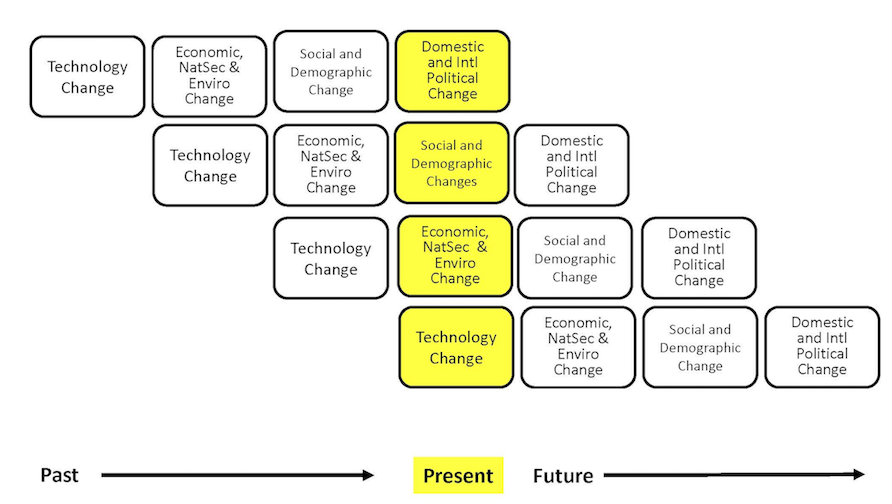
While most media coverage of these systems focused on flows (e.g., the size of the government deficit), rapid non-linear change in complex adaptive systems is often caused by a key stock (e.g., the amount of outstanding government debt) exceeding a critical threshold.
The next table highlights the key macro system stocks that we monitor.
In the next section, we will discuss information received over the past month that is related to these stocks, and which we believe is significant to our assessment of the probabilities that a critical threshold will be reached and a regime change will occur. We will conclude with our estimate, at the end of this month, of how close the macro system is to these critical thresholds, and the implications for financial market regime change probabilities.
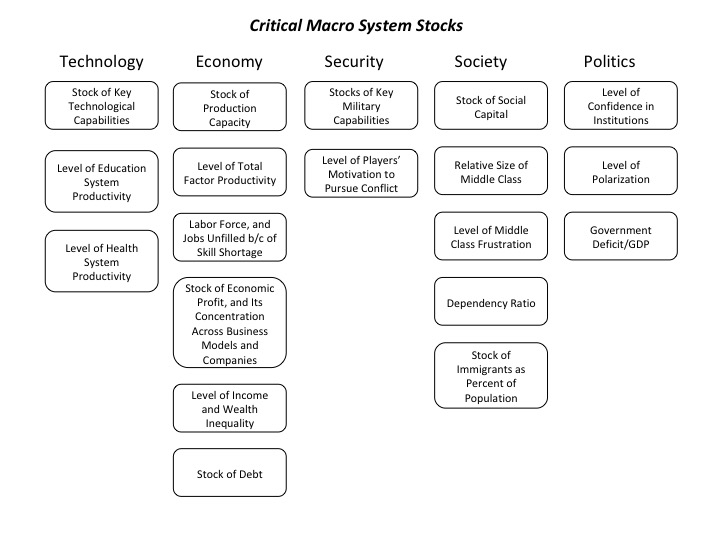
How Close is the Macro System to One or More Critical Thresholds?
As we have noted, the macro drivers of financial market regime changes typically follow a rough chronological sequence, from technology to economic, security, social, and political causes and effects. Yet there are many feedbacks loops between them, creating complex root causes for many of the critical thresholds we have identified.
Understanding the time dynamics in this complex system is critical to avoiding substantial downside investment risk.
We use the UK Met Office Warning Model to communicate our assessment of these time dynamics. We estimate the time remaining before a critical macro system threshold is reached that could trigger a regime change, which is usually accompanied by substantial changes in asset class valuations.
The model uses three increasingly serious levels of warning, from “Be Aware” (condition yellow), to “Be Prepared” (condition orange), to “Take Action” (condition red).
For our purposes, we denote as “Be Aware” (yellow) critical thresholds that we assess to be three or more years away. We estimate that “Be Prepared” (orange) thresholds could be reached within 1 to 3 years. “Take Action” thresholds are very likely to be reached within one year.
Given their nature, we also note that in our three “wildcard” areas (Environment and Energy related; Disease and Human Caused Bioevents; and Cyber and Electromagnetic Events), our forecasts have higher levels of uncertainty.
The following charts summarize our current estimate of the time remaining before different critical thresholds will be reached.
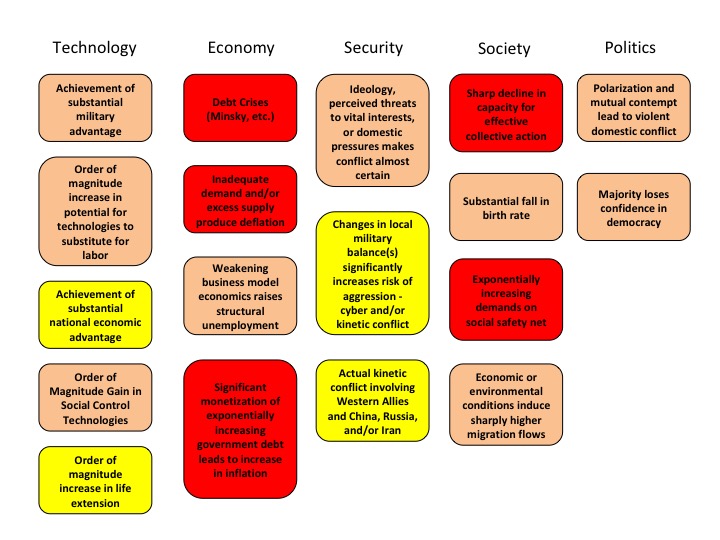
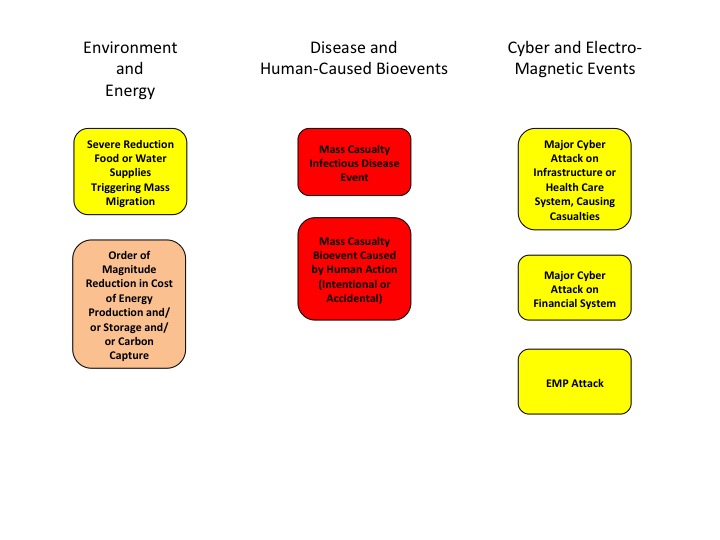
At the highest level, we believe the complex adaptive global macro system can be in one of four states, based on its degree of order versus disorder, and degree of social cooperation versus conflict. A very coarse-grained reading of history suggests that these states evolve in a predictable cycle, from ordered/cooperative, to disordered/cooperative, to disordered/conflicted, to ordered/conflicted.
We believe that the system is currently in its most uncertain state, characterized by high degrees of underlying disorder and social conflict, both domestically and internationally. Beyond some point, intensifying conflict eventually increases the degree of order in the system. That appears to be happening now, via the increasing conflict between China, Russia, and Iran and the United States and other Western nations.
If you have any questions about anything we have written in this issue, please don’t hesitate to get in touch, at contact@indexinvestor.com
Appendix: Anticipatory Thinking and Forecasting Methodologies
Our process is based on methods and tools developed over the past seven years at our affiliate, Britten Coyne Partners, which provides consulting services and education courses to executive teams and boards on strategic risk governance and management.
At The Index Investor, we engage in both anticipatory thinking to identify what could happen (e.g., different macro regimes and related events), and forecasting, to estimate the probability that events and regimes will happen, and the impact they will have if they do (e.g., on macro variables and broad asset class returns).
With respect to what could happen, we are acutely conscious of the conclusion reached by a 1983 CIA study of failed forecasts: "each involved historical discontinuity, and, in the early stages…unlikely outcomes. The basic problem was…situations in which trend continuity and precedent were of marginal, if not counterproductive value."
When it comes to forecasting, we know that in complex socio-technical systems that are constantly evolving, the accuracy of statistical or machine learning based forecasting methods declines exponentially as the time horizon lengthens, since the historical data set on which they were trained will (depending on the speed and effectiveness of any retraining cycle) bear less and less resemblance to the distribution of outcomes the system is likely to produce in the future.
Under these circumstances, forecast accuracy over longer time horizons depends on causal and counterfactual reasoning about the possible future effects of multiple interacting trends and uncertainties that are hard to quantify.
And we are acutely aware of the economist Rudi Dornbusch's famous warning: "Crises take a much longer time coming than you think, then happen much faster than you would have thought."
Our forecasting process also draws on lessons Tom Coyne learned from spending four years as a member of the Good Judgment Project team, which won the Intelligence Advanced Research Projects Activity’s forecasting tournament with forecast accuracy that was more than 50% better than the tournament's control groups (the team's experience is described in Professor Philip Tetlock's book, “Superforecasting").
Our analysis focuses on the probability of the global macro system being in four possible macro regimes 12 and 36 months from the date of our forecast: (1) Normal Times, where equity asset classes perform well; (2) a High Uncertainty regime that is usually short and transitory, where asset classes like short-term government bonds perform best and equities suffer significant declines; (3) High Inflation (which we deem 5% or more, year-on-year), where commercial property, real return bonds and other traditional hedges are favored; and (4) Persistent Deflation (a year-on-year decline in the US CPI), which up to now has only been seen in Japan, and in which the relative performance of different asset classes remains uncertain, but will likely favor high quality bonds and the consumer staples equity sector.
In response to subscriber requests, we have added a 36-month regime forecast to our existing 12 month forecast. The logic is that, in a complex evolving system like global macro, a longer forecast horizon gets beyond the “detection range” of algorithmic forecasting approaches, and therefore raises probability that a manager/investor can gain an edge in identifying emerging threats and opportunities.
That said, because evolving (i.e., “non-stationary”) complex systems populated by highly connected human agents are also capable of sudden non-linear changes (with which are hard for algorithmic approaches to predict), we are also keeping our 12 month forecast.
Our forecasting methodology starts with base rate/reference case data about the historical probability of large changes in equity and bond valuations. We then analyze the current situation from both a quantitative and qualitative perspective. In the latter, we focus on the key endogenous drivers of macro regime change, including technological, economic, national security, social, and political trends and uncertainties. We also focus on three potential sources of exogenous shocks that could also produce a macro regime change, caused by environmental, disease, and cyber related events.
While most of our attention typically focuses on various flows (e.g., economic growth, change in the price level, sales, earnings, job creation, etc.), endogenously caused regime changes result when those flows push key stocks beyond a critical threshold or tipping point, often setting off non-linear reactions across multiple areas. As noted by Hyman Minsky and others, a classic example is the steady accumulation of outstanding debt until it reaches the point where it can no longer be serviced and triggers a crisis.
Base Rate Data
Since the end of World War Two, there have been fifteen months where a downturn in the US equity market began that eventually reduced asset class value by 20% of more. That is a hazard rate of about 1.75% per month. Put differently, in any given month there is a 98.25% probability that a 20%+ downturn won’t occur, or, in a given year, an 81% probability.
However, as the time without a 20%+ downturn extends, the compound probability that one will not occur shrinks. At the end of August 2018, it is more than nine years since the last equity market decline of 20% or more. The probability of that happening is only 15%.
To estimate the base rate for a 20% fall in bond prices (which historically has been caused by a sharp increase in inflation, as we saw in the late 1970s and early 1980s), we analyzed monthly historical AAA bond yields since 1919. For consistency, we used them to calculate the price of a ten-year zero coupon bond. We then calculated the probability of a price decline of 20% or more over three different holding periods: 12, 18, and 24 months. In any month, the annualized probability of a decline of 20% or more over the subsequent 12 months is 12%; over 18 months, 20%, and over 24 months, 25%.
Market Stress Indicators Methodology
We view financial markets as a complex adaptive system. The size of changes generated by such a system follows a power law rather than a normal (Gaussian) distribution. The critical point is that large changes are much more common in complex adaptive systems than most people’s intuition leads them to believe.
While predicting the behavior of complex adaptive systems remains far more art than a science, various researchers have found that large changes in such systems are often preceded by subtle warning signs, as stress accumulates within them. While this research is not definitive, we believe that five warning signs are worth monitoring as potential indicators of growing stress within financial markets that could suddenly give rise to large changes in asset class valuations.
Our first indicator is the month-to-month autocorrelation of broad asset class returns (i.e., the relationship of this month’s returns to last month’s). A system under increasing stress loses resiliency, causing it to take longer to recover from perturbations; hence, autocorrelation increases as it approaches a critical transition (see, “Early Warning Signals for Critical Transitions” by Scheffer, et al).
The second market stress indicator we monitor is the Economic Policy Uncertainty Index published by the Federal Reserve Bank of St. Louis (via its FRED economic database), which is based on research by Baker, Bloom, and Davis (see their paper, “Measuring Economic Policy Uncertainty”). The index is based on automated text analysis of leading newspapers and magazine publications, to identify the frequency with which words and phrases are used that indicate uncertainty.
In humans’ evolutionary past, when uncertainty increased the probability of survival was enhanced by staying close to a group. All of us still have that instinct. Research has found that as uncertainty increases, we have an unconscious bias towards higher conformity of our own views with those of a larger group (i.e., reduction in cognitive diversity). Behaviorally, heightened uncertainty induces more “social copying” of others, likely due to both conformity bias and the rational belief that others may be acting on the basis of superior information. This increase in conformity and copying makes a social system more ordered as uncertainty increases, and also reduces its responsiveness to perturbations (i.e., increases autocorrelation) because of delays in the social copying process.
The key point is that increasing uncertainty induces more, not less order in social systems, and in so doing primes them for sudden non-linear change.
Our third market stress indicator is the spread between the yield on AAA rated bonds and the 10-year US Treasury. This is a proxy for the level of investor concern about financial system funding liquidity.
Our fourth market stress indicator is the yield spread between speculative BB rated bonds and the ten-year US Treasury. Throughout history, excessive credit growth has been a root cause of many financial crises. An indicator of such growth is falling credit spreads, particularly in the case of riskier borrowers. In contrast, rising BB spreads indicate growing investor concern about the consequences of such growth, and the financial distress lower rated companies could experience in an economic downturn.
Our fifth market stress indicator is what we term the “political risk premium” that is implicit in the price of gold. Our starting point for estimating this premium is the three different roles that gold plays. First, gold is a store of value in a world of fiat currencies. When the rate of money supply growth exceeds the growth of nominal GDP, gold’s price should increase to maintain its purchasing power. Between 2007 and 2017, the US money supply (M2) grew by about 86%, while nominal US GDP grew by 35%. The stock of gold grew by 18%, based on mine production over this period. We therefore infer that 33% of the increase in the price of gold represented the maximum potential gold price change that could be attributed to a desire to hedge inflation risk (86% less 35% less 18%).
Second, gold is a unit of account. We take this to mean that the annual change in GDP expressed in terms of physical gold (i.e., nominal GDP divided by the price of gold) should equal the change in real GDP calculated using the GDP price deflator to account for actual inflation over the period. A key challenge is the point at which to start this calculation.
We chose the price of gold in 1995/1996. In that period, the change in real global GDP measured using the IMF’s price deflator just about equaled the change in GDP measured in terms of physical gold. We interpret that coincidence as indicating that at that point in time, concerns about future inflation and political risk were minimal, and the change in the price of gold was mostly driven by its role as a unit of account. We calculated a subsequent series of gold prices that would produce the same change in “gold GDP” as the actual real GDP as calculated by the IMF. Between 2007 and 2017, “gold as a unit of account” warranted a 21% increase in its price.
Gold’s third role is as a hedge against inflation and what we term “political disaster” risk. We subtract the 21% estimated compensation for actual inflation from the 33% “gross” inflation risk hedge to derive an apparent 12% increase in the gold price that reflected the true risk premium to hedge against possible future inflation. However, between 2007 and 2017 the price of gold actually increased by 81%. This implies that 48% of this (81% less 21% less 12%) represented a premium for some other type of uncertainty at the end of 2017. The interesting question is the nature of the uncertainty for which gold is believed by some investors to be a superior hedge than traditional ports in a storm like short-term US government securities, or similar securities issued by other developed countries.
The logical inference is that the uncertainty in question must reflect a situation in which short term US Treasuries would be a less effective hedge than gold. This could be a world of widespread hyperinflation, capital controls, and/or radical changes in nations’ governments (of course, this would also imply a preference for investing in gold coins rather than bullion, as while the latter may be a store of value, it is far less convenient as a means of paying for transactions).
To put this in further perspective, this gold price “disaster risk” premium sharply increased from 2008 to 2012, then declined before sharply increasing again after 2016. Arguably, a significant part of the former increase reflects concerns about the potential inflationary consequences of dramatic quantitative easing by central banks. But this is not likely to be the case after 2016.