Feature Article: Civilization Decline and Collapse: What are the Warning Signs?
“I think of myself as a historian more than a statesman. As a historian, you have to be conscious of the fact that every civilization that has ever existed has ultimately collapsed. History is a tale of efforts that failed, of aspirations that weren’t realized, of wishes that were fulfilled and then turned out to be different from what one expected. So as a historian, one has to live with a sense of inevitable tragedy. [But] as a statesman one has to act on the assumption that problems must be solved.” -- Henry Kissinger
In the three years since Brexit and the election of Donald Trump, an increasing number of commentators have openly wondered if the decline of Western Civilization is upon us, and whether that decline will ultimately end in a collapse. For example, writing in New York magazine on 7Aug19 (“Can the Country Come Back from Trump? The Republic Already Looks Like Rome in Ruins”), Andrew Sullivan observed that, “It’s impossible to review the demise of the Roman Republic and not be struck by the parallel dynamics in America in 2019.”
“We now live, as the Romans did, in an economy of massive wealth increasingly monopolized by the very rich, in which the whole notion of principled public service has been eclipsed by the pursuit of private wealth and reality-show fame. Cynicism about the system is endemic, as in Rome. The concept of public service has evaporated as swiftly as trust in government had collapsed. When the republican virtues of a Robert Mueller collided this year with the populist pathologies of Donald Trump, we saw how easily a culture that gave us Cicero could turn into a culture that gave us Caesar. Class conflict — which, in America, has merged with a profound cultural clash — has split the country into two core interests: the largely white lower and middle classes in the middle of the country, roughly equivalent to Rome’s populares and susceptible to populist appeals by powerful men and women; and the multicultural coastal elites, whose wealth has soared as it has stagnated for the rest, and who pride themselves on their openness and meritocracy: the optimates.
“And just as in late-republican Rome, each side has begun not to complement but to delegitimize the other. The result, as in Rome, is a form of deepening deadlock, a political conflict in which many on both sides profoundly fear their opponents’ power, and in which compromise through the existing republican institutions, particularly Congress, has become close to impossible. Think of Pompey’s and Caesar’s armies not as actual soldiers but as today’s political-party members and activists, mobilized for nonviolent electoral battle and dissatisfied with anything less than total victory.”
Similarly, writing in January 2020 on the WaronTheRocks.com website, Francis Gavin questioned whether we are “Asking the Right Questions About the Past and Future of World Order”.
He began by noting that, “there are two great challenges to the contemporary world order — the dramatic rise of China and the consequences of the profound transformation of the global economy and international system, a revolutionary change on par with the Industrial Revolution. Most of the current debates on world order focus on the capabilities and intentions of a growing China. This is understandably important; in the past, rapidly-rising powers have challenged global arrangements, with calamitous military conflicts as the result. These two stories, however — the rise of China and the global dynamics of technology, demographics, and socio-economics — are intertwined and cannot be understood, or dealt with, separately.
“[However], the second challenge — which has transformed everything from demographics to governance to how people live and work and self-identify to calculations about war and peace — is the key challenge, and the one that people aren’t focusing on enough. Beginning in the United States in 1960s, accelerating in the 1970s, and spreading and intensifying in recent decades, how the global system operates has been completely upended. It is, to a great extent, the reason for China’s rise. The consequences of this revolution are impossible to overstate and hard to fully accommodate under current arrangements…There is an overriding sense of anxiety, dread, worry, and concern, a sense that world order is trending in the wrong direction. The elements that underpinned the postwar order in the second half of the 20th century may not be relevant to these issues…
“The problems that we faced in the past were based on scarcity. Wealth was scarce, resources scarce, information was scarce, security was scarce, health was scarce, and with populations increasing by leaps and bounds in the 19th and first part of the 20th century, intense competition for these scarce resources was bound to be violent. The problems we face now — the explosion of information and disinformation, unthinkably large global financial flows, the large movement of people, climate change generated largely by world-wide economic success, anxiety and uncertainty due, in some measures, to the dizzying increase in individual freedoms — these might be called the problems of plenty…
“Neither our intellectual tools nor our governing institutions were constructed to deal with these problems of plenty…The postwar, state-based international order was built to handle great-power war and old-timey economic crises like currency depreciations. They are completely overwhelmed when dealing with the issues we are currently facing and, in fact, often respond to these new problems with old solutions. The same goes for our scholarly models, whether in international relations or economics, which are based on scarcity models and don’t always do well dealing with the problems of plenty. The types of insecurity we face look nothing like those that worried order-builders in the middle of the 20th century. This has generated a legitimacy crisis for governance, both nationally and internationally.”
For years, the cause of civilization decline has been a popular topic. As Martin Scheffera wrote in “Anticipating Societal Collapse: Hints from the Stone Age”, “Few aspects of human history are as mindboggling as the sudden disintegration of advanced societies. It is tempting to seek common patterns or even draw some lessons for modern times from the many ancient cases of societal disintegration.”
In this month’s feature article, we will pursue these questions, beginning with what theory tells us about possible causes of civilizational decline and collapse, then moving on the conclusions reached by various historians. We will then synthesize these findings, and use them to develop a set of early warning indicators to help you better discriminate between the normal ups and downs of social, economic, and political cycles, and signs of more dangerous structural decline that could accelerate and produce some form of collapse.
However, before we start on this journey, it is important to distinguish between potential natural and man-made sources of civilizational collapse or extinction.
Potential “natural” existential risks include events that have or could be subjects of disaster films, such as:
• An asteroid strike,
• Supervolcano eruptions,
• Alien invasion,
• Naturally occurring pandemics,
• A massive solar storm or gamma ray burst from a supernova.
Potential human driven causes include extremely large destructive events caused by:
• Particle physics research (e.g., “Review of Speculative Disaster Scenarios at RHIC” by Jaffe et al),
• Artificial intelligence,
• Cyber war or malicious actions,
• Nuclear war (including widespread use of electro-magnetic pulse weapons),
• Accidental or intentional misuse of synthetic biology research,
• Accidental or intentional misuse of nanotechnology (e.g., uncontrolled, self-perpetuating processes, like molecular manufacturing),
• Climate change that severely disrupts food supply,
• Severe depletion of critical resources.
There is no shortage of analyses on the potential risks posed by all of these events (e.g., see, “Existential Risks: Analyzing Human Extinction Scenarios and Related Hazards” by Nick Bostrom). Hence, that will not be our focus here. Instead we will focus on perhaps the most difficult source of civilizational decline: the interaction over time of complex processes that can suddenly produce an emergent collapse.
As Scheffera notes, “there are at times striking parallels between stories of collapse even if they happened in entirely different periods…Perhaps the single most-intriguing aspect across stories of collapse is the speed with which massive change can be precipitated. This rapidity is also the aspect that makes such events feel so relevant from a modern perspective. How is it that a once-thriving society can so suddenly fall apart? Could it happen again? If so, is there any way we can foresee where and when? If collapse is just driven by extreme events, such as epidemics or monster droughts, it may be entirely unforeseeable. However, if the underlying cause is a gradual loss of resilience, causing societies to become fragile, we might be able to predict where collapse is most likely.”
What We Can Learn from Theory
A number of theories from different disciplines describe how system collapse can occur.
The most fundamental of these is the Second Law of Thermodynamics, which tells us that the level of disorder (entropy) in an open system will naturally increase over time in the absence of injections of energy and/or information. As Harvard’s Eric Chaisson describes in “The Natural Science Underlying Big History”, “Energy is a principal facilitator of the rising complexity of ordered systems within the expanding Universe; energy flows are as central to life and society as they are to stars and galaxies. In particular, energy rate density—contrasting with information content or entropy production—is an objective metric suitable to gauge relative degrees of complexity among a hierarchy of widely assorted systems observed throughout the material Universe.”
Looking at recent history, the remarkable increase in global growth and material wellbeing from the 19th century onward coincided with the dramatic increase in energy rate density associated with the use of fossil fuels. In the absence of a similar fuel source, the exhaustion or banning of fossil fuel use could produce a sharp decline in economic output, which would very likely trigger substantial (and highly uncertain) negative social and political effects (see also “Thermodynamics of Long Run Economic Innovation and Growth” by Timothy Garrett, and John Greer’s “How Civilizations Fall: A Theory of Catabolic Collapse”).
Complexity and Complex Adaptive Systems theory also describes how sudden collapse can occur. The simplest formulation of this assumes that systems fail when their fitness falls below the selection threshold in their environment. A system is composed of “N” different agents, with “K” connections between them. These agents seek to increase the overall fitness of the system to avoid it being selected out of existence. In each period, every agent recommends a step that will improve its individual fitness. However, via the network of “K” connections to other agents, these individual changes may cause the fitness of other agents to decline. If all, or even a majority of agents must approve a given set of system changes (i.e., the changes each agent wants to make), self-interested agents whose fitness will decline are unlikely to agree, even if the overall fitness of the system as a whole would increase.
As you can see, as the number of connections between agents (“K”) increases, it becomes less likely that the system will be able to improve its fitness, even as external changes in its environment cause it to move closer to the section threshold. This is known as “complexity catastrophe.” An applied example of this concept is Mancur Olson’s writing on how an increasing number of interest groups can lead to national decline (see his book, “The Rise and Decline of Nations”). Similar to this is Francis Fukuyama’s concept of “vetocracy” – “a dysfunctional system of governance whereby no single entity can acquire enough power to make decisions and take effective charge” (see his book, “Political Order and Political Decay: From the French Revolution to the Present”).
Complex adaptive socio-technical systems are made up of many interacting subsystems – e.g., technology development, the economy, society, politics, and financial markets. Each of these is characterized by a dense network of cause/effect relationships, many of which act with either time delays and/or in a non-linear manner. Moreover, the agents in these systems (e.g., individuals, organizations, nations, etc.) are constantly adapting their relationships and behavior in response to its effectiveness in achieving their goals, which themselves sometimes change. Hence over time the very nature of a complex adaptive system is constantly evolving.
Due to both their complexity and their adaptive nature, it is impossible to accurately predict the behavior of these systems, particularly as the forecast time horizon lengthens. At best, you can attempt to develop a “coarse-grained” understanding of the system’s critical dynamics, from which observed effects – successes and failures – are said to “emerge.” Critically, the distribution of the effects produced by complex adaptive systems tends to follow a power-law distribution, with many relatively small changes and a few very large ones.
Systems Dynamics theory describes one way such effects can occur. It is based on the relationship between flows, stocks, and feedback mechanisms. Flows go into and out of stocks, which have a finite carrying capacity. When that capacity is exceeded, the system can experience a catastrophic event and/or change in function. For example, if the flow of water into a bathtub exceeds the flow out the drain, the tub will overflow, which can trigger an electrical short-circuit that burns down a house. Feedback mechanisms should regulate flows and prevent catastrophes from occurring. But sometimes they fail.
Another relevant body of theory focuses how to avoid sharp declines in organizational effectiveness and efficiency by designing and operating systems that are robust, resilient, and adaptive. Robust strategies have a high probability of achieving their goals under a wide range of possible future scenarios. When they fail to do this, and/or when an unanticipated external shock occurs, resilient systems continue operating with only a minimal initial reduction in their effectiveness and efficiency.
System resiliency usually requires a redundancy in critical systems, maintenance of some slack resources (i.e., extremely high efficiency tends to reduce resiliency), and agility (i.e., the ability to quicky assess dynamic situations, develop courses of action, decide which one(s) to pursue, and implement them with urgency). After absorbing and initially responding to the negative shock, adaptive organizations identify and implement more permanent changes to sustain effectiveness and efficiency at or above their pre-shock levels.
Robustness, resiliency, and adaptiveness don’t happen by accident. They depend on the constant cultivation of organizational ability to make sense of complex systems and anticipate some, if not all, of the outcomes that can emerge from them; having sufficient resources, redundancy, and organizational flexibility to be resilient in the face of negative shocks; and the culture and capacity to adapt to severe changes in their external environment. When these underlying organizational capacities are allowed to atrophy, systems become increasingly vulnerable to sudden collapse in response to even small shocks.
A final theory that is relevant to system collapse is known as the “OODA” loop, which was first defined by US Air Force Colonel John Boyd, in the context of improving air combat performance. The first “O” stands for “Observation”, or paying attention to the most critical factors in a dynamically evolving environment. The second “O” stands for “Orientation”, which means making sense of the key factors on which you have focused your attention.
Sensemaking gives rise to “situation awareness”, which Mica Ensley (former Chief Scientist of the US Air Force) has found exists at three increasingly difficult levels. The first, and lowest (L1), is perception of the most important elements in a given situation. The second (L2) is understanding the relationships between these elements. The highest level (L3) of situation awareness is the ability to use your understanding of L1 and L2 to project in time how a situation is likely to evolve in response to different actions you could take.
In the OODA mode, “D” stands for “Decide” – the ability to generate alternative courses of action, mentally simulate their expected results, and select the one with the highest probability of achieving your goal(s).
“A” stands for “Act” – the ability to quickly and effectively implement the course of action you have decided to pursue.
The core of Boyd’s OODA theory is that if an individual or organization can complete the OODA cycle (sometimes called the OODA loop) more quickly than an adversary or competitor in a dynamically evolving environment, the opposing party will become increasingly confused. As more OODA cycles are completed, the exponential degradation of its understanding of its situation will eventually cause its capacity for effective action to collapse. Of course, the same problem can exist if the environment in which an individual or organization seeks to survive and thrive is changing faster than the time they require to complete their own OODA cycles.
What We Can Learn from History
For centuries, analyses of the causes of national and civilizational decline and collapse have been a staple of historical writing. What follows is a far from exhaustive review of key conclusions reached by a broad sample of authors.
Edward Gibbon wrote his “History of the Decline and Fall of the Roman Empire” between 1776 and 1788, which he mainly attributed to the multiple effects flowing from the decline of traditional values.
Between 1918 and 1922, German historian Oswald Spengler wrote “The Decline of the West”, which identified the gradual corruption of culture as a central driver of long-term decline.
Written between 1934 and 1961, Arnold Toynbee’s “A Study of History” observes that over time societies develop great expertise in problem solving. However, at some point their capacity for solving new problems declines because of constraints imposed on possible solutions by the structures created so solve previous problems.
In “Tragedy and Hope” (1966), Georgetown’s Carroll Quigley identified as a key cause of civilizational decline the transformation of institutions from organizations that solve real social needs to ones that focus on serving their own needs.
Writing in 1978, Sir John Glubb (“The Fate of Empires and Search for Survival”), cited growing decadence as a key cause of empires’ decline. “Decadence is the disintegration of a system, not of its individual members. The habits of the members of the community have been corrupted by the enjoyment of too much money and too much power for too long a period. The result has been, in the framework of their national life, to make them selfish and idle. A community of selfish and idle people declines, internal quarrels develop in the division of its dwindling wealth, and pessimism follows, which some of them endeavour to drown in sensuality or frivolity. In their own surroundings, they are unable to redirect their thoughts and their energies into new channels.”
In “The Rise and Fall of the Great Powers” (1987), Paul Kennedy attributes decline to “imperial overstretch” – the overextension of military and other external commitments relative to the economy’s ability to support them.
Written a year later (1988), in “The Collapse of Complex Societies” Joseph Tainter identifies diminishing returns to increasing complexity as the source of decline and eventual collapse. “As societies become larger, more complex control structures are needed to maintain the cohesion of society and solve the problems that appear along their path. These structures can be described in terms of governments, the nobility, armies, bureaucracy, and the like. As these structures become larger, they become less efficient, to the point that the economic returns they provide are smaller than their cost. At this point, society becomes unable to cope with the challenges it faces and must decline, or even collapse [defined as the sudden loss of complexity].” In 2006, Thomas Homer Dixon synthesized the complex adaptive systems and thermodynamic perspectives in his book “The Upside of Down.”
In 2008, Jared Diamond identified environmental crises as a central cause of decline in his book, “Collapse: How Societies Choose to Fail or Succeed.”
In “Empires on the Edge of Chaos” (2010), Niall Ferguson echoes some of Tainter’s themes, asking, “What if history is not cyclical and slow moving but arrhythmic -- at times almost stationary, but also capable of accelerating suddenly, like a sports car? What if collapse does not arrive over a number of centuries but comes suddenly, like a thief in the night?” Ferguson writes that, “Great powers and empires are, I would suggest, complex systems, made up of a very large number of interacting components that are asymmetrically organized, which means their construction more resembles a termite hill than an Egyptian pyramid. They operate somewhere between order and disorder -- on "the edge of chaos. Such systems can appear to operate quite stably for some time; they seem to be in equilibrium but are, in fact, constantly adapting.”
“But there comes a moment when complex systems "go critical." A very small trigger can set off a "phase transition" from a benign equilibrium to a crisis -- a single grain of sand causes a whole pile to collapse…In reality, the proximate triggers of a crisis are often sufficient to explain the sudden shift from a good equilibrium to a bad mess…Most of the fat-tail phenomena that historians study are not the climaxes of prolonged and deterministic story lines; instead, they represent perturbations, and sometimes the complete breakdowns, of complex systems….Empires exhibit many of the characteristics of other complex adaptive systems -- including the tendency to move from stability to instability quite suddenly. But this fact is rarely recognized because of the collective addiction to cyclical theories of history.”
Another rich source of historical material is the many studies of the rise and fall of various Chinese dynasties. For example, in “New Perspectives on the Collapse and Regeneration of the Han Dynasty”, Kidder et al write that, “Although an environmental disaster [massive flooding] triggered its fall, the Western Han dynasty’s failure has no single cause. The weakening East Asian monsoon resulted in greater aridity with increasing variability in the amplitude and frequency of floods and droughts, while population growth coupled to agricultural and technological intensification led to significantly enlarged demands on natural resources.”
“Assertions of authority by the central government and resistance to these claims by rival elites created domestic political strife at the same time that imperial expansion caused political, military, and economic crises at home and along the frontiers. These factors produced major structural contradictions that the state and society could not absorb. Thus, a complex interplay of climatic, environmental, demographic, and technological factors that accumulated over a long period of time led to a rapid cascade of ruptures in social, political, and economic structures that undermined the Western Han hold on government.”
More broadly, a repeating pattern is often noted in analyses of the rise and fall of Chinese dynasties:
1. A new ruler unites China, founds a new dynasty, and gains the Mandate of Heaven.
2. China, under the new dynasty, achieves prosperity.
3. The population increases.
4. Corruption becomes rampant in the imperial court, and the empire begins to enter decline and instability.
5. A natural disaster wipes out farm land. The disaster normally would not have been a problem; however, together with corruption and overpopulation, it causes famine.
6. The famine causes the population to rebel and a civil war ensues.
7. The ruler loses the Mandate of Heaven.
8. The population decreases because of the violence.
9. China goes through a warring states period.
10. One state emerges victorious.
11. The state starts a new empire.
12. The empire gains the Mandate of Heaven.
Peter Turchin (author of “Cliodynamics: History as Science”, “Historical Dynamics: Why States Rise and Fall”, and “Secular Cycles”) is a leader in the application of artificial intelligence and other advanced quantitative analytical techniques to the study of history, and episodes of decline and collapse. He has concluded that there are recurring “secular cycles” that last two or three centuries. Such cycles “start with a fairly equal society, then, as the population grows, the supply of labour begins to outstrip demand and so becomes cheap. Wealthy elites form, while the living standards of the workers fall. As the society becomes more unequal, the cycle enters a more destructive phase, in which the misery of the lowest strata and infighting between elites contribute to social turbulence and, eventually, collapse.”
Safa Motesharrei is a mathematician at the University of Maryland who has also applied quantitative analytical techniques to the study of collapse. In “Human and Nature Dynamics (HANDY): Modeling Inequality and Use of Resources in the Collapse of Sustainable Societies”, he notes that “there are widespread concerns that current trends in population and resource-use are unsustainable, but the possibilities of an overshoot and collapse remain unclear and controversial. How real is the possibility of a societal collapse? Can complex, advanced civilizations really collapse?”
Like other authors, he provides plenty of evidence that they can. “It is common to portray human history as a relentless and inevitable trend toward greater levels of social complexity, political organization, and economic specialization, with the development of more complex and capable technologies supporting ever-growing population, all sustained by the mobilization of ever-increasing quantities of material, energy, and information. Yet this is not inevitable. In fact, cases where this seemingly near-universal, long-term trend has been severely disrupted by a precipitous collapse – often lasting centuries – have been quite common…The process of rise-and-collapse is actually a recurrent cycle found throughout history, making it important to establish a general explanation of this process” …
“With both natural disasters and external threats, identifying a specific cause compels one to ask, “yes, but why did this particular instance of this factor produce the collapse?” Other processes must be involved, and, in fact, the political, economic, ecological, and technological conditions under which civilizations have collapsed have varied widely. Individual collapses may have involved an array of specific factors, with particular triggers, but a general explanation remains elusive. Individual explanations may seem appropriate in their particular case, but the very universal nature of the phenomenon implies a mechanism that is not specific to a particular time period of human history, nor a particular culture, technology, or natural disaster.”
Motesharrei seeks to identify this mechanism by analyzing collapse mathematically. He finds that he can reproduce the dynamics of many collapses “by simultaneously modeling two separate important features which seem to appear across so many societies that have collapsed: (1) the stretching of resources due to the strain placed on the ecological carrying capacity and (2) the economic stratification of society into rich Elites and poor Masses”.
Ian Morris is a Stanford historian who in 2010 wrote “Why the West Rules – For Now”. Writing in Forbes in 2016 (“The Dawn of a New Dark Age”), He observed that, “in every case where we have enough evidence, we see the same five causal factors, which I like to call the Five Horsemen of the Apocalypse”…
“The first, which is always prominent, is mass migration, on a scale that the societies of the time cannot control. Just how many immigrants it took to destabilize borderlands and spread violence across entire empires must have varied, although DNA seems to suggest that in the wrong circumstances even a group less than one-tenth the size of the host population could bring the roof crashing in…
“The second factor, often coming on the back of the first, is disease. Long-distance mass movements sometimes merged what had previously been separate disease pools, producing new infections to which hardly anyone was immune. Steppe nomads migrating across thousands of kilometers were probably the main vector for the Black Death, which killed perhaps a quarter of the world's population between 1350 and 1400…
“The third force, regularly linked to the first two, is state failure. Collapsing borders and shrinking populations often bring down governments too, and as chaos spreads, even states that have not been directly hit by invasion and plague can be sucked into the whirlpool…
“Fourth, and strongly linked to the first three forces, is the collapse of trade. When failing states can no longer protect merchants, long-distance exchange networks break down, bringing starvation and yet more rounds of migration, disease and violence. Many historians think that the tipping point in the fall of the Roman Empire came when the Vandals invaded North Africa and cut off grain shipments to Italy from what is now Tunisia in 439. The city of Rome lost three-quarters of its population across the next two decades, and in 476 the Western Empire was officially declared defunct.
“The fifth factor, always present but never in a straightforward way, is climate change. Some great collapses, such as that in the Eastern Mediterranean after 1200 B.C., coincide with rising temperatures; others, such as the Roman and Han Chinese breakdowns in the early first millennium, coincide with global cooling. The direction of climate change seems to matter less than the fact that any big change puts stress on farming, which — when everything else is already going wrong — might be enough to push people over the edge.”
Writing in 2016, Marten Scheffera drew on a growing body of research on ecosystem collapse, and focused on the important role that the loss of resilience plays in episodes of societal collapse. Morris’ observations are similar to those made by Marten Scheffera, in “Anticipating Societal Collapse, Hints from the Stone Age”, he notes that “it has become clear over the past years that loss of resilience may be inferred from subtle changes in dynamics in a wide range of complex systems as they approach a tipping point. The underlying generic phenomenon is that recovery from small perturbations becomes slow if resilience becomes small, resulting in elevated temporal autocorrelation (memory) and variance under natural fluctuating conditions…
“One theory is that societies tend to resist change until it is too late for smooth adjustments. Indeed, some fundamental mechanisms that hamper our capacity for change have been well documented. There is the “sunk-cost effect” preventing people from abandoning acquired property (or ways of living or beliefs) even if that would rationally be better. Then there is the “bystander effect,” leading one to copy the behavior of others in case of doubt. This effect is known for explaining why often no-one in a crowd of by-standers comes to the rescue. Finally, elites may have a vested interest in maintaining the status quo, thus delaying societal change. Certainly, such mechanisms are not specific to the Stone Age. Indeed, it may be argued that in more sophisticated societies with more elaborate physical structures and social systems, some of those mechanisms that prevent change might become stronger rather than weaker.”
Finally, in “The Collapse of Civilizations” (2018), Malcolm Wiener found that “major episodes of climate change have had profound impacts upon cultural continuity, and that the interactions between climate change, famines, migrations, pandemics, and major innovations in the means of transport and warfare are critical in understanding the collapse of past civilizations.
Conclusion
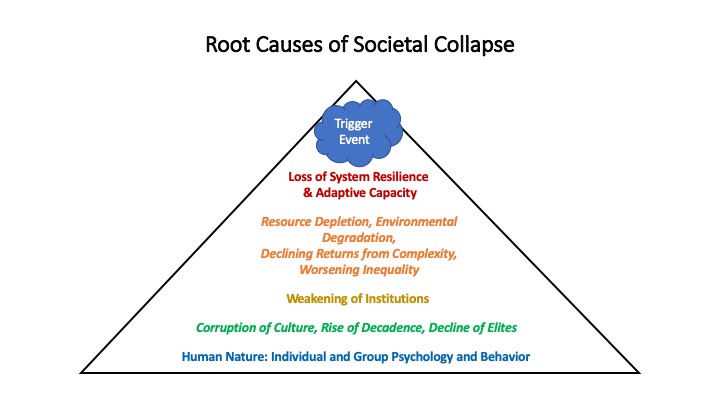
The theoretical and historical research we have reviewed highlights the complex root causes of civilizational decline and collapse.
In the final stage, public order, economic growth, energy and food supplies are all often sharply reduced.
Before this point, there is often a precipitating event that triggers this final decline. Such events include severe military defeats, famines, mass migrations, pandemics, and similar large-scale man-made and natural catastrophes.
Yet history is also full of nations and civilizations that did not collapse after these same shocks. What deeper root causes can help explain why failures occurred?
Prominent in both theory and in many historical cases are losses of both resilience and the capacity for adaptation (including large-scale collective action) on many levels, including economic, social, and political.
Yet what caused these losses?
In many historical cases, the loss of resilience was marked by worsening fiscal and monetary conditions, including ballooning government deficits (sometimes caused by Kennedy’s imperial overstretch, and other times by a growing focus on redistribution rather than creation of wealth), weak tax collections, weak economic growth, rising debt levels, and government debasement of the currency.
Yet these too are symptoms of even deeper root causes. Depletion of resources and/or environmental degradation is a theme that often comes up in cases studies of decline, whether caused by poor human decisions or natural events. Declining returns from increasing complexity, and rising inequality are other common themes. To some extent, all of these reflect the failure of institutions to address these problems before they emerged as dangerous threats to a society’s survival. But that begs the question of why this happens.
This brings us to an even deeper root cause, which various authors have termed the “decline of values”, “corruption of culture”, “rise of decadence”, and the “decline of elites”. But what causes this?
Perhaps the deepest root causes of civilization collapse lie deep our evolutionary past, and how that has conditioned most of us to think, feel, and behave, both individually and in groups.
As individuals, we are naturally prone to over-optimism and overconfidence. We are poor at using information to update our beliefs, paying more attention to, and better remembering new evidence that confirms them, and doing the opposite to information that does not cohere with them.
As uncertainty increases (as it naturally does with rising complexity), we feel a stronger urge to conform to the views of our group, clan, or tribe, and to copy their beliefs and behaviors.
But as social animals, our most dangerous trait may be our drive for status. Unlike the accumulation of material wealth, the achievement of elite status is a zero-sum game. And once it has been achieved, both individuals and groups are almost always loath to lose it, and will go to great lengths to preserve their high position in the social pecking order (e.g., popularization of the Darwinian concept of meritocracy, that enables elites to see the mass as failures). It isn’t hard to see how this fundamental and very powerful drive to preserve status can undermine the functioning of institutions, and allow the underlying stresses on a society from resource depletion or rising inequality to exponentially increase.
The following graphic summarizes the root causes of collapse:
This analysis raises a painful question: How many of the symptoms of potential civilizational decline and collapse do we see around us today?
Signs of increasing status competition, and increased conflict as groups perceive their social status is a risk?
Elites accused of being decadent and corrupt, out of touch with the masses and apparently unable (or unwilling) to develop solutions to worsening problems facing a society, nation, or even civilization?
Institutions that the masses increasingly see as serving their own and/or elite interests, rather than effectively implementing solutions to problems the masses see as critical?
Rising inequality, resource depletion, and/or environmental degradation?
Weak economic growth, widening gaps between government spending and tax collections, and increasing monetization of a rising issuance of government debt?
Signs that the system is becoming less resilient (e.g., a series of weak recoveries from economic downturns, despite increasingly strong monetary and fiscal stimulus, and a rising number of “deaths of despair”)?
Signs that the system’s capacity for adaptation to challenging circumstances has weakened (e.g., political polarization, policy gridlock, and increasing evidence of poor policy implementation by institutions)?
The good news is that our weakening resilience and adaptive capacity have not yet been tested by severe shocks, such as military defeats, natural disasters, or pandemics (though the Wuhan Coronavirus may soon do this).
The bad news is that too many of the conditions which in the past have enabled a severe shock to trigger a collapse are today either developing or perhaps already in place.
The essential nature of complex adaptive systems is that accurate prediction of their future behavior is either extremely difficult or impossible, depending on how far into the future your forecasting horizon extends. The best we can do is develop a “coarse grained” sense of their underlying dynamics, and the range of outcomes they could produce.
Our civilization is not yet doomed to collapse. But there are a growing number of reasons to fear where current trends are heading if it they do not change.
If you have any questions about anything we have written in this issue, please don’t hesitate to get in touch, at contact@indexinvestor.com