Feature Article: The Complex Dynamics of Our New Cold War: A Brief Net Assessment
“A regime beset by economic stagnation and rising social unrest at home and great-power competition abroad is inherently brittle.”
-- Mixin Pei
Rising Sino-American tensions after Xi Jinping became China’s president in March 2013 sharply accelerated following Donald Trump’s election in November 2016. They have now reached the point that many observers believe we have begun a Second Cold War.
This conflict, however, will almost certainly be very different from the First Cold War, between the United States and the Soviet Union, due to China’s greater size and integration into the global economy.
Yet in one critical sense it will be the same: In both cases, the competitive dynamics extend far beyond the military realm, and encompass the interaction of two complex adaptive systems.
The outcome of the Second Cold War will be driven both by how each of these systems internally evolves over time (i.e., vertical interactions), and how they interact with each other at many levels (i.e., horizontal interactions).
This analysis will take a brief look at the nature of these interactions, and the critical trends and uncertainties that will drive important outcomes over the next three to five years (in the case of complex adaptive systems, Philip Tetlock’s research has shown that the forecast accuracy beyond this time horizon is unlikely to be better than a coin flip).
Starting Point: Essential Strategic Questions
While the word “strategy” is frequently used, it has no common meaning. For the purposes of this analysis, we’ll use this definition:
“Strategy is a causal theory of future success that exploits one or more decisive asymmetries to achieve an organization's most important goals, with limited resources in the face of uncertainty.”
Inherent in this definition is the critical question of what an organization (or nation’s) most important goals are or should be.
Xi Jinping has effectively said that his most important goals are keeping the CCP in power by rejuvenating China’s economy, military, and foreign policy.
In the United States, and the west more broadly, developing a similar “grand strategy” is far more difficult. In democracies, this seems to be a feature, not a bug. The typical result is a mix of at best loosely integrated goals across a wide range of policy areas and different levels of government (e.g., national security strategy, national military strategy, foreign policy, trade policy, fiscal policy, monetary policy, etc.).
Yet this does not reduce the potential power of having a clear consensus on an integrated set of critical goals that a nation must achieve.
At the end of 2019, before the COVID19 pandemic exploded, the cost of elites’ failure to address the US economy’s deeper problems following the 2008 Great Financial Crisis had become painfully clear.
Debt/GDP was at near record levels, productivity growth was weak, labor share of GDP had decreased, inequality had worsened, polarization and populism (progressive and nationalist) had grown, and both government institutions and democratic capitalism itself were facing a crisis of legitimacy. Perhaps worst of all, as COVID19 subsequently demonstrated, America’s national capacity for effective collective action in the face of danger had been greatly diminished.
As such, we could define the United States’ critical goal as renewing the popular legitimacy of democratic capitalism by rejuvenating its economy, military, society, and politics.
We next turn to key areas in which China and the United States (and the West more broadly) will compete, and whose internal interactions will also affect the achievement of their respective critical goals.
In our model, there is a rough chronological ordering of these areas (albeit with many feedback loops), in a complex process where developments in technology, energy, and the environment generate economic and national security effects, which in turn generate subsequent social and political effects.
Technology
Announced in 2015, “Made in China 2025” is a long-term plan to dominate a number of critical technologies. These include advanced information technology (e.g., artificial intelligence, quantum computing), robotics, green energy and vehicles, advanced materials, and aerospace equipment.
Historically, China taken an aggressively mercantilist approach to developing its technology base. In “The Trojan Dragon”, Rob Atkinson succinctly described it as follows:
“Step 1: Identify the target industry and unfairly acquire foreign technology capability through coerced transfer, commercial espionage, and cyber theft.
“Step 2: Ensure that domestic champions, now equipped with foreign technology, receive massive government subsidies so they can operate for years, if not decades, without profits, all the while undercutting foreign competitors’ prices.
“Step 3: Limit foreign access to the Chinese market so Chinese firms have time and breathing room to gain economies of scale.
“Only then, implement. Step 4: Attack foreign markets, backed by a secure and now profitable market at home, coupled with massive export subsidies.”
As Atkinson notes, “China has a turned to this winning playbook over and over again, and racked up win after win at America’s expense.”
To be sure, some analysts have claimed that it is unlikely that Made in China 2025’s goals will be achieved, for example because of widespread academic fraud, relatively less emphasis on fundamental research than in the west, weak incentives for innovators in a country with weak intellectual property and contract laws, and the difficulty of developing tacit know how (as opposed to simply copying explicit knowledge). Studies of patents have, to some extent, supported these criticisms. While numerous, relatively few Chinese patents are the most difficult to obtain “triadic patents” that have been approved in Europe, Japan, and the United States.
However, there are also many analysts who are far less sanguine about the rate of China’s progress in advanced technologies.
As Atkinson warned in 2019, “while mastery of some particularly complex technologies such as semiconductor logic circuits remains a challenge for China, Chinese companies have made significant progress in an array of other technologies, including in some kinds of semiconductors (e.g., chips for devices connected to the Internet of Things). Moreover, the fact that nations such as Japan in the 1960s and 1970s, and Taiwan and South Korea in the 1980s and 1990s could rapidly progress to become advanced technology economies, using similar kinds of approaches (obtaining foreign technology and subsidizing and protecting domestic innovators until they are strong enough to compete on their own) suggests there is nothing inherently keeping China from making similar progress, especially given the massive amount of government support for the effort…
“Given China’s Made in 2025 plan, coupled with unfair mercantilist policies, it is no exaggeration to suggest that, without aggressive action, leading economies such as Europe, Japan, Korea, and the United States will, within two decades, likely face a world wherein their advanced industry firms face much stiffer competition and have fewer jobs in industries as diverse as semiconductors, computers, biopharmaceuticals, aerospace, Internet, digital media, and automobiles (“Is China Catching Up to the United States in Innovation?” (See also, “The China Effect on Global Innovation” by the McKinsey Global Institute).
In response to Atkinson’s warning, as of this writing it seems clear that, both before and especially after COVID19, the aggressive actions by the West against China’s technology practices he called for will almost certainly be taken. What is uncertain, however, is the extent to which they will prevent China from achieving its technology goals.
In the United States, critics have claimed that the country’s innovation ecosystem is in decline. For example, in November 2019, in “Why the U.S. Innovation Ecosystem Is Slowing Down?” Arora et al observe that, “Productivity growth in the United States, which is powered by innovation, has been decelerating. Total factor productivity grew substantially in the middle of the 20th century, but started slowing in 1970. This slow growth continues today, with productivity lower than it was more than 100 years ago.
“This slowdown has occurred despite increased investment in scientific research. Data from the National Science Foundation (NSF) indicate that U.S. investment in science has steadily increased between 1970 and 2010, as measured by dollars spent (which has gone up 5X), number of PhDs trained (2X) and articles published (7X). Why is there little productivity growth to show for this?
“One explanation is that today’s science is simply not as groundbreaking as before. Some dispute this, however, pointing to advances in quantum physics (quantum computing), plasma physics (thermionic conversion), and molecular biology (CRISPR Cas-9). Another explanation, which we explore, is that today’s science is not being translated into applications — in other words, something is keeping scientific discoveries from fueling productive innovation.
“Our research finds that [for a variety of reasons, including investor pressure for higher profits at large companies] the U.S. innovation ecosystem has splintered since the 1970s, with corporate and academic science pulling apart and making application of basic scientific discoveries more difficult. Our analysis also shows that Venture Capital (VC)-backed scientific entrepreneurship has helped to bridge this gap between corporate science and academia — but only in a couple of sectors [life science and information and communication technologies].
The authors conclude that a key obstacle is the difficulty of obtaining private venture financing for an innovation that faces both technical and commercial (market) uncertainties. These were the type of innovations where large companies once excelled.
“These findings suggest that if we want to see greater productivity growth, we need to explore alternative ways to translate science into invention” (see also their longer academic paper, “The Changing Structure Of American Innovation: Cautionary Remarks For Economic Growth”).
Energy and the Environment
China is now the world’s largest consumer of energy, the largest producer and consumer of coal, and the largest emitter of carbon dioxide.
The health impacts of China’s high pollution levels are considerable. One study concluded that over 1 million premature deaths and substantial crop losses were due to exposure to airborne pollutants. Along with other costs (e.g., work absences, lower productivity, additional healthcare costs), the overall impact was estimated at 0.67% of China’s GDP each year (“Air pollution is killing 1 million people and costing Chinese economy 267 billion yuan a year, research from CUHK shows”, South China Morning Post, 2Oct18)
According to the BP Statistical Review of World Energy, coal accounted for 67% of China’s electricity generation in 2018, followed by 26% from renewables, and 4% from nuclear.
The new coal fired electric generating capacity China currently has under construction is equal to the entire coal fired generating capacity of the European Union.
China now imports about 60% of its oil consumption, and 50% of its natural gas. Over 80% of its oil imports pass through the straits of Malacca. Some “Belt and Road” projects are intended to reduce the impact of a potential blockade of the straits, including a pipeline from the Myanmar coast to China, and a pipeline to China from the Gwadar port in Pakistan.
The United States has a far stronger position than China with respect to energy security. America’s power generation sector also emits far fewer pollutants than China’s per gigawatt hour of electricity production, due to a very different generation mix: Natural Gas, 38%; Coal, 23%; Nuclear, 20%; and Renewables, 18%.
The Economy
The structures of the Chinese and US economies are quite different, as seen below:
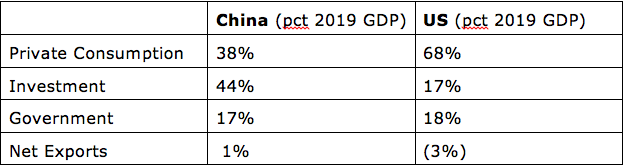
The Chinese economy faces many challenges. According to the Institute for International Finance, China’s overall debt/GDP ratio stood at 309% at the end of 3Q 2019. Over half of this debt is owed by the non-financial corporate sector, much of it to shadow banking organizations. Not included in these figures is as much as $200 billion in loans that China is believed to have made to countries taking part in its “Belt and Road Initiative”, many of which they will not be able to service in the post COVID19 downturn.
Much of this domestic debt appears to have been invested in projects that in recent years have seen declining return on capital. Inefficiency is a particular problem in many of China’s State Owned Enterprises, which the World Bank estimates contribute between 23% and 28% of the country’s GDP.
According to the IMF, China’s rate of total factor productivity growth halved in the aftermath of the Great Financial Crisis to about 2.25% per year. Due to the one child policy, China’s population is now aging fast. The size of its labor force has been declining since 2011. Between then and 2019, it fell by 2.8%.
China is also heavily dependent on some critical imports, including advanced integrated circuit chips and iron ore.
Exports will also be under pressure in the future, due to weakened global demand, the continuing trade war with the United States, and the movement of global supply chains out of China.
Finally, China’s poorly funded pension and healthcare systems drive high rates of household saving, which create an obstacle to shifting from an investment and export focused economy to one that is more driven by private consumption spending.
On the other hand, China’s economy also has some important strengths.
One of them is that the Chinese public and private sectors are compelled by the state to work together as an integrated team. For example, China’s new intelligence law (enacted in 2017) “obliges individuals, organizations, and institutions to assist Public Security and State Security officials in carrying out a wide array of intelligence work” (“Beijing’s New National Intelligence Law: From Defense to Offense”, by Murray Tanner on Lawfareblog).
Decades of aggressive Chinese mercantilism, along with cost and investor return pressures on Western companies in an ever more financialized economy, have also given China a preeminent place in many industries global supply chains. Manufacturing value added now accounts for 29% of China’s GDP, compared to only 11% in the United States.
China has become so ingrained in global supply chains that it will take a long time to move key operations to other countries. During this period, the country will continue to have many sources of leverage over other nations, often exerting it through foreign corporations with operations in China (e.g., see, “The Long Hard Road to Decoupling from China”, by Andrew Michta).
For example, the loss of US manufacturing jobs after China joined the World Trade Organization in 2001 has been stunning.
“In the four decades between 1960 and 2000, US manufacturing employment was basically stable, averaging around 17.5 million jobs… Between 2000 and 2010, manufacturing employment plummeted by a third. Nearly 6 million American factory workers lost their jobs. The drop was unprecedented—worse than any decade in US manufacturing history. Even during the Great Depression, factory jobs shrunk by only 31%...Though the sector recovered slightly since then, America’s manufacturing workforce is still more than 26% smaller than it was in 2000” (“The epic mistake about manufacturing that’s cost Americans millions of jobs”, by Gwynn Guilford, in Quartz, 3May18).
What has gone with those jobs is a great deal of tacit knowledge in the minds of manufacturing workers. Their loss will make the reshoring of manufacturing from China much more difficult, unless the lost tacit knowledge can be replicated by advanced manufacturing automation (see, “Bringing Manufacturing Back to the U.S. Is Easier Said Than Done”, by Willy Shih).
The United States economy has some undeniable strengths, including a very large domestic market, a rich endowment of natural resources, a strong legal system, deep financial markets, and, at the top, an unmatched (though still scarce) supply of world class talent in many fields.
Yet in recent years, its growing weaknesses have become more painfully apparent.
Healthcare costs now absorb about 18% of GDP. Education costs absorb another 7%. In both cases, US costs are above those of other OECD nations, while results are inferior. Due to the poor quality of the education they receive, an increasing percentage of America’s labor force is unprepared for anything but low skill/low wage jobs. Poor education has also been linked to America’s productivity slowdown (e.g., “US Total Factor Productivity Slowdown: Evidence from the US States” by the IMF).
The quality of America’s infrastructure has fallen behind many other countries.
As the economy has become more highly “financialized” (see, “Have We Been Here Before? Phases of Financialization within the 20th Century in the United States” by Fasianos et al), investment has fallen, while stock buybacks has risen. Total debt now amounts to over 300% of GDP (and that was before the COVID19 shock).
Due to the complex interaction of multiple causes, productivity growth has been anemic. These include network effects and winner take all economics in a growing number of increasingly globalized and digitized industries, and a poorly performing education (and broader human capital development) system that has created a growing scarcity of the talent needed to deploy rapidly improving technologies.
In many industries, these factors have also led to declining competition and increased concentration of talent, market share, and economic profits (e.g., see, “What Happened to US Business Dynamism?” by Akcigit and Ates).
Growing corporate power (and the weakening of workers’ power) has meant that labor’s share of GDP has declined, real median household income has stagnated, and inequality has increased (e.g., see, “Declining Worker Power And American Economic Performance” by Stansbury and Summers).
Finally, increasing inequality has contributed to weakening aggregate demand and, as top earners consume relatively less of their income.
The net result of all these factors is an economy that, even before COVID19, was facing worsening secular stagnation.
National Security
Consistent with its history, China’s top national security priority is maintaining control over its domestic population. It spends more on internal security than it does on external defense, including extensive investments in totalitarian public surveillance and social control (e.g., the Great Firewall, the social credit system, and reinserting the Communist Party into many more areas of Chinese life).
Externally, China’s priorities are (in decreasing order) defending its borders (its most important dispute is with India), the eventual incorporation of Hong Kong and Taiwan, extending its control of the South China Sea (the “Nine Dash Line”), and securing the trade routes it depends on for critical imports and foreign market access.
With its “Belt and Road” initiative, it has attempted to use infrastructure and other development funding to extend its sphere of influence.
However formation of effective alliances has been problematic for China, because of its historical view of itself as the “Middle Kingdom” between heaven and a collection of tributary vassal states.
As it has grown more confident in its power, and as conflict with the west has intensified, examples of this innate tendency have become more obvious, including, for example, arresting and imprisoning two Canadians in retaliation for the arrest in Vancouver of the CFO of Huawei, and threatening retaliation against Australian and the European Union for criticizing Chinese delays in warning the world about the dangers of COVID19. In many cases, these examples of China’s “wolf diplomacy” have backfired.
That said, China retains important relationships (grounded in a shared opposition to the United States and the West more broadly) with Russian, Iran, and North Korea, which could all seek to exploit any kinetic conflict between US and Chinese forces (e.g., by attacking a Baltic nation or the Ukraine, attacking Saudi Arabia, or invading South Korea).
China has also invested heavily in military modernization, based on an asymmetric approach designed to offset the United States’ military strengths. This includes initiatives in the cyber and space domains, ballistic missile and hypersonic weapons system intended to deny American access to the Western Pacific (the “Anti-Access/Area Denial or A2AD strategy), airborne and undersea unmanned vehicles (and associated swarming tactics), artificial intelligence, and directed energy weapons (for more on this, see, “China’s Advanced Weapons Systems” by Jane’s).
As a result of China’s aggressive military modernization programs, some analysts have questioned whether the United States would prevail in a conflict with China in the Western Pacific (e.g., should China invade Taiwan). See, for example, “The Kill Chain: Defending America in the Future of High-Tech Warfare”, by Christian Brose; “Beating the Americans at Their Own Game”, by Work and Grant; “Why America Needs a New Way of War”, by Christopher Dougherty; and “America is Well Within Range of a Big Surprise, so Why Can’t It See?” by T.X. Hammes.
Since 2003, China has also focused on developing and employing influence operations through what it calls “Three Warfares.” These include the use of public opinion, psychology, and legal systems to create and employ power to the benefit of China by winning “the battle of the narratives”. An excellent example of these in practice has been China’s attempt to subvert adversary countries’ population and political systems, and to gain decisive influence in international organizations (like the WHO and various standards setting bodies) of which it is a member.
Finally, China also benefits from a relatively small nuclear force, made up of land and sea-based weapons or questionable reliability and accuracy, and a deliberately ambiguous policy about how this force would be employed in the case of an extended conflict with the United States. The prospect of a heavy counter-city strike should the US breach the nuclear threshold undoubtedly has a deterrent effect. On the other hand, it could also tempt the United States to launch a massive counterforce strike should a conflict reach the point where nuclear weapons are employed. Ambiguity cuts both ways.
China also has military weaknesses. It’s force projection capabilities rapidly decline with distance (e.g., see “China’s Logistic Capabilities for Expeditionary Operations”, by Jane’s). While it has been improving its technology and increasing the number of its platforms (e.g., ships, planes), it lacks the 20 years of almost continuous combat experience accumulated by the US military. Perhaps most important is the uncertain impact of China’s one child policy on popular support for the actual use of China’s military forces. On balance, this seems to increase the probability that should a conflict occur with the United States, China will very likely prefer to strike in the cyber and space domains, to minimize casualties.
Even then, it is not at all clear how a “China invades Taiwan” scenario would turn out, or the consequences that would result if China successfully conquered the island. How would citizens of the United States and other western nations react to largescale American casualties, due to kinetic, space, or cyber attacks? Would Japan join the nuclear club and embark upon a rapid increase in its military capabilities? Would India more closely ally with the United States? Would Russia, faced with long-term economic decline (due to declining population and weak productivity) stand by China in the face of fortified Western opposition?
In the realm of National Security, the United States still has some very important strengths, including a range of platforms and systems across multiple domains whose full capabilities are not fully known by China (America also pursues asymmetric advantages); far more years than China of accumulated combat experience; and the strong desire on the part of many nations to avoid becoming vassal states of the Middle Kingdom.
Above all, the essence of the United States is set of ideals, grounded in freedom, liberty, and self-government, that still powerfully appeal to people around the world. Look no further than Pew surveys of the that ask people to name the top three countries to which they would most like to emigrate, or the currency to which they turn when uncertainty spikes.
That said, in the area of National Security, the United States also has a growing number of weaknesses, many of which have been self-inflicted.
While it continues to have a far more impressive network of alliances than China (including Japan, India, and Australia in the Western Pacific), the Trump administration has squandered a great deal of the United States’ historic “relationship capital.”
This is not to say that some of the administration’s complaints were unfounded – for example, one can argue that in light of the growing threat posed by Russia, European nations’ cuts to defense spending have been far too deep. But the manner in which these concerns have been put forth has largely been disastrous. Current allies have a very legitimate worry about whether the change in many Americans’ attitude towards the traditional liberal international will survive after the Trump presidency.
Militarily, the United States faces the dual challenges of shifting to a strategy of confronting China as a “near peer” competitor at the same time that COVID19 will almost certainly force cuts in the defense budget (e.g., see, “America's Security Deficit: Addressing the Imbalance Between Strategy and Resources in a Turbulent World”, by Ochmanek et al from RAND).
As Hal Brands observes in “One War Is Not Enough: Strategy and Force Planning for Great Power Competition”, “a quiet revolution in American defense strategy is currently underway. The U.S. military is no longer focusing on combating rogue states, terrorist groups, and other deadly, albeit relatively weak, enemies. Instead, the Defense Department is setting its sights on China and Russia: great power rivals that are contesting American military advantages and threatening to reorder the world. “The central challenge to U.S. prosperity and security is the reemergence of long-term, strategic competition by … revisionist powers,” the 2018 National Defense Strategy states. Deterring these rivals, and defeating them should deterrence fail, will require far-reaching changes in what the American military buys and how it fights.
“The main pillar of this strategy is a new approach to force planning, which outlines how the U.S. military should be built to fight. For more than a generation, the United States maintained a two-war standard to ensure that it could defeat a pair of regional adversaries simultaneously or in quick succession. Now, the Defense Department has adopted a one-war standard geared toward defeating a great-power rival. In other words, rather than planning to win multiple medium-sized wars, the Defense Department is preparing to win a single major war against a formidable competitor, one that can match (at least in some areas) American military might.
“This shift represents the most significant departure in American defense strategy since the end of the Cold War, and it has tremendous ramifications for a country that still has security commitments — and security challenges — around the globe.
“The one-war standard reflects serious strategic thinking and is rooted in real budgetary constraints. It is a recognition that defeating a great-power adversary would be far more difficult than anything the U.S. military has done in decades, and that losing a great-power war would be devastating to America’s global interests. It is meant to galvanize a sluggish bureaucracy to undertake the radical changes necessary to prevent this grim scenario from coming to pass. Yet, it is far more dangerous than its advocates publicly acknowledge.
“The most obvious risk of a one-war standard is that America might need to fight more than one war at a time. In fact, a one-war standard could increase this risk by tempting an opportunistic adversary to use force in one theater while Washington is occupied in another. Proponents of the one-war approach offer a number of options for avoiding a second war, if possible, or fighting it, if necessary, but these options are not promising: They would leave the United States strategically exposed, militarily overextended, or much more reliant on highly escalatory options that lack credibility. And as America loses the ability to handle challenges in more than one theater, it will also lose leverage in peacetime competitions and diplomatic crises. In short, the one-war standard exposes a serious mismatch between America’s global commitments and the military challenges it can realistically meet.”
Another military weakness in the United States is its slow moving, politicized, and expensive military procurement process, which the late Senator John McCain disparagingly referred to as the “military-industrial-congressional complex”.
To be sure, there are examples (like DARPA) of Defense Department procurement processes that are fast and relatively efficient. But they are the exceptions. For too long, many procurement projects have been characterized by cost overruns, schedule delays, and the final delivery of buggy systems. In an era of constrained budgets and a near peer competitor, these shortcomings are more dangerous than ever before.
Society
When it comes to social challenges in China, most people initially think of its rapidly ageing society, and the stereotypical picture of two parents supporting one child and four grandparents. But China’s social challenges go far beyond that.
For example, a July 2019 article in the South China Morning Post noted that, “one issue of constant risk to Chinese society comes from the developmental and emotional damage inflicted on a generation of children who remain in rural areas while their parents have left for the large number of jobs that rapid urbanisation has created for migrant workers.
“The poor quality of infrastructure and absence of parental support have led to these children suffering from a host of psychological problems relating to education, social relationships and even juvenile delinquency. It is estimated that there are about 70 million children living away from at least one parent in China” (“Are China’s social ills from four decades of rapid economic growth approaching a tipping point?” by Yeung and Chen).
A 2016 Pew Research poll found that 83% of Chinese respondents in their Global Attitudes Survey considered corrupt officials to be a very big (49%)or moderately big (34%)problem. 77% considered the gap between rich and poor to be a very (37%) or moderately (40%) big problem. 74% considered the safety of medicine to be a very big (42%) or moderately big (32%) problem. The figures for food safety were the same, and concerns over water and air pollution were similar. 69% considered health care to be a very big (33%) or moderately (36%) problem. More than half of respondents thought that problems related to the gap between rich and poor, food safety, and pollution would get worse or stay the same over the next five years.
However, the most dangerous social problem of all may be the growing frustration of China’s middle class.
In 2018, nearly 60 percent of China’s population lived in urban areas. The government claims that 29% of the country’s population meets its broad definition of being “middle class”. Using a narrower (but arguably more realistic) definition, others estimate that the middle class constitutes between 8% and 10% of the population. What everyone agrees on is that the size of the middle class has rapidly grown in the past two decades.
A recent article noted that, “Conventional wisdom assumes that a large and prosperous middle class is emerging in China – hundreds of millions of urban white-collar professionals and private business owners deeply integrated into the Chinese economy, whose spending will drive the country’s development in the years ahead.
But that view is looking increasingly suspect, as the middle class comes under pressure from high costs, rising debt and weak income growth. Heavy air pollution, food safety and vaccine scandals, a rigid education system and an increasingly authoritarian political environment are also big factors prompting those who can afford it to look abroad. And the trade war with the United States threatens to make these problems worse” (“The question mark hanging over China’s 400 million-strong middle class”, by Zhou Xin, South China Morning Post, 12Oct18).
Other analyses have found that the middle class Chinese spending is dominated by education, healthcare, eldercare, debt service, and housing costs. Dangerously, a very large proportion of middle class savings have been invested in China’s property market, which some analysts have claimed is at an extreme bubble stage. Thus far, government infusions of liquidity into financial markets have kept this bubble from bursting (see, “How big is China’s real estate bubble and why hasn’t it burst yet?”, by Zhao et al).
However, the combination of a trade war with the United States and the global economic crash triggered by COVID19 may change that. Given the very high degree of debt that is propped up by inflated property values, a crash could happen swiftly and have very painful consequences that extend beyond the middle class. As JC Davies noted in “Towards a Theory of Revolution”, “revolutions are most likely to occur when a prolonged period of objective economic and social development is followed by a short period of sharp reversal. People the subjectively fear that the ground gained with great effort will be lost; their mood becomes revolutionary.”
The United States also faces an array of serious social problems, including the rapidly rising cost of education and health care (whose quality remains below many other countries), even as median incomes stagnate and inequality worsens, more precarious employment security in the gig economy, increasingly bitter divisions over immigration, and the breakdown of traditional family and social ties in many communities (see the Social Capital Project of the Joint Economic Committee of the US Congress).
These growing social ills have led to increasing levels of substance abuse and “deaths of despair”, even as a rising percentage of federal, state, and local budgets is spent on social safety net programs.
A further weakness is the growing geographic division of the country in recent years into increasingly distinct cultural groups that have less and less in common with each other (e.g., see Charles Murray’s “Do You Live in a Bubble?” quiz).
Politics
As Xi Jinping faces a growing external conflict with the United States and other nations, the internal economic and social consequences of slowing growth, rising debt, and COVID19, the Chinese political system is under increasing pressure.
Jacqueline Deal writes that, “party elites increasingly worry about how they will sustain employment now that supply chains have been disrupted and the world is in recession, contracting demand. They express concern about how the PRC will secure access to the raw materials it requires, from food to energy, as the pandemic compels tightening of borders globally.
“Compounding these vulnerabilities, CCP experts acknowledge, albeit obliquely, the limits of their administration at home. They have failed to spur indigenous innovation, and their delayed response to the outbreak exposes their inability to react nimbly to an emergency. Yet this is a feature, not a bug, of a regime determined to exert centralized authority over the whole mainland. Xi is thus left to intensify domestic population control efforts while lashing out abroad. Contrarians carefully point out that these moves are likely to exacerbate the above problems. Their input is not welcome, and pressure continues to build up within the system” (“A Chastened China Girds for Conflict”).
Minxin Pei has noted that COVID19 allowed a brief look at these building pressures. “We always assume that the Communist Party maintains tight control over the media, public opinion, and expression of dissent. But there was one moment in early February, immediately after the death of Dr. Li Wenliang, when it appeared the Party very briefly lost control.
“You saw media, social media, and even official news clearly deviating from the Party’s guidelines. They gave front page coverage to the death of Dr. Li Wenliang, and well-known business tycoons said very critical things about how the Party handled the crisis. And then all of a sudden, you saw an explosion of civic activities, because the local bureaucracy turned out to be so incompetent that they could not deliver critical medical supplies. Local civic organizations and ordinary citizens had to step in. The moment that system opened up just a little bit, it showed that there’s this enormous energy hidden inside that could come out” (“Is Xi Jinping Weaker than We Think?” by Pei and Schmitt).
Faces with growing internal pressures, authoritarian leaders often become more aggressive externally to keep their nation united. Xi Jinping appears to be following this path, as demonstrated by multiple actions, including aggressive threatening “wolf diplomacy” towards what China perceives as weaker nations, construction of military facilities on man made islands in the South China Sea, and aggressive actions in Hong Kong and towards Taiwan, and to a lesser extent, Japan.
Going forward, Pei forecasts that, “the scenario that would entail the greatest likelihood of radical change is a succession struggle that would occur if Xi were to pass away or resign owing to infirmity. Typically, the fight for power that follows the end of strongman rule produces a weak interim leader: consider Soviet Premier Georgy Malenkov, who followed Stalin, or CCP Chair Hua Guofeng, who followed Mao.
“Such leaders are often pushed out by a stronger contender with a transformative vision: think Nikita Khrushchev in the Soviet Union and Deng Xiaoping in China. Given this new leader’s need to assert his authority and offer a different, more appealing agenda, it is unlikely that Xi’s hard authoritarianism would survive the end of his rule.
"That would leave the new leader with only two options. He could return to the survival strategy that the party had before Xi by restoring collective leadership and a risk-averse foreign policy. But he might find this to be a hard sell, as the party and all its previous survival strategies might have been discredited by this point. So he might instead opt for more radical reforms to save the party. Although stopping short of liberal democracy, he would, in this case, roll back repression, relax social control, and accelerate economic reform, just as the Soviet Union did between 1985 and its collapse in 1991.
“Such a course of action might be more attractive to a party elite traumatized by two decades of strongman rule; it might also resonate with Chinese youth yearning for a new direction” (“China’s Coming Upheaval” by Minxin Pei; see also, “What China Wants” by H.R. McMaster, and “What Kind of Regime Does China Have?” by Frank Fukuyama).
The weaknesses that had been accumulating for years in the US political system exploded into public view with the election of Donald Trump in November 2016.
Public sector decision making and in some cases even policy implementation are too often frustrated by federal/state conflicts, the actions of special interest groups (what Francis Fukuyama has termed America’s “vetocracy”), and/or the country’s polarized and increasingly antagonistic political factions.
Following Donald Trump’s election, all of these have grown worse. And, just as Xi Jinping has turned to nationalism and external conflict to partially deflect public attention from deteriorating domestic conditions, so too has Donald Trump.
Conclusion
As you can see, the conflict between China and the United States is far more complex than the First Cold War between the Soviet Union and the West.
In the area of technology, China’s momentum will very likely be slowed by US and allied nations’ actions. However, the odds that the US innovation system will substantially improve seem at best even today, due to declining competition in many industries and the continued focus on short-term returns in a highly financialized economy.
In energy and the environment, the US has decided advantages, and China has critical weaknesses that provide the US with a potential source of leverage in a protracted conflict (e.g., blockading energy supplies).
In the short term, both nations face critical economic challenges. Over the medium term, however, the United States’ stronger legal environment and capitalist system almost certainly provides an significant advantage.
In the national security competition, China very likely has a short-term advantage in the Western Pacific, while the US retains its advantage elsewhere. In the medium term, the refusal by many nations to accept Chinese vassal state status provides the US with a critical advantage, provided that, under a future president, it returns to a leadership role in the international community.
The most dangerous short-term outcomes would be a Chinese invasion of Taiwan, and/or a kinetic incident between Chinese and American forces in the South China Sea that rapidly escalated. A US defeat would have a number of effects that might turn it into a pyrrhic victory for China.
It would almost certainly hasten the west’s economic decoupling, galvanize a previously divided US public, rapidly strengthen a global anti-China alliance, and accelerate improvements to America’s military capabilities.
Failure conquer Taiwan would almost certainly lead to a Xi Jinping’s loss of power, a leadership crisis in China, and a grave threat to the future of the Chinese Communist Party.
However, just because rational analysis suggests invading Taiwan does not make sense for China does not mean it will not happen if internal conditions rapidly deteriorate.
Both nations face growing pressures from social issues. In the United States, these have generated critical political consequences. In China, this outlet for public frustration has largely been repressed – but pressures have continued to accumulate, and will very likely do so at a faster rate if and when economic conditions worsen.
Politically, both countries’ systems are, as Minxin Pei says, increasingly brittle, and therefore at growing risk of rapid and disruptive change.
In sum, both China’s and America’s systems are under increasing internal stress. Today, neither is likely to achieve the overarching strategic goals noted at the beginning of this analysis.
In China’s case, the goals of rejuvenating China’s economy and foreign policy will face increasing opposition that will very likely prevent their realization. As a result, middle class frustration will very likely continue to increase. Whether the goal of rejuvenating China’s military will be achieved depends on how you measure it, and over what time frame.
If the metric is increasing China’s multidomain capabilities (air, land, sea, space, and cyber) to a level that makes the rest of the world uncertain about the outcome of a conflict with the United States in the Western Pacific, this goal will almost certainly be achieved. However, if the goal is leveraging this to compel Taiwan to rejoin China without the need for an invasion, it very likely will not. Moreover, even if China does successfully conquer Taiwan and defeat the United States forces in a kinetic conflict, the response that will almost certainly trigger makes it unlikely that any of China’s rejuvenation goals will be met in the medium term. This obviously has grave implications for the CCP’s long term hold on power.
In the case of the United States, worsening polarization (which COVID19 has surprisingly not slowed) will almost certainly block the reforms that are necessary to renew the popular legitimacy of democratic capitalism by rejuvenating the US economy, military, society, and politics. In the medium term, however, the increasing threat posed by China, perhaps reinforced by defeat in the Western Pacific and loss of Taiwan, may finally provide sufficient impetus for the deep and difficult reforms needed to achieve this strategic goal.
This internal assessment leads to the conclusion that it is very likely that external confrontations between the United States and China will continue to intensify across multiple areas, with the possibility of non-linear escalation ever present.
For at least the next five years, we will very likely live in dangerous times, which will inevitably unnerve people with no memory of the First Cold War. Yet history teaches us that this state of affairs is neither unusual nor permanent.
As we have observed in previous analyses, over the past two centuries the world system seems to have cycled through four regimes.
The most benign is the state when the system is relatively ordered and a relatively high degree of cooperation prevails. As complexity grows faster than elites’ ability to manage it, the system becomes more disordered and cooperation declines.
Once disorder passes a threshold, cooperation gives way to conflict.
This is clearly the most dangerous regime. As multiple analyses have found, both wars and conflict related casualties have power law distributions, in which extreme events are more likely that most people appreciate (see, “On the Frequency and Severity of Interstate Wars”, by Aaron Clauset; “Toward a Unified Understanding of Casualty Distributions in Human Conflict”, by Spagat, et al; “Pattern Analysis of World Conflicts over the Past 600 Years”, by Martelloni, et al; and “On the Statistical Properties and Tail Risk of Violent Conflicts”, by Cirillo and Taleb).
However, the outbreak of conflict forces a higher degree of order on a system. And once conflict is resolved, the system returns to its cooperative/ordered state.
Eventually, things will almost certainly get better. But first we have to successfully navigate the rough seas that lie ahead.
If you have any questions about anything we have written in this issue, please don’t hesitate to get in touch, at contact@indexinvestor.com