As we enter what will very likely be an extended period of conflict between China and the United States, it is critically important to have a mental model of the complex and interacting mix of factors that will drive the evolution of this relationship.
To be sure, much has already been written about various aspects of this mental model (see the references throughout this article). What I haven’t seen, however, are many analyses that attempt to pull a range of issues together into an integrated framework, and attempt to synthesize both their horizontal (China vs US) and vertical (within China and within the US) dynamics.
It is also the case that I could write a lot longer analysis than I have room for in this issue. I suspect this is a good thing for readers, as it has forced me to focus on what I estimate are likely to be the most important dynamics. I’ll let you be the judge of the extent to which I meet this ambitious objective.
In what follows, I will first use our standard method to assess key areas of sectoral bilateral competition – technological, economic, national security (i.e., military, foreign policy, and cultural), social/demographic, and domestic political issues. I will then turn to how these drivers interact within each nation, and conclude a probability forecast for outcomes these complex dynamics could produce over the next five to seven years.
Forecast Terminology
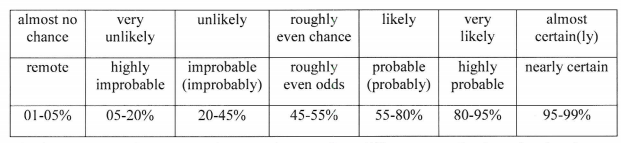
This analysis will follow the US Intelligence Community’s guidelines when using words of estimative probability.
Technological Drivers
The resolution of three critical uncertainties will drive the relative competitiveness of China’s technology sector over the next seven years.
The first is success in implementing the “Made in China 2025” initiative that was announced in May 2015. Here is how the Congressional Research Service has described it (“The Made in China 2025 Initiative: Economic Implications for the United States”):
“Introduced by China’s State Council (the highest Chinese executive organ of state power) in May 2015, the MIC 2025 initiative is the latest in a series of ambitious state-led programs introduced by the Chinese government that seek to modernize the Chinese economy, boost productivity, and make innovation a driver of economic growth. One key Chinese motivation for MIC 2025 is to avoid hitting the so-called “middle-income trap,” a phenomenon that often occurs to low-income countries that initially experience rapid economic growth after implementing certain reforms. Many such countries are able to reach middle-income levels, but eventually the factors that produced that growth can no longer be sustained or the economic returns began to diminish. Without new sources of growth, much slower economic growth rates (or stagnation) can occur, preventing a country from transitioning to a high-income economy (hence the “trap”)…
“The MIC 2025 plan notes that “China’s manufacturing sector is large but not strong, with obvious gaps in innovation capacity, efficiency of resource utilization, quality of industrial infrastructure and degree of digitalization. The task of upgrading and accelerating technological development is urgent.” China seeks to upgrade its economic model from a system where products are largely assembled in China by foreign multinational firms to a system where products made in China are invented there. MIC 2025 seeks to move China up the manufacturing value chain by utilizing innovative manufacturing technologies or “smart manufacturing”…
“By 2049, and coinciding with the 100th anniversary of the founding of the People’s Republic of China (PRC), China aims to “become the leader among the world’s manufacturing powers,” have the “capability to lead innovation and possess competitive advantages in major manufacturing areas,” and “develop advanced technology and industrial systems”…
“The MIC 2025 establishes nine priority tasks, including (1) improving manufacturing innovation, (2) integrating technology and industry, (3) strengthening the industrial base, (4) fostering Chinese brands, (5) enforcing green manufacturing, (6) promoting breakthroughs in 10 key sectors, (7) advancing restructuring of the manufacturing sector, (8) promoting service-oriented manufacturing and manufacturing-related service industries, and (9) internationalizing manufacturing. The 10 sectors identified in the State Council’s 2015 plan are (1) next-generation information technology, (2) high-end numerical control machinery and robotics, (3) aerospace and aviation equipment, (4) maritime engineering equipment and high-tech maritime vessel manufacturing, (5) advanced rail equipment, (6) energy-saving and new energy vehicles, (7) electrical equipment, (8) agricultural machinery and equipment, (9) new materials, and (10) biopharmaceuticals and high-performance medical devices…
“A 2017 study by the U.S. Chamber of Commerce concluded that “MIC 2025 aims to leverage the power of the state to alter competitive dynamics in global markets in industries core to economic competitiveness. By targeting and channeling capital to specific technologies and industries, MIC 2025 risks precipitating market inefficiencies and overcapacity, globally.”
Note that this latter outcome would increase deflationary pressures on the global economy that is already struggling to support high levels of government, corporate, and household sector debt. If successful, MIC 2025 would heighten the risk of a global debt deflation which would very likely diminish the power of the West relative to China.
However, since it was first announced the implementation MIC 2025 has run into an escalating series of obstacles. These include uneven participation by the Chinese private sector, in a period where its relationships with government authorities and state-owned companies are increasingly uncertain; an excess of local government investment in some MIC 2025 priority areas, often financed with debt-like instruments (which recall previous overinvestment in infrastructure, property, and basic industries), rising labor and financing costs (which have already triggered the shift of some manufacturing operations from China to lower cost nations like Vietnam), and above all the growing trade-war between China and the United States, which is in part based on US accusations of unfair trade practices by China.
As Jacob Parker, China operations vice-president at the US-China Business Council observed in the South China Morning Post, “The problematic aspect [of MIC 2025] is how they go about doing it … the government heavily subsidizing development, or discriminating against foreign companies or forcing technology transfers from foreign companies – these are elements of unfair competition and should be opposed” (“Made in China 2025’: Is Beijing’s plan for hitech dominance as big a threat as the West thinks it is?” by Elaine Chan, 10Sep18).
On balance, based on the evidence available in mid-2019 it is likely that MIC 2025 will fall well-short of its ambitious goals, which implies lower economic growth in China in the future.
The second critical uncertainty is rate at which China’s artificial intelligence technology will develop relative to the United States’. While this is a subset of MIC 2025, it has major national security implications.
Jeffrey Ding, from Oxford University, recently addressed this uncertainty in his testimony to the US-China Economic and Security Review Commission (“China’s Current Capabilities, Policies, and Industrial Ecosystem in AI”).
“China has been hyped as an AI superpower poised to overtake the U.S. in the strategic technology domain of AI. Much of the research supporting this claim suffers from the “AI abstraction problem”: the concept of AI, which encompasses anything from fuzzy mathematics to drone swarms, becomes so slippery that it is no longer analytically coherent or useful. Thus, comprehensively assessing a nation’s capabilities in AI requires clear distinctions regarding the object of assessment.”
Ding “compares the current AI capabilities of China and the U.S. by slicing up the fuzzy concept of “national AI capabilities” into three cross-sections: 1) scientific and technological (S&T) inputs and outputs, 2) different layers of the AI value chain (foundation, technology, and application), and 3) different subdomains of AI (e.g. computer vision, predictive intelligence, and natural language processing).”
His conclusion is that at this point in time, “China is not poised to overtake the U.S. in the technology domain of AI; rather, the U.S. maintains structural advantages in the quality of S&T inputs and outputs, the fundamental layers of the AI value chain, and key subdomains of AI.”
Other analyses reach the opposite conclusion. For example, the Allen Institute has concluded that, “China has already surpassed the US in published AI papers. If current trends continue, China is poised to overtake the US in the most-cited 50% of papers this year, in the most-cited 10% of papers next year, and in the 1% of most-cited papers by 2025. Citation counts are a lagging indicator of impact, so our results may understate the rising impact of AI research originating in China” (“China to Overtake the US in AI Research”, by Cady and Etzioni).
Perhaps the best known of arguments for eventual Chinese AI superiority is the book, “AI Superpowers” by venture capitalist Kai Fu Lee, who was previously the president of Google China. Lee’s hypothesis is that as AI technologies move from the development stage to largescale deployment, the quantity of AI trained talent will matter more than its quality, which will favor China, whose advantages lies in the former rather than the latter. Chinese development of AI will also benefit from widespread access to training data sets that are unencumbered by data privacy concerns that are increasingly creating barriers in Europe and to a lesser extent the United Sates.
Lee’s arguments have generated counter-arguments from other researchers. Some of the more persuasive include claims: (1) that training data can be artificially created by Generative Adversarial Networks (GANS); (2) that training data is not relevant for a large set of problems whose resolution depends on factors such as natural language processing, causal, counterfactual, and transfer learning, and fusing knowledge with new data, automated exploration and learning in evolving environments; and that (3) widespread deployment of automation technologies in China (McKinsey has estimated that up to 50% of current work activities in China have high automation potential) could generate a substantial social and political backlash that disrupts the nation’s AI progress.
In mid-2019, based on the conflicting evidence that is available, our assessment is that it is unlikely that China will gain a significant advantage over the United States in AI over the next five to seven years; however, over a longer time horizon, there appears to be a roughly even chance that this could happen.
The third critical uncertainty is how issues related to the supply of rare earth metals will evolve, as they are critical inputs into many high technology components. China’s reserves have been estimated at 44 million metric tonnes, or about 44% of known world reserves. China is followed by Brazil and Vietnam, which each have 22 million MTs.
While China’s recently threatened to restrict supply as part of the intensifying trade war with the United States, rare earth supply risk has been an issue since 2010, when China first raised the possibility of restricting supplies. Since then, production in other nations has expanded, and continues to rise. New discoveries have also been made, and research into new processing technologies has increased. On balance, the negotiating leverage China holds as a supplier of rare earth metals has been declining for a decade, and this will almost certainly continue over the next years (see also, “Rare Earth Elements and National Security” by Eugene Gholz).
Economic Drivers
Both China and the United States face serious economic issues that could limit their growth in the years ahead, and have the potential to trigger substantial social and political unrest and disruption.
China’s economy faces a long hangover from the credit-fueled binge of investment spending that kept the country (and arguably the world) from experiencing a far worse downturn following the 2008 financial crisis. A significant amount of this spending added to already excess capacity in many industries, producing a supply-driven deflationary shock to the global economy. Moreover, the marginal productivity of much of this excess (but long lived) investment is likely to be negative. High debt levels – in both China and the United States, amplify the potential for a severe shock that can plunge an economy into a period of prolonged deflation, as we have seen for the past 30 years in Japan.
Due to the long-term growth depressing effects of its one child policy, and consequent rapid aging of its population (with the attendant economic burdens this creates), China also faces the often-noted challenge of “growing rich before it grows old.” However, as noted above, its MIC 2025 plan for accomplishing this by winning global market share in higher value-added industries now faces increasing headwinds due to a rapidly escalating trade-war with the United States (18% of Chinese exports go to the US, while only 15% of US imports come from China) as well as a general worsening of relations between the government and private sector that has increased the latter’s uncertainty and reduced its willingness to invest.
China is also the world’s largest oil importer, with imports providing 71% of its consumption needs.
The US also faces a series of serious and potentially debilitating economic issues. As previously noted, government and corporate debt levels are at or near historic highs. Today, the healthcare and education sectors account for almost 25% of US GDP, and numerous analyses have found that both suffer from low or negative productivity growth and high and relatively rigid cost structures.
Critically, the rate at which US K-12 education results are increasing is not keeping pace with the exponential rate of improvement in many labor-substituting technologies, such as automation and artificial intelligence. As these technologies are more widely deployed, they could produce substantial job losses, and place increasing demands on social safety net budgets (beyond those increases that will be caused by population aging).
At the same time, many US states face the need to replace and improve public infrastructure that in many cases has not been adequately maintained (because of budget strains), and confront the prospect of painful public sector pension crises (which will force either cuts in benefits, cuts in other spending, or rising taxes to pay for a bailout).
Poor education performance and inadequate infrastructure, along with the rise of “winner take all” economics have in many industries held down productivity growth, and contributed to worsening income inequality.
While this combination of economic forces logically leads to demands for much higher taxes, especially on rich individuals and corporations, there is no guarantee that the targets of these tax increases will continue to play ball. Ultimately, both the sales and income tax bases are mobile; only the property tax base is not.
In sum, it seems very likely (80% probability) that both China and the United States will confront serious economic crises in the next five to seven years.
National Security Drivers
For our purposes here, we define national security competition as principally taking place in the spheres of military and foreign policy and actions, enabled by technology, economic, and intelligence policies and actions.
There is no shortage of recent studies on the Chinese-US military balance (e.g., “Chinese Grand Strategy: A Net Assessment” by Anthony Cordesman; “China’s Military and the US-Japan Alliance 2030, A Strategic Net Assessment” by Swaine et al; and “China and the International Order” by Mazarr et al).
Moreover, the essence of strategy remains unchanged. The definition I prefer is this one (from Britten Coyne Partners): "Strategy is a causal theory that exploits one or more decisive asymmetries to achieve an organization's most important goals with limited resources, in the face of constantly evolving uncertainty, constraints, and opposition."
National security leaders in both China and the United States are continuously engaged in a co-evolutionary contest to develop decisive asymmetries that will enable their respective nations to achieve their goals in the face of uncertainty.
Historically, the United States’ decisive asymmetry was the nation’s overwhelming advantage in material resources and productive capacity. However, in the years after World War 2, it became clear that both the Soviet Union and China had matched or exceeded the United States’ material resources in potential conflict zones in Europe and Asia. This led to the development of the first “offset strategy” by the United States – an increasing reliance on nuclear weapons to deter and if necessary defeat regional Soviet and/or Chinese aggression.
Later, both the Korean and Vietnam wars showed how smaller nations with fewer material advantages could develop asymmetric advantages that undermined US strategies based on material advantage, attrition, and nuclear weapons. In response, US Defense Secretary Harold Brown initiated the second offset strategy, which involved a systematic search for new technologically-based responses to asymmetric developments by potential adversaries. For example, these responses included the attainment of battlefield information superiority (surveillance and reconnaissance) to support the use of new precision guided and often stealthy weapons systems.
More recently, as potential adversaries like China and Russia have developed new asymmetric capabilities (e.g., in space and cyber operations, autonomous and hypersonic weapons systems, and “anti-access/area denial” and “gray zone” strategies), former US Defense Secretaries Chuck Hagel and Ash Carter announced the launch of a third offset strategy to develop new technological, operational, and organizational capabilities. These include greater use of autonomous systems (including swarming), artificial intelligence, high speed projectiles, and better human-machine collaboration (see, “Assessing the Third Offset Strategy” by Hicks et al from CSIS; “Toward a New Offset Strategy” by Robert Martinage, and “Mastering the Gray Zone” by Michael Mazarr).
The critical questions are the speed with which China and the United States are implementing their respective military strategies (which is in part a function of the speed with which the underlying technologies, like AI, develop), and these strategies’ relative power to deter and if necessary defeat other nations.
A number of commentators have expressed serious doubts about whether the United States is evolving fast enough to limit the size of the asymmetric military advantage China’s strategy seeks to create.
In “America is Well Within Range of a Big Surprise, So Why Can’t It See It?”, TX Hammes reminds us that history is full of examples of nations that held on too long to strategies and assets that had delivered success in the past, even as it became increasingly clear that they were far less likely to do so in the future. In the case of the United States, Hammes cites its continuing dependence on and institutional preference for large capital assets, such as satellites, aircraft carriers, and air bases, that are increasingly vulnerable to being blinded or destroyed by far cheaper (and increasingly autonomous) weapons systems that adversaries can deploy in overwhelming numbers. For example, a recent paper noted the high vulnerability of US military bases in Asia to a Chinese missile attack (“First Strike: China’s Missile Threat to US Bases in Asia” by Shugart and Gonzalez).
A growing number of analysts have been making the same point as Hammes (e.g., “Why America Needs a New Way of War” by Christopher Dougherty of the Center for a New American Security, and “Avoiding a Strategy of Bluff” by Hal Brands). Of particular concern to many commentators has been the emerging concept of “hyperwar”, which will likely be fought using artificial intelligence, and autonomous (and increasingly hypersonic) systems, operating with high synchronization at speeds faster than human cognition, in an environment where space and cyber attacks will be aggressively used to degrade an enemy’s ability to observe, orient, decide, and act. In sum, technology is enabling an emergent approach to warfare that has never been seen before, that appears to be creating a new set of “first strike” incentives. Whether these can successfully be deterred by the threat of nuclear retaliation remains to be seen.
A final concern for the United States is the increasing reluctance of some of its leading technology companies (e.g., Google) to work on US defense-related projects. It is not clear how much of a negative impact this could have on initiatives to offset asymmetric Chinese threats.
From a forecasting point of view, the essential question is this: What is the probability that over the next five to seven years China will believe it has attained a sufficient military advantage to enable it to prevail in a kinetic conflict with the United States (e.g., via an invasion of Taiwan, or kinetic conflict in the South China Sea), possibly including pre-emptive attacks on cyber and space systems? Our current assessment is that for now this remains unlikely, but with a still very worrisome 40% probability.
On the foreign policy front, both China and the United States have recently been doing a depressingly good job of alienating potential allies. In the case of China, this has been ascribed to many possible causes, including the reassertion of traditional “Han arrogance” that has its roots in centuries of China’s dominant role in Asia and treatment of other nations as vassal tributary states, and in some cases its clumsy handling of its Belt and Road Initiative (e.g., in the case of debt servicing problems). Whatever its causes, China’s foreign policy approach has caused Japan, India, Sri Lanka, South Korea, Indonesia, and Vietnam (to say nothing of Taiwan and Hong Kong) to look far more warily on its intentions, and be more likely to support a “contain China” policy (as seems to be emerging). On the other hand, China has built stronger relationships with Russia and Iran, forming a loose “anti-US” alliance.
Another critical aspect of foreign policy is a nation’s cultural appeal and dynamism. While in recent years China has attempted to popularize its culture (e.g., through the expansion of Confucius Institutes in many nations), its appeal continues to be dwarfed by the power of US, and more broadly, Anglosphere and Western culture. Moreover, China’s efforts have been undermined by many of its domestic actions, including its treatment of Uighurs, its attempt to control the internet, its increased used of surveillance and social control technologies, and the capricious nature of its legal system (including its recent attempt to impose an extradition law on Hong Kong, in seeming contravention of the 1999 “one country, two systems” treaty), and the heavy-handed ways of domestic security forces.
At the same time, the Trump administration’s “America First” philosophy and tendency to overturn or ignore longstanding practices and agreements has soured America’s relationships with many of its most important allies.
On balance, however, it will very likely be easier for a new American administration to repair the damage Trump has done than it will be for China to reverse attitudes and approaches that are far more deeply rooted in centuries of history.
In forecasting terms, the question is whether, over the next five to seven years, the United States will re-establish strong relationships with its key allies, including Asian nations that wish to contain the rise of China’s power in the region. We estimate that this development is likely, with a probability of 67%.
Our pre-mortem analysis of this estimate highlights two key reasons our forecast could turn out to be wrong: (1) domestic social and political forces in the United States could lead to the re-election of Donald Trump in 2020; and/or (2) in order to forestall the development of a global “contain China alliance”, China could attempt engage in a limited military conflict with the United States with the hope of inflicting serious casualties without triggering a wider conflict (e.g., sinking one or more US naval ships in the South China Sea).
Social/Demographic Drivers
China faces at least five critical social/demographic uncertainties. The first has been widely commented on – the rapid aging of its society, a long-term effect of the one child policy. This will place increasing burdens on public sector budgets (e.g., for social and medical care), family budgets (e.g., one worker caring for two parents and four grandparents), and could limit the nation’s transition to consumption-led growth (as there will be increasing pressure to save for the future as the costs of caring for two generations become more painfully clear).
The second issue is rising inequality, and particularly the perception that people with connections to the Chinese Communist Party (CCP) make up a disproportionate share of the nation’s most wealthy citizens. Undoubtedly, Xi Jinping’s aggressive anti-corruption campaign has in part been aimed at dampening the popular resentment this causes (its other target being members of political factions that pose a threat to Xi’s). In addition, some have argued that many Chinese have tolerated increasing inequality as an unavoidable byproduct of rapid economic growth that has also raised living standards for them and their families. Of course, this raises the question about where resentment of inequality could lead if growth slows for an extended period of time (and/or many middle-class families experience substantial wealth reductions due to an extended financial crisis and property collapse).
The third issue is a much less discussed consequence of the one child policy: the willingness of China’s military and political leaders to engage in actions that could result in high casualties. Put differently, to what extent does a military composed of only children have on the will to fight? And to what extent will their parents and grandparents continue to support the government when they lose children in whom they have invested so much, and whose income is critical to their future support? Far more frequently, one reads about how the excess of young men over women in China’s population (another consequence of the one child policy) has been one source of the nation’s increasing external aggressiveness. Yet uncertainty over the effectiveness of the Chinese military is likely an equally important concern for China’s leaders.
The fourth social uncertainty is the potential impact of automation on employment in China and social stability as more people find reality to be falling well short of their expectations. China’s heavy investment in domestic security (including surveillance and other social control technologies) are clear signs that this is a top concern of Chinese leaders.
A final social uncertainty in China is the long-term impact of having sent so many students abroad to receive their college educations. The extent to which their thinking has been affected by this experience is unknown; what is clear is that many families have sacrificed to enable their children to study abroad, and they and their children have high expectations about the future rewards this will bring. How they will react if those expectations aren’t met is an open question.
The United States also faces a number of well-known social/demographic challenges.
The first has been well-documented by writers such as Robert Putnam (in his books “Bowling Alone” and “Our Kids”), Charles Murray (in his book, “Coming Apart”), and Bill Bishop (in his book, “The Big Sort: Why The Clustering of America is Tearing Us Apart”): The increasing social and geographical division of the United States into an upper and lower class (with a much shrunken middle), which possess increasingly different levels resources including income, wealth, education, health, family structure, social capital, and, increasingly, political affiliation. Critically, in the absence of a dangerous external or other existential threat, this social division contributed to political polarization and governmental gridlock, reducing the United States’ capacity to taking collective action to address pressing national problems (and thus reducing the legitimacy of institutions and leaders which are perceived to have failed in their role). Indeed, it is painfully telling that Gallup research has repeatedly found that the only American institution held in high regard today by people in both political parties is the US military.
While not as precipitous as the change facing China, the aging of the United States’ population (now accelerating due to a declining birth rate) will also create increasing social challenges, including rising costs for social care (e.g., in-home, assisted living, and nursing homes) as well as medical care; budget pressures on Social Security and many state and local public sector pension plans; age discrimination in employment; and, more broadly, increasing conflict between younger generations burdened with debt and often inadequate educations struggling to afford housing, healthcare, and start families, and an older generation whose self-centeredness has become legendary.
Finally, like China, the United States also faces substantial uncertainty regarding the social consequences of the exponentially improving capabilities and accelerating deployment of labor substituting technologies like automation and artificial intelligence.
Domestic Political Drivers
The famous Chinese saying, “the mountains are high and the emperor is far away” refers to the nation’s internal centrifugal tendencies that throughout its history have repeatedly led to regime collapse.
Faced with rising economic and social uncertainties, Xi Jinping has accumulated a degree of power and control not seen in China since the days of Mao and Deng Xiaoping. However, underlying political conflicts in China have almost certainly only been repressed, not eliminated.
The June 4th anniversary of the massacre of university students in Beijing’s Tiananmen Square by security forces reminds one that China had, and likely still has, a considerable reservoir of support for “Western” concepts like the rule of law, and democracy, as well as more economic predictability for the private sector companies that played such an important role in China’s remarkable economic growth. Moreover, thinking back to the 1989 roles played by Hu Yaobang and Zhao Zhiyang reminds one that support for these concepts has, in the past, been found at the highest levels of the Chinese Communist Party.
Xi Jinping has also temporarily suppressed conflicts between various CCP factions, including (1) the so-called “Princelings”, whose rise often benefited from them coming from families with famous CCP pedigrees (this arguably includes Xi and the imprisoned charismatic neo-Maoist Bo Xilai); (2) the China Youth League, comprised of members who did not come from such families, and worked their way up the party ranks (like former CCP General Secretary Hu Jintao); and (3) regional factions like the Shanghai group organized around former General Secretary Jiang Zemin.
A number of authors have addressed what they call (with a nod to George Kennan’s famous 1947 “X” article on “The Sources of Soviet Conduct”) either “The Sources of Chinese Conduct: Explaining Beijing’s Assertiveness” (by Aaron Friedberg) or “The Sources of CCP Conduct” (by Mike Gallagher). The latter reviews a complex mix of motivations, including historical Chinese chauvinism and insecurity, the CCP’s historical role as an influence organization that manipulated foreign perceptions to advance its power, and CCP leaders deep fear of losing power, and consequent sense of ideological struggle against what they perceive as a hostile West. Friedberg focused more narrowly on the causes of the increase in China’s assertiveness since Xi assumed power, and concludes that it most likely rests on CCP leaders changing assessment of China’s relative power following the 2008 global economic crisis.
However, in “The Perfect Storm Confronting Xi Jinping”, Dean Cheng reminds us that Xi’s domestic political survival may also be uncertain due to a growing confluence of challenges. These include (1) the negative economic and social impact of the escalating trade war with the United States, and broadening international resistance to “Made in China 2025”; (2) the arrival of the fall armyworm in China and the substantial threat it poses to many crops and hence to the nation’s food security; and (3) the epidemic of African Swine Fever that is devastating China’s pig herds, in the world’s largest producer and consumer of pork products. Cheng notes that, depending on how Xi handles these multiple challenges, CCP factions that he has repressed may seek to remove him. It certainly wouldn’t be the first time this has happened in recent Chinese history, and if it happened 30 years after Tiananmen Square the irony would be rich. That said, based on the evidence available today, it seems likely (67% probability) that Xi Jinping will continue in his current role for the next five years.
The United States is also in the midst of serious political turmoil. While some would like to point to Donald Trump as its cause, the more accurate assessment is that his election was a symptom of deeper forces that have been at work for a much longer time.
In historical terms, the US is arguably going through a rare political party realignment, which is the consequence of a long process of technological, economic, and social change. One can argue that today the United States has multiple voter segments or political orientations whose forced grouping in two tents is increasingly untenable.
As has been seen in other Western democracies, parties on the extreme left (i.e., “progressives”) and extreme right (i.e., “nationalists”) have been gaining ground at the expense of traditionally centrist parties. However, both extreme parties suffer from a lack of clear and coherent policies and, like every revolutionary movement, a self-destructive tendency to impose increasingly extreme litmus tests on their supporters. As such, they are inherently unstable and fragile.
Whether the parties of the center, in their current or reconfigured forms, can develop the policies, leaders, and messaging needed to regain the support of a majority of voters remains to be seen. As a growing number of commentators have noted, the largest voter segment and the one which is least well represented by current parties combines a stronger economic role for the state in helping people cope in a world of heightened uncertainty, with a focus on reducing inequality, rebuilding social capital, and rejection of divisive identify politics.
Finally, Donald Trump’s hold on office seems less certain than Xi Jinping’s. While special counsel Robert Mueller’s report quelled calls for impeachment on the grounds of colluding with Russia, potential obstruction of justice charges seem much better supported by the evidence. Yet the likelihood of impeachment by the House and conviction by the Senate based on obstruction of justice seems unlikely today, in stark contrast to the Watergate crisis 45 years ago.
As a result, Democratic party leaders may reject impeachment, and instead pursue of strategy of removing Trump from office by winning the 2020 presidential election. Yet with the Democratic party moving ever-leftward, the odds of Donald Trump losing this election seem roughly even today.
Domestic and International Dynamics in China and the United States
While it is certainly not a reassuring conclusion, assessing the respective domestic dynamics at work in China and the United States makes it painfully clear that both countries are very likely to encounter greater domestic instability and conflict over the next five to seven years.
This creates dangerous conditions from which an exponentially escalating conflict between China and the United States could emerge, through a combination (on one or both sides) of overconfident belief in relative strength, underestimation of uncertainty, intensifying domestic political pressures, and/or a sudden accident that rapidly escalates.
In so far as the historical outcomes we observe result from a combination of situational factors, human decisions, and randomness, when we look at the prospects for China-US relations over the next seven years, the first signals rising danger, the second (at least for now) provides little assurance, and the last brings to mind Murphy’s Law.
From a forecasting perspective, we conclude that increasing conflict between China and the United States over the next five to seven years is very likely (90% probability). However, rising political and economic conflict does not automatically translated into a kinetic (or serious cyber) conflict, which is a function not only of intentions, but also relative capabilities and random factors.
Absent the removal of Donald Trump and/or Xi Jinping from their leadership roles (a critical uncertainty), we estimate that some type of kinetic/space or cyber conflict between the two nations has a 33% probability of occurrence over the next seven years (i.e., an annual probability of about 5.6%).
If you have any questions about anything we have written in this issue, please don’t hesitate to get in touch, at contact@indexinvestor.com