Feature Article: The Case Against Bitcoin
Last month, Nate Horsey, our guest analyst, presented the case in favor of investing in Bitcoin (BTC). This month, we present the case against BTC, either as money or an asset class.
A common definition of money meets three tests:
• It is a means of payment
• It is a store of value
• It is a unit of account.
Does Bitcoin meet them?
As a means of payment, BTC transactions and take longer to finalize than payments made with currency, debit and credit cards, and digital means like Apple Pay, Google Wallet, or PayPal (which are linked to default card or bank account). Moreover, most merchants do not accept payments in Bitcoin today.
Bitcoin transaction costs are also much higher that those for other means of payment, and there appear to be substantial barriers to reducing them (e.g., “Beyond The Doomsday Economics Of “Proof-Of-Work” In Cryptocurrencies”, by Raphael Auer of the Bank for International Settlements).
On the other hand, Bitcoin does have one attractive feature as a means of payment: Privacy. For this reason, it has become a favorite means of payment for money launderers, illicit transactions on the dark web, and ransom payments of various types (e.g., to cyber hackers who have taken control of an organization’s computer system).
Bitcoin as a store of value suffers from the very high volatility of its price (which also limits its utility as a means of payment, given the cost to retailers of constantly adjusting prices specified in BTC). Bitcoing is therefore better described as an investable asset than as money.
High price volatility also restricts the usefulness of BTS as a unit of account.
This is similar to the problems that arise in countries experiencing hyperinflation – once inflation rises above a certain level, accounting (and staying solvent) become fulltime, high anxiety challenges for governments, businesses, and individuals. It is for this reason that at some point, “dollarization” occurs, either officially or unofficially. Businesses start to keep two sets of books, one in dollars and one in local currency, and to the extent possible try to price their cash flows in dollars to maintain an accurate understanding of the economic condition of the business.
On the other hand, there is sometimes insight to be gained by measuring financial flows and stocks using something other than fiat money (e.g., the US Dollar or Euro) as a unit of account.
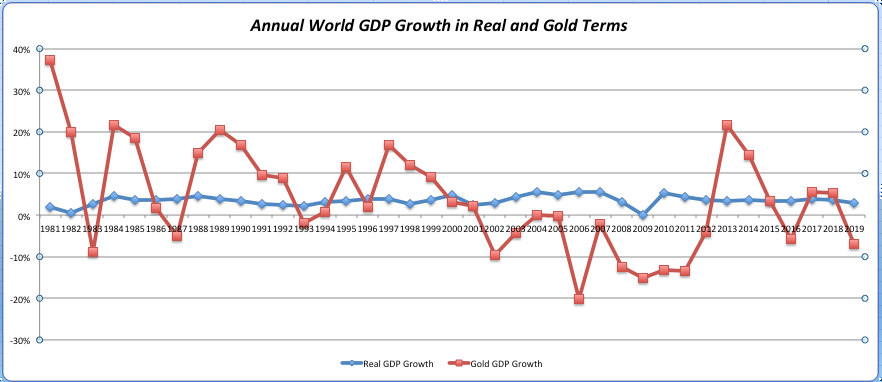
For example, the chart below shows annual world GDP growth expressed in both inflation-adjusted US dollar terms (i.e., real GDP growth) and in terms of gold. The latter calculation is divides each year’s nominal world GDP by the average price of gold for that year, producing World GDP expressed in gold ounces, and annual change in “gold GDP”.
While real GDP adjusts nominal GDP for changes in inflation, gold GDP adjusts if for changes not just in inflation (which is one driver of the price of gold), but also for changes in the perceived risk of future “tail event” or catastrophic risks (which is another driver of the price of gold).
To be sure, “gold GDP growth” is a noisy measure. But as you can see from the chart, it is also one that has been a useful early warning indicator.
Could BTC play the same role as gold in this type of analysis? Would calculating “BTC GDP growth” provide as much insight as gold?
At this point, almost certainly not.
To be sure, neither BTC nor gold provides any current return, which effectively makes it impossible to determine either one’s fundamental value. Yet gold has a much longer price history than BTC, and factors affecting its price are much better understood (e.g., changes in and cost of supply, availability of substitutes, demand drivers like industrial and jewelry uses, central bank, and investor demand, etc.).
In contrast, the price of BTC is far less anchored to any aspect of either history or the real economy. As a result, the BTC’s price almost certainly reflects the state of speculation, rather than a forward looking assessment of certain tail risks.
On balance, the weight of evidence supports the conclusion that Bitcoin is not money, as traditionally defined (e.g., “Bitcoin Is Not a New Type of Money”, by Lee and Martin from the Federal Reserve Bank of New York).
Now let’s turn to BTC as an asset class.
Technically, the asset class is more accurately described as cryptocurrencies or cryptoassets, as there are others besides Bitcoin (e.g., Ethereum). BTC currently accounts for about two thirds of the total market cap of all cryptoassets.
The most important problem with cryptoassets as an asset class is the challenge in valuing them.
A number of approaches have been tried.
The first is classic discounted cash flow valuation. Unfortunately, this requires both a stream of cash flows, and some estimate of terminal value that can be discounted to the present using an appropriate discount rate. As in the case of fine art and gold, these don’t exist.
The second is relative valuation. This involves dividing some numerator by the maximum of 21 million bitcoins that can exist to arrive at an estimate of a bitcoin’s value. There are multiple problems with this approach. What is the right numerator to use? I’ve seen valuations based on the total value of global fiat money supply (using various definitions of that quantity), the market value of the world’s gold supply, and the estimated value of annual illegal transactions for which Bitcoin is the preferred means of payment. As you would expect, that yields a range of BTC valuation estimates that are all over the map.
Another problems with this approach lies in its assumption of a fixed denominator. In reality, while the total amount of Bitcoins may be fixed, there is no limit on growth in the supply of similar crytoasses, like Etherium.
The third starts with the assumption that, because of the impossibility of fundamentally valuing it, Bitcoin is a purely speculative asset, whose value is determined solely by social interactions, as in the classic Keynesian “Beauty Contest” game. Given this assumption, a variety of machine learning and social network methods can be used to try to predict BTC’s future booms, busts, and prices over different time horizons.
Even if it is hard/impossible to value with any degree of accuracy, another claim that has been advanced in favor of Bitcoin as an asset class is its value in hedging certain risks.
The first is an unexpected increase in inflation. However, no evidence has been advanced to show that BTC provides superior protection against this contingency, especially in comparison to equities, property, and (especially when inflation is above 5% annually), gold.
The second is a catastrophic breakdown in confidence in fiat currencies issued by governments, as would occur in the case of widespread hyperinflation. Again, no evidence has been put forward to show why cryptoassets would provide better protection than traditional refuges from catastrophe risk, like physical gold and directly owned property. In fact, because of its dependence on functioning global information technology and communications (ITC) systems, one can make the argument that BTC is an inferior hedge against extreme catastrophe risks (e.g., a solar storm or cyberattack that knocks out much of Earth’s ITC infrastructure).
So, to conclude.
Bitcoin is not money.
Bitcoin (and crypto assets more generally) is not an asset class.
In essence, BTC is a vehicle for pure speculation and betting on human nature, similar to a classical Keynesian “beauty contest”.
As such, Bitcoin offers the opportunity for significant active management profits (and losses), assuming an investor can predict the future beliefs, feelings, and decision of the crowd with a degree of skill that goes beyond simple luck, the skills of other humans, and the capabilities of algorithms.
At this point, almost certainly not.
To be sure, neither BTC nor gold provides any current return, which effectively makes it impossible to determine either one’s fundamental value. Yet gold has a much longer price history than BTC, and factors affecting its price are much better understood (e.g., changes in and cost of supply, availability of substitutes, demand drivers like industrial and jewelry uses, central bank, and investor demand, etc.).
In contrast, the price of BTC is far less anchored to any aspect of either history or the real economy. As a result, the BTC’s price almost certainly reflects the state of speculation, rather than a forward looking assessment of certain tail risks.
On balance, the weight of evidence supports the conclusion that Bitcoin is not money, as traditionally defined (e.g., “Bitcoin Is Not a New Type of Money”, by Lee and Martin from the Federal Reserve Bank of New York).
Now let’s turn to BTC as an asset class.
Technically, the asset class is more accurately described as cryptocurrencies or cryptoassets, as there are others besides Bitcoin (e.g., Ethereum). BTC currently accounts for about two thirds of the total market cap of all cryptoassets.
The most important problem with cryptoassets as an asset class is the challenge in valuing them.
A number of approaches have been tried.
The first is classic discounted cash flow valuation. Unfortunately, this requires both a stream of cash flows, and some estimate of terminal value that can be discounted to the present using an appropriate discount rate. As in the case of fine art and gold, these don’t exist.
The second is relative valuation. This involves dividing some numerator by the maximum of 21 million bitcoins that can exist to arrive at an estimate of a bitcoin’s value. There are multiple problems with this approach. What is the right numerator to use? I’ve seen valuations based on the total value of global fiat money supply (using various definitions of that quantity), the market value of the world’s gold supply, and the estimated value of annual illegal transactions for which Bitcoin is the preferred means of payment. As you would expect, that yields a range of BTC valuation estimates that are all over the map.
Another problems with this approach lies in its assumption of a fixed denominator. In reality, while the total amount of Bitcoins may be fixed, there is no limit on growth in the supply of similar crytoasses, like Etherium.
The third starts with the assumption that, because of the impossibility of fundamentally valuing it, Bitcoin is a purely speculative asset, whose value is determined solely by social interactions, as in the classic Keynesian “Beauty Contest” game. Given this assumption, a variety of machine learning and social network methods can be used to try to predict BTC’s future booms, busts, and prices over different time horizons.
Even if it is hard/impossible to value with any degree of accuracy, another claim that has been advanced in favor of Bitcoin as an asset class is its value in hedging certain risks.
The first is an unexpected increase in inflation. However, no evidence has been advanced to show that BTC provides superior protection against this contingency, especially in comparison to equities, property, and (especially when inflation is above 5% annually), gold.
The second is a catastrophic breakdown in confidence in fiat currencies issued by governments, as would occur in the case of widespread hyperinflation. Again, no evidence has been put forward to show why cryptoassets would provide better protection than traditional refuges from catastrophe risk, like physical gold and directly owned property. In fact, because of its dependence on functioning global information technology and communications (ITC) systems, one can make the argument that BTC is an inferior hedge against extreme catastrophe risks (e.g., a solar storm or cyberattack that knocks out much of Earth’s ITC infrastructure).
So, to conclude.
Bitcoin is not money.
Bitcoin (and crypto assets more generally) is not an asset class.
In essence, BTC is a vehicle for pure speculation and betting on human nature, similar to a classical Keynesian “beauty contest”.
As such, Bitcoin offers the opportunity for significant active management profits (and losses), assuming an investor can predict the future beliefs, feelings, and decision of the crowd with a degree of skill that goes beyond simple luck, the skills of other humans, and the capabilities of algorithms.
If you have any questions about anything we have written in this issue, please don’t hesitate to get in touch, at contact@indexinvestor.com