The Index Investor
June 2019
Key Takeaways
All of our market stress indicators significantly increased in May.
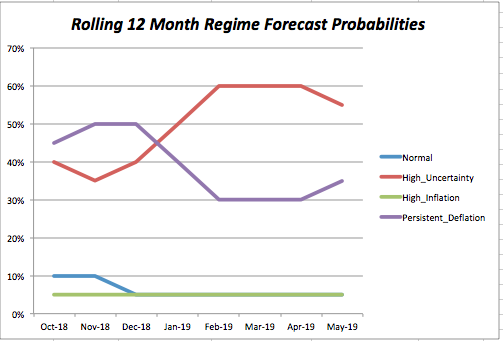
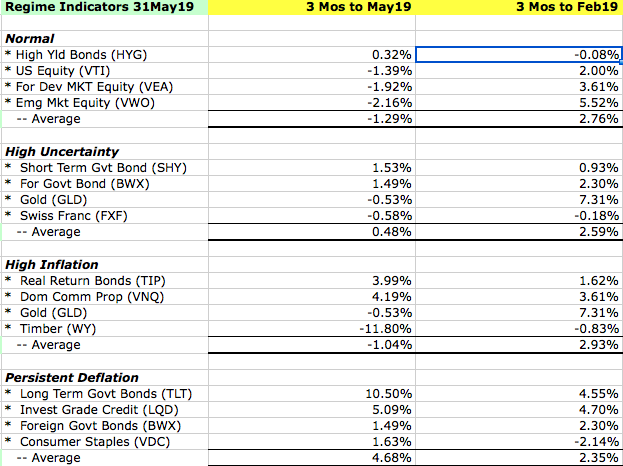
The rolling three-month returns on asset classes that will perform best under the Normal, High Uncertainty, High Inflation, and Persistent Deflation regimes imply that the probability of High Uncertainty giving way to Persistent Deflation is increasing.
This estimate is supported by newly published micro level research that that confirms the previously hypothesized negative firm level employment impact of the accelerated deployment of automation technology, as well as its impact on the distribution of profits across firms in a given sector (with a substantial shift to early automation adopters). There was also new research that found weak employee skill levels that will likely inhibit the re-employment of people displaced by increasing automation.
This month’s feature article analyzes the technological, economic, national security, social, and political trends and uncertainties driving the escalating conflict between China and the United States, and concludes it is likely to further intensify over the next five to seven years
Asset Class Valuation and Momentum Indicators (@31May19)
| Asset Class (ETF) | Valuation | 1 Month Return | Conclusion |
| US Real Return Govt Bond (TIP) | Likely Overvalued* | 1.75% | Increasing Overvaluation |
| US Nom Return Govt Bond (GOVT) | Likely Overvalued* | 2.41% | Increasing Overvaluation |
| US Investment Grade Credit (LQD) | Close to Fairly Valued* | 1.65% | Close to Fairly Valued |
| US High Yield Credit (HYG) | Very Likely Overvalued* | (1.93%) | Decreasing Overvaluation |
| US Commercial Property (VNQ) | Likely Undervalued* | 0.14% | Decreasing Undervaluation |
| US Equity (VTI) | Likely Overvalued* | (6.45%) | Decreasing Overvaluation |
| Foreign Developed Mkt Equity (VEA) | Likely Undervalued* | (5.21%) | Increasing Undervaluation |
| Emerging Markets Equity (VWO) | Almost Certainly Overvalued* | (6.38%) | Decreasing Overvaluation |
| Timber (WY) | Very Likely Undervalued* | (14.93%) | Increasing Undervaluation |
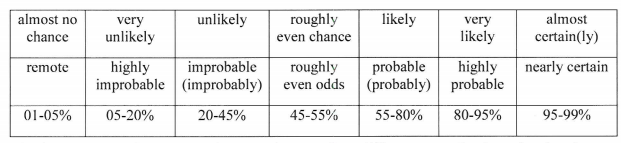
Note: The language we use to describe our estimated likelihood of asset class over or undervaluation is based on US Intelligence Community Directive 203 on Analytic Standards, which includes the following table:
Market Stress Indicators (@31May19)
| Market Stress Indicator | This Month vs Last Month |
| Asset Class Returns Autocorrelation (this month versus last month). Higher autocorrelation is an indicator of higher market stress. | (.72) vs (.20) last month. Indicates a high level of market stress. |
| Economic Policy Uncertainty Index (how many days over the last 30 was index in top quartile of values since 1985?) | On 5 days the index was in the top quartile of daily values since 1984 (the 48th percentile of all rolling 30 day counts). This is sharp increase from the 7th percentile last month. |
| AAA Rated Bonds Spread over 10 Year Treasury Yield (month end). Higher spreads indicate rising concern about market liquidity. | 1.37% (55th percentile since 1983) vs 1.20% last month (48th percentile). |
| BB Rated Bonds Spread over 10 Year Treasury Yield (month end). High spreads indicate increasing credit risk. | 2.94% (42nd percentile since 1996) versus 2.26% last month (16th percentile). |
| Gold Price per Ounce in US Dollars (month end). Rising gold prices are an indicator of increasing market uncertainty and stress. | $1,296 vs $1,285, up 0.84% from last month. |
Market Stress Indicators: Forecast Discussion
We view financial markets as a complex adaptive system. The size of changes generated by such a system follows a power law rather than a normal (Gaussian) distribution. The critical point is that large changes are much more common in complex adaptive systems than most people’s intuition leads them to believe.
While predicting the behavior of complex adaptive systems remains far more art than a science, various researchers have found that large changes in such systems are often preceded by subtle warning signs, as stress accumulates within them. While this research is not definitive, we believe that five warning signs are worth monitoring as potential indicators of growing stress within financial markets that could suddenly give rise to large changes in asset class valuations.
Our first indicator is the month-to-month autocorrelation of broad asset class returns (i.e., the relationship of this month’s returns to last month’s). A system under increasing stress loses resiliency, causing it to take longer to recover from perturbations; hence, autocorrelation increases as it approaches a critical transition (see, “Early Warning Signals for Critical Transitions” by Scheffer, et al).
The one-month autocorrelation of returns for the broad asset classes we monitor sharply increased in May. This indicates that financial markets remained have become more ordered, and thus closer to a critical transition point (which would most likely be accompanied by sudden and substantial changes in asset class values) than they were last month.
The second market stress indicator we monitor is the Economic Policy Uncertainty Index published by the Federal Reserve Bank of St. Louis (via its FRED economic database), which is based on research by Baker, Bloom, and Davis (see their paper, “Measuring Economic Policy Uncertainty”). The index is based on automated text analysis of leading newspapers and magazine publications, to identify the frequency with which words and phrases are used that indicate uncertainty.
In humans’ evolutionary past, when uncertainty increased the probability of survival was enhanced by staying close to a group. All of us still have that instinct. Research has found that as uncertainty increases, we have an unconscious bias towards higher conformity of our own views with those of a larger group (i.e., reduction in cognitive diversity). Behaviorally, heightened uncertainty induces more “social copying” of others, likely due to both conformity bias and the rational belief that others may be acting on the basis of superior information. This increase in conformity and copying makes a social system more ordered as uncertainty increases, and also reduces its responsiveness to perturbations (i.e., increases autocorrelation) because of delays in the social copying process.
The key point is that increasing uncertainty induces more, not less order in social systems, and in so doing primes them for sudden non-linear change.
Based on our continued research into the insights this index can provide, in 2019 we are focusing on the number of days, in the previous 30 days, that this index was in the top quartile of all values since the index series begins at the start of 1985. We then compare this statistic to the full set of rolling 30-day periods, and calculate its percentile at the end of the most recent month. At the end of May, our rolling 30 day count of top quartile values was in the 48th percentile – a significant jump from the 7th percentile last month, which indicates the macro system is becoming primed for sudden, non-linear change.
Our third market stress indicator is the spread between the yield on AAA rated bonds and the 10-year US Treasury. This is a proxy for the level of investor concern about financial system funding liquidity. At the end of May 2019, this spread stood at 1.37%, (the 55th percentile since the series began in 1983), up from 1.20% last month. This indicates an increase in market stress in May, and a considerable increase since April 2018 when this liquidity spread was 1.00%.
Our fourth market stress indicator is the yield spread between speculative BB rated bonds and the ten-year US Treasury. Throughout history, excessive credit growth has been a root cause of many financial crises. An indicator of such growth is falling credit spreads, particularly in the case of riskier borrowers. In contrast, rising BB spreads indicate growing investor concern about the consequences of such growth, and the financial distress lower rated companies could experience in an economic downturn. At the end of May 2019, this spread was 2.94% (42nd percentile since the series began in 1996), significantly up from 2.26% last month (16th percentile). This is still a very low level for this late in what is already an exceptionally long period without a serious economic downturn, and where qualitative warning signs of danger ahead abound (see both this months Evidence file, and the cumulative Evidence file on our website).
Our fifth market stress indicator is what we term the “political risk premium” that is implicit in the price of gold. Our starting point for estimating this premium is the three different roles that gold plays. First, gold is a store of value in a world of fiat currencies. When the rate of money supply growth exceeds the growth of nominal GDP, gold’s price should increase to maintain its purchasing power. Between 2007 and 2017, the US money supply (M2) grew by about 86%, while nominal US GDP grew by 35%. The stock of gold grew by 18%, based on mine production over this period. We therefore infer that 33% of the increase in the price of gold represented the maximum potential gold price change that could be attributed to a desire to hedge inflation risk (86% less 35% less 18%).
Second, gold is a unit of account. We take this to mean that the annual change in GDP expressed in terms of physical gold (i.e., nominal GDP divided by the price of gold) should equal the change in real GDP calculated using the GDP price deflator to account for actual inflation over the period. A key challenge is the point at which to start this calculation.
We chose the price of gold in 1995/1996. In that period, the change in real global GDP measured using the IMF’s price deflator just about equaled the change in GDP measured in terms of physical gold. We interpret that coincidence as indicating that at that point in time, concerns about future inflation and political risk were minimal, and the change in the price of gold was mostly driven by its role as a unit of account. We calculated a subsequent series of gold prices that would produce the same change in “gold GDP” as the actual real GDP as calculated by the IMF. Between 2007 and 2017, “gold as a unit of account” warranted a 21% increase in its price.
Gold’s third role is as a hedge against inflation and what we term “political disaster” risk. We subtract the 21% estimated compensation for actual inflation from the 33% “gross” inflation risk hedge to derive an apparent 12% increase in the gold price that reflected the true risk premium to hedge against possible future inflation. However, between 2007 and 2017 the price of gold actually increased by 81%. This implies that 48% of this (81% less 21% less 12%) represented a premium for some other type of uncertainty at the end of 2017. The interesting question is the nature of the uncertainty for which gold is believed by some investors to be a superior hedge than traditional ports in a storm like short-term US government securities, or similar securities issued by other developed countries.
The logical inference is that the uncertainty in question must reflect a situation in which short term US Treasuries would be a less effective hedge than gold. This could be a world of widespread hyperinflation, capital controls, and/or radical changes in nations’ governments (of course, this would also imply a preference for investing in gold coins rather than bullion, as while the latter may be a store of value, it is far less convenient as a means of paying for transactions).
To put this in further perspective, this gold price “disaster risk” premium sharply increased from 2008 to 2012, then declined before sharply increasing again after 2016. Arguably, a significant part of the former increase reflects concerns about the potential inflationary consequences of dramatic quantitative easing by central banks. But this is not likely to be the case after 2016.
Over the last month, the price of gold increased by 0.84%. The gold price has now returned to approximately where it was at the end of 2017. Therefore, on a rough approximation, the political uncertainty premium at the end of May 2019 stood at about 48%, compared to a low of about 39% at the end of August 2018. On balance, this is another indication of falling market stress.
To conclude, all of our indicators showed a significant increase in underlying market stress in May.
Macro Regime Forecast and Implications for Asset Class Values
Macro Regime Probabilities: Forecast Discussion
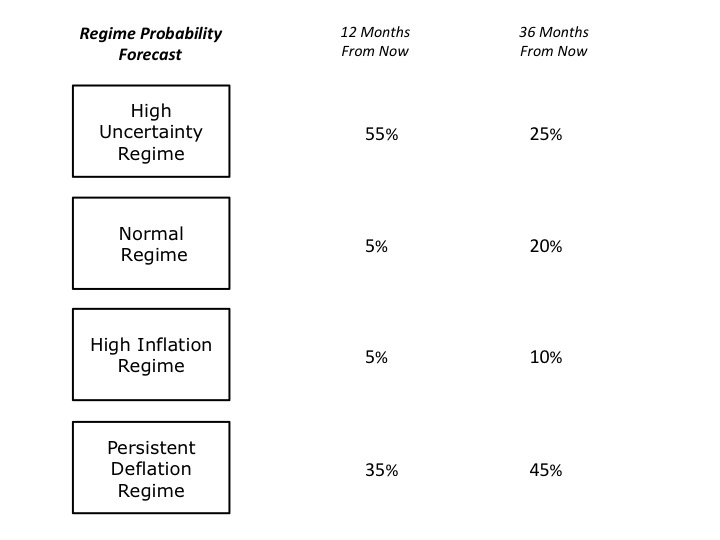
In response to subscriber requests, we are adding a 36 month regime forecast to our existing 12 month forecast. The logic is that, in a complex evolving system like global macro, a longer forecast horizon gets beyond the “detection range” of algorithmic forecasting approaches, and therefore raises probability that a manager/investor can gain an edge in identifying emerging threats and opportunities.
That said, because evolving (i.e., “non-stationary”) complex systems populated by highly connected human agents are also capable of sudden non-linear changes (with which are hard for algorithmic approaches to predict), we are also keeping our 12 month forecast.
This is consistent with what is perhaps the wisest insight I’ve come across in 40 years of forecasting -- this quote by the late economist Rudi Dornbusich: “Crises take a much longer time coming than you think, then happen much faster than you would have thought.”
There were also more articles focused on the relatively weak tools that governments currently have available to respond to a downturn, with interest rates close to the zero lower bound and in many places fiscal policy potentially constrained by high government debt levels relative to GDP. Also, as discussed in previous issues, housing has a heavy weight in the US CPI, and the rate of increase in housing costs has begun to slow in the US, halving from a few months ago Moreover, uncertainty is increasing, which should cause delayed increases in consumer and investment expenditures.
This month further research was published that showed the potentially negative impact of accelerated deployment of automation technology on employment, as well as the distribution of profits across firms in a given sector (with a substantial shift to early automation adopters). There was also new research on weak employee skill levels that will likely inhibit the re-employment of people displaced by increasing automation. These new pieces of evidence have caused us to increase our estimated probability for the deflation regime relative to continuation of the high uncertainty regime.
With respect to the high inflation regime, tensions between the United States and Iran have continued to increase. However, this has not yet fed through into a substantial increase in oil prices, in part due to the reduced importance of Middle East production to global oil supply. However, that could quickly change with tensions rising. China, however, is providing the world with an example of how supply side shocks (in this case, to food supplies) can produce sharp increases in inflation.
Forecast Methodology
Our analysis focuses on four possible macro regimes: (1) Normal Times, where equity asset classes perform well; (2) a High Uncertainty regime that is usually short and transitory, where asset classes like short-term government bonds perform best and equities suffer significant declines; (3) High Inflation (which we deem 5% or more, year-on-year), where commercial property, real return bonds and other traditional hedges are favored; and (4) Persistent Deflation (a year-on-year decline in the US CPI), which up to now has only been seen in Japan, and in which the relative performance of different asset classes remains uncertain, but will likely favor high quality bonds and the consumer staples equity sector.
Our forecasting methodology is derived from our experience on the Good Judgment Project, as described in the book, “Superforecasting” by Gardner and Tetlock, as well as a range of other sources, from the intelligence community to systems dynamics and complex adaptive systems to statistics and political economy.
We start with base rate/reference case data about the historical probability of large changes in equity and bond valuations. We then analyze the current situation from both a quantitative and qualitative perspective. In the latter, we focus on the key endogenous drivers of macro regime change, including technological, economic, national security, social, and political trends and uncertainties. We also focus on three potential sources of exogenous shocks that could also produce a macro regime change, caused by environmental, disease, and cyber related events.
While most of our attention typically focuses on various flows (e.g., economic growth, change in the price level, sales, earnings, job creation, etc.), endogenously caused regime changes result when those flows push key stocks beyond a critical threshold or tipping point, often setting off non-linear reactions across multiple areas. As noted by Hyman Minsky and others, a classic example is the steady accumulation of outstanding debt until it reaches the point where it can no longer be serviced and triggers a crisis.
Base Rate Data
Since the end of World War Two, there have been fifteen months where a downturn in the US equity market began that eventually reduced asset class value by 20% of more. That is a hazard rate of about 1.75% per month. Put differently, in any given month there is a 98.25% probability that a 20%+ downturn won’t occur, or, in a given year, an 81% probability.
However, as the time without a 20%+ downturn extends, the compound probability that one will not occur shrinks. At the end of August 2018, it is more than nine years since the last equity market decline of 20% or more. The probability of that happening is only 15%.
To estimate the base rate for a 20% fall in bond prices (which historically has been caused by a sharp increase in inflation, as we saw in the late 1970s and early 1980s), we analyzed monthly historical AAA bond yields since 1919. For consistency, we used them to calculate the price of a ten-year zero coupon bond. We then calculated the probability of a price decline of 20% or more over three different holding periods: 12, 18, and 24 months. In any month, the annualized probability of a decline of 20% or more over the subsequent 12 months is 12%; over 18 months, 20%, and over 24 months, 25%.
The Current State of Quantitative Regime Predictors
Our quantitative methodology focuses on the level and change in three-month returns, over the most recent and previous three-month periods, for those asset classes which should perform best under different regimes.
As you can see in the following table, based on three-month returns to the end of May 2019, this analysis indicates that, over the next 12 months, market expectations are again more heavily weighted towards transition to the Deflation regime. This is a significant change from last month, but vindicates our previous view that the market was only slowly incorporating new information, particularly long horizon information outside the “detection range” of many algorithms, whether because of its complexity and/or long-horizon nature.
Like Professors Andrew Lo, Doyne Farmer and others, we regard financial markets as a complex adaptive system (CAS), that exist as part of a larger macro system comprised of other CAS between which there are multiple feedback loops. These other systems include those that produce technology innovations, and economic, environmental, national security (including cyber), social, demographic, and political outcomes.
We also find that these systems tend to operate and generate effects in a rough chronological sequence, albeit with many feedback loops between them. The following chart highlights that the changes we observe in different areas at any point in time are actually part of a much more complex evolutionary process.
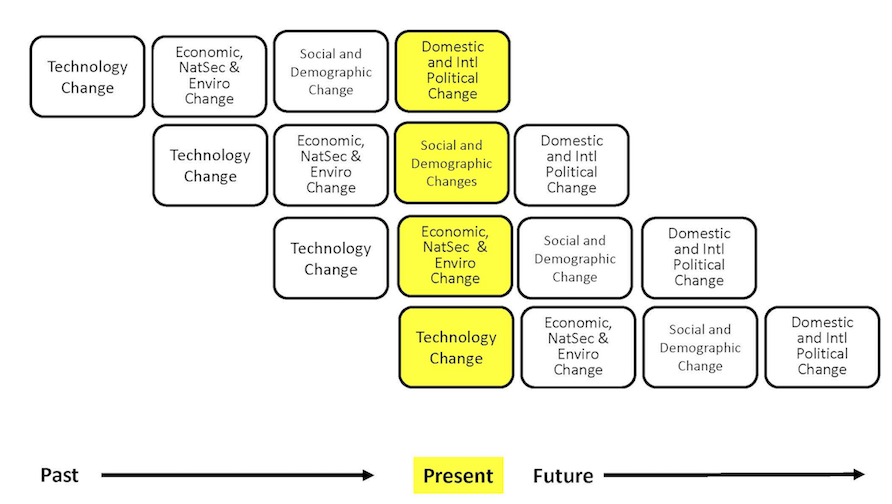
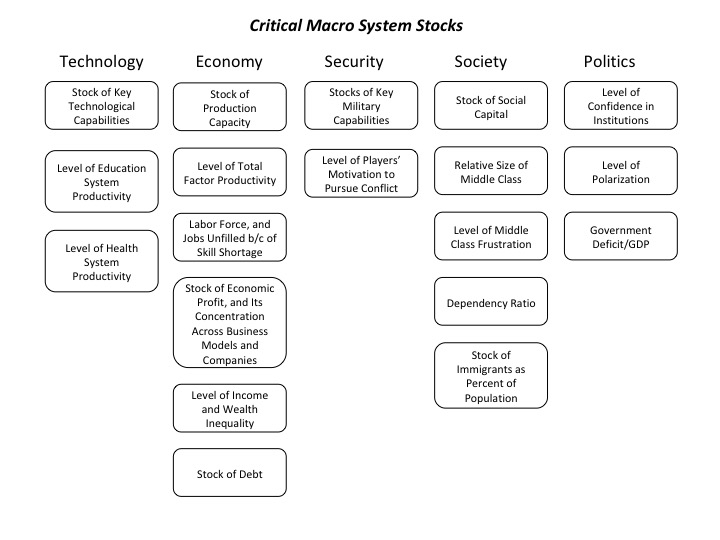
While most media coverage of these systems focused on flows (e.g., the size of the government deficit), rapid non-linear change in complex adaptive systems is often caused by a key stock (e.g., the amount of outstanding government debt) exceeding a critical threshold.
The next table highlights the key macro system stocks that we monitor.
In the next section, we will discuss information received over the past month that is related to these stocks, and which we believe is significant to our assessment of the probabilities that a critical threshold will be reached and a regime change will occur. We will conclude with our estimate, at the end of this month, of how close the macro system is to these critical thresholds, and the implications for financial market regime change probabilities.
In our methodology, we classify new information as significant and highly valuable if either it (1) is an “indicator”, which reduces or increases our uncertainty about the value of a parameter in our mental model for making sense of the dynamic macro system, or (2) it is a “surprise” which increases our uncertainty about, and causes us to revaluate the structure of our mental model.
| New Technology Information: Indicators and Surprises | Why Is This Information Valuable? |
| “Gifted classes may not help talented students move ahead faster”, by Jill Barshay, Hechinger Report | “A large survey of 2,000 elementary schools in three states found that not much advanced content is actually being taught to gifted students…“Teachers and educators are not super supportive of acceleration,” said Betsy McCoach, one of the researchers and a professor at the University of Connecticut.” At a time when performance is increasingly dependent on a small number of “hyperperformers” or “superstar” talent (e.g., see, The Best and The Rest: Revisiting The Norm Of Normality Of Individual Performance” by O’Boyle and Aguinis, and “Superstars: The Dynamics of Firms, Sectors, and Cities Leading the Global Economy” by Manyika et al from McKinsey), this finding that the education of America’s most talented students is largely being neglected by public schools has worrisome implications for future performance. |
| “COBRA: Data-Efficient Model-Based RL through Unsupervised Object Discovery and Curiosity-Driven Exploration,” by Watters et al from Deep Mind | Progress in unsupervised reinforcement learning is a key indicator of developing AI capability. “Recent advances in deep reinforcement learning (RL) have shown remarkable success on challenging tasks. However, data efficiency and robustness to new contexts remain persistent challenges for deep RL algorithms, especially when the goal is for agents to learn practical tasks with limited supervision. Drawing inspiration from self-supervised “play” in human development, we introduce an agent that learns object-centric representations of its environment without supervision and subsequently harnesses these to learn policies efficiency and robustly.” |
| “Cognitive Model Priors for Predicting Human Decisions” by Bourgin et al | SURPRISE This is yet another indicator of accelerating improvement in AI technologies. “Human decision-making underlies all economic behavior. For the past four decades, human decision-making under uncertainty has continued to be explained by theoretical models based on prospect theory, a framework that was awarded the Nobel Prize in Economic Sciences. However, theoretical models of this kind have developed slowly, and robust, high-precision predictive models of human decisions remain a challenge. “While machine learning is a natural candidate for solving these problems, it is currently unclear to what extent it can improve predictions obtained by current theories. We argue that this is mainly due to data scarcity, since noisy human behavior requires massive sample sizes to be accurately captured by off-the-shelf machine learning methods.” “To solve this problem, what is needed are machine learning models with appropriate inductive biases for capturing human behavior, and larger datasets. We offer two contributions towards this end: “First, we construct “cognitive model priors” by pretraining neural networks with synthetic data generated by cognitive models (i.e., theoretical models developed by cognitive psychologists). “We find that fine-tuning these networks on small datasets of real human decisions results in unprecedented state-of-the-art improvements on two benchmark datasets.” Second, we present the first large-scale dataset for human decision-making, containing over 240,000 human judgments across over 13,000 decision problems. This dataset reveals the circumstances where cognitive model priors are useful, and provides a new standard for benchmarking prediction of human decisions under uncertainty.” |
| “Robots and Firms” by Koch et al | SURPRISE This study is based on unique micro-level evidence, and highlights the substantial disruption that lies ahead as the adoption of AI and automation technologies accelerates. The authors “study the implications of robot adoption at the level of individual firms using a rich panel data-set of Spanish manufacturing firms over a 27-year period (1990-2016). We focus on three central questions: (1) Which firms adopt robots? (2) What are the labor market effects of robot adoption at the firm level? (3) How does firm heterogeneity in robot adoption affect the industry equilibrium?... “As for the first question, we establish robust evidence that ex-ante larger and more productive firms are more likely to adopt robots, while ex-ante more skill-intensive firms are less likely to do so. As for the second question, we find that robot adoption generates substantial output gains in the vicinity of 20-25% within four years, reduces the labor cost share by 5-7% points, and leads to net job creation at a rate of 10%. Finally, we reveal substantial job losses in firms that do not adopt robots, and a productivity-enhancing reallocation of labor across firms, away from non-adopters, and toward adopters.” Unfortunately, the authors don’t report the impact on compensation of the employment changes they highlight. |
| Coursera Global Skills Index 2019 | SURPRISE This report provides further evidence that exponentially improving automation and AI technologies seem increasingly likely to produce substantial economic and social disruption, with, at this point, uncertain by likely negative political consequences. “Two-thirds of the world’s population is falling behind in critical skills, including 90% of developing economies. Countries that rank in the lagging or emerging categories (the bottom two quartiles) in at least one domain [Business, Technology, and Data Science] make up 66% of the world’s population, indicating a critical need to upskill the global workforce. Such a large proportion of ill-prepared workers calls for greater investment in learning to ensure they remain competitive in the new economy… “Europe is the global skills leader. European countries make up over 80% of the cutting-edge category (top quartile globally) across Business, Technology, and Data Science. Finland, Switzerland, Austria, Sweden, Germany, Belgium, Norway, and the Netherlands are consistently cutting-edge in all the three domains. This advanced skill level is likely a result of Europe’s heavy institutional investment in education via workforce development and public education initiatives… “Skill performance within Europe still varies, though. Countries in Eastern Europe with less economic stability don’t perform as well as Western Europe in the three domains; Turkey, Ukraine, and Greece consistently land in the bottom half globally. “Asia Pacific, the Middle East and Africa, and Latin America have high skill inequality… “The United States must upskill while minding regional differences. Although known as a business leader for innovation, the U.S. hovers around the middle of the global rankings and is not cutting-edge in any of the three domains. While there’s a need for increased training across the U.S., skill levels vary between sub-regions. “The West leads in Technology and Data Science, reflecting the concentration of talent in areas like Silicon Valley. The Midwest shines in Business, ranking first or second in every competency except finance. “The South consistently ranks last in each domain and competency, suggesting a need for more robust training programs in the sub-region.” |
| “The Wrong Kind of AI? Artificial Intelligence and the Future of Labor Demand” by Acemoglu and Restrepo | SURPRISE Written by two leading academic analysts of the economic and social impacts of advancing AI technologies and their implementation, this new paper provides an important warning about the disruption that lies ahead of current trends continue. “Artificial Intelligence is set to influence every aspect of our lives, not least the way production is organized. AI, as a technology platform, can automate tasks previously performed by labor or create new tasks and activities in which humans can be productively employed. “Recent technological change has been biased towards automation, with insufficient focus on creating new tasks where labor can be productively employed. The consequences of this choice have been stagnating labor demand, declining labor share in national income, rising inequality and lower productivity growth. “The current tendency is to develop AI in the direction of further automation, but this might mean missing out on the promise of the ‘right’ kind of AI with better economic and social outcomes.” |
| | |
| | |
| | |
| | |
| | |
| | |
| | |
| New Economic Information: Indicators and Surprises | Why Is This Information Valuable? |
| “The Global Economy Hit by Higher Uncertainty” by Ahir et al | The authors find that increased in uncertainty, as measured by World Uncertainty Index, could reduce global GDP growth by up to 0.5% in 2019 |
| “Evolution or Revolution: An Afterward” by Blanchard and Summers | The authors begin by observing that, “the changes in macroeconomic thinking prompted by the Great Depression and the Great Inflation of the 1970s were much more dramatic than have yet occurred in response to the events of the last decade. “ They forecast that “this gap is likely to close in the next few years as a combination of low neutral rates, the reemergence of fiscal policy as a primary stabilisation tool, difficulties in hitting inflation targets [i.e., the rising threat of deflation], and the financial ramifications of a low rate environment lead to important changes in our understanding of the macroeconomy and in policy judgments about how to achieve the best performance.” |
| “The Burden of Debt” by Irwin Stelzer | “The spectre of debt is haunting the world…In America, the government’s outstanding debt tops $22 trillion and is rising at close to $1 trillion per year, soon to exceed even that level. The Congressional Budget Office (CBO) estimates that the federal debt held by the public, now at 78 percent of GDP, will rise to 92 percent in 2029. And that statistic assumes that Congress, in an unusual display of fiscal responsibility and political heroism, does not extend the Trump tax cuts that are due to expire in 2025. More likely, tax cutters will be on as thin on the ground in 2025 as they are now, and government debt will exceed 100 percent of GDP. “Harvard economists Kenneth Rogoff and Carmen Reinhart studied data on the relation of growth to debt in 44 countries spanning about 200 years and concluded that when the ratio reaches 90 percent, growth significantly declines. “America is not alone in choosing profligacy over prudence. Between 2008 and 2017 global financial debt rose from $97 trillion to $169 trillion according to McKinsey & Company. Stephen Jen, CEO of hedge fund Eurison SLJ Capital, believes “the debt load in the world is so high now that it can’t withstand any historically normal size of interest-rate increases anymore.” |
| “A better way to anticipate downturns” by Tim Koller of McKinsey | “While the savviest executives and investors know better than to get caught up in the short-term fluctuations of the economy, many others, looking for evidence of longer-term trends, still fixate on movements in the equity markets. “They shouldn’t. The fact is that those markets, well analyzed as they are, don’t predict downturns effectively. Credit markets are a better place to look for signs of impending trouble, in no small part because they have been at the core of most financial crises and recessions for hundreds of years… “The credit markets are where crises develop—and then filter through to the real economy and drive downturns in the equity markets…Unfortunately, it takes several years for crises to develop, and once the conditions are in place, they are nearly inevitable.” |
| “Aggregate Implications of Changing Sectoral Trends” by Foerster et al | SURPRISE “This paper highlights the steady decline in trend GDP growth over the post-war period, 1950 to 2016…The estimates reveal that trends in total factor productivity (TFP) and labor [employment] growth have steadily decreased across a majority of U.S. sectors since 1950… “Interestingly, more than 2/3 of the secular decline in aggregate TFP growth results from the combination of sector-specific disturbances, thus leaving only an ancillary role for aggregate TFP… “Construction more than any other sector stands out by a considerable margin for its contribution to the trend decline in GDP growth since 1950, accounting for close to 1/3 of this decline. Structural changes in Professional and Business Services and Nondurable Goods together account for another 25 percent…” “In addition, the slow process of capital accumulation means that structural changes have endogenously persistent effects. We estimate that trend GDP growth will continue to decline for the next 10 years absent persistent increases in TFP and labor growth.” |
| “The Economic Effects of the 2017 Tax Revision: Preliminary Observations” by Gravelle and Marples from the Congressional Research Service | “In 2018, gross domestic product (GDP) grew at 2.9%, about the Congressional Budget Office’s (CBO’s) projected rate published in 2017 before the tax cut. On the whole, the growth effects tend to show a relatively small (if any) first-year effect on the economy. Although growth rates cannot indicate the tax cut’s effects on GDP, they tend to rule out very large effects particularly in the short run. Although investment grew significantly, the growth patterns for different types of assets do not appear to be consistent with the direction and size of the supply-side incentive effects one would expect from the tax changes. This potential outcome may raise questions about how much longer-run growth will result from the tax revision.” |
| | |
| | |
| | |
| | |
| | |
| | |
| New National Security Information: Indicators and Surprises | Why Is This Information Valuable? |
| “Artificial Intelligence and National Security” by Kelley Sayler, Congressional Research Service | “From the Cold War era until recently, most major defense-related technologies, including nuclear technology, the Global Positioning System (GPS), and the internet, were first developed by government-directed programs before later spreading to the commercial sector…Today, commercial companies—sometimes building on past government-funded research—are leading AI development, with DOD later adapting their tools for military applications. Noting this dynamic, one AI expert commented, “It is unusual to have a technology that is so strategically important being developed commercially by a relatively small number of companies”… “An apparent cultural divide between DOD and commercial technology companies may also present challenges for AI adoption. A recent survey of leadership in several top Silicon Valley companies found that nearly 80% of participants rated the commercial technology community’s relationship with DOD as poor or very poor. This was due to a number of factors, including process challenges, perceptions of mutual distrust, and differences between DOD and commercial incentive structures. Moreover, some companies are refusing to work with DOD due to ethical concerns over the government’s use of AI in surveillance or weapon systems…U.S. competitors may have fewer moral, legal, or ethical qualms about developing military AI applications.” |
| “Space Threat Assessment 2019” by Harrison et al from CSIS | SURPRISE “Satellites are vulnerable to a wide array of intentional threats, such as killer satellites. Other nations have learned how to attack the global commons of space. Our vulnerability is acute because our satellites are the juiciest targets. Cripple our satellites, and you cripple us. “Satellites are not only our crown jewels but the crown itself—and we have no castle to protect them. “The United States is not the leader in anti-satellite technology. We had naively hoped that our satellites were simply out of reach, too high to be attacked, or that other nations would not dare. As this report meticulously documents, other nations are developing, testing, and fielding a range of counterspace weapons that threaten to deprive us of the many economic and military advantages we derive from space. “The risk of a space Pearl Harbor is growing every day. Yet this war would not last for years. Rather, it would be over the day it started. Without our satellites, we would have a hard time regrouping and fighting back. We may not even know who had attacked us, only that we were deaf, dumb, blind, and impotent. “We have been officially warned of this danger since at least 2001 when the Rumsfeld Report was released, but the Pentagon has done very little to reduce this existential risk. The 2008 Allard Report even warned that ‘no one is in charge’ of our space strategy. Sadly, this is still true.” |
| “The Mexico Tragedy” by Shepard Barbash in The American Interest | SURPRISE “Will Mexico ever become a healthy democracy—more law abiding and better governed, more prosperous and free? “The question is as enduring as it is hard to answer. Few nations have inspired such a mixture of love, fear, and revulsion—a perennial sense that it has come so far, yet has so far to go…political dysfunction and the resulting feebleness of many government institutions threaten to destroy all this progress. Adding to the worries: the landslide victory in July of a president, Andrés Manuel López Obrador, who is a creature of the system at its worst… “Whereas ten years ago, most crime came from drug cartels on the U.S. border, the problem has since metastasized nationwide. In cities and villages, from north to south and sea to sea, an ever-evolving, ever-replenishing population of thieves, extortionists, kidnappers, drug traffickers, cheats, and assassins has besieged society, defying or coopting governments at every level. Mexicans’ ingenuity and ambitions, long stifled by their self-dealing political class, are finding an outlet in outlawry… “The numbers shock. More than 135,000 people have been killed since 2012. More than 1,300 clandestine graves have turned up since 2007. More than 37,000 people are reported missing. More than 600 soldiers have been killed in the drug war. At least 130 politicians and nine journalists were killed preceding the elections in July… “And the violence is indeed spreading. Murder rates have risen in 26 of the country’s 32 states. In 2014, 152 municipalities accounting for 43 percent of Mexico’s population reported at least one execution-style murder per month; in 2017, the number grew to 262 municipalities and 57 percent of the population. Villages have become worse than cities: 40 percent of the population lives outside metropolitan areas but suffers 48 percent of homicides… “Most killings remain tied to the drug wars, but a growing share comes from robbery, assault, extortion, and kidnapping…All told, the government reports 33.6 million crimes with a victim in 2017, an all-time high. Most victims were women… Only one in 6,000 crimes ends in a conviction… “According to the World Values Survey, the percentage of Mexicans who say that most of their countrymen can be trusted has fallen from 34 percent in 1990 to 11 percent in 2017, the lowest rate ever recorded in Mexico and among the lowest rates in the world…Resignation is realism in Mexico. The country breaks one’s heart.” |
| “Russia Has Americans’ Weaknesses All Figured Out” by Jim Sciutto of CNN in The American Interest | “What are Americans supposed to think when their leaders contradict one another on the most basic question of national security—who is the enemy? “This is happening every day on the floors of the House and the Senate, in committee hearing rooms, on television news programs, and in President Donald Trump’s Twitter feed. Is Russia the enemy, or was the investigation of Russia’s interference in the 2016 election just a slow-motion attack on the president and his supporters? Are Russian fake-news troll farms stirring up resentment among the American electorate, or are mainstream-media outlets just making things up? “U.S. military commanders, national-security officials, and intelligence analysts have a definitive answer: Russia is an enemy. It is taking aggressive action right…now, from cyberspace to outer space, and all around the world, against the United States and its allies. But the public has been slow to catch on, polls suggest, and Trump has given Americans little reason to believe that their president recognizes Russia’s recent actions as a threat. “All the uncertainty is part of Vladimir Putin’s plan. America’s confusion is both a product and a principal goal of a qualitatively new kind of warfare that the Kremlin is waging—a campaign that systematically targets a democratic but politically divided society whose economy, media environment, and voting systems all depend on vulnerable electronic technologies. The essence of this strategy is to attack U.S. interests just below the threshold that would prompt a military response and then, over time, to stretch that threshold further and further. “The purpose of this shadow war is simple: to create what Russian General Valery Gerasimov has called ‘a permanent front through the entire territory of the enemy state.’” … “Yet for years after the end of the Cold War, leaders in the United States and other Western nations were willfully blind to Russia’s hostility. They fell victim to “mirroring,” imagining that the Russians—and the Chinese, for that matter —wanted what the U.S. wanted: for them to be drawn into the rules-based international order. “But leaders of both Russia and China view that system as skewed toward the interests of the West. Perhaps not coincidentally, China is pursuing a strategy nearly identical to Russia’s, and with similar success—from stealing U.S. trade and government secrets to manufacturing territory in the disputed South China Sea to deploying offensive weapons in space. “Only now, as these events unfold, are decision makers in the American public and private sectors abandoning misconceptions about the kind of relationship they might have with Moscow and Beijing.” |
| In India, Prime Minister Narendra Modi’s Bharatiya Janata won re-election by a large margin that surprised many commentators, and provoked a mix of reactions. | Some (e.g., Ed Luce, who was the Financial Times’ correspondent in India for five years) saw it as another example of “the global advance of ethno-nationalism around the world” (FT, 24May19), and what Kanchan Chandra has called the “triumph of Hindu majoritarianism” and the death of the original pluralist idea of a secular Indian state (Foreign Affairs 23Nov18. See also “How Hindu Nationalism Went Mainstream in Modi’s India” by Amy Kazmin in the 8May19 Financial Times). In contrast, Guy Sorman, writing in City Journal, noted that the socialist and redistributive orientation of the previously dominant Congress had for many years held down India’s economic growth, even as its population continued to rapidly grown. On the economic front, Modi has implemented reforms that have increased economic growth and raised living standards (“Triumph of a Free Society”, 29May19). To be sure, more reforms are needed; however, Sorman notes that “By keeping Modi and his BJP party in power, Indians are declaring that a free economy is good for them, particularly for the poor.” Whether Hindu majoritarianism will increased domestic conflict and derail rising growth remains to be seen, and remains, in the medium term, a critical issue global security and economic issue. |
| | |
| | |
| | |
| | |
| | |
| | |
| | |
| | |
| | |
| New Health and Disease Information: Indicators and Surprises | Why Is This Information Valuable? |
| | |
| | |
| New Social Information: Indicators and Surprises | Why Is This Information Valuable? |
| RAND released an interesting new report on “News in the Digital Age” | Three key takeaways: First, “Print journalism and reporting on broadcast television have been mostly consistent in tone and style over the last 30 years. But since 2000, there’s been a gradual shift toward more subjective reporting.” Second, “In stark contrast to the tone of broadcast television news, between 2000 and 2017, cable news featured content that was more subjective, abstract, argumentative, and based on opinion rather than reporting events.” Third, “Old media is more grounded in traditional reporting. New media tends to lean more subjective. Through 2017 newspapers have remained anchored in traditional reporting techniques. These include strong use of characters, time, descriptive and concrete language, numbers, and retrospective reasoning. But online media outlets tend to deviate from this model, using more conversational language and putting more emphasis on interpersonal interactions and individual perspectives and opinions. Additionally, the tone in online media is often more argumentative and aims to persuade readers.” |
| “A new look at the declining labor share of income in the United States” by Manyika et al from the McKinsey Global Institute | SURPRISE This analysis looks at the industry and firm level drivers of the other side of declining labor share – the rise in capital’s share of income. “In analyzing the various hypotheses behind the labor share decline across these sectors, we find that a set of supercycle and boom-bust effects appears as the main driver, accounting for one-third of the total decline in labor share since 1998…The commodity supercycle notably increased profits in the mining sector, while the real estate boom temporarily increased capital stocks in the sector and its weight in the total economy… “The second-most important factor (26 percent of the decline) is rising and faster depreciation, due to higher capital stocks and a shift to intangible assets with shorter life cycles. For example, computer and electronics manufacturing raised the share of assets from intellectual property products in total capital and, with it, depreciation. Pharmaceuticals and chemicals also used more intangible capital and experienced higher depreciation... “Superstar effects—which see a small proportion of large firms capturing a disproportionately larger share of economic profit than their peers—along with industry consolidation appear to explain about 18 percent of the decline in labor share… “Capital substitution of labor and automation underpin 12 percent of the labor share decline…[and] globalization and decreased labor bargaining power, which affected the automotive sector among others, account for the remaining 11 percent.” |
| “The Global Increase in Socioeconomic Achievement Gap, 1964 to 2015” by Anna Chmielewski, University of Toronto | SURPRISE “The socioeconomic achievement gap —the disparity in academic achievement between students from high- and low-socioeconomic status (SES) backgrounds—is well-known in the sociology of education. The SES achievement gap has been documented across a wide range of countries. Yet in most countries, we do not know whether the SES achievement gap has been changing over time. This study combines 30 international large-scale assessments over 50 years, representing 100 countries and about 5.8 million students. SES achievement gaps are computed between the 90th and 10th percentiles of three available measures of family SES… “Results indicate that achievement gaps increased in a majority of sample countries… The largest increases are observed in countries with rapidly increasing school enrollments, implying that expanding access reveals educational inequality that was previously hidden outside the school system. However, gaps also increased in many countries with consistently high enrollments, suggesting that cognitive skills are an increasingly important dimension of educational stratification worldwide… “Cognitive skills are increasingly seen as the most important outcome of schooling and replace direct inheritance as the only legitimate source of social stratification. In such a society, all parents may equally recognize the importance of academic skills, but higher-SES families have greater resources and information about how to foster their children’s achievement… “Growing SES achievement gaps may also have political implications. Although belief in meritocracy is growing in many countries, this belief is strongly socioeconomically graded, particularly in countries with the highest income inequality A growing awareness of increasing SES achievement gaps—coupled with cases of outright fraud, such as the recent U.S. college admissions bribery scandal — may contribute to increased socioeconomic polarization of trust in the legitimacy of educational institutions.” |
| The Deloitte Global Millennial Survey, 2019 | “Notwithstanding current global economic expansion and opportunity, millennials and Generation Z are expressing uneasiness and pessimism—about their careers, their lives in general, and the world around them. They appear to be struggling to find their safe havens, their beacons of trust…Economic and social/political optimism is at record lows. Respondents express a strong lack of faith in traditional societal institutions, including mass media, and are pessimistic about social progress.” |
| The CDC reported that in 2018, US births fell to the lowest level in 32 years | Albeit with a delay, the USA now appears to be following the sharp decline in the birth rate that has been observed in Europe in recent years. While one can speculate about the reasons for this (most of which are arguably negative indicators about current and expected social and economic conditions), declining birth rates imply lower future economic growth rates, unless immigration and/or productivity increases |
| “The Wealth of Relations” by the US Congress Joint Economic Committee | SURPRISE The Joint Economic Committee of the US Congress has recently, and without much recognition, been pursuing an interesting and potentially important agenda for better understanding and rebuilding social capital as a critical foundation for expanded opportunity and reduced inequality. It is a project that bears watching. “In more recent decades, researchers and theorists have described another source of wealth: social capital. While not previously unknown to economists, social capital was first comprehensively analyzed by political scientist Robert Putnam. It refers to the aspects of human relationships that may be expected to afford value to their possessors. Relationships inhere in social networks as well as in the institutions that people create together for specific purposes and in which they participate. These institutions are ubiquitous, ranging from families to schools to book clubs to unions to churches to athletic leagues. “The social capital literature has suffered from inconsistent and imprecise definitions, and like human capital, the social variety presents complex measurement challenges… “For two years, the Social Capital Project within the Joint Economic Committee (JEC) has documented trends in associational life—what we do together—and its distribution across the country. With this evidentiary base established, the Project now turns to the development of a policy agenda rooted in social capital. “Specifically, the focus of the Project will be to craft an agenda to expand opportunity by strengthening families, communities, and civil society... “Just as there is too often a narrow focus on economic outcomes in debates about opportunity, discussions too often emphasize economic or personal barriers. Among political liberals, in particular, “lifting artificial weights” and “clearing paths” mostly mean giving more money to poor, working class, and (increasingly) middle-class people. Hence the calls on the left for guaranteed jobs, a $15 minimum wage, universal child care, universal college, and a universal basic income guarantee. “In contrast, conservatives have tended to point to personal barriers to opportunity. Different income levels in adulthood, for instance, may be due to unequal economic resources growing up, but they also may be the product of different orientations, preferences, values, and personal strengths and weaknesses. Equalizing incomes will not necessarily change these differences. However, the conservative perspective is not without its own problems. Conservatives have tended to wield the concept of opportunity defensively, affirming their support for “equality of opportunity” as against the “equality of outcomes” that they accuse liberals of seeking. The distinction is rooted in conservatism’s view of people as mostly the captains of their own ships. Given that we have made great strides as a nation achieving formal political equality, the US is often thought to have realized actual equality of opportunity. If someone fails to realize her own definition of the good life—perhaps as a consequence of problematic orientations, preferences, values, and weaknesses—many conservatives view this failure as a personal shortcoming. Most conservatives would agree with Martin Luther King Jr. that “a productive and happy life is not something you find, it is something you make.” But we do not navigate our lives in isolation, we make a productive and happy life with other people. Supportive relationships and institutions are instrumental for expanding opportunity. In part, that is because they are instrumental in forming our orientations, preferences, values, and personal strengths and weaknesses. “That is to say, opportunity depends on social capital—what is available to us from our relationships with family, friends, neighbors, congregants, coworkers, and others. In particular, the people to whom we are born and around whom we live are consequential for our opportunities. “Artificial weights” are not only economic, not only personal, but social as well.” |
| | |
| | |
| | |
| | |
| | |
| | |
| | |
| New Political Information: Indicators and Surprises | Why Is This Information Valuable? |
| The past month has seen a number of important political developments around the world that help to bring key trends and dynamics into better focus. In Australia, the (conservative) Liberal party won a surprise win over the Labor party… | As Tyler Cowen noted, “Sometimes political revolutions occur right before our eyes without us quite realizing it. I think that’s what’s been happening over the last few weeks around the world, and the message is clear: The populist “New Right” isn’t going away anytime soon, and the rise of the “New Left” is exaggerated” (“The New Right is Beating the New Left. Everywhere”, Bloomberg, 20May19). Writing in Quilette, Claire Lehman observed that, “The swing against Labor was particularly pronounced in the northeastern state of Queensland—which is more rural and socially conservative than the rest of Australia. Many of Queensland’s working-class voters opposed Labor’s greener-than-thou climate-change policies, not a surprise given that the state generates half of all the metallurgical coal burned in the world’s blast furnaces. Queensland’s rejection of Labor carried a particularly painful symbolic sting for [Labor party leader Bill} Shorten, given that this is the part of Australia where his party was founded by 19 century sheep shearers meeting under a ghost gum tree. In 1899, the world’s "first Labor government was sworn into the Queensland parliament. “Shorten’s “wipe-out” in Queensland demonstrates what has become of the party’s brand among working-class people 120 years later…Picture a dinner party where half the guests are university graduates with prestigious white-collar jobs, with the other half consisting of people who are trade workers, barmaids, cleaners and labourers. While one side of the table trades racy jokes and uninhibited banter, the other half tut-tuts this “problematic” discourse. “These two groups both represent traditional constituencies of mainstream centre-left parties—including the Labour Party in the UK, the Democrats in the United States, and the NDP in Canada. Yet they have increasingly divergent attitudes and interests—even if champagne socialists paper over these differences with airy slogans about allyship and solidarity… “Progressive politicians like to assume that, on election day at least, blue-collar workers and urban progressives will bridge their differences, and make common cause to support leftist economic policies. This assumption might once have been warranted. But it certainly isn’t now—in large part because the intellectuals, activists and media pundits who present the most visible face of modern leftism are the same people openly attacking the values and cultural tastes of working and middle-class voters. “And thanks to social media (and the caustic news-media culture that social media has encouraged and normalized), these attacks are no longer confined to dinner-party titterings and university lecture halls… “What the election actually shows us is that the so-called quiet Australians, whether they are tradies (to use the Australian term) in Penrith, retirees in Bundaberg, or small business owners in Newcastle, are tired of incessant scolding from their purported superiors. Condescension isn’t a good look for a political movement.” |
| In elections for the European Union parliament, centrist parties lost ground to both extremes | Across many countries, traditional center left (e.g., Social Democrat) and center right (e.g., Conservative and Christian Democrat) parties suffered significant losses, with parties of the right (populist, nationalist) and parties of the left (greens) gaining at their expense. Many commentators took this as a sign of continuing middle class frustration with the leadership of traditional elites, and the lack of appealing policy solutions offered by the centrist parties. For example, see “The Slow Death of Europe’s Traditional Center”, by Yasmeen Serhan in The Atlantic 27May19 |
| “Five Issue Positions that Could Blow Up a Democratic Campaign”, by Elaine Kamarck from Brookings | “So far this election cycle five issues have arisen that could blow up a Democratic candidate for president, a Democratic candidate for dog-catcher and everyone in between. The only exceptions are those Democratic candidates who live in Vermont or who live in the 17 congressional districts (approximately 4 percent of the House of Representatives,) that are so solidly Democratic that George Washington reincarnated as a Republican couldn’t win an election: (1) Allowing prisoners to vote; (2) Third trimester abortion; (3) Abolishing private health insurance; (4) Abolishing the Immigration and Customs Enforcement Service (ICE); and (5) Embracing Socialism. |
| “America Adrift: How the U.S. Foreign Policy Debate Misses What Voters Really Want”, by Halpin et al for the Center for American Progress | SURPRISE “Research revealed important gaps in voters’ basic understanding of U.S. foreign policy objectives and widespread confusion about what the nation is trying to achieve in the world…Likewise, traditional language from foreign policy experts about “fighting authoritarianism and dictatorship,” “promoting democracy,” or “working with allies and the international community” uniformly fell flat with voters in our groups… “The findings in this survey suggest that American voters are not isolationist. Rather, voters are more accurately described as supporting “restrained engagement” in international affairs—a strategy that favors diplomatic, political, and economic actions over military action when advancing U.S. interests in the world. American voters want their political leaders to make more public investments in the American people in order to compete in the world and to strike the right balance abroad after more than a decade of what they see as military overextension… “At the most basic level, voters want U.S. foreign policy and national security policies to focus on two concrete goals: protecting the U.S. homeland and its people from external threats—particularly terrorist attacks—and protecting jobs for American workers. “They also support efforts to protect U.S. democracy from foreign interference, advance common goals with allies, and promote equal rights in other countries. But these are second-order preferences. In the hierarchy of concerns about foreign policy, terrorism and a strong economy are more immediate issues for voters than are efforts to advance democratic values around the world… “Younger voters are much less committed to traditional international and military engagement than are their elder cohorts, and they are more in favor of global action on issues such as climate change, human rights, and basic living standards for all people. Younger voters are also far less committed than older voters to several “America First” sentiments, particularly those related to trade and immigration. “At the same time, the survey finds that many Generation Z and Millennial voters hold no strong views whatsoever about any foreign policy or national security issue. Many of these youngest voters are entirely disengaged from foreign policy and national security news and debates and consequently hold few strong opinions on many issues.” |
| “The Coming Generation War”, by Ferguson and Freymann | SURPRISE “There is a mysterious cycle in human events,” said Franklin Delano Roosevelt, accepting the Democratic nomination for president in Philadelphia in 1936. “To some generations much is given. Of others much is expected. This generation of Americans has a rendezvous with destiny.” “In the 20th century, many sociologists and historians flirted with the idea that generational changes could explain U.S. politics. The historians Arthur Schlesinger Sr. and Jr. wrote about “cycles of American history,” arguing that, as the generations turn, American politics rotates inexorably between liberal and conservative consensus… “We are skeptical about cyclical theories of history. We are also aware of the slipperiness of generations as categories for political analysis. As Karl Mannheim pointed out more than 90 years ago, a generation is defined not solely by its birth years but also by the principal historical experience its members shared in their youth, whatever that might be. “Nevertheless, we do believe that a generational division is growing in American politics that could prove more important than the cleavages of race and class, which are the more traditional focuses of political analysis…”The Millennials and Generation Z—that is, Americans aged 18 to 38—are generations to whom little has been given, and of whom much is expected. “Young Americans are burdened by student loans and credit-card debt. They face stagnant real wages and few opportunities to build a nest egg. Millennials’ early working lives were blighted by the financial crisis and the sluggish growth that followed. In later life, absent major changes in fiscal policy, they seem unlikely to enjoy the same kind of entitlements enjoyed by current retirees. “Under different circumstances, the under-39s might conceivably have been attracted to the entitlement-cutting ideas of the Republican Tea Party (especially if those ideas had been sincere). Instead, we have witnessed a shift to the political left by young voters on nearly every policy issue, economic and Cultural alike… “In short, Ocasio-Cortez is neither an aberration nor a radical. She is close to the political center of America’s younger generations.” |
| “How Trump Voters are Giving the Right Qualms About Capitalism” by Park MacDougald | "One of the paradoxes of the American right has always been its full-throated embrace of capitalism. In some respects, of course, this embrace makes perfect sense: Capitalism is a pillar of American national identity; markets (at least in theory) promote conservative virtues such as thrift and responsibility; and the Hayekian critique of government planning, according to which economies are too complex for humans to fully understand, is a form of classical conservative skepticism regarding the limits of rational knowledge. Yet if one thinks of “conservatism” in the broad sense as a preference for continuity over change — for history and tradition over novelty and innovation — it fits uncomfortably with an economic system that tends toward a relentless abolition of the old. “In Europe, conservatives have tended not only to take a more positive view of the state than Americans do but to regard capitalism as, at best, a necessary evil — something to be defended against left-wing leveling but that has the potential to dissolve the sorts of traditional social bonds that conservatism exists to protect… But in the United States today, “the market triumphalism that has dominated the American right since Reagan seems, for the first time in a generation, to be on the back foot…” |
| “How France’s cultural revolution is causing new political divides”, by Simon Kuper, Financial Times, 30May19 | SURPRISE “The French traditionally didn’t get tattoos, partly because the church frowned on the practice. But there’s been a massive recent shift: a quarter of under-35s have tattoos compared with 1 per cent of over-65s, according to pollsters Ifop. The working-class young are the most decorated. “Since moving to France in 2002, I’ve watched the country complete a cultural revolution. Catholicism has almost died out (only 6 per cent of French people now habitually attend mass), though not as thoroughly as its longtime rival “church”, communism… “In many regions, family history looks like this: grandpa François was a farmer, grandma Marie raised the kids, daddy Jean-Claude had a factory job while Mama Nathalie taught part-time. Now young Kevin (English names are replacing French ones) is a hotel receptionist, separated from the mother of his child, Malika. “A new individualised, globalised, irreligious society requires a new politics… “Pollster Jerôme Fourquet, explains the splintering of society behind these numbers…French winners now exist in a kind of “autarchy”, rarely mixing with other classes, writes Fourquet. They are optimists in a pessimistic nation. They feel they are rising in the “social elevator”, as the French call it, whereas most working-class people say in polls that they live worse than their parents.” |
| | |
| | |
| | |
| | |
| New Financial Markets and Investor Behavior: Indicators and Surprises | Why Is This Information Valuable? |
| “The Expected Unexpected & Unexpected Unexpected”, by Quinn et al | This paper makes a critical point about a key forecasting challenge: Conceiving of scenarios that are substantially different from both the present what linearly extrapolated trends would be likely to produce in the future. “The answers people give when asked to ‘think of the unexpected’ for everyday event scenarios appear to be more expected than unexpected. There are expected unexpected outcomes that closely adhere to the given information in a scenario, based on familiar disruptions and common plan failures. “There are also unexpected unexpected outcomes that are more inventive, that depart from given information, adding new concepts/actions. However, people seem to tend to conceive of the unexpected as the former more than the latter.” |
| “Stop Worrying About Your Portfolio” by Ben Inker from GMO | Inker echoes a point that we have been making for 20 years at the Index Investor. “Investors have a tendency to focus on the characteristics of their portfolios almost to the exclusion of other factors that will lead to success or failure for the larger objective that the portfolio is intended to serve. By taking into account the characteristics of the assets and liabilities that exist outside of their investment portfolios, they could build portfolios that are a better match for the true problem they should be solving. “Because the liabilities and assets outside of the portfolios do not generally have quantitatively well-estimated characteristics the way that traditional investment assets do, this type of analysis necessarily involves a certain amount of judgment rather than simpler historical return analysis. But this effort seems well worth the attempt, because most apparently rigorous attempts to build “optimal” investment portfolios are solving the wrong problem for most investors.” |
| “The Sound of Many Funds Rebalancing” by Chinco and Fos | “Noise makes financial markets possible. But where exactly does noise come from? Research has pointed to several mechanisms. Early papers suggested that noise comes from random supply shocks, or from liquidity traders with random cash demands. There's also a lot of research into noise traders whose random demand stems from irrational beliefs. Other papers have modeled noise as the result of agents' need to hedge random endowment shocks… “An overlooked source of noise is that in modern markets it is computationally infeasible to predict how even simple, rational trading rules interact to create net demand for a stock. For example, empirical data suggest that we can predict whether a stock will be affected by an exchange traded fund portfolio rebalancing cascade, but not how.” |
| “Alice’s Adventures in Factorland: Three Blunders That Plague Factor Investing” by Arnott et all | “Factor investing has failed to live up to its many promises. Its success is compromised by three problems that are often underappreciated by investors. First, many investors develop exaggerated expectations about factor performance as a result of data mining, crowding, unrealistic trading cost expectations, and other concerns. Second, for investors using naive risk management tools, factor returns can experience downside shocks far larger than would be expected. Finally, investors are often led to believe their factor portfolio is diversified. Diversification can vanish, however, in certain economic conditions, when factor returns become much more correlated… “Factor investing is a powerful tool, but understanding the risks involved is essential before adopting this investment framework.” |
| “The Dynamics of Households’ Stock Market Beliefs” by von Gaudecker and Wogrolly | SURPRISE This paper provides yet more evidence of how complexity and uncertainty (and lack of predictability) naturally arise n financial markets – in this case due to the interactions between investors who employ very different belief updating processes. “We analyse a long panel of households’ stock market beliefs to gain insights into the nature of their expectations formation processes. We classify respondents into one of five groups based on their data and estimate group-wise models of expectations formation. “Two of the groups are at opposite extremes in terms of optimism: Pessimists who expect substantially negative returns and financially sophisticated individuals whose expectations are close to the historical average. “Two groups expect returns around zero and differ only in how they respond to information: Extrapolators who become more optimistic following positive information and mean-reverters for whom the opposite is the case. “The final group is characterised by poor probability numeracy; its individuals are not willing or able to quantify their beliefs about future returns. “None of the estimated belief formation processes passes a rational expectations test.” |
| “New Thinking is Needed as the Gloss Drips Off the Art Market”, by John Dizard | Dizard’s description of this market is too priceless not to share: “The headline art market is more a high-end retail business that takes the form of a global series of cocktail parties. It is mostly run by three western auction houses, two Chinese auction houses, a dozen art fair promoters and a couple of hundred major dealers and consultants. “These have a supporting cast of sycophants, publicists, “specialists”, security guards, party planners, removals companies, hired academics and journalists. “The whole point is to tickle the enthusiasm and maintain the turnover of a floating crowd of a few hundred active collectors who require constant affirmation of their good taste and relative standing. Many of the collectors want to be dealers themselves or even raise their status to ‘museum founder’”. |
| “Long Term Economic Consequences of Hedge Fund Activist Interventions” by deHann et al | SURPRISE Nearly 40 years ago, I was involved (as a banker) in my first LBO. Back then, a lot of companies and divisions thereof were inefficiently run, and many buyouts created substantial value. But that game didn’t last long; companies began to evaluate their cost structures through buyout funds’ eyes, and deal leverage ratios kept rising, with too many “priced for perfection” as we used to (and still do) say. Still some funds still created value by astutely timing market cycles, taking companies private at low points, sometimes completing strategic (usually cost driven) transactions before going public again at a higher price. As this approach to value creation became more challenging (in no small part because of multiple bidders driving up buyout prices), there has arisen a new thesis: That buyout funds could not just cut cost and add leverage, but also materially improve revenue generation at their portfolio companies. In my personal experience, this has often proved far more difficult than expected, as fund analysts discovered that it is far easier to change a number on a spreadsheet than to navigate the messy process of actually making it happen in the real world. With that in mind, I was reassured to discover this paper, and confirm that my personal experience were consistent with a much larger pattern. The authors “examine the long-term effects of interventions by activist hedge funds. “Research documents positive equal-weighted long-term returns and operating performance improvements following activist interventions, and typically conclude that activism is beneficial. We extend the literature in two ways. "First, we find that equal-weighted long-term returns are driven by the smallest 20% of firms, with an average market value of $22 million. The larger 80% of firms experience insignificant negative long-term returns. On a value-weighted basis, which likely best gauges the effects on shareholder wealth and the economy, we find that pre- to post-activism long-term returns insignificantly differ from zero. “For operating performance, we find that prior results are a manifestation of abnormal trends in pre-activism performance. Using an appropriately matched sample, we find no evidence of abnormal post-activism performance improvements. Overall, our results do not strongly support the hypothesis that activist interventions drive long-term benefits for the typical shareholder, nor do we find evidence of shareholder harm.” |
| | |
How Close is the Macro System to One or More Critical Thresholds?
As we have noted, the macro drivers of financial market regime changes typically follow a rough chronological sequence, from technology to economic, security, social, and political causes and effects. Yet there are many feedbacks loops between them, creating complex root causes for many of the critical thresholds we have identified.
Understanding the time dynamics in this complex system is critical to avoiding substantial downside investment risk.
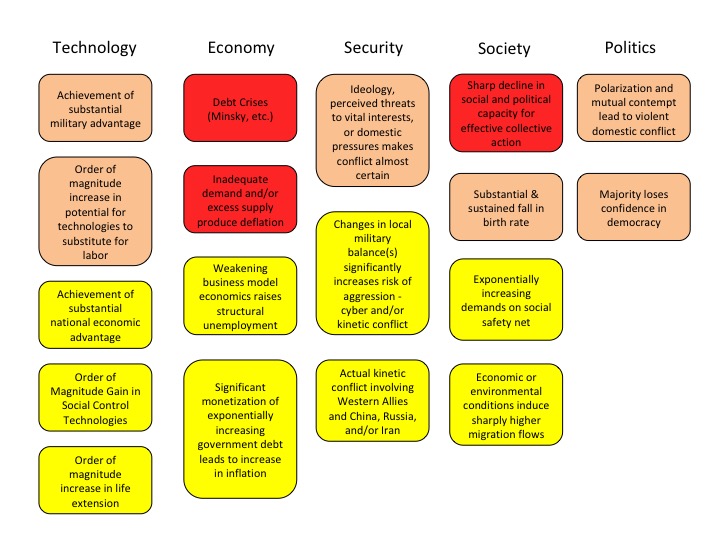
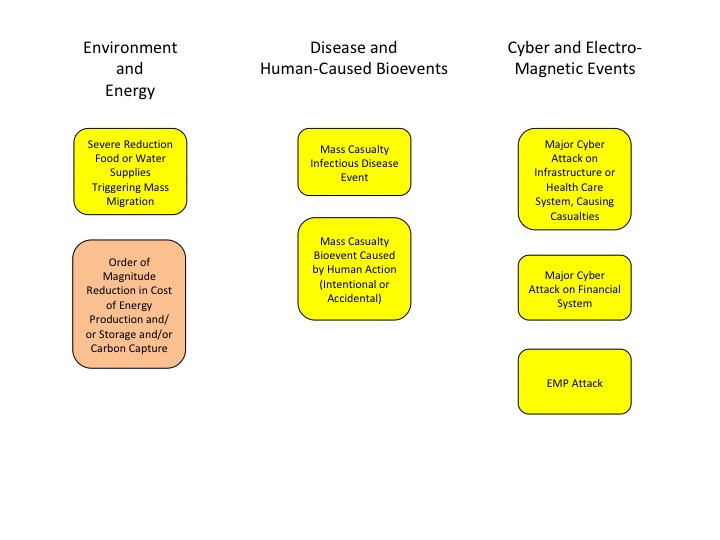
We use the UK Met Office Warning Model to communicate our assessment of these time dynamics. We estimate the time remaining before a critical macro system threshold is reached that could trigger a regime change, which is usually accompanied by substantial changes in asset class valuations.
The model uses three increasingly serious levels of warning, from “Be Aware” (condition yellow), to “Be Prepared” (condition orange), to “Take Action” (condition red).
For our purposes, we denote as “Be Aware” (yellow) critical thresholds that we assess to be three or more years away. We estimate that “Be Prepared” (orange) thresholds could be reached within 1 to 3 years. “Take Action” thresholds are very likely to be reached within one year.
Given their nature, we also note that in our three “wildcard” areas (Environment and Energy related; Disease and Human Caused Bioevents; and Cyber and Electromagnetic Events), our forecasts have higher levels of uncertainty.
The following charts summarize our current estimate of the time remaining before different critical thresholds will be reached.
At the highest level, we believe the complex adaptive global macro system can be in one of four states, based on its degree of order versus disorder, and degree of social cooperation versus conflict. A very coarse-grained reading of history suggests that these states evolve in a predictable cycle, from ordered/cooperative, to disordered/cooperative, to disordered/conflicted, to ordered/conflicted.
We believe that the system is currently in its most uncertain state, characterized by high degrees of underlying disorder and social conflict, both domestically and internationally. Beyond some point, intensifying conflict eventually increases the degree of order in the system. That appears to be happening now, via the increasing conflict between China, Russia, and Iran and the United States and other Western nations.
Pre-Mortem Analysis
One of the most important forecasting disciplines is to ask yourself why your forecast could be wrong. Dr. Gary Klein’s research has shown that a very powerful and insightful way to do this is via a “pre-mortem analysis.” This method asks you to assume that it is a point in the future, and your forecast has been proven wrong (or your strategy or company has failed). You are then asked to look backward from this imagined point in the future, to explain why you failed, what you missed, and what you could have done differently to avoid your fate.
The pre-mortem method takes advantage of the fact that humans reason much more concretely and in more detail when explaining the past than they do when trying to forecast the future.
So let us assume that it is one year from now, and our current forecast has turned out to be wrong.
How did this happen? What developments did we fail to anticipate?
At the end of May 2019, the leaders of the world’s three major powers – Xi Jinping, Donald Trump, and Vladimir Putin are all facing weakening economies and declining political popularity. History teaches us that this can lead to increased “foreign adventurism” to distract the public from worsening domestic conditions, as a nation rallies around its leader in a period of heightened external conflict. Should such a conflict develop between China and the United States, or between Russia and one or more European countries, it would generate a sharp increase in uncertainty that would likely cause an equally sharp economic slowdown and, given high debt levels, speed the arrival of the Persistent Deflation Regime.
As we have noted in previous issues, while it is very unlikely on a global scale, a supply side shock of some type could produce a sudden increase in inflation – the most likely scenario being a reduction in oil supplies due to a kinetic and conflict in the Middle East that produced a prolonged disruption in global oil supplies, or, less likely, an global infectious disease pandemic or major crop failures in multiple regions (e.g., due to climate change and/or disease).
While we believe it is very unlikely, we can envision a scenario in which for a range of possible reasons, both Xi Jinping and Donald Trump leave their current roles, and are replaced by leaders who are more committed to lessening conflicts both between China and the United States and in the international system as a whole. This would likely provide a strong boost to confidence (and thus lead to an equally strong reduction in uncertainty). Whether this would also create an opening for a reduction in domestic political conflict in the United States, and thus progress on policy reforms to address weak growth and rising inequality isn’t clear.
Note: Combining this Forecast with Others and Extremizing the Result Should Increase Predictive Accuracy
Research has found that three steps can improve forecast accuracy. The first is seeking forecasts based on different forecasting methodologies, or prepared by forecasters with significantly different backgrounds (as a proxy for different mental models and information). The second is combining those forecasts (using a simple average if few are included, or the median if many are). The final step, which significantly improved the performance of the Good Judgment Project team in the IARPA forecasting tournament, is to “extremize” the average (mean) or median forecast by moving it closer to 0% or 100%.
Forecasts for binary events (e.g., the probability an event will or will not happen within a given time frame) are most useful to decision makers when they are closer to 0% or 100% than the uninformative “coin toss” 50%. As described by Baron et al in “Two Reasons to Make Aggregated Probability Forecasts More Extreme”, forecasters will often shrink their probability estimates towards 50% to take into account their subjective belief about the extent of potentially useful information that they are missing.
When you average multiple forecasters’ estimates, you are including more information, which should increase forecast confidence and push the mean estimate closer to 0% or 100%. However, this doesn’t happen when you use simple averaging. For this reason, forecast accuracy is increased when you employ a structured “extremizing” technique to move the mean estimate closer to 0% or 100%.
You can download an extremizing model from our website to use when combining the forecasts you use in your decision process.
The extremizing factors in our model are those that the Good Judgment Project found maximized the accuracy of combined forecasts. Note that the extremizing factor is lower when average forecaster expertise is higher. This is based on the assumption that a group of expert forecasters will incorporate more of the full amount of potentially useful information than will novice forecasters.
As we enter what will very likely be an extended period of conflict between China and the United States, it is critically important to have a mental model of the complex and interacting mix of factors that will drive the evolution of this relationship.
To be sure, much has already been written about various aspects of this mental model (see the references throughout this article). What I haven’t seen, however, are many analyses that attempt to pull a range of issues together into an integrated framework, and attempt to synthesize both their horizontal (China vs US) and vertical (within China and within the US) dynamics.
It is also the case that I could write a lot longer analysis than I have room for in this issue. I suspect this is a good thing for readers, as it has forced me to focus on what I estimate are likely to be the most important dynamics. I’ll let you be the judge of the extent to which I meet this ambitious objective.
In what follows, I will first use our standard method to assess key areas of sectoral bilateral competition – technological, economic, national security (i.e., military, foreign policy, and cultural), social/demographic, and domestic political issues. I will then turn to how these drivers interact within each nation, and conclude a probability forecast for outcomes these complex dynamics could produce over the next five to seven years.
Forecast Terminology
This analysis will follow the US Intelligence Community’s guidelines when using words of estimative probability.
Technological Drivers
The resolution of three critical uncertainties will drive the relative competitiveness of China’s technology sector over the next seven years.
The first is success in implementing the “Made in China 2025” initiative that was announced in May 2015. Here is how the Congressional Research Service has described it (“The Made in China 2025 Initiative: Economic Implications for the United States”):
“Introduced by China’s State Council (the highest Chinese executive organ of state power) in May 2015, the MIC 2025 initiative is the latest in a series of ambitious state-led programs introduced by the Chinese government that seek to modernize the Chinese economy, boost productivity, and make innovation a driver of economic growth. One key Chinese motivation for MIC 2025 is to avoid hitting the so-called “middle-income trap,” a phenomenon that often occurs to low-income countries that initially experience rapid economic growth after implementing certain reforms. Many such countries are able to reach middle-income levels, but eventually the factors that produced that growth can no longer be sustained or the economic returns began to diminish. Without new sources of growth, much slower economic growth rates (or stagnation) can occur, preventing a country from transitioning to a high-income economy (hence the “trap”)…
“The MIC 2025 plan notes that “China’s manufacturing sector is large but not strong, with obvious gaps in innovation capacity, efficiency of resource utilization, quality of industrial infrastructure and degree of digitalization. The task of upgrading and accelerating technological development is urgent.” China seeks to upgrade its economic model from a system where products are largely assembled in China by foreign multinational firms to a system where products made in China are invented there. MIC 2025 seeks to move China up the manufacturing value chain by utilizing innovative manufacturing technologies or “smart manufacturing”…
“By 2049, and coinciding with the 100th anniversary of the founding of the People’s Republic of China (PRC), China aims to “become the leader among the world’s manufacturing powers,” have the “capability to lead innovation and possess competitive advantages in major manufacturing areas,” and “develop advanced technology and industrial systems”…
“The MIC 2025 establishes nine priority tasks, including (1) improving manufacturing innovation, (2) integrating technology and industry, (3) strengthening the industrial base, (4) fostering Chinese brands, (5) enforcing green manufacturing, (6) promoting breakthroughs in 10 key sectors, (7) advancing restructuring of the manufacturing sector, (8) promoting service-oriented manufacturing and manufacturing-related service industries, and (9) internationalizing manufacturing. The 10 sectors identified in the State Council’s 2015 plan are (1) next-generation information technology, (2) high-end numerical control machinery and robotics, (3) aerospace and aviation equipment, (4) maritime engineering equipment and high-tech maritime vessel manufacturing, (5) advanced rail equipment, (6) energy-saving and new energy vehicles, (7) electrical equipment, (8) agricultural machinery and equipment, (9) new materials, and (10) biopharmaceuticals and high-performance medical devices…
“A 2017 study by the U.S. Chamber of Commerce concluded that “MIC 2025 aims to leverage the power of the state to alter competitive dynamics in global markets in industries core to economic competitiveness. By targeting and channeling capital to specific technologies and industries, MIC 2025 risks precipitating market inefficiencies and overcapacity, globally.”
Note that this latter outcome would increase deflationary pressures on the global economy that is already struggling to support high levels of government, corporate, and household sector debt. If successful, MIC 2025 would heighten the risk of a global debt deflation which would very likely diminish the power of the West relative to China.
However, since it was first announced the implementation MIC 2025 has run into an escalating series of obstacles. These include uneven participation by the Chinese private sector, in a period where its relationships with government authorities and state-owned companies are increasingly uncertain; an excess of local government investment in some MIC 2025 priority areas, often financed with debt-like instruments (which recall previous overinvestment in infrastructure, property, and basic industries), rising labor and financing costs (which have already triggered the shift of some manufacturing operations from China to lower cost nations like Vietnam), and above all the growing trade-war between China and the United States, which is in part based on US accusations of unfair trade practices by China.
As Jacob Parker, China operations vice-president at the US-China Business Council observed in the South China Morning Post, “The problematic aspect [of MIC 2025] is how they go about doing it … the government heavily subsidizing development, or discriminating against foreign companies or forcing technology transfers from foreign companies – these are elements of unfair competition and should be opposed” (“Made in China 2025’: Is Beijing’s plan for hitech dominance as big a threat as the West thinks it is?” by Elaine Chan, 10Sep18).
On balance, based on the evidence available in mid-2019 it is likely that MIC 2025 will fall well-short of its ambitious goals, which implies lower economic growth in China in the future.
The second critical uncertainty is rate at which China’s artificial intelligence technology will develop relative to the United States’. While this is a subset of MIC 2025, it has major national security implications.
Jeffrey Ding, from Oxford University, recently addressed this uncertainty in his testimony to the US-China Economic and Security Review Commission (“China’s Current Capabilities, Policies, and Industrial Ecosystem in AI”).
“China has been hyped as an AI superpower poised to overtake the U.S. in the strategic technology domain of AI. Much of the research supporting this claim suffers from the “AI abstraction problem”: the concept of AI, which encompasses anything from fuzzy mathematics to drone swarms, becomes so slippery that it is no longer analytically coherent or useful. Thus, comprehensively assessing a nation’s capabilities in AI requires clear distinctions regarding the object of assessment.”
Ding “compares the current AI capabilities of China and the U.S. by slicing up the fuzzy concept of “national AI capabilities” into three cross-sections: 1) scientific and technological (S&T) inputs and outputs, 2) different layers of the AI value chain (foundation, technology, and application), and 3) different subdomains of AI (e.g. computer vision, predictive intelligence, and natural language processing).”
His conclusion is that at this point in time, “China is not poised to overtake the U.S. in the technology domain of AI; rather, the U.S. maintains structural advantages in the quality of S&T inputs and outputs, the fundamental layers of the AI value chain, and key subdomains of AI.”
Other analyses reach the opposite conclusion. For example, the Allen Institute has concluded that, “China has already surpassed the US in published AI papers. If current trends continue, China is poised to overtake the US in the most-cited 50% of papers this year, in the most-cited 10% of papers next year, and in the 1% of most-cited papers by 2025. Citation counts are a lagging indicator of impact, so our results may understate the rising impact of AI research originating in China” (“China to Overtake the US in AI Research”, by Cady and Etzioni).
Perhaps the best known of arguments for eventual Chinese AI superiority is the book, “AI Superpowers” by venture capitalist Kai Fu Lee, who was previously the president of Google China. Lee’s hypothesis is that as AI technologies move from the development stage to largescale deployment, the quantity of AI trained talent will matter more than its quality, which will favor China, whose advantages lies in the former rather than the latter. Chinese development of AI will also benefit from widespread access to training data sets that are unencumbered by data privacy concerns that are increasingly creating barriers in Europe and to a lesser extent the United Sates.
Lee’s arguments have generated counter-arguments from other researchers. Some of the more persuasive include claims: (1) that training data can be artificially created by Generative Adversarial Networks (GANS); (2) that training data is not relevant for a large set of problems whose resolution depends on factors such as natural language processing, causal, counterfactual, and transfer learning, and fusing knowledge with new data, automated exploration and learning in evolving environments; and that (3) widespread deployment of automation technologies in China (McKinsey has estimated that up to 50% of current work activities in China have high automation potential) could generate a substantial social and political backlash that disrupts the nation’s AI progress.
In mid-2019, based on the conflicting evidence that is available, our assessment is that it is unlikely that China will gain a significant advantage over the United States in AI over the next five to seven years; however, over a longer time horizon, there appears to be a roughly even chance that this could happen.
The third critical uncertainty is how issues related to the supply of rare earth metals will evolve, as they are critical inputs into many high technology components. China’s reserves have been estimated at 44 million metric tonnes, or about 44% of known world reserves. China is followed by Brazil and Vietnam, which each have 22 million MTs.
While China’s recently threatened to restrict supply as part of the intensifying trade war with the United States, rare earth supply risk has been an issue since 2010, when China first raised the possibility of restricting supplies. Since then, production in other nations has expanded, and continues to rise. New discoveries have also been made, and research into new processing technologies has increased. On balance, the negotiating leverage China holds as a supplier of rare earth metals has been declining for a decade, and this will almost certainly continue over the next years (see also, “Rare Earth Elements and National Security” by Eugene Gholz).
Economic Drivers
Both China and the United States face serious economic issues that could limit their growth in the years ahead, and have the potential to trigger substantial social and political unrest and disruption.
China’s economy faces a long hangover from the credit-fueled binge of investment spending that kept the country (and arguably the world) from experiencing a far worse downturn following the 2008 financial crisis. A significant amount of this spending added to already excess capacity in many industries, producing a supply-driven deflationary shock to the global economy. Moreover, the marginal productivity of much of this excess (but long lived) investment is likely to be negative. High debt levels – in both China and the United States, amplify the potential for a severe shock that can plunge an economy into a period of prolonged deflation, as we have seen for the past 30 years in Japan.
Due to the long-term growth depressing effects of its one child policy, and consequent rapid aging of its population (with the attendant economic burdens this creates), China also faces the often-noted challenge of “growing rich before it grows old.” However, as noted above, its MIC 2025 plan for accomplishing this by winning global market share in higher value-added industries now faces increasing headwinds due to a rapidly escalating trade-war with the United States (18% of Chinese exports go to the US, while only 15% of US imports come from China) as well as a general worsening of relations between the government and private sector that has increased the latter’s uncertainty and reduced its willingness to invest.
China is also the world’s largest oil importer, with imports providing 71% of its consumption needs.
The US also faces a series of serious and potentially debilitating economic issues. As previously noted, government and corporate debt levels are at or near historic highs. Today, the healthcare and education sectors account for almost 25% of US GDP, and numerous analyses have found that both suffer from low or negative productivity growth and high and relatively rigid cost structures.
Critically, the rate at which US K-12 education results are increasing is not keeping pace with the exponential rate of improvement in many labor-substituting technologies, such as automation and artificial intelligence. As these technologies are more widely deployed, they could produce substantial job losses, and place increasing demands on social safety net budgets (beyond those increases that will be caused by population aging).
At the same time, many US states face the need to replace and improve public infrastructure that in many cases has not been adequately maintained (because of budget strains), and confront the prospect of painful public sector pension crises (which will force either cuts in benefits, cuts in other spending, or rising taxes to pay for a bailout).
Poor education performance and inadequate infrastructure, along with the rise of “winner take all” economics have in many industries held down productivity growth, and contributed to worsening income inequality.
While this combination of economic forces logically leads to demands for much higher taxes, especially on rich individuals and corporations, there is no guarantee that the targets of these tax increases will continue to play ball. Ultimately, both the sales and income tax bases are mobile; only the property tax base is not.
In sum, it seems very likely (80% probability) that both China and the United States will confront serious economic crises in the next five to seven years.
National Security Drivers
For our purposes here, we define national security competition as principally taking place in the spheres of military and foreign policy and actions, enabled by technology, economic, and intelligence policies and actions.
There is no shortage of recent studies on the Chinese-US military balance (e.g., “Chinese Grand Strategy: A Net Assessment” by Anthony Cordesman; “China’s Military and the US-Japan Alliance 2030, A Strategic Net Assessment” by Swaine et al; and “China and the International Order” by Mazarr et al).
Moreover, the essence of strategy remains unchanged. The definition I prefer is this one (from Britten Coyne Partners): "Strategy is a causal theory that exploits one or more decisive asymmetries to achieve an organization's most important goals with limited resources, in the face of constantly evolving uncertainty, constraints, and opposition."
National security leaders in both China and the United States are continuously engaged in a co-evolutionary contest to develop decisive asymmetries that will enable their respective nations to achieve their goals in the face of uncertainty.
Historically, the United States’ decisive asymmetry was the nation’s overwhelming advantage in material resources and productive capacity. However, in the years after World War 2, it became clear that both the Soviet Union and China had matched or exceeded the United States’ material resources in potential conflict zones in Europe and Asia. This led to the development of the first “offset strategy” by the United States – an increasing reliance on nuclear weapons to deter and if necessary defeat regional Soviet and/or Chinese aggression.
Later, both the Korean and Vietnam wars showed how smaller nations with fewer material advantages could develop asymmetric advantages that undermined US strategies based on material advantage, attrition, and nuclear weapons. In response, US Defense Secretary Harold Brown initiated the second offset strategy, which involved a systematic search for new technologically-based responses to asymmetric developments by potential adversaries. For example, these responses included the attainment of battlefield information superiority (surveillance and reconnaissance) to support the use of new precision guided and often stealthy weapons systems.
More recently, as potential adversaries like China and Russia have developed new asymmetric capabilities (e.g., in space and cyber operations, autonomous and hypersonic weapons systems, and “anti-access/area denial” and “gray zone” strategies), former US Defense Secretaries Chuck Hagel and Ash Carter announced the launch of a third offset strategy to develop new technological, operational, and organizational capabilities. These include greater use of autonomous systems (including swarming), artificial intelligence, high speed projectiles, and better human-machine collaboration (see, “Assessing the Third Offset Strategy” by Hicks et al from CSIS; “Toward a New Offset Strategy” by Robert Martinage, and “Mastering the Gray Zone” by Michael Mazarr).
The critical questions are the speed with which China and the United States are implementing their respective military strategies (which is in part a function of the speed with which the underlying technologies, like AI, develop), and these strategies’ relative power to deter and if necessary defeat other nations.
A number of commentators have expressed serious doubts about whether the United States is evolving fast enough to limit the size of the asymmetric military advantage China’s strategy seeks to create.
In “America is Well Within Range of a Big Surprise, So Why Can’t It See It?”, TX Hammes reminds us that history is full of examples of nations that held on too long to strategies and assets that had delivered success in the past, even as it became increasingly clear that they were far less likely to do so in the future. In the case of the United States, Hammes cites its continuing dependence on and institutional preference for large capital assets, such as satellites, aircraft carriers, and air bases, that are increasingly vulnerable to being blinded or destroyed by far cheaper (and increasingly autonomous) weapons systems that adversaries can deploy in overwhelming numbers. For example, a recent paper noted the high vulnerability of US military bases in Asia to a Chinese missile attack (“First Strike: China’s Missile Threat to US Bases in Asia” by Shugart and Gonzalez).
A growing number of analysts have been making the same point as Hammes (e.g., “Why America Needs a New Way of War” by Christopher Dougherty of the Center for a New American Security, and “Avoiding a Strategy of Bluff” by Hal Brands). Of particular concern to many commentators has been the emerging concept of “hyperwar”, which will likely be fought using artificial intelligence, and autonomous (and increasingly hypersonic) systems, operating with high synchronization at speeds faster than human cognition, in an environment where space and cyber attacks will be aggressively used to degrade an enemy’s ability to observe, orient, decide, and act. In sum, technology is enabling an emergent approach to warfare that has never been seen before, that appears to be creating a new set of “first strike” incentives. Whether these can successfully be deterred by the threat of nuclear retaliation remains to be seen.
A final concern for the United States is the increasing reluctance of some of its leading technology companies (e.g., Google) to work on US defense-related projects. It is not clear how much of a negative impact this could have on initiatives to offset asymmetric Chinese threats.
From a forecasting point of view, the essential question is this: What is the probability that over the next five to seven years China will believe it has attained a sufficient military advantage to enable it to prevail in a kinetic conflict with the United States (e.g., via an invasion of Taiwan, or kinetic conflict in the South China Sea), possibly including pre-emptive attacks on cyber and space systems? Our current assessment is that for now this remains unlikely, but with a still very worrisome 40% probability.
On the foreign policy front, both China and the United States have recently been doing a depressingly good job of alienating potential allies. In the case of China, this has been ascribed to many possible causes, including the reassertion of traditional “Han arrogance” that has its roots in centuries of China’s dominant role in Asia and treatment of other nations as vassal tributary states, and in some cases its clumsy handling of its Belt and Road Initiative (e.g., in the case of debt servicing problems). Whatever its causes, China’s foreign policy approach has caused Japan, India, Sri Lanka, South Korea, Indonesia, and Vietnam (to say nothing of Taiwan and Hong Kong) to look far more warily on its intentions, and be more likely to support a “contain China” policy (as seems to be emerging). On the other hand, China has built stronger relationships with Russia and Iran, forming a loose “anti-US” alliance.
Another critical aspect of foreign policy is a nation’s cultural appeal and dynamism. While in recent years China has attempted to popularize its culture (e.g., through the expansion of Confucius Institutes in many nations), its appeal continues to be dwarfed by the power of US, and more broadly, Anglosphere and Western culture. Moreover, China’s efforts have been undermined by many of its domestic actions, including its treatment of Uighurs, its attempt to control the internet, its increased used of surveillance and social control technologies, and the capricious nature of its legal system (including its recent attempt to impose an extradition law on Hong Kong, in seeming contravention of the 1999 “one country, two systems” treaty), and the heavy-handed ways of domestic security forces.
At the same time, the Trump administration’s “America First” philosophy and tendency to overturn or ignore longstanding practices and agreements has soured America’s relationships with many of its most important allies.
On balance, however, it will very likely be easier for a new American administration to repair the damage Trump has done than it will be for China to reverse attitudes and approaches that are far more deeply rooted in centuries of history.
In forecasting terms, the question is whether, over the next five to seven years, the United States will re-establish strong relationships with its key allies, including Asian nations that wish to contain the rise of China’s power in the region. We estimate that this development is likely, with a probability of 67%.
Our pre-mortem analysis of this estimate highlights two key reasons our forecast could turn out to be wrong: (1) domestic social and political forces in the United States could lead to the re-election of Donald Trump in 2020; and/or (2) in order to forestall the development of a global “contain China alliance”, China could attempt engage in a limited military conflict with the United States with the hope of inflicting serious casualties without triggering a wider conflict (e.g., sinking one or more US naval ships in the South China Sea).
Social/Demographic Drivers
China faces at least five critical social/demographic uncertainties. The first has been widely commented on – the rapid aging of its society, a long-term effect of the one child policy. This will place increasing burdens on public sector budgets (e.g., for social and medical care), family budgets (e.g., one worker caring for two parents and four grandparents), and could limit the nation’s transition to consumption-led growth (as there will be increasing pressure to save for the future as the costs of caring for two generations become more painfully clear).
The second issue is rising inequality, and particularly the perception that people with connections to the Chinese Communist Party (CCP) make up a disproportionate share of the nation’s most wealthy citizens. Undoubtedly, Xi Jinping’s aggressive anti-corruption campaign has in part been aimed at dampening the popular resentment this causes (its other target being members of political factions that pose a threat to Xi’s). In addition, some have argued that many Chinese have tolerated increasing inequality as an unavoidable byproduct of rapid economic growth that has also raised living standards for them and their families. Of course, this raises the question about where resentment of inequality could lead if growth slows for an extended period of time (and/or many middle-class families experience substantial wealth reductions due to an extended financial crisis and property collapse).
The third issue is a much less discussed consequence of the one child policy: the willingness of China’s military and political leaders to engage in actions that could result in high casualties. Put differently, to what extent does a military composed of only children have on the will to fight? And to what extent will their parents and grandparents continue to support the government when they lose children in whom they have invested so much, and whose income is critical to their future support? Far more frequently, one reads about how the excess of young men over women in China’s population (another consequence of the one child policy) has been one source of the nation’s increasing external aggressiveness. Yet uncertainty over the effectiveness of the Chinese military is likely an equally important concern for China’s leaders.
The fourth social uncertainty is the potential impact of automation on employment in China and social stability as more people find reality to be falling well short of their expectations. China’s heavy investment in domestic security (including surveillance and other social control technologies) are clear signs that this is a top concern of Chinese leaders.
A final social uncertainty in China is the long-term impact of having sent so many students abroad to receive their college educations. The extent to which their thinking has been affected by this experience is unknown; what is clear is that many families have sacrificed to enable their children to study abroad, and they and their children have high expectations about the future rewards this will bring. How they will react if those expectations aren’t met is an open question.
The United States also faces a number of well-known social/demographic challenges.
The first has been well-documented by writers such as Robert Putnam (in his books “Bowling Alone” and “Our Kids”), Charles Murray (in his book, “Coming Apart”), and Bill Bishop (in his book, “The Big Sort: Why The Clustering of America is Tearing Us Apart”): The increasing social and geographical division of the United States into an upper and lower class (with a much shrunken middle), which possess increasingly different levels resources including income, wealth, education, health, family structure, social capital, and, increasingly, political affiliation. Critically, in the absence of a dangerous external or other existential threat, this social division contributed to political polarization and governmental gridlock, reducing the United States’ capacity to taking collective action to address pressing national problems (and thus reducing the legitimacy of institutions and leaders which are perceived to have failed in their role). Indeed, it is painfully telling that Gallup research has repeatedly found that the only American institution held in high regard today by people in both political parties is the US military.
While not as precipitous as the change facing China, the aging of the United States’ population (now accelerating due to a declining birth rate) will also create increasing social challenges, including rising costs for social care (e.g., in-home, assisted living, and nursing homes) as well as medical care; budget pressures on Social Security and many state and local public sector pension plans; age discrimination in employment; and, more broadly, increasing conflict between younger generations burdened with debt and often inadequate educations struggling to afford housing, healthcare, and start families, and an older generation whose self-centeredness has become legendary.
Finally, like China, the United States also faces substantial uncertainty regarding the social consequences of the exponentially improving capabilities and accelerating deployment of labor substituting technologies like automation and artificial intelligence.
Domestic Political Drivers
The famous Chinese saying, “the mountains are high and the emperor is far away” refers to the nation’s internal centrifugal tendencies that throughout its history have repeatedly led to regime collapse.
Faced with rising economic and social uncertainties, Xi Jinping has accumulated a degree of power and control not seen in China since the days of Mao and Deng Xiaoping. However, underlying political conflicts in China have almost certainly only been repressed, not eliminated.
The June 4th anniversary of the massacre of university students in Beijing’s Tiananmen Square by security forces reminds one that China had, and likely still has, a considerable reservoir of support for “Western” concepts like the rule of law, and democracy, as well as more economic predictability for the private sector companies that played such an important role in China’s remarkable economic growth. Moreover, thinking back to the 1989 roles played by Hu Yaobang and Zhao Zhiyang reminds one that support for these concepts has, in the past, been found at the highest levels of the Chinese Communist Party.
Xi Jinping has also temporarily suppressed conflicts between various CCP factions, including (1) the so-called “Princelings”, whose rise often benefited from them coming from families with famous CCP pedigrees (this arguably includes Xi and the imprisoned charismatic neo-Maoist Bo Xilai); (2) the China Youth League, comprised of members who did not come from such families, and worked their way up the party ranks (like former CCP General Secretary Hu Jintao); and (3) regional factions like the Shanghai group organized around former General Secretary Jiang Zemin.
A number of authors have addressed what they call (with a nod to George Kennan’s famous 1947 “X” article on “The Sources of Soviet Conduct”) either “The Sources of Chinese Conduct: Explaining Beijing’s Assertiveness” (by Aaron Friedberg) or “The Sources of CCP Conduct” (by Mike Gallagher). The latter reviews a complex mix of motivations, including historical Chinese chauvinism and insecurity, the CCP’s historical role as an influence organization that manipulated foreign perceptions to advance its power, and CCP leaders deep fear of losing power, and consequent sense of ideological struggle against what they perceive as a hostile West. Friedberg focused more narrowly on the causes of the increase in China’s assertiveness since Xi assumed power, and concludes that it most likely rests on CCP leaders changing assessment of China’s relative power following the 2008 global economic crisis.
However, in “The Perfect Storm Confronting Xi Jinping”, Dean Cheng reminds us that Xi’s domestic political survival may also be uncertain due to a growing confluence of challenges. These include (1) the negative economic and social impact of the escalating trade war with the United States, and broadening international resistance to “Made in China 2025”; (2) the arrival of the fall armyworm in China and the substantial threat it poses to many crops and hence to the nation’s food security; and (3) the epidemic of African Swine Fever that is devastating China’s pig herds, in the world’s largest producer and consumer of pork products. Cheng notes that, depending on how Xi handles these multiple challenges, CCP factions that he has repressed may seek to remove him. It certainly wouldn’t be the first time this has happened in recent Chinese history, and if it happened 30 years after Tiananmen Square the irony would be rich. That said, based on the evidence available today, it seems likely (67% probability) that Xi Jinping will continue in his current role for the next five years.
The United States is also in the midst of serious political turmoil. While some would like to point to Donald Trump as its cause, the more accurate assessment is that his election was a symptom of deeper forces that have been at work for a much longer time.
In historical terms, the US is arguably going through a rare political party realignment, which is the consequence of a long process of technological, economic, and social change. One can argue that today the United States has multiple voter segments or political orientations whose forced grouping in two tents is increasingly untenable.
As has been seen in other Western democracies, parties on the extreme left (i.e., “progressives”) and extreme right (i.e., “nationalists”) have been gaining ground at the expense of traditionally centrist parties. However, both extreme parties suffer from a lack of clear and coherent policies and, like every revolutionary movement, a self-destructive tendency to impose increasingly extreme litmus tests on their supporters. As such, they are inherently unstable and fragile.
Whether the parties of the center, in their current or reconfigured forms, can develop the policies, leaders, and messaging needed to regain the support of a majority of voters remains to be seen. As a growing number of commentators have noted, the largest voter segment and the one which is least well represented by current parties combines a stronger economic role for the state in helping people cope in a world of heightened uncertainty, with a focus on reducing inequality, rebuilding social capital, and rejection of divisive identify politics.
Finally, Donald Trump’s hold on office seems less certain than Xi Jinping’s. While special counsel Robert Mueller’s report quelled calls for impeachment on the grounds of colluding with Russia, potential obstruction of justice charges seem much better supported by the evidence. Yet the likelihood of impeachment by the House and conviction by the Senate based on obstruction of justice seems unlikely today, in stark contrast to the Watergate crisis 45 years ago.
As a result, Democratic party leaders may reject impeachment, and instead pursue of strategy of removing Trump from office by winning the 2020 presidential election. Yet with the Democratic party moving ever-leftward, the odds of Donald Trump losing this election seem roughly even today.
Domestic and International Dynamics in China and the United States
While it is certainly not a reassuring conclusion, assessing the respective domestic dynamics at work in China and the United States makes it painfully clear that both countries are very likely to encounter greater domestic instability and conflict over the next five to seven years.
This creates dangerous conditions from which an exponentially escalating conflict between China and the United States could emerge, through a combination (on one or both sides) of overconfident belief in relative strength, underestimation of uncertainty, intensifying domestic political pressures, and/or a sudden accident that rapidly escalates.
In so far as the historical outcomes we observe result from a combination of situational factors, human decisions, and randomness, when we look at the prospects for China-US relations over the next seven years, the first signals rising danger, the second (at least for now) provides little assurance, and the last brings to mind Murphy’s Law.
From a forecasting perspective, we conclude that increasing conflict between China and the United States over the next five to seven years is very likely (90% probability). However, rising political and economic conflict does not automatically translated into a kinetic (or serious cyber) conflict, which is a function not only of intentions, but also relative capabilities and random factors.
Absent the removal of Donald Trump and/or Xi Jinping from their leadership roles (a critical uncertainty), we estimate that some type of kinetic/space or cyber conflict between the two nations has a 33% probability of occurrence over the next seven years (i.e., an annual probability of about 5.6%).
If you have any questions about anything we have written in this issue, please don’t hesitate to get in touch, at contact@indexinvestor.com