The Index Investor
January 2019
Key Takeaways
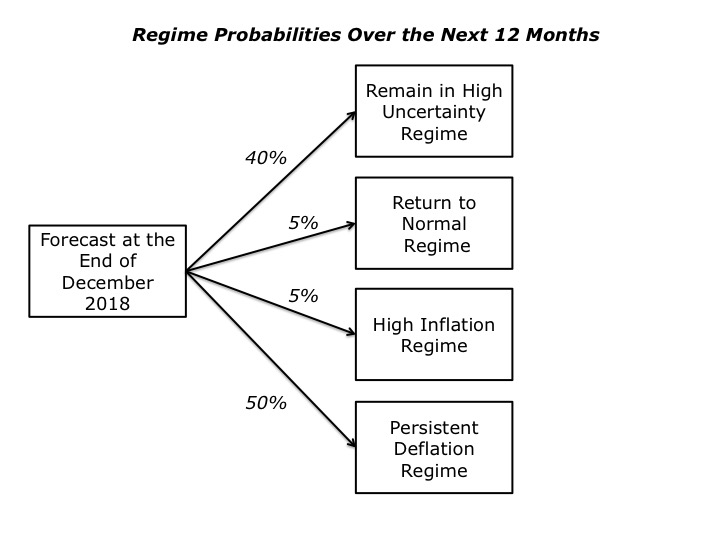
Over the next 12 months, our updated regime probability forecasts are as follows: Continuation of Current High Uncertainty Regime (40% up 5% from last month); transition to High Inflation Regime (5%, down 5%); return to Normal Regime (5%); and transition to Persistent Deflation Regime (50%). In making our forecast, we are acutely conscious of Rudiger Dornbusch’s famous quote: “Crises take a much longer time coming than you think, then happen much faster than you would have thought.”
While some quantitative indicators point to a reduced level of stress in the macro system compared to last month, others point in the opposite direction, as do many of the qualitative indicators we track.
Key indicators this month were new reports on some underappreciated indicators, including the extent of the US housing market boom; new IMF data on the level of debt in the global economy; and the apparent speed with which China’s economy is slowing.
As we will discuss at length in next month’s feature article, we are also very conscious of the multi-period negative impact of the sharp increase in uncertainty we have recently experienced.
Asset Class Valuation and Momentum Indicators (@31Dec18)
| Asset Class (ETF) | Valuation | 1 Month Return | Conclusion |
| US Real Return Govt Bond (TIP) | Likely Overvalued* | 0.36% | Increasing Overvaluation |
| US Nom Return Govt Bond (GOVT) | Likely Overvalued* | 1.31% | Increasing Overvaluation |
| US Investment Grade Credit (LQD) | Likely Overvalued* | 1.54% | Increasing Overvaluation |
| US High Yield Credit (HYG) | Close to fairly valued over long term horizon; likely overvalued over short term* | (5.90%) | Decreasing Overvaluation |
| US Commercial Property (VNQ) | Likely Undervalued* | (7.88%) | Increasing Undervaluation |
| US Equity (VTI) | Likely Overvalued* | (9.20%) | Decreasing Overvaluation |
| Foreign Developed Mkt Equity (VEA) | Likely Undervalued* | (8.62%) | Increasing Undervaluation |
| Emerging Markets Equity (VWO) | Almost Certainly Overvalued* | (3.35%) | Decreasing Overvaluation |
| Timber (WY) | Almost Certainly Undervalued* | (17.23%) | Increasing Undervaluation |
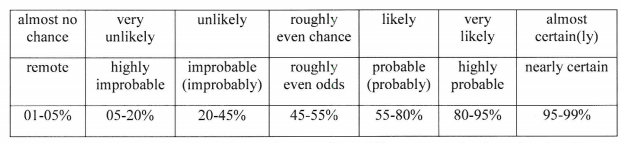
Note: The language we use to describe our estimated likelihood of asset class over or undervaluation is based on US Intelligence Community Directive 203 on Analytic Standards, which includes the following table:
Market Stress Indicators (@31Dec18)
Compared to November, some of our market stress indicators have generally declined, while others have risen. BB rated bonds’ spread over the 10 Year US Treasury is now 3.60%, which puts it the 57th percentile since the series started in 1996. Such a low credit spread at this late stage in one of the longest expansions on is a sign of excessive credit growth, which underlies many other sources of market stress.
| Market Stress Indicator | This Month vs Last Month |
| Correlation of returns across asset classes | (.09) vs .86 Lower correlations are an indicator of less market stress. |
| Economic Policy Uncertainty Index (monthly average) | 170 (5% of months since 1985 were higher) vs 136 |
| AAA Rated Bonds Spread over 10 Year Treasury Yield (month end) | 1.30% (53% of cases since 1983 were higher) vs 1.21% |
| BB Rated Bonds Spread over 10 Year Treasury Yield (month end) | 3.60% (43% of cases since 1996 were higher) vs 2.80% |
| Gold Price per Ounce in US Dollars (month end) | $1,277 vs $1,220 (up 4.7%) |
Market Stress Indicators: Forecast Discussion
We view financial markets as a complex adaptive system. The distribution of the changes generated by such a system follows a power law rather than the normal (Gaussian or "bell curve") distribution. The critical point is that large changes are much more common in complex adaptive systems than most people’s intuition leads them to believe.
While predicting the behavior of complex adaptive systems remains far more art than a science, various researchers have found that large changes in such systems are often preceded by subtle warning signs, as stress accumulates within them. While this research is not definitive, we believe that five warning signs are worth monitoring as potential indicators of growing stress within financial markets that could suddenly give rise to large changes in asset class valuations.
Our first indicator is the month-to-month autocorrelation of broad asset class returns (i.e., the relationship of this month’s returns to last month’s). A system under increasing stress loses resiliency, causing it to take longer to recover from perturbations; hence, autocorrelation increases as it approaches a critical transition (see, “Early Warning Signals for Critical Transitions” by Scheffer, et al).
The one-month autocorrelation of returns for the broad asset classes we monitor sharply decreased to (.09) versus .86 last month. This indicates that financial markets are becoming less ordered and are further away from a critical transition point (which would most likely be accompanied by sudden and substantial changes in asset class values) than they were last month.
The second market stress indicator we monitor is the Economic Policy Uncertainty Index published by the Federal Reserve Bank of St. Louis (via its FRED economic database), which is based on research by Baker, Bloom, and Davis (see their paper, “Measuring Economic Policy Uncertainty”). The index is based on automated text analysis of leading newspapers and magazine publications, to identify the frequency with which words and phrases are used that indicate uncertainty.
In our evolutionary past, when uncertainty increased our probability of survival was enhanced by staying close to our group. We still have that instinct. Research has found that as uncertainty increases, we have an unconscious bias towards higher conformity of our own views with those of a larger group (i.e., reduction in cognitive diversity). Behaviorally, heightened uncertainty induces more “social copying” of others, likely due to both conformity bias and the rational belief that others may be acting on the basis of superior information. This increase in conformity and copying makes a social system more ordered as uncertainty increases, and also reduces its responsiveness to perturbations (i.e., increases autocorrelation) because of delays in the social copying process.
The key point is that increasing uncertainty induces more, not less order in social systems, and in so doing primes them for sudden non-linear change.
This month, the average Economic Policy Uncertainty Index stood at the 95th percentile of its values since the data series began in 1985 – to be clear, just 5% of values were higher over that period. This was a further increase in average uncertainty since last month.
Our more fine-grained intra-month measure of uncertainty is the number of daily changes that are in the top and bottom 20% of the historical distribution. This month it fell sharply, to just the 9th percentile (i.e., it was lower than in 95% of the rolling 30-day periods since 1985). This is a sharp drop from last month, when it was in the 68th percentile.
To reiterate the point made above, high levels of uncertainty tend to cause people’s opinions to become more ordered, due to a higher tendency toward conformity and social copying. This primes a system for sudden, non-linear change.
Our third market stress indicator is the spread between the yield on AAA rated bonds and the 10-year US Treasury. We interpret this as a proxy for the level of investor concern about financial system liquidity. At the end of December 2018, this spread stood at 1.30%, (51st percentile), up slightly from last month’s 1.21% spread. That said, at the end of September it stood at .95%. So market concerns about liquidity have been steadily rising.
Our fourth market stress indicator is the yield spread between speculative BB rated bonds and the ten-year US Treasury. Throughout history, excessive credit growth has been a root cause of many financial crises. An indicator of such growth is falling credit spreads, particularly in the case of riskier borrowers. At the end of December, this spread was 3.60%, which still put it in the 57th percentile of spreads recorded since this data series began in 1996. This is a dangerously low level this late in what is already an exceptionally long period without a serious economic downturn.
Our fifth market stress indicator is what we term the implicit “political risk premium” that is implicit in the price of gold. Our starting point for estimating this premium is the three different roles that gold plays. First, gold is a store of value in a world of fiat currencies. When the rate of money supply growth exceeds the growth of nominal GDP, gold’s price should increase to maintain its purchasing power. Between 2007 and 2017, the US money supply (M2) grew by about 86%, while nominal US GDP grew by 35%. The stock of gold grew by 18%, based on mine production over this period. We therefore infer that 33% of the increase in the price of gold represented the maximum potential gold price change that could be attributed to a desire to hedge inflation risk (86% less 35% less 18%).
Second, gold is a unit of account. We take this to mean that the annual change in GDP expressed in terms of physical gold (i.e., nominal GDP divided by the price of gold) should equal the change in real GDP calculated using the GDP price deflator to account for actual inflation over the period. A key challenge is the point at which to start this calculation.
We chose the price of gold in 1995/1996. In that period, the change in real global GDP measured using the IMF’s price deflator just about equaled the change in GDP measured in terms of physical gold. We interpret that coincidence as indicating that at that point in time, concerns about future inflation and political risk were minimal, and the change in the price of gold was mostly driven by its role as a unit of account. We calculated a subsequent series of gold prices that would produce the same change in “gold GDP” as the actual real GDP as calculated by the IMF. Between 2007 and 2017, “gold as a unit of account” warranted a 21% increase in its price.
Gold’s third role is as a hedge against inflation and what we term “political disaster” risk. We subtract the 21% estimated compensation for actual inflation from the 33% “gross” inflation risk hedge to derive an apparent 12% increase in the gold price that reflected the true risk premium to hedge against possible future inflation.
However, between 2007 and 2017 the price of gold actually increased by 81%. This implies that 48% of this (81% less 21% less 12%) represented a premium for some other type of uncertainty at the end of 2017. The interesting question is the nature of the uncertainty for which gold is believed by some investors to be a superior hedge than traditional ports in a storm like short-term US government securities, or similar securities issued by other developed countries.
The logical inference is that the uncertainty in question must reflect a situation in which short term US Treasuries would be a less effective hedge than gold. This could be a world of widespread hyperinflation, capital controls, and/or radical changes in nations’ governments (of course, this would also imply a preference for investing in gold coins rather than bullion, as while the latter may be a store of value, it is far less convenient as a means of paying for transactions).
To put this in further perspective, this gold price “disaster risk” premium sharply increased from 2008 to 2012, then declined before sharply increasing again after 2016. Arguably, a significant part of the former increase reflects concerns about the potential inflationary consequences of dramatic quantitative easing by central banks. But this is not likely to be the case after 2016.
Over the last month, the price of gold rose by 4.7%. Through December 2018, the price of gold has fallen by about 1.5% since the end of 2017, so, on a rough approximation, the political uncertainty premium now stands at about 47%, compared to a low of 39% at the end of August 2018.
Macro Regime Forecast and Implications for Asset Class Values
Summary: Why Did We Change Our Regime Probabilities?
These were the key pieces of new information we observed this month that caused us to decrease the probability that over the next 12 months we will transition into the Normal Regime, and increase the probability of remaining in the High Uncertainty Regime. All of these pieces of new information are discussed in more detail in this month’s Evidence File (see below).
(1) Two new reports on the extent to which house price increases in the United States have been increasing at an unsustainable rate.
(2) New reports indicating a worsening economic slowdown in China.
(3) New IMF analysis that integrates various types of outstanding debt into a single database, and show its true – and historically very high – level.
(4) The inevitable secondary impacts – including a negative impact on aggregate demand – of this month’s uncertainty shocks.
(5) The initial aggressive actions of the new Democratic majority in the US House of Representatives towards the Trump administration, and the president’s equally aggressive response (including the continuing budget stalemate and shutdown of the US government), continuing Gilet Jaune demonstrations in France, and rising uncertainty over Brexit – all of which reduce the probability of returning to the Normal Regime, and increase the probability of remaining in the High Uncertainty Regime for the next 12 months.
Forecast Methodology
The focus of our monthly macro forecast is twofold. First, the probability of a change in financial market regime that causes changes of 20% or more in asset class valuations over the next year. Second, contingent on such a change taking place, the probability of a subsequent transition to other regimes.
Our analysis focuses on four possible macro regimes: (1) Normal Times, where equity asset classes perform well; (2) a High Uncertainty regime that is usually short and transitory, where asset classes like short-term government bonds perform best; (3) High Inflation, where commercial property, real return bonds and other traditional hedges are favored; and (4) Persistent Deflation, which up to now has only been seen in Japan, and in which the relative performance of different asset classes remains most uncertain.
Our forecasting methodology is derived from our experience on the Good Judgment Project, as described in the book, “Superforecasting” by Gardner and Tetlock, as well as a range of other sources, from the intelligence community to systems dynamics and complex adaptive systems to statistics and political economy.
We start with base rate/reference case data about the historical probability of large changes in equity and bond valuations. We then analyze the current situation from both a quantitative and qualitative perspective. In the latter, we focus on the key endogenous drivers of macro regime change, including technological, economic, national security, social, and political trends and uncertainties. We also focus on three potential sources of exogenous shocks that could also produce a macro regime change, caused by environmental, disease, and cyber related events.
While most of our attention typically focuses on various flows (e.g., economic growth, change in the price level, sales, earnings, job creation, etc.), endogenously caused regime changes result when those flows push key stocks beyond a critical threshold or tipping point, often setting off non-linear reactions across multiple areas. As noted by Hyman Minsky and others, a classic example is the steady accumulation of outstanding debt until it reaches the point where it can no longer be serviced and triggers a crisis.
Base Rate Data
Since the end of World War Two, there have been fifteen months where a downturn in the US equity market began that eventually reduced asset class value by 20% of more. That is a hazard rate of about 1.75% per month. Put differently, in any given month there is a 98.25% probability that a 20%+ downturn won’t occur, or, in a given year, an 81% probability.
However, as the time without a 20%+ downturn extends, the compound probability that one will not occur shrinks. At the end of August 2018, it is more than nine years since the last equity market decline of 20% or more. The probability of that happening is only 15%.
To estimate the base rate for a 20% fall in bond prices (which historically has been caused by a sharp increase in inflation, as we saw in the late 1970s and early 1980s), we analyzed monthly historical AAA bond yields since 1919. For consistency, we used them to calculate the price of a ten-year zero coupon bond. We then calculated the probability of a price decline of 20% or more over three different holding periods: 12, 18, and 24 months. In any month, the annualized probability of a decline of 20% or more over the subsequent 12 months is 12%; over 18 months, 20%, and over 24 months, 25%.
The Current State of Quantitative Regime Predictors
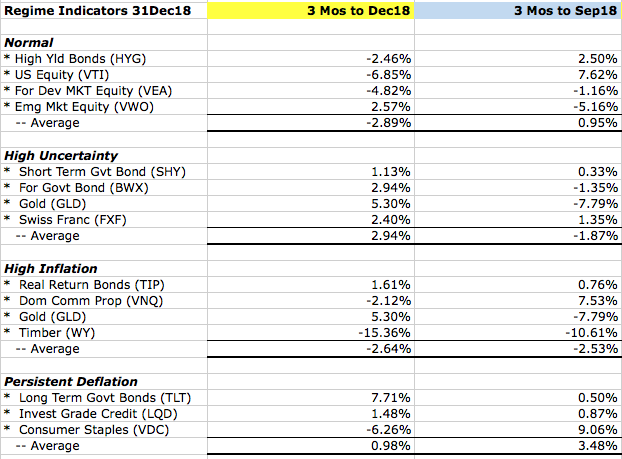
Our quantitative methodology focuses on the level and change in three-month returns, over the most recent and previous three-month periods, for those asset classes which should perform best under different regimes.
As you can see in the following table, at the end of December 2018, this analysis indicates that, over the next 12 months, the balance expectations favored continuation of the High Uncertainty Regime with the next strongest support being a transition to the Persistent Deflation Regime.
Like Professors Andrew Lo, Doyne Farmer and others, we regard financial markets as a complex adaptive system (CAS), that exist as part of a larger macro system comprised of other CAS between which there are multiple feedback loops. These other systems include those that produce technology innovations, and economic, environmental, national security (including cyber), social, demographic, and political outcomes.
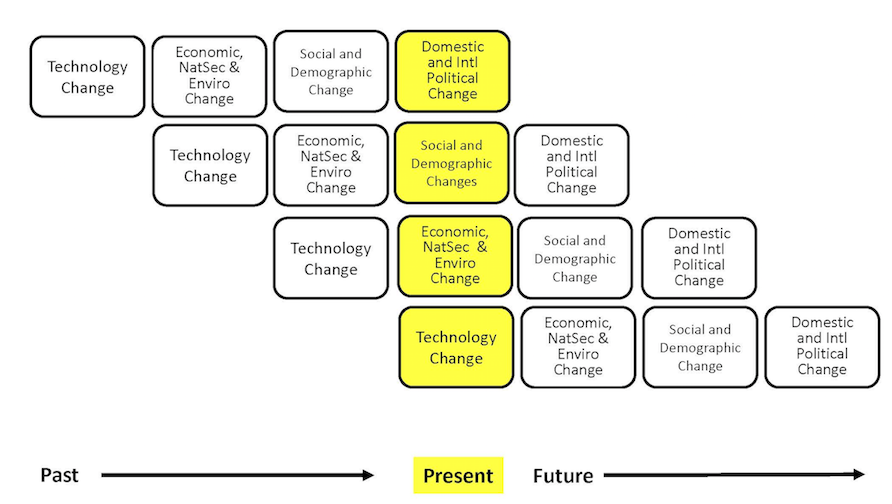
We also find that these systems tend to operate and generate effects in a rough chronological sequence, albeit with many feedback loops between them. The following chart highlights that the changes we observe in different areas at any point in time are actually part of a much more complex evolutionary process.
While most media coverage of these systems focused on flows (e.g., the size of the government deficit), rapid non-linear change in complex adaptive systems is often caused by a key stock (e.g., the amount of outstanding government debt) exceeding a critical threshold.
The next table highlights the key macro system stocks that we monitor.
In the next section, we will discuss information received over the past month that is related to these stocks, and which we believe is significant to our assessment of the probabilities that a critical threshold will be reached and a regime change will occur. We will conclude with our estimate, at the end of this month, of how close the macro system is to these critical thresholds, and the implications for financial market regime change probabilities.
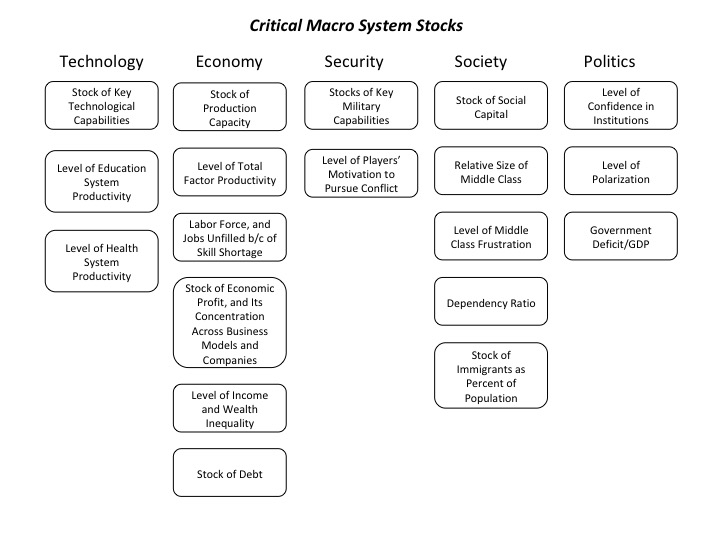
In our methodology, new information is valuable insofar as it provides an updated indicator of how close we are to a critical threshold, or it is surprising and causes us to question the structure of our overall system model (e.g., the existence of another critical threshold we should monitor, or the range of possible outcomes for a key uncertainty).
| Dec18: New Technology Information: Indicators and Surprises | Why Is This Information Valuable? |
| “Profiling for IQ Opens Up New Uber-Parenting Possibilities”, Financial Times, 22Nov18 | SURPRISE “A US start-up, Genomic Prediction, claims it can genetically profile embryos to predict IQ, as well as height and disease risk. Since fertility treatment often produces multiple viable embryos, only one or two of which can be implanted, prospective parents could pick those with the “best” genes.” The FT notes the implications of this technology development: “We are sliding into Gattaca territory, in which successive generations are selected not only for health but also for beauty, intellect, stature and other aptitudes. Parents may even think it their moral duty to choose the “best” possible baby, not just for themselves but to serve the national interest. Carl Shulman and Nick Bostrom, from the Future of Humanity Institute at Oxford university, predicted in 2013 that some nations may pursue the idea of a perfectible population to gain economic advantage. China, incidentally, has long been reading the genomes of its cleverest students.” If this technology is scaled up, the economic, national security, social, and political implications will be both profound and highly disruptive. |
| “Natural Language Understanding Poised to Transform How We Work”, Financial Times, 3Dec19 | The FT notes, “If language understanding can be automated in a wide range of contexts, it is likely to have a profound effect on many professional jobs. Communication using written words plays a central part in many people’s working lives. But it will become a less exclusively human task if machines learn how to extract meaning from text and churn out reports.” Up to now, an obstacle “in training neural networks to do the type of work analysts face — distilling information from several sources — is the scarcity of appropriate data to train the systems. It would require public data sets that include both source documents and a final synthesis, giving a complete picture that the system could learn from. [However], despite challenges such as these, recent leaps in natural language understanding (NLU) have made these systems more effective and brought the technology to a point where it is starting to find its way into many more business applications.” The article focuses on technology from Primer (www.primer.ai), a new AI start-up, that has developed more capable natural language understanding technology that is now in use by intelligence agencies. |
| “Why Companies that Wait to Adopt AI May Never Catch Up”, Harvard Business Review, by Mahidhar and Davenport, 3Dec18 | SURPRISE If the authors’ hypothesis is correct, then AI will lead to the intensification of “winner take all” markets, with more companies and business models struggling to earn economic profits. Research has shown that this will also lead to worsening income inequality between employees at the winning companies and everyone else. |
| “Your Smartphone’s AI Algorithms Could Tell if You are Depressed”, MIT Technology Review, 3Dec18 | Reports on a Stanford study (“Measuring Depression Symptom Severity from Spoken Langage and 3D Facial Expresisons” by Haque et al) that used “a combination of facial expressions, voice tone, and use of specific words was used to diagnose depression”, with 80% accuracy. This could well turn out to be a two edged sword, with clear benefits for early diagnosis and treatment of mental illness, but equally important concerns about privacy (e.g., its use by employers or insurance companies). |
| The Artificial Intelligence Index 2018 Annual Report | This report provides a range of excellent benchmarks for measuring the rate of improvement for various AI technologies, and their adoption across industries. Key findings include substantial shortening of training times (e.g., for visual recognition tasks), and the increasing rate of improvement for natural language understanding based on the GLUE benchmark. |
| “Learning from the Experts: From Expert Systems to Machine Learned Diagnosis Models” by Ravuri et al | This paper describes how a model that embodies the knowledge of domain experts was used to generate artificial (synthetic) data about a system that was then used to train a deep learning network. This is an interesting approach that bears monitoring, particularly its potential future application to agent based modeling of complex adaptive systems. |
| “How Artificial Intelligence will Reshape the Global Order: The Coming Competition Between Digital Authoritarianism and Liberal Democracy”, by Nicholas Wright | SURPRISE A thought provoking forecast of how developing social control technologies could affect domestic politics and strengthen authoritarian governments. |
| “Data Breaches Could Cause Users to Opt Out of Sharing Personal Data. Then What?” by Douglas Yeung from RAND | “If the public broadly opts out of using tech tools…insufficient or unreliable user data could destabilize the data aggregation business model that powers much of the tech industry. Developers of technologies such as artificial intelligence, as well as businesses built on big data, could not longer count on ever-expanding streams of data. Without this data, machine learning models would be less accurate.” Arguably, with its General Data Protection Regulation (GDPR), the European Union has already moved in this direction. While the author focuses on commercial issues, there are also national security implications if China – where data privacy is not recognized as a legitimate concern – is able to develop superior AI applications because of access to a richer set of training data. |
| “Parents 2018: Going Beyond Good Grades”, a report by Learning Heroes and Edge Research | SURPRISE Improving education, and more broadly the quality of a nation’s human capital, is critical to improving employment, productivity and economic growth and reducing income inequality. But no system, team, or individual can improve (except by random luck) in the absence of accurate feedback. And this new report makes painfully clear that this is too often missing in America’s K-12 education system. The report begins with the observation that, “parents have high aspirations for their children. Eight in 10 parents think it’s important for their child to earn a college degree, with African-American and Hispanic parents more likely to think it’s absolutely essential or very important. Yet if students are not meeting grade-level expectations, parents’ aspirations and students’ goals for themselves are unlikely to be realized. Today, nearly 40% of college students take at least one remedial course; those who do are much more likely to drop out, dashing both their and their parents’ hopes for the future… Over three years, one alarming finding has remained constant: Nearly 9 in 10 parents, regardless of race, income, geography, and education levels, believe their child is achieving at or above grade level. Yet national data indicates only about one-third of students actually perform at that level. In 8th grade mathematics, while 44% of white students scored at the proficient level on the National Assessment of Educational Progress in 2017, only 20% of Hispanic and 13% of African-American students did so. This year, we delved into the drivers of this “disconnect.” We wanted to understand why parents with children in grades 3-8 hold such a rosy picture of their children’s performance and what could be done to move them toward a more complete and accurate view… Report Cards Sit at the Center of the Disconnect: Parents rely heavily on report card grades as their primary source of information and assume good grades mean their child is performing at grade level. Yet two-thirds of teachers say report cards also reflect effort, progress, and participation in class, not just mastery of grade-level content… More than 6 in 10 parents report that their child receives mostly A’s and B’s on their report card, with 84% of parents assuming this indicates their child is doing the work expected of them at their current grade… Yet a recent study by TNTP found that while nearly two-thirds of students across five school systems earned A’s and B’s, far fewer met grade-level expectations on state tests. On the whole, students who were earning B’s in math and English language arts had less than a 35% chance of having met the grade-level bar on state exams.” |
| New Economic Information: Indicators and Surprises | Why Is This Information Valuable? |
| “The Late Cycle Lament: The Dual Economy, Minsky Moments, and Other Concerns”, by James Montier of GMO | For many years, I have long regarded James Montier as one of the world’s most insightful macro analysts. Hence, I take what he has written in his latest note with more than a grain of salt. I strongly agree with his opening observation: “Overoptimism and overconfidence are two well-known psychological traits of our species. They are particularly dangerous in the late stages of an economic cycle where these terrible twins result in investors overestimating return and underestimating risk – a potentially lethal combination of errors.” I also strongly endorse his conclusions, which agree with our own view: “The corporate bid is really a massive debt for equity swap, with firms issuing massive amounts of corporate bonds (very low quality debt at that), and effectively leveraging themselves up. This creates a systemic vulnerability, and is potentially a Minsky Moment in the making. The listed sector has been at the vanguard (or perhaps better described as the forlorn hope) of this movement… “All of this occurs against a backdrop of an extremely expensive U.S. equity market, which is increasingly looking like Wile. E. Coyote – the hapless adversary of Roadrunner – having run off the edge of a cliff only to realise the ground is no longer below his feet. Tragically, it seems valuation is doomed to suffer Cassandra’s curse at a time when telling the truth is never believed.” |
| “Risk is Building in the Housing Market” by Fisher and Pinto from AEI | “If the economy were to experience a downturn or worse in the next few years, home prices, which have boomed over the last six years, will surely realize a price correction and foreclosure rates will increase dramatically. This will be a surprise to many who say that this time is different and that a lack of supply will sustain prices. However, house prices adjusted for inflation are growing almost exactly as fast six years into the current price boom as over the same period in the last boom. Real prices are currently increasing around 4.2% per year through the middle of 2018 compared to 4.3% annually through the third quarter of 2003. That equates to about a 27% cumulative run up in real prices over six years.” The reason this is concerning is that, in nominal terms, recent house price appreciation is far outstripping wage gains for most Americans. When house prices run way above longer run trends in wages, the gap between wage growth and house price growth constitutes territory ripe for a price correction. That gap does not exist in every major metropolitan area, but it exists in most.” |
| “The Housing Boom is Already Gigantic. How Long Can It Last?” by Robert Shiller | “We are, once again, experiencing one of the greatest housing booms in United States history. How long this will last and where it is heading next are impossible to know now. But it is time to take notice: My data shows that this is the United States’ third biggest housing boom in the modern era… It can’t go on forever, of course. But when it will end isn’t knowable. The data can’t tell us when prices will level off, or whether they will plunge catastrophically. All we do know is that prices have been roaring higher at a speed rarely seen in American history.” |
| “Demography, unemployment, and automation: Challenges in creating decent jobs until 2030” by David Bloom, Mathew McKenna, Klaus Prettner | SURPRISE The conclusion of this analysis suggests that pressures on developed nations from increased economic migration will increase in the years ahead (and that is before taking climate change-induced increases in migration into account). “Based on growth in the working age population, labour force participation rates, and unemployment, about three quarters of a billion jobs will need to be created in 2010–2030. The challenges of technological progress as represented by automation further raise the number of jobs required." "A large proportion of the jobs that are needed will have to be created in low to low-middle income countries, which often lack a strong tradition of decent work, compounding the job creation challenge… sub-Saharan Africa faces an especially daunting task in creating jobs due to its still growing population, as does South Asia. In fact, these two regions represent about half of the global job creation needs.” |
| “Testing the Resilience of Europe’s Inclusive Growth Model”, by Bughin et al from the McKinsey Global Institute | SURPRISE “Although inequality across Europe has grown only moderately since the early 2000s, social divergence between and within some European countries has increased. Citizens’ trust of national and European Union (EU) institutions has fallen. Six global megatrends [ageing demographics; digital technology, automation, and artificial intelligence (AI); increased global competition; migration; climate change and pollution; and shifting geopolitics.] could widen income inequality and social divergence further to 2030, putting Europe’s inclusive growth model under even more strain… In a simulated “denial” scenario, in which the EU and European countries do not respond to the megatrends (and roll back current policies), a social contract centred on inclusive growth would seem elusive, as Europe would face prolonged economic stagnation, rising inequality, and growth in welfare costs outstripping gross income growth…. One of the EU’s most pressing challenges—even in the [optimistic] scenario—could be rising inequality. Particularly digitisation and AI, but also global competition, could amplify skills premiums and put pressure on wages of routine jobs, superstar effects among firms and cities could continue, and both ageing and migration could further increase the wedge between top and bottom-income households. What’s more, consensus forecasts project that Europe’s South is likely to diverge from, rather than reconverge with, Europe’s North, and a shift in global competition to digital may create yet more headwinds in Europe’s economically weaker geographies, threatening EU cohesion… The EU is likely to be able to preserve the essence of its social contract only by delivering effective policies in response to the megatrends to restore social convergence in the EU, and by adjusting the parameters of its social contract.” |
| “Economic Piety is a Crisis for Workers” by Oren Cass | Writing in the Atlantic Monthly (a left of center publication), Cass (from the right of center Manhattan Institute) proposes that government should focus on production and labor market health rather than consumption and GDP growth for its own sake. This is a particularly well-written and cogent policy prescription that presents a cogent alternative to the current status quo |
| “Wiping the Slate Clean: Is it Time to Consider Debt Forgiveness?” by Gillian Tett in the Financial Times, 12Dec18 | “As a veteran of the LDC debt crisis, Tett’s article hit very close to home for me. Ostensibly, it is a review of Michael Hudson’s excellent new book on debt forgiveness throughout history: “…And Forgive Them Their Debts: Lending, Foreclosure, and Redemption from Bronze Age Finance to the Jubilee Year.” However, Tett uses the review to raise what I believe to be a central issue confronting us today. Tett notes that, “Mesopotamian scribes knew that debt tends to grow much faster than the economy as a whole, creating inequality and social tensions.” She goes on to note how debt jubilees (forgiveness) “created a safety valve whenever debt exploded to a point that inequality was creating crushing tensions and harming productivity.” Tett then notes that “if you look at the economic history of the past century, it is a story of ever-expanding global debt: so much so that as a proportion of GDP, debt now stands at a record high of 217 percent, up from 117 percent in 2008.” As I have seen over and over again in my career as a banker and turnaround specialist, there are only four ways to deal with excessive debt: (1) shrinking spending in other areas to pay it off – i.e., severe austerity; (2) growing your way out of it; (3) default – e.g., via bankruptcy, maturity extension, or outright; or outright forgiveness, or (4) converting it into another asset – e.g., cash via the seizure and sale of collateral, or equity in the debtor company. We have seen that mass austerity is politically infeasible, and growing your way out of it is extremely challenging (when the obstacles to faster growth are large and durable). That leaves default and conversion as, to some extent, unavoidable options. Tett concludes with this observation: “Is rising debt destined to be a permanent feature of our 21st-century economy? Or will that debt eventually spark hyperinflation, selective defaults — or a social explosion in some countries? Is there, in other words, any way for nations to create 21st-century safety valves to cope with the fact that most countries are unlikely to “grow” their way out of debt? The answer is unclear.” But as we look at the future, the answer remains central. |
| “Time Scales and Economic Cycles”, by Bernard, et al, and “Measuring Financial Cycle Time” by Filardo, et al | SURPRISE These papers provide an excellent overview of different economic and financial cycles that occur over longer time frames than the familiar business cycle, as well as the causal processes that underlie them and indicators that can be used to track them. |
| “New Data on Global Debt”, IMF Blog | SURPRISE The IMF has unveiled a major upgrade to its global debt database, which now includes a wider range of instruments and countries, and covers a longer time period. In their blog post, the IMF highlights some findings from the new data: “Global debt has reached an all-time high of $184 trillion in nominal terms, the equivalent of 225 percent of GDP in 2017. On average, the world’s debt now exceeds $86,000 in per capita terms, which is more than 2ó times the average income per-capita.” “Of the global total of $184 trillion in debt at the end of 2017, close to two-thirds is nonfinancial private debt and the remainder is public debt.” “The private sector’s debt has tripled since 1950. This makes it the driving force behind global debt.” “As we close the first decade after the global financial crisis, the legacy of excessive debt still looms large.” |
| “The Dire Effects of a Lack of Fiscal and Monetary Coordination” by Bianchi and Melosi | SURPRISE “What happens if the government’s fiscal willingness to stabilize a large stock of debt is waning, while the central bank is adamant about preventing a rise in inflation? The large-scale imbalance brings about inflationary pressures, triggering a vicious spiral of higher inflation, monetary tightening, output contraction, and further debt accumulation. Furthermore, the mere possibility of this institutional conflict represents a drag on the economy.” |
| | |
| New National Security Information: Indicators and Surprises | Why Is This Information Valuable? |
| “Macron's Ghosts Return To Haunt Him” – Spiegel’ commentary on the Giletes Jaunes demonstrations in France | “For Macron, for his credibility and authority, which he has orchestrated publicly like few others before him, it is too much. If he ends up having to backtrack on his policies, it will represent a U-turn and a watershed moment for his presidency -- a point from which he will struggle to recover Rather than playing the role of a Jupiter, he would be an Icarus; a man who wished to fly high, but fell. He would have to govern with clipped wings… Almost everything he wanted to accomplish for his country is at stake. Up to this point, he and his government had abided by the principle that no matter what happens, they would stay the course. His aim was nothing less than the "transformation" of France. Everything was to become new, different. But now it appears things could turn out very differently… Many are now talking about the forgotten France, about the rural areas, largely disconnected from public life, where people eke out a grim marginal existence… When Macron traveled through France during his election campaign, he often spoke of the "feeling of degradation" he witnessed in some places. He wanted to fight against it, he said. But perhaps he should have done more to heed his own advice. When people picture him, they don't exactly conjure up images of him visiting remote villages. "The yellow vests' revolt is also one of the rural areas against Paris, led by French people who, contrary to what is often said about them, do not belong to the middle class. It is the little people, the 'class populaire,' or working class -- those to whom Macron promised social advancement and who voted for him instead of the Socialists in response and helped secure his win. These people feel degraded, even if that is more of a sentiment than reality… If you were to try to sum up the yellow vests, as varied as they may be, one would describe them as pessimists and people who trust nothing, especially not things that take a long time. And democracy takes time. These days, they only rely on themselves -- and, if necessary, on their own capacity for violence. They have also registered that this can be effective given the zig-zagging by a government that appears to be increasingly unstable. It might also be that people in France feel particularly neglected because inequalities seem even crueler in a country that constantly invokes the noble virtue of equality… "Macron, of all people, is becoming the target of an anger that has been growing for years, and even decades. He is paying for others' mistakes, which is, on the one hand, unfair, but, on the other, understandable.” |
| “A Macron Failure Would Bode Ill for the EU’s Future”, by Wolfgang Muchau, Financial Times, 29Dec18 | “The new year promises to be one of important decisions for the EU. The biggest of these will probably not be Brexit but the European parliamentary elections in May and the resulting decisions on the future direction of the EU. The polls will determine whether the balance of power will tilt towards EU reformers, assorted populists or a new group of Nordic decelerators of European integration. This coalition is also known under the misnomer of the “ new Hanseatic League” and is led by Mark Rutte, prime minister of the Netherlands. The so-called populists stand no chance of taking control of the European Parliament, but they could end up shifting the balance of power in one direction or another…It is too early to conclude that we are staring at the abyss of yet another failed French presidency — he still has time to recover. But that would require a dramatic presidential reboot… The more immediate issue is whether he can recover in time for the European elections. He might not, and such a failure would probably end any hopes of further European integration for a long time. Without him, there will be nobody else of weight in the European Council to push for it…. If Mr Macron were to fail, the EU would retreat in on itself and become at the mercy of outside forces, China among them. At no point will you hear a loud bang, but you might discern a faint echo of deflating soft power. That said, we Europeans still have a lot going for us. We are liberal and rich, have some of the world’s most beautiful cities, great art and great wine and are vastly over-represented in international institutions. But we are not investing in the future. We are falling behind in innovation and we are getting old. The 2019 elections are about whether the EU can stand on its own in a more hostile world.” |
| “Two Roads for the New French Right” by Mark Lilla, 20Dec18 | SURPRISE “Journalists have had trouble imagining that there might be a third force on the right that is not represented by either the establishment parties or the xenophobic populists… In countries as diverse as France, Poland, Hungary, Austria, Germany, and Italy, efforts are underway to develop a coherent ideology that would mobilize Europeans angry about immigration, economic dislocation, the European Union, and social liberalization, and then use that ideology to govern. Now is the time to start paying attention to the ideas of what seems to be an evolving rightwing Popular Front.” |
| “Divided Kingdom: How Brexit is Remaking the UK’s Constitutional Order” by Amanda Sloat, from Brookings | SURPRISE While the media is filled with stories about the last minute game of three way Brexit chicken being played between UK Prime Minister Theresa May, the EU, and the British Parliament (current estimate: Parliamentary vote in favor of draft UK/EU separation treaty fails, after which many outcomes seem possible at this point), Sloat’s analysis is unique and takes a closer look at how the Brexit experience is affecting domestic politics in the UK, and where this could lead. |
| On 20Dec18, in a widely reported speech to a military conference, “Rear Admiral Lou Yuan has told an audience in Shenzhen that the ongoing disputes over the ownership of the East and South China Seas could be resolved by sinking two US super carriers.” The Hoover Institution (and partners) released a report on China’s broad attempts to influence domestic American institutions and politics (“Chinese Influence & American Interests: Promoting Constructive Vigilance”). “To achieve its global ambitions it is exercising a new form of power—not the hard power of military force, but not the soft power of transparent persuasion either. Rather, this is "sharp power" that seeks to penetrate the institutions of democracies in ways that are often what a former Australian prime minister called "covert, coercive, or corrupting." We need to learn to recognize these forms of influence and strengthen our institutions to resist them.” There were a variety of indicators related to concerns about the sharp slowing of China’s economy, including Apple’s earnings miss due to weakening sales in China, widening problems in China’s non-bank financial system (and losses being incurred by the nation’s middle class), and increasing unemployment (e.g., “China Factory Jobs Dry Up as Trade Tensions Hit Manufacturing”, Financial Times 26Dec18). Trade tensions continued to increase, with the CFO of Huawei being arrested at US request (on charges of evading US sanctions on trade with Iran) during a transit stop at Vancouver airport (e.g., “Chinese Elites Reel From Shock of Huawei Executive’s Arrest”, Financial Times 12Dec18). Finally, in the 17Dec18 Financial Times, Gideon Rachman questioned whether China’s leaders have fully grasped that “there has been a profound bipartisan shift in US thinking” about China, while on 14Dec18 Graham Allison wrote an article in National Affairs titled, “China and Russia: A Strategic Alliance in the Making.” Finally, in his 18Dec18 speech on the 40th anniversary of Deng Xiaoping’s economic reforms, president Xi Jinping aimed squarely at many Chinese’ resentments over past humiliations when he stated that “No one is in a position to dictate to the Chinese people what should or should not be done.” | All of these are further indicators of worsening of China’s domestic economy and its growing conflict with the United States. While we may yet see some sort of face-saving truce in the trade war between the two nations (which will give US President Trump the public relations victory he seeks), it is very unlikely that this will reverse the current trajectory of Chinese-US relations. |
| “Trump Delivers a Victory to Iran” by Gerecht and Dubowitz | SURPRISE “Trump’s decision to withdraw U.S. forces from Syria, concurrently with his intention to drastically reduce the number of American soldiers in Afghanistan and the likely soon-to-be-announced further drawdown of U.S. personnel in Iraq, has made mincemeat of the administration’s efforts to contain Iran. If you add up who wins locally by this decision (the clerical regime in Iran, Russian President Vladimir Putin, the Syrian dictator Bashar al-Assad, Lebanese Hezbollah, Iraqi Shiite radicals, and Turkish President Recep Tayyip Erdoğan) and who loses (Jordan, Israel, the Syrian and Iraqi Kurds and Sunni Arabs, everyone in Lebanon resisting Hezbollah, the vast majority of the Iraqi Shia, the Gulf States), it becomes clear that the interests of the United States have been routed.” |
| “Pattern Analysis of World Conflict Over the Past 600 Years”, by Martelloni et al (See also, “Trends and Fluctuations in the Severity of Interstate Wars” by Aaron Clauset, and “On the Statistical Properties and Tail Risk of Violent Conflict”, by Cirillo and Taleb) | Previously, Clauset has concluded that, “historical patterns of war seem to imply that the long peace may be substantially more fragile than proponents believe, despite efforts to identify the mechanisms that reduce the likelihood of interstate wars.” Cirillo and Taleb have also found that claims of a drop in the frequency of wars and severity of casualties are not supported, and that previous studies have very likely underestimated tail risks. As Reinhart and Rogoff concluded in their study of eight centuries of financial crises, “this time isn’t different.” Martelloni’s study adds to this growing body of research. He and his co-authors find that, “he causes of human conflicts remain largely an unresolved subject, especially for the large conflicts that we call “wars.” Historians often tend to see wars arising from specific decisions of human actors, in turn the result of specific economic or political strains pitting nations or social groups against each other. But another possible interpretation is that wars are related to the structure of the human society as a whole.” Based on data covering 600 years of human conflict, they find that “the number of casualties [normalized for human population at the time] tends to follow a power law, with no evidence of periodicity. We also observe that the number of conflicts, again normalized for the human population, show a decreasing trend as a function of time. Our result agree with previous analyses on this subject and tend to support the idea that war is a statistical phenomenon related to self-organized criticality in the network structure of the human society” and the behavior of human beings that produces it.” |
| “2019 Index of US Military Strength” by the Heritage Foundation | This new analysis, like similar ones by other organizations (e.g., RAND) documents in detail the decline of relative US hard power versus key military contingencies. |
| “The Eroding Balance of Terror: The Decline of Deterrence” by Andrew Krepinevich in Foreign Affairs | SURPRISE “Deterring aggression has become increasingly difficult, and it stands to become more difficult still, as a result of developments both technological and geopolitical. The era of unprecedented U.S. military dominance that followed the Cold War has ended, leading to renewed competition between the United States and two great revisionist powers, China and Russia. Military competition is expanding to several new domains, from space and cyberspace to the seabed, and new capabilities are making it harder to accurately gauge the military balance of power. Meanwhile, advances in cognitive science are challenging the theoretical underpinnings of deterrence by upending our understanding of how humans behave in high-risk situations— such as when facing the possibility of war. Taken together, these developments lead to an inescapable—and disturbing—conclusion: the greatest strategic challenge of the current era is neither the return of great-power rivalries nor the spread of advanced weaponry. It is the decline of deterrence.” |
| “How a World Order Ends” by Richard Haas in Foreign Affairs | Haas uses historical analogies to explain the deterioration of the current world order, and where it might lead. “A stable world order is a rare thing. When one does arise, it tends to come after a great convulsion that creates both the conditions and the desire for something new. It requires a stable distribution of power and broad acceptance of the rules that govern the conduct of international relations. It also needs skillful statecraft, since an order is made, not born. And no matter how ripe the starting conditions or strong the initial desire, maintaining it demands creative diplomacy, functioning institutions, and effective action to adjust it when circumstances change and buttress it when challenges come. Eventually, inevitably, even the best-managed order comes to an end. The balance of power underpinning it becomes imbalanced. The institutions supporting it fail to adapt to new conditions. Some countries fall, and others rise, the result of changing capacities, faltering wills, and growing ambitions. Those responsible for upholding the order make mistakes both in what they choose to do and in what they choose not to do. But if the end of every order is inevitable, the timing and the manner of its ending are not. Nor is what comes in its wake.” |
| “Understanding the Emerging Era of International Competition” by Mazarr et al from RAND | SURPRISE Mazaar and his colleagues in some ways take up with Haas’ article leaves off. This excellent new report from RAND provides a useful framework for better understanding the evolving world of weaker rules and intensified interstate (and inter-bloc) competition. |
| | |
| New Social Information: Indicators and Surprises | Why Is This Information Valuable? |
| Three recent papers highlight the important changes underway in the United States’ population dynamics. | In “US population growth hits 80-year low, capping off a year of demographic stagnation”, William Frey from Brookings notes that falling fertility and rising death rates as the population ages have sharply reduced population growth. He also notes how rates of geographic mobility are at record low levels. Both of these trends reduce economic growth potential. In “Declining Fertility in America”, Lyman Stone from the American Enterprise Institute begins by highlighting research that shows Americans want more children than they are actually having. Stone then identifies and analyzes the obstacles to higher fertility rates, including heavy student debt burdens, rising housing costs, expensive childcare costs. He concludes that, “Young families today face a sufficiently wide range of challenges to childbearing, and policy responses are likely to be sufficiently anemic, that a major recovery in fertility seems unlikely. Rather, fertility will likely remain below the historic average until the next recession, when it will plummet even lower.” Finally, in “Economic Uncertainty and Fertility Cycles”, Chabe-Ferret and Gobbi “find that economic uncertainty has a large and robust negative effect on fertility.” |
| Stagnant population growth, aging, and declining fertility, naturally lead to discussion of immigration as an obvious solution to the demographic drag on economic growth (the other one being the path Japan has pursued, higher productivity growth). | According to the Pew and Ipsos MORI survey data cited in Remi Adekoya’s article “Anxiety About Immigration is a Global Issue”, it is not just developed western nations that are struggling with this issue (which will only get worse if climate change and/or economic and political crises boost the number of migrants in the years ahead). Yet to varying degrees, concerns about immigration may be based on beliefs that are both widespread and mistaken. An excellent example of this is found in Janan Ganesh’s column on “America’s Future is Asian, Not Hispanic” (Financial Times, 19Dec18), who notes, “You would not guess from the present acrimony that more people have immigrated to the US from Asia than from Latin America in every year since 2010.” |
| “Inequality And Visibility Of Wealth In Experimental Social Networks”, by Nishi et al | SURPRISE In essence, the authors of this important paper have used advanced network analysis and simulation methods to find that Thorsten Veblen’s warnings about the dangers of inequality combined with conspicuous consumption were right on target. They conclude that making wealth inequality visible reduces social connectivity and cooperation between people with differing levels of wealth. At the aggregate level, this reduces the society’s overall level of wealth. Supporters of progressive consumption taxes will be embolden by this research. |
| Three interesting new articles all focus on the decline of religion in America, and the different paths people are taking in the search for sources of transcendent meaning. | In “America’s New Religions”, Andrew Sullivan asks what happens when religion is removed as a source of ultimate meaning, and concludes that too many people are turning to illiberal politics to fill the resulting void. He notes that, “We have the cult of Trump on the right, a demigod who, among his worshippers, can do no wrong…and we have the cult of social justice on the left, a religion whose followers show the same zeal as any born-again Evangelical. They are filling the void that Christianity once owned, without any of the wisdom and culture and restraint that Christianity once provided.” In “From Astrology to Cult Politics—the Many Ways We Try (and Fail) to Replace Religion”, Clay Routledge begins by noting that, “the degree to which humans perceive their lives as meaningful correlates reliably with observable measures of psychological and physical health. A sense of meaning also helps people mobilize toward the pursuit of their goals (persistence), and serves to protect them from the negative effects of stress and trauma (resilience). In short, people who view their lives as full of meaning are more likely to thrive than those who don’t.” While Sullivan sees more people turning to illiberal politics for meaning, Routledge notes that the “decline of traditional religion has been accompanied by a rise in a diverse range of supernatural, paranormal and related beliefs”, including “transhumanism, whose adherents dream of transcending mortality through medicine and bioengineering.” Finally, in their new report “Where Americans Find Meaning in Life”, Pew Research reports that when Americans were asked what provides them with a sense of meaning, 69% said family, 34% said career, 23% money, 20% spirituality and faith, 19% friends, and 19% activities and hobbies. When asked to name the single most important source of meaning in their lives, 40% said family, and 20% said their religious faith. The two next highest replies were “caring for pets” at 6%, and being outdoors, at 5%. |
| Finally, two articles this month were both widely read, and seemed to capture something important about the current state of our society. | In “The West at an Impasse” (New York Times 19Dec18), Ross Douthat claims that, “when meritocracy loses credibility and legitimacy, the result is a political impasse. The official elite becomes too arrogant and self‑deceiving and unpopular to govern effectively, but the populist alternative is… disorganized, ill‑led, susceptible to snake‑oil salesmen and vulnerable to manipulation by factions within the upper class.” He notes that, “different versions of this impasse exist in Britain, France, and the United States.” As he sums it up, we are confronted today with “a governing class that has vaulting self‑confidence and dwindling credibility, locked in stalemate with populist movements that are easily grifted upon and offer more grievances than plans.” One of the most compelling (and painful) portraits of the anxieties and fears confronting middle and upper middle class Americans today is Austin Murphy’s “I Used to Write for Sports Illustrated. Now I Deliver Packages for Amazon” (Atlantic Monthly, 25Dec18). It did not surprise me at all that this was one of the most read articles in the Atlantic, which is a left of center publication. |
| | |
| | |
| | |
| | |
| New Political Information: Indicators and Surprises | Why Is This Information Valuable? |
| The month began with the death and funeral of George H.W. Bush. | As with the funeral of John McCain, only more so, Bush 41’s funeral was a painful reminder for many people of how much the United States has changed. An article in the Atlantic Monthly (“What the Tributes to George H. W. Bush Are Missing,” by Peter Beinart) raised this surprising point: “In the contemporary United States, presidential legitimacy stems from three sources. The first source is democracy. Although America’s system of choosing presidents has many undemocratic features, many Americans associate presidential legitimacy with winning a majority of the vote. The second source is background. Throughout American history, America’s presidents have generally looked a certain way. They’ve been white, male, (mostly) Protestant, and often associated with legitimating institutions such as the military, elite universities, or previous high office. Americans are more likely to question the legitimacy of presidents who deviate from those traditions. The third source is behavioral. Presidents can lose legitimacy if they violate established norms of personal or professional conduct. George H. W. Bush was the last president who could not be impugned on any of these fronts. He was elected with a clear majority of the popular vote. He was racially and culturally familiar: A WASP man who had served in World War II, attended Yale, and held a variety of top government jobs. And he behaved the way Americans expect their presidents to behave. Since then, every president has faced some sort of crisis of legitimacy.” |
| December also saw the resignations of Marine Corps Generals John Kelly and James Mattis from the Trump administration, and the latter’s resignation letter, following Trump’s impulsive decision to withdraw American troops from Syria. | SURPRISE As The Economist noted, Mattis is the first American Secretary of Defense who has ever resigned in an act of protest. More so than any other administration departure, the loss of Mattis will almost certainly be a source of grave concern for many of the president’s Republican supporters. If Special Prosecutor Robert Mueller’s report eventually provides evidence of collusion with Russia, the Mattis resignation could be the straw that convinces enough Republican Senators to convict if the Democrat controlled House of Representatives passes a bill of impeachment (a 2/3 vote is needed to convict). |
| The US Senate Intelligence Committee released two reports by independent organizations “detailing the tactics used by Russia’s Internet Research Agency (IRA) in their attempts to influence US political discourse.” (The Tactics and Tropes of the Internet Research Agency and The IRA and Political Polarization in the United States, 2015-2017). | These reports provide very detailed information about the extent to which social media (and social network analysis methods) have made large populations and elections more vulnerable to manipulation. They have also created a base of evidence for impeaching Donald Trump if Robert Mueller’s report connects his campaign to these Russian initiatives. |
| “The Divide Between Silicon Valley and Washington is a National Security Threat” by Zegard and Childs in the Atlantic Monthly | “A silent divide is weakening America’s national security, and it has nothing to do with President Donald Trump or party polarization. It’s the growing gulf between the tech community in Silicon Valley and the policymaking community in Washington. Beyond all the acrimonious headlines, Democrats and Republicans share a growing alarm over the return of great-power conflict. China and Russia are challenging American interests, alliances, and values—through territorial aggression; strong-arm tactics and unfair practices in global trade; cyber theft and information warfare; and massive military buildups in new weapons systems … In Washington, alarm bells are ringing. Here in Silicon Valley, not so much… In the past year, Google executives, citing ethical concerns, have canceled an artificial-intelligence project with the Pentagon and refused to even bid on the Defense Department’s Project JEDI, a desperately needed $10 billion IT improvement program. While stiff-arming Washington, Google has been embracing Beijing, helping the Chinese government develop a more effective censored search engine despite outcries from human-rights groups, American politicians, and, more recently, its own employees.” |
| “The Center Can Hold: Public Policy for an Age of Extremes” by Lindsey et al. | A thoughtful analysis that attempts to chart a course between the two extremes that now seem to dominate American politics, even if they don’t reflect what polls say are the views of the majority of voters. |
| Newly elected US Senator Mitt Romney wrote an OpEd in the Washington Post newspaper that was highly critical of Donald Trump. Meanwhile, former South Carolina governor and UN Ambassador Nikki Haley has rapidly gained a large twitter following. | SURPRISE Either or both of these center/right politicians could challenge Donald Trump in a 2020 Republican primary election, and make painfully clear the party’s widening divisions. |
| The election of Alexandria Ocasio-Cortez (AOC) and other progressives to the US House of Representatives, as well as progressive US Senator Elizabeth Warren’s declaration of her presidential candidacy signal that the long simmering battle between traditional and progressive Democrats is finally coming out into the open. | SURPRISE This has already led to the introduction of and support for policy initiatives (like single payer healthcare and much higher top marginal tax rates) that in the past either would not have been introduced or which would have been immediately dismissed. That is clearly no longer the case. |
| “Understanding the Customer Experience with Government”, by D’Emidio and Wagner from McKinsey & Company | An often heard observation is that these days governments seem to be filled with more people who studied public policy, and fewer who studied public administration – how to implement those policies and deliver results. Moreover, as business has become much better at understanding customer needs and wants and efficiently delivering value propositions that satisfy them, the public’s perception of government’s performance has inevitably declined (with some notable exceptions like the military), which has no doubt further increased public frustration and anger. This new McKinsey report will do little to dispel that view. As it succinctly states, “Understanding precisely what matters to the customers you serve is essential to improving their experience. Yet McKinsey research has found that most agencies don’t.” |
| Financial Markets and Investor Behavior: Indicators and Surprises | Why Is This Information Valuable? |
| “Perspectives on Today’s ‘Unconventional’ Portfolio Positions”. In this note to investors, GMO offered such a clear and succinct statement of its investment philosophy that it bears sharing here (it is also a view with which we strongly agree). | “Investing success comes from identifying a coherent and grounded investment philosophy, building a repeatable investment process and adhering to both of them. We seek to be long-term, long-horizon investors. Most capital that is invested institutionally is for long-term needs, yet unfortunately often acts with a short-term viewpoint. GMO’s objective is to buy assets that trade below their intrinsic value and let the force of mean reversion work on our behalf.
|
| “Finance’s Lengthening Shadow”, by Nicole Gelinas in City Journal. | Gelinas offers a clear warning that nonbank (or “market-based”) lending is likely to play a significant role in our next financial crisis. This warning has recently become more acute, as investors have begun to flee riskier corporate debt markets. “Banks remain hugely important, of course, but the potential for a sudden, 2008-like seizure in global credit markets increasingly lies beyond traditional banking…the financial system isn’t just banks. Over the last ten years, a plethora of “nonbank” lenders, or “shadow banks”—ranging from publicly traded investment funds that purchase debt to private equity firms loaning to companies for mergers or expansions—have expanded their presence in the financial system, and thus in the U.S. and global economies. Banks may have tighter lending standards today, but many of these other entities loosened them up. One consequence: despite a supposed crackdown on risky finance, American and global debt has climbed to an all time high… “The ultimate cause of the [2008] crisis, however, wasn’t complex at all: a massive increase in debt, with too little capital behind it…” As examples of market based lending vehicles that could present future systemic risks, Gelinas points to ETFs that invest in relatively illiquid bonds and bank loans, as well as private credit funds. |
| “Passive Attack: The Story of a Wall Street Revolution”, by Robin Wigglesworth in the 19Dec18 Financial Times | This is one of the best short histories of index investing — from how it began to what it has become — that I’ve read in 20+ years of being involved with this industry. Well worth a read. |
| “20 for Twenty: Selected Papers from AQR Capital Management on Its 20th Anniversary” | At 632 pages, this is much longer than Wigglesworth’s short history of indexing, but equally rewarding, with 20 thought provoking (but often technical) articles for investors. |
| “Intelligence and You: A Guide for Policymakers”, by Brian Katz | As we have frequently noted over the years, there are far more similarities between investment management and intelligence analysis than both sides realize. With that in mind, Brian Katz’ article should be a very thought-provoking read for investment managers, who we are sure will come away more effective for having read it. |
| | |
| | |
| | |
How Close is the Macro System to One or More Critical Thresholds?
As we have noted, the macro drivers of financial market regime changes typically follow a rough chronological sequence, from technology to economic, security, social, and political causes and effects. Yet there are many feedbacks loops between them, creating complex root causes for many of the critical thresholds we have identified.
Understanding the time dynamics in this complex system is critical to avoiding substantial downside investment risk.
We use the UK Met Office Warning Model to communicate our assessment of these time dynamics. We estimate the time remaining before a critical macro system threshold is reached that could trigger a regime change, which is usually accompanied by substantial changes in asset class valuations.
The model uses three increasingly serious levels of warning, from “Be Aware” (condition yellow), to “Be Prepared” (condition orange), to “Take Action” (condition red).
For our purposes, we denote as “Be Aware” (yellow) critical thresholds that we assess to be three or more years away. We estimate that “Be Prepared” (orange) thresholds could be reached within 1 to 3 years. “Take Action” thresholds are very likely to be reached within one year.
Given their nature, we also note that in our three “wildcard” areas (Environment and Energy related; Disease and Human Caused Bioevents; and Cyber and Electromagnetic Events), our forecasts have higher levels of uncertainty.
The following charts summarize our current estimate of the time remaining before different critical thresholds will be reached.
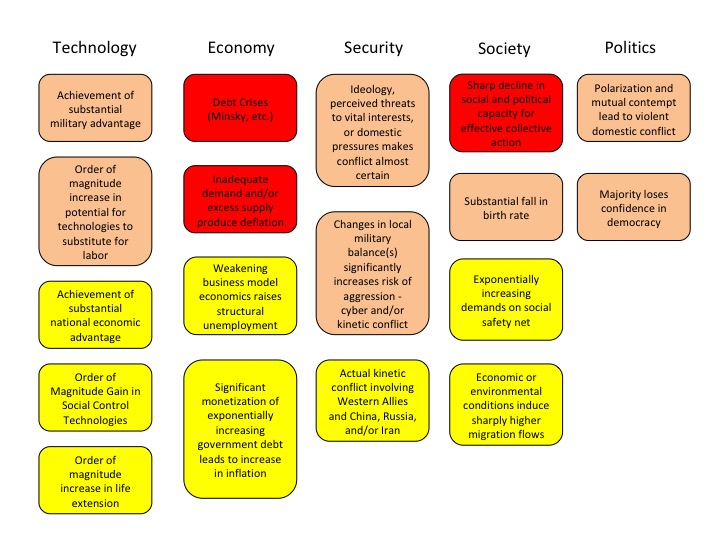
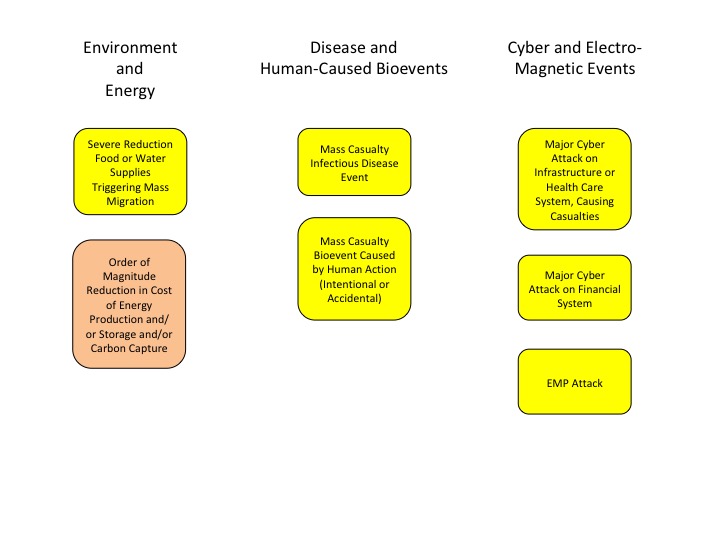
At the highest level, we believe the global macro system can be in one of four states, based on its degree of order versus disorder, and degree of social cooperation versus conflict. We believe that the system is currently in its most uncertain state, characterized by high degrees of underlying disorder and social conflict.
Our current forecast question is this: what is the probability we will either remain in the High Uncertainty Regime or transition to another regime over the next twelve months?
We currently estimate there is a 40% chance of remaining in the High Uncertainty Regime over the next 12 months, which will see the commencement of what promises to be a tumultuous US presidential campaign, and perhaps resolution of the Brexit saga (or at least the “end of the beginning”, and possibly the “beginning of the end”).
We also conclude that over the next 12 months, the probability of returning to the Normal Regime is slight, at 5%, as is the probability of entering the High Inflation regime over the next 12 months, at only 5%.
We estimate that the probability of entering the Persistent Deflation Regime over the next 12 months is now 50%. With the waning in the US of the stimulative effect of the Trump tax cuts, increasing uncertainty will have a more strongly negative impact on aggregate demand. This will be magnified by the substantial amount of debt that has been taken on by many companies, which more of them will likely struggle to service, which in turn will put more pressure on their cost structures, and potentially lead to increased unemployment, which will accelerate the downward spiral.
While we expect the High Uncertainty Regime will produce declines of 20% or more in equity asset classes, it is unlikely that any other asset class will experience a gain of 20% or more. We estimate there is a roughly even chance that gold could be the exception, with that increase heavily tied to continued global confidence in the US government and economy. While the apparent inflation and political uncertainty premia in the gold price today are high relative to the last 25 years, they are still below the peak reached in 2012, and it is possible that herding in the face of increasing uncertainty could produce 20% price gains.
Pre-Mortem Analysis
One of the most important forecasting disciplines is to ask yourself why your forecast could be wrong. Dr. Gary Klein’s research has shown that a very powerful and insightful way to do this is via a “pre-mortem analysis.” This method asks you to assume that it is a point in the future, and your forecast has been proven wrong (or your strategy or company has failed). You are then asked to look backward from this imagined point in the future, to explain why you failed, what you missed, and what you could have done differently to avoid your fate.
The pre-mortem method takes advantage of the fact that humans reason much more concretely and in more detail when explaining the past than they do when trying to forecast the future.
So let us assume that it is one year from now, and the high uncertainty regime has given way to a return to the Normal Regime, rather than to the Persistent Deflation regime.
How did this happen? What didn’t we anticipate happening?
(1) In previous issues, we have conjectured that perhaps because of an intensifying domestic debt crisis (and its own fear of Japanese-style deflation), or a belief that it had not yet achieved sufficient advantages to pursue more intense conflict with the United States, China could reach a new trade agreement with the US and EU to support continued economic growth. This would reverse (at least in the short-term) the growing tension in the US/China relationship, providing a strong confidence boost to the world economy and financial markets. In light of the twin deterioration of the Chinese economy and president Trump’s apparent political support in December, the probability that a temporary truce in the building trade war has risen. However, we do not believe this will reverse the fundamental transition that has taken place in US-China relations, from wary cooperation to increasing conflict. Hence we conclude that it is unlikely that a new US-China trade agreement would result in a sustained return to the Normal Regime.
(2) However we have not dismissed Donald Trump’s replacement by Mike Pence as a viable pre-mortem scenario that could cause our forecasts to be wrong. That said, upending our forecast would still require a Pence administration to make significant progress on a number of critical policy (and staffing fronts, such as the return of James Mattis to the role of Secretary of Defense) fronts, including relations with China, the productivity of the US healthcare and education systems, increasing real median household income, and reducing inequality.
Note: Combining this Forecast with Others and Extremizing the Result Should Increase Predictive Accuracy
Research has found that three steps can improve forecast accuracy. The first is seeking forecasts based on different forecasting methodologies, or prepared by forecasters with significantly different backgrounds (as a proxy for different mental models and information). The second is combining those forecasts (using a simple average if few are included, or the median if many are). The final step, which significantly improved the performance of the Good Judgment Project team in the IARPA forecasting tournament, is to “extremize” the average (mean) or median forecast by moving it closer to 0% or 100%.
Forecasts for binary events (e.g., the probability an event will or will not happen within a given time frame) are most useful to decision makers when they are closer to 0% or 100% than the uninformative “coin toss” 50%. As described by Baron et al in “Two Reasons to Make Aggregated Probability Forecasts More Extreme”, forecasters will often shrink their probability estimates towards 50% to take into account their subjective belief about the extent of potentially useful information that they are missing.
When you average multiple forecasters’ estimates, you are including more information, which should increase forecast confidence and push the mean estimate closer to 0% or 100%. However, this doesn’t happen when you use simple averaging. For this reason, forecast accuracy is increased when you employ a structured “extremizing” technique to move the mean estimate closer to 0% or 100%.
You can download an extremizing model from our website to use when combining the forecasts you use in your decision process. The extremizing factors in our model are those that the Good Judgment Project found maximized the accuracy of combined forecasts. Note that the extremizing factor is lower when average forecaster expertise is higher. This is based on the assumption that a group of expert forecasters will incorporate more of the full amount of potentially useful information than will novice forecasters.
Feature Article: Understanding the Critical Difference Between Macro Threats and Threat Signatures
In our work at Britten Coyne Partners, we focus on helping clients anticipate, accurately assess, and adapt in time to emerging threats that could become existential – i.e., they could put the survival of the organization at risk.
We think of these threats as existing in three increasingly challenging realms, which you can visualize as three concentric circles. The innermost is the realm of risk, where the nature of a threat is well understood, including its range of possible outcomes and affects, and the probability of their occurrence. Because they can be assessed using traditional frequentist statistics, these threats seem easy to price and hedge, via insurance or derivative contracts. Yet as Long Term Capital Management demonstrated, they can still be existential, for example, because they are poorly modeled or if a hedge counterparty defaults.
A far larger circle encompasses the realm of uncertainty, in which some combination of a threat’s possible outcomes, affects, and probabilities is poorly understood. The challenge posed by uncertainty was famously described by Frank Knight in his 1921 book, “Risk, Uncertainty, and Profit.” Quantitatively, uncertainty is usually assessed using Bayesian statistics, in which probability represents not the historical frequency of a phenomenon’s occurrence, but rather an observer’s subjective belief that it will occur in the future, and the consequences it will have. The basis for such beliefs ranges from intuition, to copying the beliefs of others, to more sophisticated approaches to evaluating and weighing relevant evidence (e.g., Dempster-Shafer or Baconian methods).
The far larger circle, whose true dimensions are unknowable, is the realm of ignorance (both individual and organizational). Chapter 12 of John Maynard Keynes’ 1936 book on “The General Theory of Employment, Interest, and Money” is still one of the best descriptions to how we make decisions in the face of ignorance, and the fragility of the assumptions (“conventions”) that underlie them. As Keynes wrote:
“The state of long-term expectation, upon which our decisions are based, does not solely depend, therefore, on the most probable forecast we can make. It also depends on the confidence with which we make this forecast — on how highly we rate the likelihood of our best forecast turning out quite wrong. If we expect large changes but are very uncertain as to what precise form these changes will take, then our confidence will be weak. The state of confidence, as they term it, is a matter to which practical men always pay the closest and most anxious attention. But economists have not analysed it carefully and have been content, as a rule, to discuss it in general terms…
“The outstanding fact is the extreme precariousness of the basis of knowledge on which our estimates of prospective yield have to be made. Our knowledge of the factors which will govern the yield of an investment some years hence is usually very slight and often negligible. If we speak frankly, we have to admit that our basis of knowledge for estimating the yield ten years hence of a railway, a copper mine, a textile factory, the goodwill of a patent medicine, an Atlantic liner, a building in the City of London amounts to little and sometimes to nothing; or even five years hence. In fact, those who seriously attempt to make any such estimate are often so much in the minority that their behaviour does not govern the market.
“In practice we have tacitly agreed, as a rule, to fall back on what is, in truth, a convention. The essence of this convention — though it does not, of course, work out quite so simply — lies in assuming that the existing state of affairs will continue indefinitely, except in so far as we have specific reasons to expect a change. This does not mean that we really believe that the existing state of affairs will continue indefinitely. We know from extensive experience that this is most unlikely. The actual results of an investment over a long term of years very seldom agree with the initial expectation. Nor can we rationalise our behaviour by arguing that to a man in a state of ignorance errors in either direction are equally probable, so that there remains a mean actuarial expectation based on equi-probabilities. For it can easily be shown that the assumption of arithmetically equal probabilities based on a state of ignorance leads to absurdities. We are assuming, in effect, that the existing market valuation, however arrived at, is uniquely correct in relation to our existing knowledge of the facts which will influence the yield of the investment, and that it will only change in proportion to changes in this knowledge; though, philosophically speaking it cannot be uniquely correct, since our existing knowledge does not provide a sufficient basis for a calculated mathematical expectation. In point of fact, all sorts of considerations enter into the market valuation which are in no way relevant to the prospective yield…”
“A conventional valuation which is established as the outcome of the mass psychology of a large number of ignorant individuals is liable to change violently as the result of a sudden fluctuation of opinion due to factors which do not really make much difference to the prospective yield; since there will be no strong roots of conviction to hold it steady. In abnormal times in particular, when the hypothesis of an indefinite continuance of the existing state of affairs is less plausible than usual even though there are no express grounds to anticipate a definite change, the market will be subject to waves of optimistic and pessimistic sentiment, which are unreasoning and yet in a sense legitimate where no solid basis exists for a reasonable calculation…”
“Thus the professional investor is forced to concern himself with the anticipation of impending changes, in the news or in the atmosphere, of the kind by which experience shows that the mass psychology of the market is most influenced.”
As Keynes noted, in the face of uncertainty and ignorance, our capacity for anticipation is critical.
Our methodology decomposes anticipation into four challenges, as shown the following matrix:
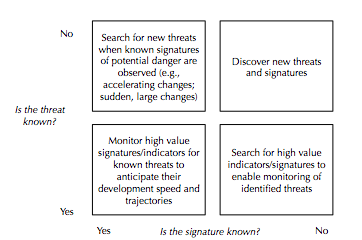
As the terms are used in this matrix, “threats” are distinguished by a clear causal story that links trends and/or events to specific negative consequences (e.g., for an individual, company, or nation). Threats can be further categorized by the time remaining before negative consequences are expected to occur, and the extent of those consequences – e.g., an imminent existential threat.
In contrast, a “signature” is a signal or set of signals that has a high probability of being associated with a threat. Such probabilities can be derived by multiple means, including the study of history, simulation modeling, deduction from axioms and theories, identification of patterns in current intelligence (e.g., the monthly reports in our Evidence File, which are chronologically organized by issue area in the subscribers-only section of our website), and intuition.
In the matrix above, most individuals and organizations likely spend most of their time in the bottom two quadrants – monitoring signals that are associated with known threats, and identifying new signals that can be used for this purpose.
We would argue, however, that when it comes to successful anticipation, activities in the upper half of the matrix are even more important.
For example, the upper right box of the matrix at first seems an impossible task: Where does one begin when trying to simultaneously discover new threats and signatures?
In the intelligence community, a new methodology in this quadrant is known as “Activity Based Intelligence” or ABI. It integrates a huge volume of data from multiple sources and “analyzes the interactions of people, activities, and events, in order to discover relevant patterns, and characterize those patterns” in order to identify new threats and signatures.
Even newer is the Defense Advanced Research Project Agency’s “KAIROS” initiative, which stands for “Knowledge-directed Artificial Intelligence Reasoning Over Schemas.”
A “schema” is an “organized unit of knowledge about an event or series of events”, that is based on past experience. Schemas are the building blocks of more complex mental models.
The goal of KAIROS is to use artificial intelligence to induce schemas from massive sets of unstructured (and often textual) data, and use them “to enable contextual and temporal reasoning about complex real-world events, in order to generate an actionable understanding fo them and predict how they will unfold.”
Lacking the resources of the world’s military and intelligence services, in our consulting work we have found that organizations can more usefully focus their anticipation efforts in the top left quadrant of the matrix, where they seek to recognize common threat signatures, and then use them as the starting point for identifying specific threats that could be associated with them.
Here are some examples:
- Evolution has primed human beings to automatically allocate attention to changes in their environment that are unanticipated (i.e., surprising), large, and/or rapid. We are less sensitive (at least at first) to changes whose rate is accelerating, though these are no less important.
- As individuals, we are also primed to rapidly recognize indications fear in others, and to stick more closely to our group when we receive signals indicating our environment has become more uncertain (which leads to higher levels of conformity and copying the behavior of others).
- In recent years, complex adaptive systems research has provided us with new threat signatures, including the “critical slowing down” (e.g., rising autocorrelation) of some systems before large changes occur. In social systems, both “Conviction Narrative Theory” (see David Tuckett’s work) and “Narrative Economics” (see Robert Shiller’s work) have highlighted the critical role of narrative in group behavior, and how shrinkage in the number of or support for competing narratives (i.e., the emergence of a dominant narrative), is an indicator of increasing fragility and a precursor of non-linear changes. Finally, Benoit Mandelbrot’s research on fractals, as well as Murray Gell Mann‘s and Didier Sornette’s related work have demonstrated that in many systems the size of changes follows a power-law pattern, with a growing number of smaller changes often indicating the buildup of stresses within a system that eventually gives rise to an exponentially larger change.
Complex adaptive systems like financial markets are characterized by multiple links between causes and effects, which are themselves often time-delayed and non-linear. This is why the identification of specific threats – with clear causal pathways and indicators – is so notoriously difficult, and why many narrow forecasts turn out to be inaccurate.
In our forecasting work over the years, we have found it is more productive to pay attention to the signatures that indicate growing stresses within a complex adaptive system, which can eventually produce changes that are sudden, large, and usually very disruptive.
Here are some examples of signatures in the five issue areas we focus on when developing our macro regime forecasts:
Technology
- New functionality
- Improvements in form/convenience
- Large gains in the performance of existing functionality
Economy
- Rapid growth in all forms of debt (e.g., bank, bond, pension, unfunded entitlements, etc.)
- Substantial change in energy prices
- Slowing demographic and/or productivity growth
- Introduction of significantly different business models and architectures that drive large changes in profitability
- Increasing and increasingly visible inequality
- Rapid environmental change
National Security
- Increasing mismatch between goals and resources, with minimal change in strategy (e.g., Paul Kennedy’s “imperial overstretch”).
- Rising challenger powers
- Increasing system disorder and level of conflict
- Rapid changes in weapons capabilities, along with military doctrine and organization, leading to increasing asymmetry between nations
Society
- Worsening educational and health outcomes
- Declining social mobility
- Increasing middle class frustration
- Declining popular legitimacy of traditional elites
- Rising migration pressures
Politics
- Increasing polarization
- Political shifts away from the center, especially of they are extreme and symmetrical
- Weakened institutional capacity to implement policy to produce improving results
- Political gridlock
Individually or in combination, these signatures can be used to trigger and guide the search for more specific threats when one or more of them are observed. And collectively, they can also provide a “coarse grained” warning that dangerous stresses are building up within the macro system.
If you have any questions about anything we have written in this issue, please don’t hesitate to get in touch, at contact@indexinvestor.com