The Index Investor
December 2019
Market Stress Indicators
Macro Regime Forecast
Tactical Asset Allocation Implications of Our Forecasts
Pre-Mortem Analysis
Critical System Thresholds/Tipping Points Analysis
Combining and Extremizing Forecasts to Improve Predictive Accuracy
High Value Information Observed Last Month
Feature Article: What Do We Know About Escaping from the Persistent Deflation Regime?
Appendix: Anticipatory Thinking and Forecasting Methodologies
Asset Class Valuation and Momentum Indicators (@29Nov19)
| Asset Class (ETF) | Valuation | 1 Month Return | Conclusion |
| US Real Return Govt Bond (TIP) | Likely Overvalued* | 0.29% | Increasing Overvaluation |
| US Nom Return Govt Bond (GOVT) | Likely Overvalued* | (0.30)% | Decreasing Overvaluation |
| US Investment Grade Credit (LQD) | Likely Overvalued* | 0.44% | Close to Fairly Valued |
| US High Yield Credit (HYG) | Almost Certainly Overvalued* | 0.57% | Increasing Overvaluation |
| US Commercial Property (VNQ) | Likely Undervalued* | (1.30)% | Increasing Undervaluation |
| US Equity (VTI) | Likely Overvalued* | 3.79% | Increasing Overvaluation |
| Foreign Devel Mkt Equity (VEA) | Very Likely Undervalued* | 1.34% | Decreasing Undervaluation |
| Emerging Markets Equity (VWO) | Very Likely Overvalued* | 0.50% | Increasing Overvaluation |
| Timber (WY) | Almost Certainly Undervalued* | 1.03% | Decreasing Undervaluation |
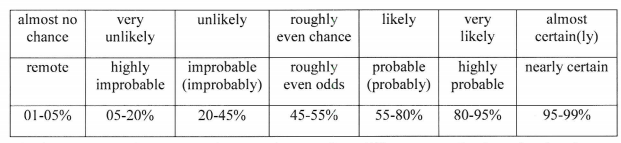
Note: The language we use to describe our estimated likelihood of asset class over or undervaluation is based on US Intelligence Community Directive 203 on Analytic Standards, which includes the following table:
Market Stress Indicators (@29Nov19)
| Market Stress Indicator | This Month vs Last Month |
| Asset Class Returns Autocorrelation (this month versus last month). Higher autocorrelation is an indicator of higher market stress. | .12 vs .65 last month. Indicates a lower evel of market stress compared to last month. |
| Economic Policy Uncertainty Index (how many days over the last 30 was index in top quartile of values since 1985?) | On only 2 days last month was the index in the top quartile of daily values since 1985 (the 19th percentile of all rolling 30-day counts). This is a substantial decrease from last month. |
| AAA Rated Bonds Spread over 10 Year Treasury Yield (month end). Higher spreads indicate rising concern about market liquidity. | 1.17% (46th percentile since 1983), essentially unchanged from last month. This is lower than last month. |
| BB Rated Bonds Spread over 10 Year Treasury Yield (month end). High spreads indicate increasing credit risk. | 2.18% (14th percentile since 1996), essentially unchanged since last month. Extremely low after ten years without a recession. |
| Gold Price per Ounce in US Dollars (month end). Rising gold prices are an indicator of increasing market uncertainty and stress. | $1,456 vs $1,506, down 3.3% from last month. At the end of 2017, we estimated the "disaster premium" in the gold price was 47% (see our methodology in the Appendix). At the end of last month, the estimated premium was 59%. |
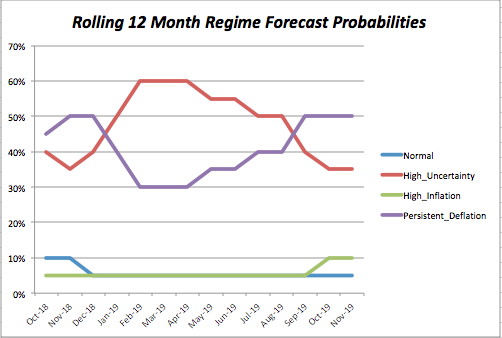
At the end of November, all five quantitative indicators showed a decreased level of market stress. This aligns with the market regime forecast probabilities implied by asset class returns (see next section). Both, however, are very much at odds with our qualitative analysis and regime forecast.
Macro Regime Forecast Probabilities (@29Nov19)
The Current State of Quantitative Regime Predictors
Our quantitative forecast methodology focuses on the level and change in three-month returns, over the most recent and previous three-month periods, for those asset classes, which should perform best under different regimes (in this sense, our regimes can be regarded as macro factors). We assume that relatively higher returns are associated with more widely held investor beliefs in the probability that a given macro regimes will develop in the future.
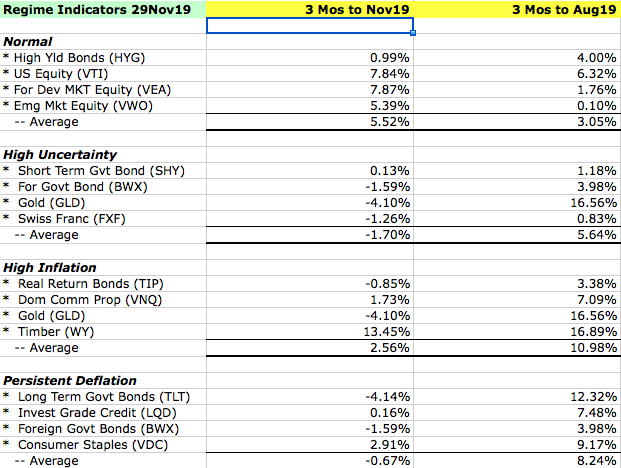
Over the last three months, there has been a relative strengthening in investors’ beliefs that either the normal times regime lies ahead.
Qualitative Considerations
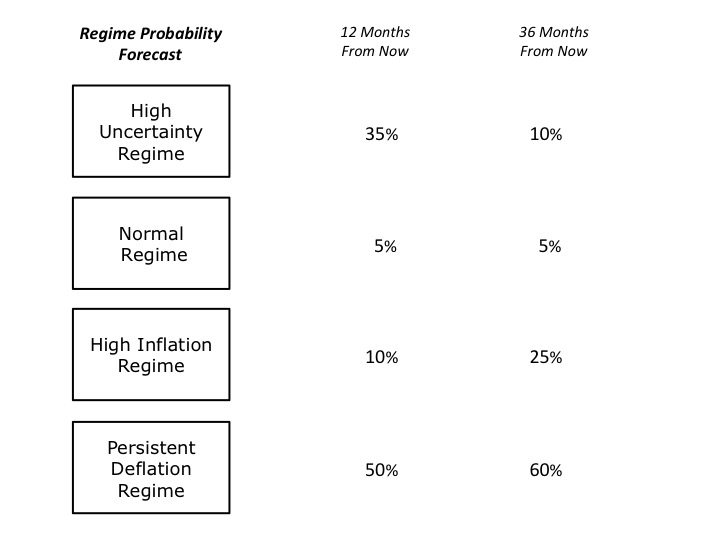
Based on our qualitative analysis of accumulated and new evidence, we are considerably more pessimistic about the future than those investors whose trades have driven the returns on different asset classes. We continue to believe that three years from now the most likely outcome is that the global macro system will be in the persistent deflation regime.
In our forecasting approach, technology and environmental developments tend to precede economic and national security changes, which in turn precede social and political trends and events, whose effects then become visible in financial markets. As covered in more detail in this month’s Evidence File (see below), here are the most important new indicators and surprises that influenced this month’s changes to our regime probability forecasts:
Technology: The latest OECD PISA assessments of 15 year olds’ ability to apply reading, math, and science learning showed that, despite higher government spending on education, results have not improved in many countries, which does not bode well for future labor productivity gains. A new analysis by McKinsey found accelerating AI deployment, with a number of “power adopters” pulling further ahead in terms of business results. Also, 33% of companies expect AI adoption to lead to workforce cuts. Finally, a new paper reported progress towards using AI to detect and quantify causal relationships in large data sets, which has been a major obstacle to a step change in AI performance.
Environment: The UN Environmental Programme reported that forecast production of fossil fuels is 50% above the level that would be consistent with limiting the rise in global average temperature to 2 degrees Celsius. Another report found 148GW of coal fired electric generation capacity is either being build or about to begin construction. To put that in perspective, the coal generation capacity in the EU is 149GW. These developments are consistent with continued increases in the average global temperature and the adverse effects that could create.
Economy: A new analysis found that increased use of financial repression will likely to depress GDP growth rates, while other reports highlighted the growing pressure on government budgets from social care and pension spending. Another paper found heavy exposure of non-bank lenders (which don’t have access to the Fed’s discount window for liquidity) to lower quality credits. Finally, a new analysis found minimal benefits from financial globalization, which raises the probability that the next global downturn could see the imposition of capital controls.
National Security: In Iran, protests intensified while the US imposed tighter sanctions. If history is a guide, this raises the probability of Iran taking more aggressive external action to focus a restive population on an external threat to the nation. The very detailed 2019 report of the US-China Economic and Security Review Commission concluded that, “the Chinese Communist Party faces a number of significant internal and external challenges as it seeks to ensure its hold on power while sustaining economic growth, maintaining control at home, and advancing its regional and increasingly global ambitions.”
Society: New data show that healthcare costs in the US continue to grow faster than median incomes, and now consume an average of 11.5% of household spending. A new paper detailed the widening regional divisions in the United States that are driving increasing social and political conflicts, as well as rising “deaths of despair.” Both US fertility and geographic mobility rates were reported to be at all-time lows, which will depress future economic growth (and also says something about the state of popular uncertainty about the future). Finally, Gallup reported a very wide gap between the way most Americans define success, and the way they believe society defines it – another indicator of the deep divisions that impede collective action to address the problems facing the United States.
Politics: There were many reports in November about protests around the world that fundamentally reflect “the extreme disconnect between the public and the political system.” The US House looks ready to impeach Donald Trump and force a trial in the Senate in a presidential election year, which is guaranteed to further inflame partisan divisions. In the UK, Boris Johnson and the Conservative Party won “a thumping victory” over a Labor Party that lost the allegiance of long term loyalists after having moved far to the left on economic and defense issues under Jeremy Corbyn. Johnson helped his cause by moving the Tories to the left on economic issues relevant to working class voters. The Liberal Democrats had a surprisingly weak showing, having promised to reverse the vote to leave the EU and strongly supported progressive identity politics issues.
Financial Markets: A new report found that many bond mutual funds have been misclassified, and are riskier than reported. Other reports highlighted the risks in the next downturn (in financial markets whose liquidity is increasingly questionable) posed by investment products like ETFs and mutual funds that offer investors daily liquidity while holding increasingly illiquid assets.
Tactical Asset Allocation Implications of Our Forecasts
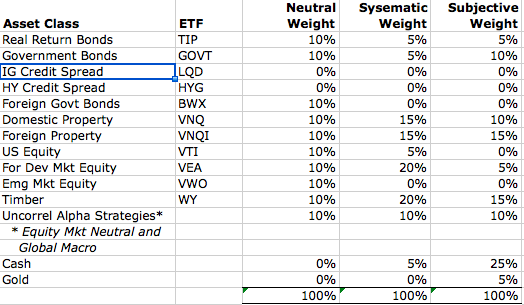
Based on subscriber requests, this month we are re-introducing a feature from the previous version of The Index Investor: Tactical Asset Allocation Implications from our analyses.
These take two forms. The first takes a systematic approach, and is based on relative asset class valuations. Our starting point is our “neutral” model portfolio, which is equally weighted across nine broad asset classes, and also includes a 10% allocation to alpha strategies (equity market neutral and global macro) that are designed to have a low correlation to returns on broad asset classes. Based on asset class valuations, we systematically vary the asset class weights (but not the active strategy weight), increasing from 10% to 15% when an asset class is likely undervalued, and 15% when it is very likely undervalued. In the case of overvaluations, we go to 5% and then into cash, if there are no undervalued asset classes with room for an increase. In effect, this replicates the systematic rebalancing strategy we used for 15 years in our previous model portfolios.
The second tactical approach is based on our subjective view not only of current asset class valuations, but also of the implications of the broader macro trends and uncertainties that we analyze each month. Importantly, this subjective view reflects our primary goal of avoiding large downside losses, rather than seeking large upside gains.
Two final notes. First, with respect to US fixed income, we include credit products (investment grade and high yield) in the same asset class as government debt, and will shift into the former when their valuations become attractive. Second, we regard gold not as a separate asset class to be held long-term, but rather as a complement to cash, into which we shift in periods of substantial overvaluation across multiple asset classes.
Here are our tactical asset allocation views for December:
Pre-Mortem Analysis
One of the most important forecasting disciplines is to ask yourself why your forecast could be wrong. Dr. Gary Klein’s research has shown that a very powerful and insightful way to do this is via a “pre-mortem analysis.” This method asks you to assume that it is a point in the future, and your forecast has been proven wrong (or your strategy or company has failed). You are then asked to look backward from this imagined point in the future, to explain why you failed, what you missed, and what you could have done differently to avoid your fate.
The pre-mortem method takes advantage of the fact that humans reason much more concretely and in more detail when explaining the past than they do when trying to forecast the future.
So let us assume that it is one year from now, and our current forecast has turned out to be wrong.
How did this happen? What developments did we fail to anticipate? Here are three possibilities:
- The leaders of the world’s three major powers – Xi Jinping, Donald Trump, and Vladimir Putin are all facing weakening economies and declining political popularity. History teaches us that this can lead to increased “foreign adventurism” to distract the public from worsening domestic conditions, as a nation rallies around its leader in a period of heightened external conflict. Should a “kinetic” conflict develop between China and the United States, or between Russia and one or more European countries (e.g., due to a Russian incursion into the Baltics), it would generate a very sharp increase in uncertainty that would likely cause an equally sharp economic slowdown which, given high debt levels, would speed the arrival of the Persistent Deflation Regime.
- While the probability is remote, a supply side shock of some type could produce a sudden increase in inflation – the most likely scenario being a reduction in oil supplies due to a prolonged kinetic conflict between Iran and the US that produced a extended disruption in global oil supplies, or, less likely, an infectious disease pandemic or major crop failures (e.g., due to climate change and/or agricultural disease).
- Another route to the high inflation regime (repeatedly noted by Bridgewater’s Ray Dalio) would be a sudden loss of confidence in the US dollar relative to other currencies (driving up import prices), perhaps because of deficit monetization and policy paralysis as a severe downturn continues. However, this would also require that there was relatively more confidence in another currency, with the Euro being the most likely candidate. This currently seems unlikely, given both the Eurozone’s economic and political situation, and the prospect of an intensifying conflict between the West and China. However, if confidence collapsed in all major currencies, a sharp increase in inflation would lead to a dramatic rise in the price of gold.
- Though we believe it is still unlikely, it is becoming easier envision a scenario in which both Xi Jinping and Donald Trump leave their current roles, and are replaced by leaders who are more committed to lessening the intensifying conflict between China and other nations. This would likely provide a strong boost to confidence (and thus lead to an equally strong reduction in uncertainty). However, a reduction in perceived external threats might also intensify already substantial internal divisions and conflicts in China and the United States, which could, ironically, also lead to the deflation regime.
System Tipping Points/Critical Threshold Analysis
Like Professors Andrew Lo, Doyne Farmer and others, we regard financial markets as a complex adaptive system (CAS), that exist as part of a larger macro system comprised of other CAS between which there are multiple feedback loops. These other systems include those that produce technology innovations, and economic, environmental, national security (including cyber), social, demographic, and political outcomes.
We also find that these systems tend to operate and generate effects in a rough chronological sequence, albeit with many feedback loops between them. The following chart highlights that the changes we observe in different areas at any point in time are actually part of a much more complex evolutionary process.
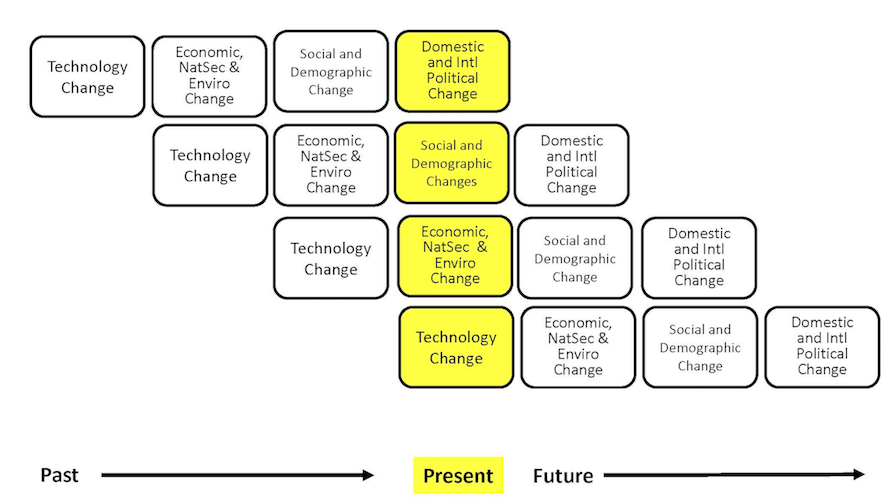
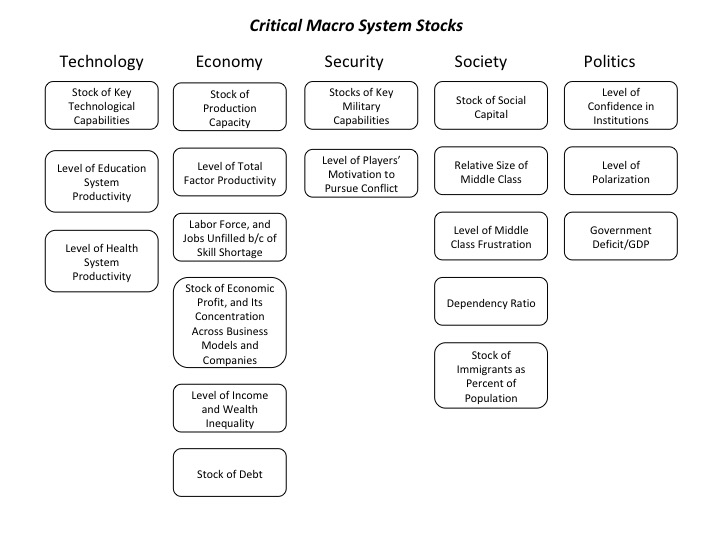
While most media coverage of these systems focused on flows (e.g., the size of the government deficit), rapid non-linear change in complex adaptive systems is often caused by a key stock (e.g., the amount of outstanding government debt) exceeding a critical threshold.
The next table highlights the key macro system stocks that we monitor.
In the next section, we will discuss information received over the past month that is related to these stocks, and which we believe is significant to our assessment of the probabilities that a critical threshold will be reached and a regime change will occur. We will conclude with our estimate, at the end of this month, of how close the macro system is to these critical thresholds, and the implications for financial market regime change probabilities.
How Close is the Macro System to One or More Critical Thresholds?
As we have noted, the macro drivers of financial market regime changes typically follow a rough chronological sequence, from technology to economic, security, social, and political causes and effects. Yet there are many feedbacks loops between them, creating complex root causes for many of the critical thresholds we have identified.
Understanding the time dynamics in this complex system is critical to avoiding substantial downside investment risk.
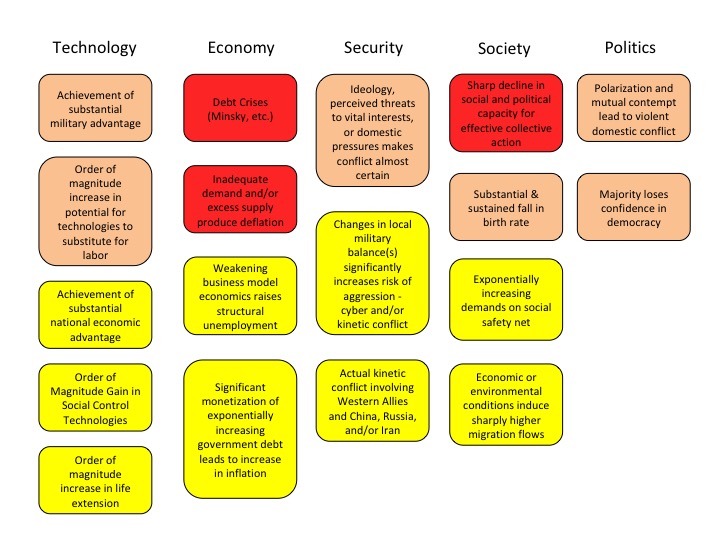
We use the UK Met Office Warning Model to communicate our assessment of these time dynamics. We estimate the time remaining before a critical macro system threshold is reached that could trigger a regime change, which is usually accompanied by substantial changes in asset class valuations.
The model uses three increasingly serious levels of warning, from “Be Aware” (condition yellow), to “Be Prepared” (condition orange), to “Take Action” (condition red).
For our purposes, we denote as “Be Aware” (yellow) critical thresholds that we assess to be three or more years away. We estimate that “Be Prepared” (orange) thresholds could be reached within 1 to 3 years. “Take Action” thresholds are very likely to be reached within one year.
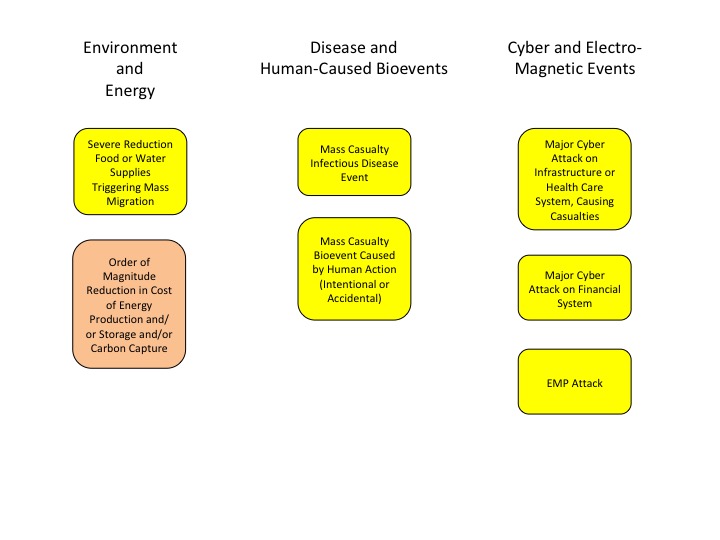
Given their nature, we also note that in our three “wildcard” areas (Environment and Energy related; Disease and Human Caused Bioevents; and Cyber and Electromagnetic Events), our forecasts have higher levels of uncertainty.
The following charts summarize our current estimate of the time remaining before different critical thresholds will be reached.
At the highest level, we believe the complex adaptive global macro system can be in one of four states, based on its degree of order versus disorder, and degree of social cooperation versus conflict. A very coarse-grained reading of history suggests that these states evolve in a predictable cycle, from ordered/cooperative, to disordered/cooperative, to disordered/conflicted, to ordered/conflicted.
We believe that the system is currently in its most uncertain state, characterized by high degrees of underlying disorder and social conflict, both domestically and internationally. Beyond some point, intensifying conflict eventually increases the degree of order in the system. That appears to be happening now, via the increasing conflict between China, Russia, and Iran and the United States and other Western nations.
Note: Combining Our Forecasts with Others From Other Sources and Extremizing the Result Should Increase Your Predictive Accuracy
Research has found that three steps can improve forecast accuracy. The first is seeking forecasts based on different forecasting methodologies, or prepared by forecasters with significantly different backgrounds (as a proxy for different mental models and information). The second is combining those forecasts (using a simple average if few are included, or the median if many are). The final step, which significantly improved the performance of the Good Judgment Project team in the IARPA forecasting tournament, is to “extremize” the average (mean) or median forecast by moving it closer to 0% or 100%.
Forecasts for binary events (e.g., the probability an event will or will not happen within a given time frame) are most useful to decision makers when they are closer to 0% or 100% than the uninformative “coin toss” 50%. As described by Baron et al in “Two Reasons to Make Aggregated Probability Forecasts More Extreme”, forecasters will often shrink their probability estimates towards 50% to take into account their subjective belief about the extent of potentially useful information that they are missing.
When you average multiple forecasters’ estimates, you are including more information, which should increase forecast confidence and push the mean estimate closer to 0% or 100%. However, this doesn’t happen when you use simple averaging. For this reason, forecast accuracy is increased when you employ a structured “extremizing” technique to move the mean estimate closer to 0% or 100%.
You can download an extremizing model from our website to use when combining the forecasts you use in your decision process.
The extremizing factors in our model are those that the Good Judgment Project found maximized the accuracy of combined forecasts. Note that the extremizing factor is lower when average forecaster expertise is higher. This is based on the assumption that a group of expert forecasters will incorporate more of the full amount of potentially useful information than will novice forecasters.
High Value Information Observed In November 2019
In our model of the complex macro change drivers are arrayed in a roughly chronological process (albeit one with many feedback loops), in which technological and environmental changes precedes changes in the economy and national security, which in turn lead to changes in society and politics, all of which produce the effects we observe in investor behavior and financial market valuations and returns.
In our methodology, we classify new information as significant and highly valuable if either it (1) is an “indicator”, which reduces our uncertainty about the value of a parameter in our mental model for making sense of the dynamic macro system, or (2) it is a “surprise” which increases our uncertainty about either the range of potential values for a parameter or the structure of our model.
| New Technology Information: Indicators and Surprises | Why Is This Information Valuable? |
| “Teacher Pay Raises Aren’t Enough” by Eric Hanushek from Stanford University | he OECD has reported the latest PISA scores. This international assessment measures 15 year olds’ ability to apply their knowledge of reading, math, and science. The US ranked 8th in reading, 11th in science, and 30th in math, despite higher spending on education. As a Financial Times headline noted, “Rich-nation education splurge fails to deliver results.” Unfortunately, improved education results are critical for raising labor productivity and offsetting the economic impact of ageing populations on the economic growth of many developed nations. Hanushek notes that, “The discussion educators and policymakers need to have begins With a simple fact: U.S. teachers are woefully underpaid…the penalty shows up in the quality of our teacher force [compared to other nations’]… Since today's students become our future labor force, their lower achievement bodes ill for the future economic well-being of our nation…if the United States is to improve its schools, the available research indicates that the only feasible solution is to increase the overall effectiveness of our teachers”… However, “higher salaries may work to retain the most effective teachers, but they also retain the least effective. In fact, the across-the-board raises—the hallmark of the settlements with teachers unions—make getting out of the bad salary situation even more difficult, because they slow the chances of any new openings in the teacher force”… “Additionally, raises going indiscriminately to ineffective teachers likely dampen public enthusiasm for salary increases.” Hanushek concludes that, “the only practical solution apparent to me is the "grand bargain"—an idea broached more than 15 years ago but now perhaps more feasible as teacher salaries stagnate and U.S. student achievement continues to lag that of other countries. This bargain is simple: a substantial increase in teacher salaries combined with policies that produce a significant tilt toward more effective teachers” [by making it easier to dismiss weak ones]. |
| “Why the U.S. Innovation Ecosystem Is Slowing Down” by Arora et al | SURPRISE Many observers have long noted the declining interest of practitioners in the social science and business research being produced by universities, pointing with envy to the closer relationship they believe exists between practitioners and university researchers in science and engineering. This new paper finds that now a gap is growing there too. “Data from the National Science Foundation (NSF) indicate that U.S. investment in science has steadily increased between 1970 and 2010, as measured by dollars spent (which has gone up 5X), number of PhDs trained (2X) and articles published (7X). Why is there little productivity growth to show for this?” … “One explanation, which we explore, is that today’s science is not being translated into applications — in other words, something is keeping scientific discoveries from fueling productive innovation. Our research finds that the U.S. innovation ecosystem has splintered since the 1970s, with corporate and academic science pulling apart and making application of basic scientific discoveries more difficult… “This marks a significant shift... We’ve moved from an economy where big firms did both scientific research and development toward one with a starker division of labor, where corporations specialize in development, and universities specialize in research…University researchers are rewarded for precedence (“who comes first”), while corporate researchers are rewarded for their usefulness in invention (“does it work”). Therefore, university research is more likely to be new, but less likely to function as intended by businesses.” |
| “Detecting And Quantifying Causal Associations In Large Nonlinear Time Series Datasets”, by Runge et al | SURPRISE Better integration of causality has been a major challenge for artificial intelligence developers. This research suggests that progress in this area may be accelerating. “Identifying causal relationships and quantifying their strength from observational time series data are key problems in disciplines dealing with complex dynamical systems such as the Earth system or the human body… "The goal in time series causal discovery from complex dynamical systems is to statistically reliably estimate causal links, including their time lags… "Data-driven causal inference in such systems is challenging since datasets are often high dimensional and nonlinear with limited sample sizes…We introduce a novel method that flexibly combines linear or nonlinear conditional independence tests with a causal discovery algorithm to estimate causal networks from large-scale time series datasets… “Our method outperforms state-of-the-art techniques in detection power, which opens up entirely new possibilities to discover and quantify causal networks from time series across a range of research fields.” |
| “Global AI Survey: AI proves its worth, but few scale impact”, by McKinsey | The pace at which organizations implement artificial intelligence technologies is just as important as the rate at which those technologies improve. More specifically, the extent to which AI adoption results in higher unemployment, and the extent to which is widens the gap between highly profitable firms and others that are barely earning their cost of capital has major implications for the evolution of productivity, inequality, and social and political conflict. This latest McKinsey analysis notes that, “most companies report measurable benefits from AI where it has been deployed; however, much work remains to scale impact, manage risks, and retrain the workforce. A group of high performers shows the way… “Adoption of artificial intelligence (AI) continues to increase, and the technology is generating returns. The findings of the latest McKinsey Global Survey on the subject show a nearly 25 percent year-over-year increase in the use of AI in standard business processes, with a sizable jump from the past year in companies using AI across multiple areas of their business. A majority of executives whose companies have adopted AI report that it has provided an uptick in revenue in the business areas where it is used, and 44 percent say AI has reduced costs. “The results also show that a small share of companies—from a variety of sectors—are attaining outsize business results from AI, potentially widening the gap between AI power users and adoption laggards…our results suggest that workforce retraining will need to ramp up. While the findings indicate that AI adoption has generally had modest overall effects on organizations’ workforce size in the past year, about one-third of respondents say they expect AI adoption to lead to a decrease in their workforce in the next three years, compared with one-fifth who expect an increase.” |
| “The Measure of Intelligence”, by Francois Chollet from Google | SURPRISE This paper will very likely help to clarify the ongoing debate about the rate of technological progress towards AI that represents “artificial general intelligence.” Chollet notes that, “to make deliberate progress towards more intelligent and more human-like artificial systems, we need to be following an appropriate feedback signal: we need to be able to define and evaluate intelligence in a way that enables comparisons between two systems, as well as comparisons with humans. “Over the past hundred years, there has been an abundance of attempts to define and measure intelligence, across both the fields of psychology and AI. We summarize and critically assess these definitions and evaluation approaches, while making apparent the two historical conceptions of intelligence that have implicitly guided them. “We note that in practice, the contemporary AI community still gravitates towards benchmarking intelligence by comparing the skill exhibited by AIs and humans at specific tasks, such as board games and video games. “We argue that solely measuring skill at any given task falls short of measuring intelligence, because skill is heavily modulated by prior knowledge and experience: unlimited priors or unlimited training data allow experimenters to “buy” arbitrary levels of skills for a system, in a way that masks the system’s own generalization power. “We then articulate a new formal definition of intelligence based on Algorithmic Information Theory, describing intelligence as skill-acquisition efficiency and highlighting the concepts of scope, generalization difficulty, priors, and experience, as critical pieces to be accounted for in characterizing intelligent systems. Using this definition, we propose a set of guidelines for what a general AI benchmark should look like.” |
| | |
| | |
| | |
| | |
| | |
| | |
| | |
| | |
| New Energy and Environment Information: Indicators and Surprises | Why Is This Information Valuable? |
| "China ramps up coal power in face of emissions efforts", FT 19Nov19 | “China is set to add new coal-fired power plants equivalent to the EU’s entire capacity, as the world’s biggest energy consumer ignores global pressure to rein in carbon emissions in its bid to boost a slowing economy. Across the country, 148GW of coal-fired plants are either being built or are about to begin construction… The current capacity of the entire EU coal fleet is 149 GW [and 256 GW in the US].” |
| “Climate change: how China moved from leader to laggard”, FT 24Nov19 | “Chinese investment in clean energy is plummeting — down from $76bn during the first half of 2017, to $29bn during the first half of this year… “The highest political priority in China is trying to stabilise the economy,” says Kevin Tu, an energy economist who previously led the China desk at the IEA. “Anything else, including environmental protection, especially climate change, will have to make some room for these political priorities.” |
| “Climate Tipping Points: Too Risky to Bet Against” by Lenton et al See also, “Tipping elements and climate–economic shocks: Pathways toward integrated assessment”, by Kopp et al | “Politicians, economists and even some natural scientists have tended to assume that tipping points [largescale discontinuities] in the Earth system — such as the loss of the Amazon rainforest or the West Antarctic ice sheet — are of low probability and little understood. Yet evidence is mounting that these events could be more likely than was thought, have high impacts and are interconnected across different biophysical systems, potentially committing the world to long-term irreversible changes.” The authors conclude that, “ff tipping points are looking more likely, then…warming must be limited to 1.5 degrees Celsius, which requires an emergency response.” However, the authors also note that there is considerable uncertainty associated with their analysis: “Researchers need to improve their understanding of these observed changes in major ecosystems, as well as where future tipping points might lie… To address these issues, we need models that capture a richer suite of couplings and feedbacks in the Earth system, and we need more data — present and past — and better ways to use them. Improving the ability of models to capture known past abrupt climate changes and ‘hothouse’ climate states should increase confidence in their ability to forecast these.” |
| “A New World: The Geopolitics of the Energy Transformation” by The International Renewable Energy Agency | “The accelerating deployment of renewables has set in motion a global energy transformation that will have profound geopolitical consequences. Just as fossil fuels have shaped the geopolitical map over the last two centuries, the energy transformation will alter the global distribution of power, relations between states, the risk of conflict, and the social, economic and environmental drivers of geopolitical instability… “The world that will emerge from the renewable energy transition will be very different from the one that was built on a foundation of fossil fuels. Global power structures and arrangements will change in many ways and the dynamics of relationships within states will also be transformed. Power will become more decentralized and diffused. The influence of some states, such as China, will grow because they have invested heavily in renewable technologies and built up their capacity to take advantage of the opportunities they create. By contrast, states that rely heavily on fossil fuel exports and do not adapt to the energy transition will face risks and lose influence.” |
| “Macroeconomic and Financial Policies for Climate Change Mitigation: A Review of the Literature”, by Krogstrup and Oman from the IMF | “More research is needed on the most effective policy mix for climate change mitigation, and the role of climate mitigation in the overall policy framework. While some macroeconomic and financial tools are clearly desirable and complementary, others may substitute for each other, giving rise to trade-offs. The literature is scarce on the desirable package of [policy] measures to address climate mitigation.” |
| “Climate change: shades of green run across political spectrum”, FT 1Dec19 See also, “US Public Views on Climate and Clean Energy”, by Pew Research, November 2019 | “Climate change strategies are taking shape not so much because of radical activist pressure but because societies — that is to say more voters, employees and citizens — want something to be done… The politics of climate change in Europe are evolving. Radical right parties, that once scorned environmentalism as a cosmopolitan delusion, are changing their tune — partly because younger supporters believe in climate change.” |
| “The Production Gap: The discrepancy between countries’ planned fossil fuel production and global production levels consistent with limiting warming to 1.5°C or 2°C” by the UN Environmental Programme | SURPRISE “This report is the first assessment of countries' plans and outlooks for fossil fuel production, and what is needed to align this production with climate objectives… Governments are planning to produce about 50% more fossil fuels by 2030 than would be consistent with a 2°C pathway and 120% more than would be consistent with a 1.5°C pathway.” |
| | |
| | |
| | |
| | |
| | |
| | |
| New Economic Information: Indicators and Surprises | Why Is This Information Valuable? |
| “Five market axioms that can no longer be relied upon”, by Mohamed El-Erian, FT, 13Nov19 | SURPRISE In the coming years, “investors will have to grapple with once-unthinkable economic and market trends as they set about fine-tuning their portfolios next year. Where they end up will depend on five factors that are growing less stable by the day… "First, that globalisation carries on expanding markets and delivering efficiency gains. Second, that "emerging economies will continue to catch up with their more developed counterparts, led by those pursuing reforms". Third, that "robust liquidity will anchor well-functioning markets". Fourth, that "policy effectiveness in developed markets will limit the global economy’s downside”. And finally, "that politics and governance will support market-based systems and the global rule of law.” |
| “Financial Repression is Knocking at the Door, Again. Should We Be Concerned?”, by Jafarov et al from the IMF | SURPRISE This paper concludes that much higher debt-financed government spending in the future will likely be accompanied by higher rates of financial repression, which in turn is likely to depress GDP growth rates. This is not a good omen if the goal of fiscal stimulus is to escape secular stagnation and deflation. “Financial repression (legal restrictions on interest rates, credit allocation, capital movements, and other financial operations) was widely used in the past but was largely abandoned in the liberalization wave of the 1990s, as widespread support for interventionist policies gave way to a renewed conception of government as an impartial referee. “Financial repression has come back on the agenda with the surge in public debt in the wake of the Global Financial Crisis, and some countries have reintroduced administrative ceilings on interest rates. By distorting market incentives and signals, financial repression induces losses from inefficiency and rent-seeking that are not easily quantified. This study attempts to assess some of these losses by estimating the impact of financial repression on growth using an updated index of interest rate controls covering 90 countries over 45 years. “The results suggest that financial repression poses a significant drag on growth, which could amount to 0.4-0.7 percentage points of GDP.” |
| “Will debt-fuelled buyout boom end in stagnation?”, by John Dizard, FT 14Nov19 | As always, Dizard is very likely right on target. “Apparently all informed and decent opinion is converging on the certainty that the rise of leveraged private equity will end with a market crash. But what if the result of the debt-powered asset buying is not a shock, but stagnation? It has happened before… “The outcome of buying assets at high prices with high leverage seems depressingly clear…Private equity companies have directly or implicitly promised more capability to their investors. They are supposed to be hands-on operational managers. When the economy goes south, their names will be on the lay-offs and unpaid contracts, however clever their documentation.” |
| “Billions needed to fund rising cost of social care, think-tank warns”, FT 10Nov19 | SURPRISE Most discussions of the rising cost of healthcare focus on the effectiveness and efficiency with which countries respond to chronic and acute needs. The rising cost of social care for an aging population (including home care, assisted living, nursing homes, etc.) is quite similar to the rising cost of social security and underfunded public sector defined benefit pension plans – they are grey swans, whose increasing danger is right before our eyes, but that we disregard because its arrival seems so far off. This article shows that authorities in the UK are far more sensitive to this issue than their counterparts in the United States. “English local authorities will need billions in extra funding during the next parliament to meet the rising cost of adult social care, even if council taxes rise at twice the rate of inflation, according to a prominent think-tank. “The Institute for Fiscal Studies analysis concludes that councils will struggle even to maintain services at existing levels over the next few years, with election pledges of more generous provision — such as Labour’s plan for free personal care for the over-65s — adding to the pressures. Over the longer term, as the population ages, the challenge will be much greater, and the councils able to raise most revenue from local taxes are unlikely to be those with the highest social care needs.” |
| OECD Economic Outlook, Nov19 | This warning indicator reminded me of similar ones – e.g., by William White of the BIS – that some raised in advance of the 2008 Global Financial Crisis. The juxtaposition of the OECD’s commentary with rising equity and bond markets cannot help but reinforce one’s belief in the short-term focus and momentum-driven nature of today’s financial system. “For the past two years, global growth outcomes and prospects have steadily deteriorated, amidst persistent policy uncertainty and weak trade and investment flows. We now estimate global GDP growth to have been 2.9% this year and project it to remain around 3% for 2020-21, down from the 3.5% rate projected a year ago and the weakest since the global financial crisis… “Overall, growth rates are below potential. The mix between monetary and fiscal policies is unbalanced. Central banks have been easing decisively and timely, partly offsetting the negative impacts of trade tensions and helping to prevent a further rapid worsening of the economic outlook… “However, to date, other than a few countries, fiscal policy has been only marginally supportive, and not especially of investment, while asset prices have been buoyant. The biggest concern, however, is that the deterioration of the outlook continues unabated, reflecting unaddressed structural changes more than any cyclical shock.” |
| Two major publications ran features this month on underfunded public sector pension plans: The Economist (“Public Pensions are Woefully Underfunded”) and the FT: (“‘Their house is on fire’: the pension crisis sweeping the world” by Cumbo and Wigglesworth, and “Pension Funds Warn Over QE Damage” by Jennifer Thompson). | Low interest rates have increased the discounted present value of public sector defined benefit pension plans’ future liabilities to beneficiaries, while reducing the returns they earn on their investments. This has worsened already very large funding shortfalls in many plans. Ray Dalio’s latest essay (see next evidence item) highlights the potentially negative impacts that could – and very likely will – result from more widespread public recognition of the size of government’s off balance sheet pension liabilities and the very painful choices they create for already polarized political systems. |
| “The World Has Gone Mad, and the System is Broken”, by Ray Dalio from Bridgewater | SURPRISE In light of rising concerns with pensions (and the underlying government liabilities they represent), it was interesting to see that in his latest essary, Ray Dalio focused on them more than he has before. In addition to the sharp increase in government deficit spending financed by monetary creation that he expects to see as a result of the protracted downturn he (like us at The Index Investor) expects to commence in the near future, in this essay Dalio also notes that, “pension and healthcare liability payments will increasingly be coming due while many of those who are obligated to pay them don’t have enough money to meet their obligations. Right now many pension funds that have investments that are intended to meet their pension obligations use assumed returns that are agreed to with their regulators. They are typically much higher (around 7%) than the market returns that are built into the pricing and that are likely to be produced. As a result, many of those who have the obligations to deliver the money to pay these pensions are unlikely to have enough money to meet their obligations. “Those who are recipients of these benefits and expecting these commitments to be adhered to are typically teachers and other government employees who are also being squeezed by budget cuts. They are unlikely to quietly accept having their benefits cut. “While pension obligations at least have some funding, most government healthcare obligations are funded on a pay-as-you-go basis, and because of the shifting demographics in which fewer earners are having to support a larger population of baby boomers needing healthcare, there isn’t enough money to fund these obligations either. “Since there isn’t enough money to fund these pension and healthcare obligations, there will likely be an ugly battle to determine how much of the gap will be bridged by 1) cutting benefits, 2) raising taxes, and 3) printing money (which would have to be done at the federal level and pass to those at the state level who need it). This will exacerbate the wealth gap battle. “While none of these three paths are good, printing money is the easiest path because it is the most hidden way of creating a wealth transfer and it tends to make asset prices rise. After all, debt and other financial obligations that are denominated in the amount of money owed only require the debtors to deliver money; because there are no limitations made on the amounts of money that can be printed or the value of that money, it is the easiest path. “The big risk of this path is that it threatens the viability of the major world reserve currencies as viable storeholds of wealth. At the same time, if policy makers can’t monetize these obligations, then the rich/poor battle over how much expenses should be cut and how much taxes should be raised will be much worse. As a result rich capitalists will increasingly move to places in which the wealth gaps and conflicts are less severe and government officials in those losing these big tax payers will increasingly try to find ways to trap them.” |
| “Nonbank Lending”, by Chernenko et al | SURPRISE This is a very sobering paper especially when you realize that these loans have been made by entities that do not have access to liquidity from the Federal Reserve’s discount window. In the next downturn, these loans will likely contribute to debt deflation. “We show that nonbank lending in the US is widespread, with 32% of all loans being extended by nonbanks. Nonbank borrowers are less profitable, more levered, and more volatile than bank borrowers. Firms with a small negative EBITDA are 34% more likely to borrow from a nonbank than firms with a small positive EBITDA. “While nonbank lenders are less likely to monitor by including financial covenants, they are more likely to align incentives through the use of warrants. Controlling for firm and loan characteristics, nonbank loans carry 190 basis points higher interest rates.” |
| “The 2019 Global Mercantilist Index”, by Foote and Ezell | “In the global race for leadership in the most advanced technology industries, many countries are resorting to “innovation mercantilism” to create unfair advantages for their own industries at the expense of foreign competitors and global innovation progress. Ranking 60 nations on 18 variables such as market access, forced localization, currency manipulation and intellectual property protections, the 2019 Global Mercantilist Index finds that China is the world’s most innovation-mercantilist nation. Others such as India, Indonesia, and Russia have also engaged in innovation mercantilist practices, placing them in the report’s “moderate-high” category.” |
| “Public Debt and Private Investment”, by Huang et al | SURPRISE An almost certain consequence of a prolonged economic downturn will be a sharp increase in debt-financed government spending. This paper finds that this will very likely have negative consequences for small firms. “Establishing the presence of a causal link from public debt to economic growth and investment has proved challenging. This column uses data for nearly 550,000 firms in 69 countries to show that government debt affects corporate investment by tightening the credit constraints faced by private firms. Higher levels of public debt increase the correlation between investment and cashflow for firms that are more likely to be credit constrained – i.e. unlisted, small, and young firms – but appear to have no effect on the correlation between cash and investment of listed, well-established, and large firms.” |
| “The Global Equilibrium Real Interest Rate: Concepts, Estimates, and Challenges”, by Michael Kiley of the Federal Reserve | SURPRISE This paper makes the important point that global factors (e.g., increasing secular stagnation around the world) are making a powerful contribution to today’s low real interest rates, and that models that focus only on national drivers are likely to produce erroneous estimates. “Real interest rates have been persistently below historical norms over the past decade, leading economists and policymakers to view the equilibrium real interest rate as likely to be low for some time. Various definitions and approaches to estimating the equilibrium real interest rate are examined, including approaches based on the term-structure of interest rates and small macroeconomic models. “The individual-country approaches common in the literature are extended to allow for global trend and cyclical factors. The analysis finds that global factors dominate the downward trend in the equilibrium interest rate across 13 advanced economies. A corollary of this finding is that the U.S. equilibrium rate may be substantially lower than estimated in U.S.-only studies.” |
| “The Aggregate and Distributional Effects Of Financial Globalization”, by Furceri et al | SURPRISE This is an important paper that quantifies what many already intuitively believe about the “financialization” of the global economy. The critical implication is that controls on cross-border capital flows – last seen in the 60s and early 70s – are likely to reappear as national politicians seek ways out of the next global economic downturn. “Free trade has contributed to a great convergence of emerging market countries toward incomes in industrialised nations in recent decades. It is less clear whether free mobility of capital across national boundaries has conferred similar benefits.” The authors “present evidence suggesting that the gains in average incomes have been – at best – small, while increases in income inequality and the decline in the labour share of income have been significant. Financial globalisation thus poses far more difficult equity-efficiency trade-offs than free trade and should be at the centre of debates about how to make globalisation inclusive.” |
| New National Security Information: Indicators and Surprises | Why Is This Information Valuable? |
| U.S. National Security Commission on Artificial Intelligence, Interim Report | “The convergence of the artificial intelligence revolution and the reemergence of great power competition must focus the American mind. These two factors threaten the United States’ role as the world’s engine of innovation and American military superiority. “If the United States fails to sustain its advantages, it will not be because it was caught by surprise…China, our most serious strategic competitor, has declared its intent to become the world leader in AI by 2030 as part of a broader strategy that will challenge America’s military and economic position in Asia and beyond”… “Global leadership in AI technology is a national security priority…AI adoption for national security is an urgent imperative. We see no way to protect the American people, US interests, and shape the development of international norms for using AI if the United States is not leading the way in application… “Private sector leaders and government officials must build a shared sense of responsibility for the welfare and security of the American people…The United States confronts hard choices between economic and security interests, between maintaining our openness and protecting our innovation economy from strategic competitors, and between commercial and national objectives, all while balancing short and long-term considerations.” |
| “Society, Technology, and Future Warfare”, by Kenneth Pollack | “Military analysts are struggling to understand how the new technology of the information age will transform warfare. There is a persistent, dangerous tendency to assume that all actors will simply employ new technology according to a theoretical set of best practices—and an even more dangerous expectation that the United States will define those best practices and dominate the information-age battlefield because the US is leading the information revolution. “Historical evidence from the early industrial era, when a similar transformation occurred, offers warnings on both counts. “Great Britain led the industrial revolution. It was the leading economy of the era and the primary source of civilian innovations that brought about the Industrial Revolution and the military innovations that redefined warfare. Yet its military forces were not the most effective practitioners of industrial-age warfare. “Similarly, the experience of the Germans and French from World War I to World War II warns that it is extremely difficult to know beforehand which army has learned to use new technologies most effectively before the audit of battle. Overreliance on AI and autonomous systems also comes with uncertainties, both recognized and in the realm of unknown unknowns”. See also, “The Digital Maginot Line Autonomous Warfare and Strategic Incoherence”, by Michael Ferguson, and “Decide, Disrupt, Destroy: Information Systems in Great Power Competition with China”, by Ainikki Riikonen |
| “SecDef: China is Exporting Killer Robots to the Mideast”, by Patrick Tucker | SURPRISE “China is exporting drones that it advertises as having lethal autonomy to the Middle East, Defense Secretary Mark Esper said Tuesday. It’s the first time that a senior Defense official has acknowledged that China is selling drones capable of taking life with little or no human oversight.” |
| “Australia’s China Syndrome”, by Joel Kotkin | “Australia continues to benefit from China’s rise, though few countries are more threatened by its expanding power. Once closely tied to the British Commonwealth, and later to the United States, the Australian subcontinent, with only 24 million people, now relies on China for one-third of its trade— more than with Japan and the U.S. combined. “Australia’s major economic sectors rely on Chinese support; investors poured in $17.4 billion in 2017. Australians increasingly understand the implicit danger of this dependency. Unlike the U.S., which possesses the market size, military capacity, and technological power to resist Chinese expansionism, Australia is far more vulnerable to the Communist regime’s efforts to shape its economy, cities, and political system. “Australians aren’t as threatened as Hong Kong’s democracy activists, but China’s influence has intensified…Many Australians have expressed concern that the country’s intense integration with an authoritarian superpower presages a new life as a “vassal” state |
| Protests in Iran have been worsening, at the same time that the US has further tightened sanctions on the country. History suggests that this combination will raise the probability that the regime leaders will engage in further external aggression, which has the potential to spiral into a wider conflict. | SURPRISE As human beings with brains shaped by our evolutionary past, we face an increasingly daunting challenge when it comes to allocating our scarce attention to the daily flood of information we receive about the widening range of developments emerging from our increasingly complex global system. And even when we focus our attention, we often struggle to make sense of dynamic causal processes that are often characterized by time delays and nonlinearities. As a result, we often feel surprised by events. Today, there is no shortage of developments vying for our attention, like the UK election, the future of Brexit, the US-China tradewar, and Donald Trump’s impeachment. As a result, accumulating system pressures can easily be overlooked. Iran is a case in point, as these recent articles about Iran (and in the next evidence item, India) highlight. In “Iran’s Deepening Malaise Laid Bare by Protests”, on 19Nov19, the editorial board of the FT observed that, “Iran is ablaze with public anger. Banks have been looted, petrol stations torched and highways barricaded as thousands have taken to the streets in cities across the Islamic republic in the biggest protests in two years. The unrest was triggered by the government’s decision to slash subsidies on fuel, as it grapples with crippling US sanctions. This means prices at the petrol pump will rise by at least 50 per cent at a time when the economy is in recession and inflation is above 40 per cent. “As in Lebanon and neighbouring Iraq in recent weeks, protests over economic grievances have swiftly taken on an anti-regime tone…The middle and lower classes — whose economic and political interests do not always align — also seem united. “The sense of injustice and disillusionment in Iran is clear. So is the precarious state of the Islamic regime, which is facing its toughest challenge since the 1980s war with Iraq… “But hawks in Washington would be naive to think the regime is nearing collapse. In the 40 years since the Islamic revolution, the regime has proven itself to be resilient and pragmatic as it has confronted myriad threats. It will happily use force to crackdown on protesters.” In contrast, in “Is Iran Near Collapse?”, Mohammed Auyoob writes that, “The events of the last few weeks in Iran indicate that the country may be in for a repetition of the events of 1978 that led to the toppling of the Shah. Anti-government protests in Iran have reached a boiling point with the streets of several of Iran’s cities and towns reverberating with slogans demanding the overthrow of Supreme Leader Ayatollah Ali Khamenei. “One can hear echoes of the “Death to the Shah” slogans of 1978–79 in these frenzied chants. Security forces have repeatedly opened fire, killing people by the dozens—possibly by the hundreds—in order to disperse protestors just as they did in the autumn of 1978.” See also, “Repression Won’t Solve the Deeper Problems Bringing Iranians to the Streets”, by Kadivar et al, and “Iranian protesters strike at the heart of the regime’s revolutionary legitimacy”, by Suzanne Maloney |
| While India will be strategically critical to the West as conflict with China intensifies in the future, it receives far less mainstream media attention than it deserves. That is gradually changing. Unfortunately, recent coverage has highlighted the challenges facing the country, and Prime Minister Narenda Modi | SURRISE In “Can India’s Prime Minister Succeed Even as the Economy Plummets?” Milan Vishnav observes that, “When India’s prime minister, Narendra Modi, ran for the top job five years ago, he campaigned as the country’s best hope for economic reform… “Modi has succeeded politically despite—not because of—the economy, which is in the midst of a protracted downturn that began on his watch. For his second term, the prime minister has doubled down on the grand economic promises he made in his 2014 campaign and gone still further, setting a goal of turning India into a $5 trillion economy by 2024. But his government has struggled to articulate just how it will bring about India’s economic renewal. “While the prime minister has yet to pay a serious political price for this failure, he cannot count on the indefinite forbearance of Indian voters.” In “India’s Narenda Modi Has Had a Free Pass form the West for Too Long” (FT 11Nov19), Gideon Rachman notes that, “The world’s democracies are desperate to believe in India…The west’s investment in India is now strategic, emotional, intellectual and financial. But the sunk costs of that investment mean that western countries are reluctant to acknowledge the dark side of Mr Modi’s India — in particular, threats to minority rights and the erosion of democratic norms.” Rachman concludes that, “The west’s fear of China means that it is likely to continue to give Modi’s India a free pass for some time. But a failure to talk openly about the failings of the Modi model is not cost-free. The danger is that the west is embracing a comforting illusion — that democratic India will act as an ideological bulwark against authoritarian China. The reality is that India’s slide into illiberalism may actually be strengthening the global trend towards authoritarianism” (a conclusion shared by his FT colleague Ed Luce, who spent five years in India – see, ”India’s Journey to Illiberal Democracy”, FT 11Nov19). In “Imbalance of Power: India’s Military Choices in an Era of Strategic Competition with China”, Kliman et al explore a critical issue for the 2020s: “The United States has made a strategic bet: that India will decisively shape the military balance in Asia. In an era of avowed great power competition with China, at a time when the U.S. military’s edge over the People’s Liberation Army (PLA) continues to erode, this wager will have an outsized impact on the future trajectory of the region. If India can maintain an advantage over China along its Himalayan frontier and sustain its dominance in the Indian Ocean, U.S. efforts to deny Beijing a regional sphere of influence are far more likely to succeed— as is the vision of a free and open Indo-Pacific shared by Washington and Delhi. [However], “if India fails to realize its military potential, the United States, caught in between its many global commitments, will struggle to uphold a favorable balance of power. Today, America’s wager has yet to fully pay off. The trend lines in the India-China military equation are broadly negative. Despite very real improvements in Delhi’s defense capabilities and a significant advantage conveyed by India’s maritime geography, its longstanding superiority over China in the Indian Ocean is at risk of slipping away.” See also: “Narenda Modi’s India” by Dexter Filkins; “Can India’s Economy Return to High Growth?” Knowledge@Wharton; and “Past Grudges Overshadow Present Woes in India’s Public Discourse” by the FT’s Henny Sender. |
| “European Security In Crisis: What To Expect If The United States Withdraws From NATO”, by Fix and Giegerich in WarontheRocks.com, 29Nov19 | This article reports on the results of a wargame that assumes a United States withdrawal from NATO after the reelection of Donald Trump is shortly followed by Russian attempts to exploit an apparent weakening of European defense. It is a very sobering read about what may happen if this scenario comes to pass. |
| “The New German Question: What Happens When Europe Comes Apart?” by Robert Kagan | SURPRISE “Many have been lamenting the dark path that Europe and the transatlantic relationship are currently on, but there hasn’t been much discussion of where that path leads. European weakness and division, a strategic “decoupling” from the United States, the fraying of the European Union, “after Europe,” “the end of Europe”—these are the grim scenarios, but there is a comforting vagueness to them. They suggest failed dreams, not nightmares. “Yet the failure of the European project, if it occurs, could be a nightmare, and not only for Europe. It will, among other things, bring back what used to be known as “the German question.” “The German question produced the Europe of today, as well as the transatlantic relationship of the past seven-plus decades. Germany’s unification in 1871 created a new nation in the heart of Europe that was too large, too populous, too rich, and too powerful to be effectively balanced by the other European powers, including the United Kingdom… “With the order that made today’s Germany possible now under attack, including by the United States, the world is about to find out. History suggests it may not like [what comes next]. As a historical matter, Germany, in its relatively brief time as a nation, has been one of the most unpredictable and inconsistent players on the international scene.” |
| “No Country for Young Men”, by John Lloyd | SURPRISE Many commentators have noted that Italy is likely to be the epicenter of the next EU/Euro crisis. This article explains why. “No country in Europe is more critically important to the future of the European Union and the euro currency than today’s Italy… “Italy is going nowhere: which is its, and the EU’s, largest problem. Its growth is minimal—0.1 percent this year. Its debt is highest in the developed world after Japan. Its productivity is among the lowest in Europe. Its unemployment rate is hovering around 10 percent, with the three southern regions of Calabria, Campania, and Sicily registering over 20 percent. And youth unemployment stands nationally at 29 percent.” |
| 2019 Report To Congress Of The U.S.-China Economic And Security Review Commission | SURPRISE The annual report of this congressionally mandated, bipartisan commission is always a must read. “In 2019, Beijing declared in unambiguous terms its intent to revise and reorder the international system in ways more befitting its national interests and repressive vision of governance. In a series of national addresses, Chinese leaders suggested the CCP viewed its “historic mission” as being not only to govern China, but also to profoundly influence global governance. The CCP took new steps to promote itself abroad as a model worthy of emulation, casting its political system and approach to economic development as superior alternatives to that of the United States and other democratic countries… “Chinese leaders took a more strident tone in their discussion of military affairs, reinforcing a sense of urgency in the PLA’s preparations for a potential military conflict while indicating Beijing’s intent to position the PLA as a globally-oriented military force. General Secretary Xi urged the PLA to make preparations for a possible conflict with the “powerful enemy adversary”—a phrase the CCP uses to refer to the United States—central to its modernization and training efforts... “Despite signs of outward confidence, CCP leadership also revealed a growing unease over the mounting external resistance to its ambitions, which it viewed as threatening its objectives abroad and rule at home. In response to these challenges, the CCP deepened its control over the Chinese government and Chinese society and stepped up an ideological and nationalistic messaging campaign instructing key groups to “win the ideological war” against Western and other democratic countries… “China continued its efforts to coerce or interfere in the domestic affairs of countries acting in ways contrary to its interests, detaining foreign citizens and carrying out an extensive influence campaign targeting foreign universities, media, and the Chinese diaspora… “The CCP faces a number of significant internal and external challenges as it seeks to ensure its hold on power while sustaining economic growth, maintaining control at home, and advancing its regional and increasingly global ambitions. Despite a lengthy campaign to clean up its ranks, the CCP has growing concerns over widespread corruption, weakened control and cohesion, and ideological decay. Chinese policymakers credit their state-led economic model for the country’s rapid growth, but the contradictions in China’s approach are increasingly apparent as it faces a struggling private sector, high debt levels, and a rapidly-aging population. China remains deeply dependent on foreign technology and vulnerable to supply chain disruption, but is pouring vast amounts of resources toward encouraging domestic innovation… “China’s senior leaders are concerned over perceived shortfalls in the PLA’s warfighting experience and capabilities and its failure to produce an officer corps that can plan and lead. These concerns undermine Chinese leaders’ confidence in the PLA’s ability to prevail against a highly-capable adversary. The CCP has also long harbored concerns over the loyalty and responsiveness of the PLA and internal security forces to Beijing and the potential for provincial officials to co-opt these forces to promote their own political ambitions… “The CCP perceives Western values and democracy as weakening the ideological commitment to China’s socialist system of Party cadres and the broader populace, which the Party views as a fundamental threat to its rule… “General Secretary Xi’s signature anticorruption campaign has contributed to bureaucratic confusion and paralysis while failing to resolve the endemic corruption plaguing China’s governing system… “China’s current economic challenges include slowing economic growth, a struggling private sector, rising debt levels, and a rapidly-aging population. Beijing’s deleveraging campaign has been a major drag on growth and disproportionately affects the private sector. Rather than attempt to energize China’s economy through market reforms, the policy emphasis under General Secretary Xi has shifted markedly toward state control.” |
| "Xi Jinping's “Proregress”: Domestic Moves Toward A Global China", by Cheng Li | “Xi’s insecurity — his shifting identity from a princeling to a populist — stems from the CCP’s precarious hold on the country, an insecurity shared among the party elite as a whole. That observation can help explain the way in which Xi is clamping down to control an increasingly pluralistic, mobile, and restless society on the one hand while he and his leadership are simultaneously pressing to resolve the combined economic, demographic, and technological problems that portend stagnant growth on the other.” |
| | |
| | |
| | |
| New Health and Disease Information: Indicators and Surprises | Why Is This Information Valuable? |
| | |
| | |
| New Social Information: Indicators and Surprises | Why Is This Information Valuable? |
| “Trends in Employer Health Care Coverage, 2008–2018: Higher Costs for Workers and Their Families”, by Collins et al from The Commonwealth Fund | The rising cost of healthcare in the United States relative to median income is driving increasing popular frustration with political leaders – from both parties – who seek ideologically pure rather than pragmatic solutions to a problem that weighs heavily on the lives of a large majority of Americans. “Average annual growth in the combined cost of employees’ contributions to premiums and deductibles outpaced growth in U.S. median income between 2008 and 2018 in every state. Middle-income workers spent an average 6.8 percent of income on employer premium contributions in 2018; per-person deductibles across single and family plans amounted to 4.7 percent of median income.” That’s 11.5% of income spent on healthcare… |
| “Europe’s Unauthorized Immigrant Population Peaks in 2016, then Levels Off; New Estimates Find Half Live in Germany and the UK” by Pew Research | SUPRRISE “Europe has experienced a high level of immigration in recent years, driving debate about how countries should deal with immigrants when it comes to social services, security issues, deportation policies and integration efforts… “Analysis based on European data sources estimates that at least 3.9 million unauthorized immigrants – and possibly as many as 4.8 million – lived in Europe in 2017. The total is up from 2014, when 3.0 million to 3.7 million unauthorized migrants lived in Europe, but is little changed from a recent peak of 4.1 million to 5.3 million in 2016.” “Overall, unauthorized immigrants accounted for less than 1% of Europe’s total population of more than 500 million people.” In comparison, Pew Estimates that unauthorized immigrants make up 3.2% of the US population. |
| "The Geography of Desperation in America: Labor Force Participation, Mobility Trends, Place, and Well-being", by Graham and Pinto | SURPRISE The authors deliver more evidence on the underlying and growing divisions in the United States that manifest themselves in rising social and political conflict. They “track the reported well-being and ill-being of individuals and places [and] find large differences in these trends across education levels, races, and places. Desperation – and the associated trends in premature mortality – are concentrated among the less than college educated and are much higher among poor whites than poor minorities, who remain optimistic about their futures. “The trends are also geographically dispersed, with racially and economically diverse urban and coastal places much more optimistic and with much lower incidences of premature mortality (on average). Both death and desperation are higher in the heartland and in particular in areas that were previously hubs for the manufacturing and mining jobs which have long since disappeared.” |
| “Millionaires expect billionaires to plug charity gaps”, by Stefan Wagstyl, FT 15Nov19 | “Many of the world’s multimillionaires are limiting their donations to charity because they think supporting good causes is for those even richer than themselves. A survey by Barclays bank of 400 multimillionaires across nine countries [The Barclays study largely excludes the US, where the rich are, by international standards, big Donors], found that 75 per cent believed philanthropy was the responsibility of those wealthier than themselves. Some 46 per cent think financing good causes is the state’s job, 29 per cent say family and business commitments come first, and 27 per cent cite a lack of faith in how charities are run.” |
| “Tribalism is Human Nature”, by Clark et al | The commonly held belief that the other guys are tribal, but we're too civilized for that is quite wrong… “Humans evolved in the context of intense intergroup competition, and groups comprised of loyal members more often succeeded than those that were not. Therefore, selective pressures have consistently sculpted human minds to be "tribal," and group loyalty and concomitant cognitive biases likely exist in all groups. Modern politics is one of the most salient forms of modern coalitional conflict and elicits substantial cognitive biases. “Given the common evolutionary history of liberals and conservatives, there is little reason to expect pro-tribe biases to be higher on one side of the political spectrum than the other. We call this the evolutionarily plausible null hypothesis and recent research has supported it. “In a recent meta-analysis, liberals and conservatives showed similar levels of partisan bias, and a number of pro-tribe cognitive tendencies often ascribed to conservatives (e.g., intolerance toward dissimilar others) have been found in similar degrees in liberals. We conclude that tribal bias is a natural and nearly ineradicable feature of human cognition, and that no group—not even one’s own—is immune.” |
| “Americans' Perceptions Of Success In The U.S.”, by Reinhart and Ritter from Gallup | SURPRISE This new analysis provides compelling evidence of how far political beliefs on both extremes, not to mention the depictions of American life in much popular media, really are from America’s social center of gravity. “How do Americans define success? While less than 10% of Americans personally define success in status-oriented, comparative or zero-sum ways, they largely believe other Americans do… The most important domains in Americans’ personal definitions of success are education (17.1%), relationships (15.6%), and character (15.4%).” The report also finds that, “there is a disconnect between Americans' perceptions of their attainment of personal success and what they believe society views as success…Many more Americans are achieving success according to their own views of success ("personal success") than what they believe to be society's views of success ("perceived societal success")… Americans believe others in society have a one-size-fits-all definition of success, concentrated on status (45.9%), followed by education (19.8%) and finances (8.8%)… “The average personal success score is 68 (on a 100-point scale), while the average perceived societal success score is 31.” |
| “Driven to the Edge”, by Ronald W. Dworkin | SUPRRISE When I was in high school, back in the early 1970s, our class was assigned a book published in 1962: “Man Alone: Alienation in Modern Society” by Eric and Mary Josephson. It introduced me to a concept that I have never forgotten: The dangers that endogenously arise when societies evolve to the point that a majority of their people lose touch with traditional sources of meaning and purpose. Dworkin argues that this is exactly what is happening in the United States today (and, I would argue, Europe). He claims that, “Millions of Americans today feel a unique sense of threat in their private, and sometimes inner, lives. More than class envy, this has led them to seek some vision of salvation in extremist ideologies far away from the political center…the intensity of that alienation, arising from changes in capitalism over the last half century, would have shocked even Marx. It is the basis for all extremist ideologies in American politics today… “Many Americans today have embraced illusions and joined protest movements with goals that are not just economic, but also psychological, even exclusively psychological, adding to the sense of [social and political] unpredictability. The excitement these illusions produce in people’s hearts is palpable. If we want to bring some of them back toward the political center, thereby making American politics once again a game fought between the 40-yard lines, these psychological issues must be addressed” through policy changes that keep them clearly in mind. |
| “For the first time on record, fewer than 10% of Americans moved in a year”, by William Frey | “For the first time since the Census Bureau began recording annual migration statistics, fewer than 10% of Americans changed residence in a single year, according to just-released data for 2018-19. The new all-time low of 9.8% occurred on the heels of a year when the nation’s total population growth fell to an 80- year nadir, with only a modest increase in its foreign-born population—signaling a general stagnation of the nation’s demographic dynamics.” “Together, these data run counter to economic trends reflecting an increasingly robust national economy a decade after the Great Recession.” |
| The US Fertility Rate has reached an all time low | The population replacement fertility rate is estimated to be 2.1 lifetime births per woman, which the US last reached in 2007. The most recent data shows it has continued to fall; the most recent data shows it was 1.73 in 2018. As demographer Wendell Cox notes in “New Fertility Data: Indication of a Cultural Divide?”, the lowest state fertility rates were concentrated in the Northeast, California, Oregon, and Colorado, while the highest were in the middle of the country, plus Utah. |
| | |
| | |
| | |
| | |
| New Political Information: Indicators and Surprises | Why Is This Information Valuable? |
| Recent articles on political protests erupting around the world hint at similar underlying causes. See also Martin Gurri’s book, “The Revolt of the Public and the Crisis of Authority in the New Millennium” | “The Roots of Chile’s Social Discontent” (FT 7Nov19): “Rather than inequality, the causes lie in an extreme disconnect between the public and the political system.” “[Deputy Leader] Tom Watson’s Surprise [Retirement] Signals Surrender of Centrist Labor”, FT 6Nov19… “Germany’s Ruling Coalition Shaken by New SPD Election” that puts leftwing leaders in power… “SPD Result Heralds the End of Germany’s Grand Coalition” [and] “looks likely to hasten Merkel’s exit and bring Green Party into power.” FT 1Dec19… “The Collapse of German Centrism: Rhetorical Concessions Alone Won’t Swamp the Populists’ Momentum”, by Peter Kuras… “Macron jousts with hometown foes as discontent grows.” FT 22Nov19… “The Age of Leaderless Revolution”, (CSIS 1Nov19) notes that, “Mass protest movements are roiling politics around the globe…Citizen grievances are many but share a common theme: the failure of ruling elites and political institutions to meet expectations of dignity and betterment. Protesters are frustrated with perceived corruption and economic inequality. Often young, angry, and urban, protesters are not an organized opposition proposing the substitution of their party or ideology for an existing one but a leaderless movement demanding their voices are heard. “In some cases, protesters’ demands are clear; more often they are muddled. Across the board the aggrieved want change in systems that feel outdated, broken, or nonresponsive.” Similarly, in “Protests are Everywhere. The World is Rising Up”, the Globe and Mail, (23Nov19) observes that, “from Hong Kong to Iraq, Bolivia to Spain, Lebanon to Chile and Ecuador, 2019 has been a year of widespread anti-government unrest…The only thing that is certain in these moments of contagious social protest is that no one knows with certainty what will happen next. When the status quo is faced with vehement demands for change, many previously dormant (or restrained) forces actively vie to influence the course of events. The outcome is always unpredictable.” |
| “How America Ends” by Yoni Applebaum | SURPRISE Applebaum begins his excellent article with a pointed, and essential question: “A tectonic demographic shift is under way. Can the country hold together?” He argues that, “For most of the 20th century, parties and candidates in the United States have competed in elections with the understanding that electoral defeats are neither permanent nor intolerable. The losers could accept the result, adjust their ideas and coalitions, and move on to fight in the next election. Ideas and policies would be contested, sometimes viciously, but however heated the rhetoric got, defeat was not generally equated with political annihilation. The stakes could feel high, but rarely existential. In recent years, however, beginning before the election of Donald Trump and accelerating since, that has changed.” He later observes that, “as partisans have drifted apart geographically and ideologically, they’ve become more hostile towards each other…[And] as hostility rises, trust in political institutions, and in one another, is declining.” Applebaum claims that the biggest driver of these trends may be demographic change. Specifically, whites confronting the prospect of the United States becoming a “minority majority” nation have caused them to “lose faith that they can win elections in the future. And with this comes dark possibilities.” As he notes, “a conservatism defined by ideas can hold its own against progressivism, winning converts to its principles and evolving with each generation. A conservatism defined by identity reduces the complex calculus of politics to a simple arithmetic question—and at some point, the numbers no longer add up.” Applebaum then goes on to present a number of historical examples where the demise of the political center right led to disastrous consequences. As he notes, “the United States possesses a strong radical tradition, but its most successful social movements have generally adopted the language of conservatism, framing their calls for change as an expression of America’s founding ideals rather than as a rejection of them…The conservative strands of America’s political heritage—a bias in favor of continuity, a love for traditions and institutions, a healthy skepticism of sharp departures—provide the nation with a requisite ballast. America is at once a land of continual change and a nation of strong continuities.” Unfortunately, the weakening of the center right is a pattern we arguably see being repeated today yet again in Europe, not just in the United State, where Applebaum observes that “Trumpism has deprioritized conservative ideas and principles in favor of ethno-nationalism.” He concludes that a critical uncertainty facing American politics is whether the center right’s popular appeal can be restored. |
| “Trump’s Defenders Have No Defense”, by Peggy Noonan | I can’t help but agree with former Reagan speechwriter Noonan’s common sense view about the best way for the impeachment process to proceed. But I also doubt that current political leaders in Washington will follow her advice, and will instead end up further hardening the nation’s partisan divisions ahead of the 2020 election. “Look", says Noonan, "the case has been made. Almost everything in the impeachment hearings this week fleshed out and backed up the charge that President Trump muscled Ukraine for political gain. The pending question is what precisely the House and its Democratic majority will decide to include in the articles of impeachment, what statutes or standards they will assert the president violated. “What was said consistently undermined Mr. Trump’s case, but more deadly was what has never been said. In the two months since Speaker Nancy Pelosi announced a formal impeachment inquiry was under way and the two weeks since the Intelligence Committee’s public hearings began, no one, even in the White House, has said anything like, “He wouldn’t do that!” or “That would be so unlike him.” His best friends know he would do it and it’s exactly like him”… “As to impeachment itself, the case has been so clearly made you wonder what exactly the Senate will be left doing. How will they hold a lengthy trial with a case this clear? Who exactly will be the president’s witnesses, those who’d testify he didn’t do what he appears to have done, and would never do it?” … “A full-blown trial on charges most everyone will believe are true, and with an election in less than a year, will seem absurd to all but diehards and do the country no good. So the reasonable guess is Republican senators will call to let the people decide. In a divided country this is the right call.” As a veteran of both the Nixon and Clinton impeachments, what I have found most significant is how president Trump’s approval rating has remained steady at about 42% throughout the impeachment process. This contrasts with support for Nixon’s impeachment, which was nearly 60% by the time the Supreme Court ordered the release of the famous “Watergate Tapes.” This is an important indicator of just how deep social and partisan divides have become in the United States. |
| Boris Johnson and the Conservative Party delivered a stunning win in the UK’s 12 December election, and now control a sufficient parliamentary majority to, as they said in the campaign, “get Brexit done.” | SURPRISE Beyond Brexit (which will now happen), and the challenges it will create for the EU (which will be negotiating a trade treaty with the UK while the US is also doing the same thing), the most important lesson from the Tories surprisingly strong election win was the political dynamics that were at work. Under Jeremy Corbyn’s leadership, the hard left has taken over the Labor Party, which ran on a platform of nationalization, punitive taxation, and identity politics (with an anti-Semitic stench). All of these were repudiated by the electorate, including many traditional Labor voters, especially in the Midlands and the North. The Tories won by shifting leftward on economic issues while remaining well to the right of the Corbynistas on social issues. Many commentators have noted that this positioning could reinvigorate centrist parties in other Western nations. Whether Labor’s loss will serve as a warning to US progressives who are seeking to nominate a relatively left wing Democratic candidate in 2020 remains to be seen, as does the Republican party’s willingness and ability to match the Tories’ leftward shift on key economic issues. Finally, it is as yet unclear what will happen to Labor moderates. If they cannot seize control of the party machinery from the hard left, it appears that they have no choice (if the UK is to have a true opposition party) than to join with the Liberal Democrats to form a new center-left party. |
| | |
| | |
| | |
| | |
| | |
| | |
| New Financial Markets and Investor Behavior: Indicators and Surprises | Why Is This Information Valuable? |
| Russell Investments was put up for sale by its private equity owner. | A furtner indicator of the consolidation in the asset management industry that is being driven by the intensifying competition active managers face from indexed and algorithm based strategies. See also, “How Quants and QE Shook the Cult of the Stockpicker”, FT 21Nov19 “Assets held in exchange traded funds surge to record $6tn, doubling in size in less than four years”, FT 30Nov19 |
| “Beyond the Rubicon North American asset management in an era of unrelenting change”, by McKinsey & Company | “Any question as to whether North American asset management has undergone a fundamental phase shift should have been put to rest in 2018 (and 2019 thus far). The period served up a heady mix of macroeconomic shocks to the financial markets as well as changes in the industry, spurring revenue and profit pressure for firms across the sector. “While average assets under management (AUM) in North America edged up nearly 7 percent for 2018 to $43 trillion, the industry’s aggregate revenue pool gained just 1 percent and, facing a rising cost bill, industry profits fell nearly 4 percent… A set of now familiar industry forces continued to redraw the asset management landscape, and their impact was accelerated and intensified by the stresses of the macroeconomic environment. “Six major themes played out in North America over the course of 2018: (1) An intensifying search for yield and diversification; (2) A continued challenge to active management in public markets; (3) A power shift in factor of distributors and intermediaries; (4) Emergence of new paradigms for pricing; (5) An untethering of costs from revenues; (6) Continued importance of scale and scope.” Finally, at The Index Investor, we couldn’t help but note this observation by McKinsey: “Market reactions to macroeconomic shocks have elevated the importance of portfolio construction as a source of returns and resilience. Accordingly, investors have turned to [asset allocation] specialists.” |
| “Don’t Take Their Word For It: The Misclassification of Bond Mutual Funds”, by Chen et al | SUPRRISE The authors “provide evidence that mutual fund managers misclassify their holdings, and that these misclassifications have a real and significant impact on investor capital flows. In particular, we provide the first systematic study of bond funds’ reported asset profiles to Morningstar against their actual portfolios. Many funds report more investment grade assets than are actually held in their portfolios, making these funds appear significantly less risky. “This results in pervasive misclassifications across the universe of US fixed income mutual funds by Morningstar, who relies on these reported holdings. "The problem is widespread- resulting in about 30% of funds being misclassified with safer profiles, when compared against their actual, publicly reported holdings. “Misclassified funds” – i.e., those that hold risky bonds, but claim to hold safer bonds– outperform the actual low-risk funds in their peer groups. “Misclassified funds” therefore receive higher Morningstar Ratings (significantly more Morningstar Stars) and higher investor flows due to this perceived outperformance. However, when we correctly classify them based on their actual risk, these funds are mediocre performers. Misreporting is stronger following several quarters of large negative returns.” |
| “Investment Funds Under Stress”, by Gourdel et all of the European Central Bank | SURPRISE “This paper presents a model for stress testing investment funds, based on a broad worldwide sample of primary open-end equity and bond funds… “Our results indicate that the impact of a global adverse macro-financial scenario leads to a median depletion in assets under management (AUM) of 24% and 5%, for euro area-domiciled equity and bond funds respectively, largely driven by valuation effects…Based on this, we estimate that 5.8% and 0.5% of euro area-domiciled equity and bond funds respectively could go into liquidation.” |
| “Bond Funds and Credit Risk”, by Choi et al | SUPRRISE With so much below investment grade bond and loan debt held by ETFs and mutual funds that promise daily liquidity to investors, the authors describe what could, in the next downturn, become a key driver of debt deflation dynamics. The authors “show that supply side effects arising from the bond holdings of open-end mutual funds affect corporate credit risk through a refinancing channel. In our framework, bond funds exposed to flow-performance relationships become excessively reluctant to refinance bonds of companies with poor cash flow prospects. This lowers refinancing prices, enhancing incentives for strategic default, thus engendering a positive association between bond funds’ presence and credit risk.” |
| | |
| | |
| | |
Introduction
One of The Index Investor’s core deliverables is a monthly forecast of the probabilities that the global macro system will be operating in each of four regimes over the next 12 and 36 months.
One of the inputs into our forecasting process is our estimate of the base case probability of the system staying in the same regime or moving to another one, as depicted in the following table (based on our qualitative and quantitative assessments of the past).
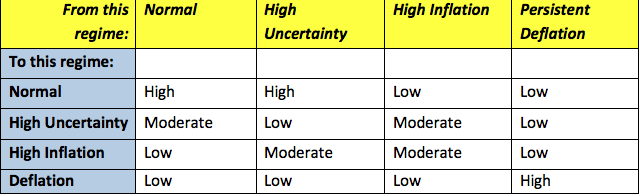
Yet today, we forecast that the probability of entering the deflation regime over the next 36 months is substantial. Given the historical tendency of deflation regimes to persist, it is critically important that investors understand what we know about what causes transitions into this regime, and how to escape its grasp.
This is an issue that has preoccupied us for nearly twenty years. We previously wrote about it in November 2002 (“Are We Headed Towards Global Deflation?”) and August 2010 (“The Risk of Deflation and Its Impact on Asset Class Returns”).
The Causes of Deflation
A frequently heard saying (at least if you spend time around macroeconomists) is that there are three kinds of deflation (defined as a decline in a broad index measuring the price of goods and services): good deflation, bad deflation, and ugly deflation (e.g., see “Deflation in a Historical Perspective”, by Bordo and Filardo). Let’s look at simplified examples of each of these.
Good deflation is caused by a sharp increase in the productive capacity of the economy — also known as a supply side shock (i.e., to simplify, the supply curve shifts to the right while the demand curve stays constant). Let’s look at two examples: One narrow, and the other broad.
In the USA, average natural gas price at Henry Hub (a major delivery point) was $8.86 per million cubic feet. Ten years later, it had declined to $3.17/mmcf. This happened because even though demand for natural gas grew over this period, total production grew even faster, from 25.6 trillion cubic feet per year, to 37.1 tcf.
To be sure, this fall in prices forced out of business those producers with the highest marginal cost of production. But this didn’t increase unemployment, because more efficient companies were growing, and laid off employees could switch to them. Moreover, this good deflation also generated significant social benefits — for example, the lower cost of natural gas enabled a reduction in CO2 emissions as electric power generation from gas replaced generation from coal.
A broader example of the same type of “good” deflation was the fall in the US price level at the end of the 19th century that was caused by the expansion of production of many goods as the industrial revolution entered its second phase. Note that in many “good deflations”, real per capita GDP continues to increase.
Bad deflation is caused not by an increase in supply, but rather by a reduction in demand (i.e., the demand curve shifts to the left while the supply curve stays constant). This is the type of deflation that Japan has faced (e.g., see, “Understanding the Costs of Deflation in the Japanese Context”, by Taimur Baig of the IMF). The extended fall in global demand between 1890 and 1896 (which, before the 1930s, was referred to as the “Great Depression”) is another example.
In bad deflations, in order to stay in business, producers are forced to cut prices down to the marginal cost of production. However, because of employees’ resistance to wage reduction, companies facing deflation often find it hard to reduce costs. As a result, the least efficient companies are forced out of business. In this case, however, because of weak overall demand, laid off employees will be more likely to become unemployed, which will further reduce aggregate demand. The classic policy remedy for this situation includes expanded government spending and/or tax cuts (fiscal stimulus) as well as expansion of the money supply to reduce interest rates in the hope of incentivizing more investment and consumption spending.
Ugly deflation occurs when the negative impact of bad deflation is amplified by the presence of high levels of debt throughout an economy, as happened in the United States during the 1930s Great Depression. High leverage lowers the threshold at which a fall in revenues will force a company into financial distress (which can lead to cost cutting and layoffs) or bankruptcy (which can result in its liquidation). Deflation worsens this dynamic by raising the real value of outstanding debt, without raising the debtor’s real capacity to service it. This process can also result in the lenders on the other side of those debt contracts falling into financial distress if a sufficient number of loans go bad. Finally, for consumers, high debt levels can cause even a slight fall in income to trigger financial problems.
The situation facing the world economy
Today we face a triple whammy of all three kinds of deflation:
Increased Productive Capacity
Over the past 25 years, the global economy has experienced a series of supply shocks, including, for example, the introduction of the internet and innovations in other information and communication technologies (ICT) and the profusion of new business models they spawned; the entry of China into the World Trade Organization in 2001; and with the advent of fracking (as well as the falling cost of electricity generation from wind and solar) the reversal of what had been a steady increase in the cost of energy. Looking ahead, the exponential improvement of automation, artificial intelligence, biotechnology, and advanced materials technologies promises to deliver further expansions of global production capacity in a wide range of economic sectors.
Weak Demand
In our August and September 2019 issues, we described the complex mix of interacting trends that are contributing to weak global demand (secular stagnation), including, for example, population ageing, weak productivity growth, rising inequality, increasing corporate concentration and pricing power, burdensome debt service payments, and high levels of general uncertainty and fear (“The Next Downturn: How Different? How Deep? How Long?” and “Future Labor Productivity Growth: The Supply Side Secular Stagnation Story”).
Excessive Debt
Global debt levels today are at unprecedented levels as a percentage of GDP, especially when off-balance sheet items like unfunded social security and defined benefit public pension liabilities are included. Particularly worrisome are high levels of corporate debt, much of which is now held by credit hedge funds, exchange traded funds, and other non-bank lenders that despite lacking access to liquidity via central bank discount windows, have still promised their investors access to liquidity over periods of time that are considerably shorter than the tenor of the debt they hold. This is the Russian Roulette version of maturity transformation. On top of this are still very high levels of consumer and student debt, despite attempts to deleverage for a decade after the 2008 Global Financial Crisis (a cause which certainly hasn’t been helped by rising inequality, social pressures for aspirational spending driven by conspicuous elite consumption, and still lax lending standards, for autos and student debt).
What do we know about escaping from the deflation regime, once we’ve fallen into it?
The glib answer is that it’s bloody hard once deflation expectations become entrenched, as we have seen in Japan.
Not so glibly, the historical record teaches us that successful exits from the deflation regime critically depend on an accurate diagnosis of the type of deflation policymakers are dealing with.
Unfortunately, today we face a very complex, interacting, and dangerous mix of all three types of deflation. Should we enter it, successful exit from the deflation regime will therefore require deft use of the monetary, fiscal, and structural policy tools that are available to national decision makers.
Reversing national exposure to the global supply shocks that cause good deflation is the least important challenge to address. That said, this seems to be one of the Trump administration’s policy objectives in the current US/China trade war.
Addressing secular demand stagnation that causes bad deflation is not only far more important, but also much more difficult, given the complex tangle of underlying root causes we face today.
With government debt rates at or below the “zero lower bound”, the ability of monetary policy to further stimulate demand is now much weaker than it has been in the past. A possible exception to this would be deliberate attempts to reduce a nation’s exchange rate, in order to raise import prices (and thus the overall price level), while boosting demand for cheaper exports. However, this type of “beggar-thy-neighbor” approach would almost certainly trigger retaliation by other countries.
That makes government fiscal policy much more important. However, this faces many challenges, including not only deciding on the mix of initiatives to pursue in the face of high uncertainty (e.g., tax cuts versus increased spending on transfer payments, infrastructure, R&D, defense, and other investments, and whether to pay for these via higher taxes on the wealthy and/or via deficit spending), but also gaining approval for these initiatives in the face of what is likely to be opposition from highly polarized and antagonistic legislatures and electorates. Moreover, as we saw when the United States attempted to pursue fiscal stimulus to moderate the impact of the 2008 downturn, the implementation of approved initiatives (like infrastructure projects) is highly likely to face local opposition (e.g., environmental litigation) and further delays.
As we have seen in Japan, the challenges of using monetary and fiscal policy to escape deflation pale in comparison to the political obstacles to the use of structural policy, such as changes to education healthcare, and financial systems, or the markets for goods, services, and labor, where defenders of the status quo are usually very firmly entrenched. Unfortunately, these are the very areas where change is likely to be critical to sustainable resolution of the weak demand problem.
However, all these challenges pale in comparison to the real elephant in the room: the debt problem that can trigger ugly deflation. As a veteran of the Latin American debt crisis (as well as assorted other workouts in North America and Europe), I long ago learned that there are only four solutions to excessive debt:
Prolonged Austerity – Cut spending in other areas in order to make debt service payments to creditors. The longer this approach continues, the more likely it will become self-defeating. Economically it depresses demand, which can worsen deflation and increase the real size of the debt, while also increasing political opposition to austerity.
Higher Growth – Everybody’s favorite silver bullet. Increase revenue/income to enable you to repay your debts without cutting, and hopefully while increasing consumption and investment spending. Unfortunately, it usually doesn’t work both because of the complex mix of challenges that must be resolved to increase aggregate demand, and because heavy debt service payments are often a critical obstacle to growth (e.g., they limit investment from internal cash flow, and restrict access to external financing).
Higher Inflation – This only works under three conditions that rarely fully apply: (1) your debt is denominated in a high inflation currency; (2) if this isn’t the currency in which you generate your revenue, then you have sufficient access to foreign exchange at the depreciating exchange rate inflation should cause; (3) the debt is fixed rate; and (4) the debt had a tenor/duration that is long enough for the inflation rate to substantially reduce its real value.
Restructuring and Write Offs – This is where most situations of excessive leverage and financial distress usually end up. Sometimes this process works well, as in the case of US Chapter 11 bankruptcies that often effectively convert debt to equity, and enable the company to keep operating. But the debt workout process can also get very ugly. Seizure and liquidation of collateral, particularly if it becomes widespread, can easily make a bad situation much worse, as falls in collateral reduce lenders’ incentives to roll over maturing loans that borrowers can’t repay, triggering more collateral liquidation, business failures, increased unemployment, weaker demand, and what the economist Irving Fisher termed a vicious “debt deflation” spiral. And Fisher wrote long before the invention of Credit Default Swaps, which, as we’ve seen in cases like the Thomas Cook Group Plc bankruptcy, can easily make debt restructurings much more complicated and push them towards collateral seizure and corporate failure.
It is almost certain that some people will claim there is a fifth alternative, commonly called “extend and pretend”. This entails using monetary policy to lower interest rates to reduce debt servicing burdens, and political and regulatory pressure to induce lenders to rollover maturing loans, or even increase them to cover interest payments that companies can’t pay out of operating cash flow or the proceeds from asset sales. However, as Japan has shown, kicking the can down the road like this (usually in the hope that an eventual revival of demand will enable excess debt to be repaid) can actually worsen the situation. So-called “zombie” companies on life support are unable make the investments (e.g., in research, training, and capital assets) that are needed to increase productivity, wages, profits, and aggregate demand. Instead, they serve as a drag on the economy.
One of the economic policymakers I most admire has reached the same conclusion. William White chaired the Economic and Development Review Committee at the Organisation for Economic Co-operation and Development from 2009 to 2018. Before that he was the Economic Adviser and Head of the Monetary and Economic Department at the Bank for International Settlements. He was one of the few who accurately forecasted the 2008 Global Financial Crisis.
In an interview earlier this year with “The Market” (www.themarket.ch), White noted that, “The path that we have been on has led us to a dead end…Years of expansionary fiscal and monetary policies have left the world economy overburdened with debt. In the next downturn, much of that debt will become unserviceable… Our economies would benefit greatly from more voluntary debt restructuring by creditors, and the sooner the better; orderly solutions are better than disorderly solutions. Moreover, there is a political advantage in forcing those who have made imprudent loans to pay a price for it. This would take the sting out of the populist cry that the elite always get off, while ordinary citizens suffer…
“Recently, the OECD, the IMF, and the Group of Thirty have drawn attention to the serious inadequacies in the legal framework for restructuring private sector debt in many countries. Laws are poorly drafted and the judicial framework is inadequate. There are not enough out of court deals, nor specialized judges, nor adequate flows of information, nor adequate enforcement…Many banks also have an inadequate capacity to manage bad loans internally, and in most countries no external market exists for distressed loans…All of this could and should be dealt with.”
Conclusion
As it turns out, we actually know quite a bit about how to escape the persistent deflation regime, should we fall into it. But that is the easy part. We also know from recent experience just how difficult it will be to gain political approval for the policy changes that will be required. And even if that challenge is met, the actual implementation of those policies will face equally daunting obstacles, with large-scale debt restructuring the biggest of all.
Asset Allocation Implications
There is a reason so much government debt has negative yields today. Rather than a source of income, it has become a defacto source of insurance against capital loss for which investors are willing to pay a premium. In the deflation regime, fiscal deficits will sharply increase, and government debt issuance will grow. However, to keep interest rates low (to minimize debt servicing problems), much of this new issuance will almost certainly end up on central bank balance sheets. With respect to real return government bonds (like TIPS), it is important to recognize that the way they adjust for inflation substantially differs across issues. Some of them increase capital value to compensate for inflation, but do not decrease it in the case of deflation. As such, these will produce very attractive returns in the deflation regime.
The deflation scenario will sharply increase yields (and defaults) on non-government bonds and loans. Withdrawals from bond and loan funds that promise investors daily liquidity will very likely trigger sharp price falls and market liquidity problems, which will likely have a non-linear impact on public uncertainty and fear. On the other hand, it is almost certain that bonds issues by companies with strong business models and balance sheets (i.e., low leverage) will be unfairly penalized during the period of market panic, and become underpriced relative to the risk they represent.
As the capital structures of most commercial property projects have high levels of debt, the same cautions regarding corporate debt apply here too. That said, commercial property will likely benefit by the tendency of some investors to move into this asset class when political-economic uncertainty sharply increases. In contrast, housing is usually highly leveraged and owned by individuals who will be exposed to much higher employment and income uncertainty in the deflation regime. As such, returns will likely be negative.
Returns on gold will almost certainly be high in the deflation regime. Timber will likely also deliver attractive returns, particularly if and when fears increase that exploding government debt levels will eventually result in high inflation. Due to very weak demand, other commodities are very unlikely to deliver attractive returns.
Returns on equity asset classes – including private equity (which specializes in highly leveraged investments) – are almost certain to be low during the deflation regime. However, sectoral returns within them – such as the consumer staples sector – will very likely be positive.
In terms of uncorrelated alpha strategies (that aim to deliver positive returns with a low correlation to returns on broad asset classes), higher levels of uncertainty will likely produce positive returns for global macro. Distressed debt strategies are also likely to deliver attractive returns. However, as the number of these funds is very likely to grow during the deflation regime, declining average manager quality will likely reduce overall average returns for this strategy.
If you have any questions about anything we have written in this issue, please don’t hesitate to get in touch, at contact@indexinvestor.com
Appendix: Anticipatory Thinking and Forecasting Methodologies
Our process is based on methods and tools developed over the past seven years at our affiliate, Britten Coyne Partners, which provides consulting services and education courses to executive teams and boards on strategic risk governance and management.
At The Index Investor, we engage in both anticipatory thinking to identify what could happen (e.g., different macro regimes and related events), and forecasting, to estimate the probability that events and regimes will happen, and the impact they will have if they do (e.g., on macro variables and broad asset class returns).
With respect to what could happen, we are acutely conscious of the conclusion reached by a 1983 CIA study of failed forecasts: "each involved historical discontinuity, and, in the early stages…unlikely outcomes. The basic problem was…situations in which trend continuity and precedent were of marginal, if not counterproductive value."
When it comes to forecasting, we know that in complex socio-technical systems that are constantly evolving, the accuracy of statistical or machine learning based forecasting methods declines exponentially as the time horizon lengthens, since the historical data set on which they were trained will (depending on the speed and effectiveness of any retraining cycle) bear less and less resemblance to the distribution of outcomes the system is likely to produce in the future.
Under these circumstances, forecast accuracy over longer time horizons depends on causal and counterfactual reasoning about the possible future effects of multiple interacting trends and uncertainties that are hard to quantify.
And we are acutely aware of the economist Rudi Dornbusch's famous warning: "Crises take a much longer time coming than you think, then happen much faster than you would have thought."
Our forecasting process also draws on lessons Tom Coyne learned from spending four years as a member of the Good Judgment Project team, which won the Intelligence Advanced Research Projects Activity’s forecasting tournament with forecast accuracy that was more than 50% better than the tournament's control groups (the team's experience is described in Professor Philip Tetlock's book, “Superforecasting").
Our analysis focuses on the probability of the global macro system being in four possible macro regimes 12 and 36 months from the date of our forecast: (1) Normal Times, where equity asset classes perform well; (2) a High Uncertainty regime that is usually short and transitory, where asset classes like short-term government bonds perform best and equities suffer significant declines; (3) High Inflation (which we deem 5% or more, year-on-year), where commercial property, real return bonds and other traditional hedges are favored; and (4) Persistent Deflation (a year-on-year decline in the US CPI), which up to now has only been seen in Japan, and in which the relative performance of different asset classes remains uncertain, but will likely favor high quality bonds and the consumer staples equity sector.
In response to subscriber requests, we have added a 36-month regime forecast to our existing 12 month forecast. The logic is that, in a complex evolving system like global macro, a longer forecast horizon gets beyond the “detection range” of algorithmic forecasting approaches, and therefore raises probability that a manager/investor can gain an edge in identifying emerging threats and opportunities.
That said, because evolving (i.e., “non-stationary”) complex systems populated by highly connected human agents are also capable of sudden non-linear changes (with which are hard for algorithmic approaches to predict), we are also keeping our 12 month forecast.
Our forecasting methodology starts with base rate/reference case data about the historical probability of large changes in equity and bond valuations. We then analyze the current situation from both a quantitative and qualitative perspective. In the latter, we focus on the key endogenous drivers of macro regime change, including technological, economic, national security, social, and political trends and uncertainties. We also focus on three potential sources of exogenous shocks that could also produce a macro regime change, caused by environmental, disease, and cyber related events.
While most of our attention typically focuses on various flows (e.g., economic growth, change in the price level, sales, earnings, job creation, etc.), endogenously caused regime changes result when those flows push key stocks beyond a critical threshold or tipping point, often setting off non-linear reactions across multiple areas. As noted by Hyman Minsky and others, a classic example is the steady accumulation of outstanding debt until it reaches the point where it can no longer be serviced and triggers a crisis.
Base Rate Data
Since the end of World War Two, there have been fifteen months where a downturn in the US equity market began that eventually reduced asset class value by 20% of more. That is a hazard rate of about 1.75% per month. Put differently, in any given month there is a 98.25% probability that a 20%+ downturn won’t occur, or, in a given year, an 81% probability.
However, as the time without a 20%+ downturn extends, the compound probability that one will not occur shrinks. At the end of August 2018, it is more than nine years since the last equity market decline of 20% or more. The probability of that happening is only 15%.
To estimate the base rate for a 20% fall in bond prices (which historically has been caused by a sharp increase in inflation, as we saw in the late 1970s and early 1980s), we analyzed monthly historical AAA bond yields since 1919. For consistency, we used them to calculate the price of a ten-year zero coupon bond. We then calculated the probability of a price decline of 20% or more over three different holding periods: 12, 18, and 24 months. In any month, the annualized probability of a decline of 20% or more over the subsequent 12 months is 12%; over 18 months, 20%, and over 24 months, 25%.
Market Stress Indicators Methodology
We view financial markets as a complex adaptive system. The size of changes generated by such a system follows a power law rather than a normal (Gaussian) distribution. The critical point is that large changes are much more common in complex adaptive systems than most people’s intuition leads them to believe.
While predicting the behavior of complex adaptive systems remains far more art than a science, various researchers have found that large changes in such systems are often preceded by subtle warning signs, as stress accumulates within them. While this research is not definitive, we believe that five warning signs are worth monitoring as potential indicators of growing stress within financial markets that could suddenly give rise to large changes in asset class valuations.
Our first indicator is the month-to-month autocorrelation of broad asset class returns (i.e., the relationship of this month’s returns to last month’s). A system under increasing stress loses resiliency, causing it to take longer to recover from perturbations; hence, autocorrelation increases as it approaches a critical transition (see, “Early Warning Signals for Critical Transitions” by Scheffer, et al).
The second market stress indicator we monitor is the Economic Policy Uncertainty Index published by the Federal Reserve Bank of St. Louis (via its FRED economic database), which is based on research by Baker, Bloom, and Davis (see their paper, “Measuring Economic Policy Uncertainty”). The index is based on automated text analysis of leading newspapers and magazine publications, to identify the frequency with which words and phrases are used that indicate uncertainty.
In humans’ evolutionary past, when uncertainty increased the probability of survival was enhanced by staying close to a group. All of us still have that instinct. Research has found that as uncertainty increases, we have an unconscious bias towards higher conformity of our own views with those of a larger group (i.e., reduction in cognitive diversity). Behaviorally, heightened uncertainty induces more “social copying” of others, likely due to both conformity bias and the rational belief that others may be acting on the basis of superior information. This increase in conformity and copying makes a social system more ordered as uncertainty increases, and also reduces its responsiveness to perturbations (i.e., increases autocorrelation) because of delays in the social copying process.
The key point is that increasing uncertainty induces more, not less order in social systems, and in so doing primes them for sudden non-linear change.
Our third market stress indicator is the spread between the yield on AAA rated bonds and the 10-year US Treasury. This is a proxy for the level of investor concern about financial system funding liquidity.
Our fourth market stress indicator is the yield spread between speculative BB rated bonds and the ten-year US Treasury. Throughout history, excessive credit growth has been a root cause of many financial crises. An indicator of such growth is falling credit spreads, particularly in the case of riskier borrowers. In contrast, rising BB spreads indicate growing investor concern about the consequences of such growth, and the financial distress lower rated companies could experience in an economic downturn.
Our fifth market stress indicator is what we term the “political risk premium” that is implicit in the price of gold. Our starting point for estimating this premium is the three different roles that gold plays. First, gold is a store of value in a world of fiat currencies. When the rate of money supply growth exceeds the growth of nominal GDP, gold’s price should increase to maintain its purchasing power. Between 2007 and 2017, the US money supply (M2) grew by about 86%, while nominal US GDP grew by 35%. The stock of gold grew by 18%, based on mine production over this period. We therefore infer that 33% of the increase in the price of gold represented the maximum potential gold price change that could be attributed to a desire to hedge inflation risk (86% less 35% less 18%).
Second, gold is a unit of account. We take this to mean that the annual change in GDP expressed in terms of physical gold (i.e., nominal GDP divided by the price of gold) should equal the change in real GDP calculated using the GDP price deflator to account for actual inflation over the period. A key challenge is the point at which to start this calculation.
We chose the price of gold in 1995/1996. In that period, the change in real global GDP measured using the IMF’s price deflator just about equaled the change in GDP measured in terms of physical gold. We interpret that coincidence as indicating that at that point in time, concerns about future inflation and political risk were minimal, and the change in the price of gold was mostly driven by its role as a unit of account. We calculated a subsequent series of gold prices that would produce the same change in “gold GDP” as the actual real GDP as calculated by the IMF. Between 2007 and 2017, “gold as a unit of account” warranted a 21% increase in its price.
Gold’s third role is as a hedge against inflation and what we term “political disaster” risk. We subtract the 21% estimated compensation for actual inflation from the 33% “gross” inflation risk hedge to derive an apparent 12% increase in the gold price that reflected the true risk premium to hedge against possible future inflation. However, between 2007 and 2017 the price of gold actually increased by 81%. This implies that 48% of this (81% less 21% less 12%) represented a premium for some other type of uncertainty at the end of 2017. The interesting question is the nature of the uncertainty for which gold is believed by some investors to be a superior hedge than traditional ports in a storm like short-term US government securities, or similar securities issued by other developed countries.
The logical inference is that the uncertainty in question must reflect a situation in which short term US Treasuries would be a less effective hedge than gold. This could be a world of widespread hyperinflation, capital controls, and/or radical changes in nations’ governments (of course, this would also imply a preference for investing in gold coins rather than bullion, as while the latter may be a store of value, it is far less convenient as a means of paying for transactions).
To put this in further perspective, this gold price “disaster risk” premium sharply increased from 2008 to 2012, then declined before sharply increasing again after 2016. Arguably, a significant part of the former increase reflects concerns about the potential inflationary consequences of dramatic quantitative easing by central banks. But this is not likely to be the case after 2016.