The Index Investor
April 2019
Key Takeaways
Many asset classes remain significantly overvalued.
Market stress indicators remain weak. Asset class return indicators imply that aggregate expectations favor either a return to the Normal Regime or a transition to the High Inflation Regime. We believe this conventional wisdom is wrong.
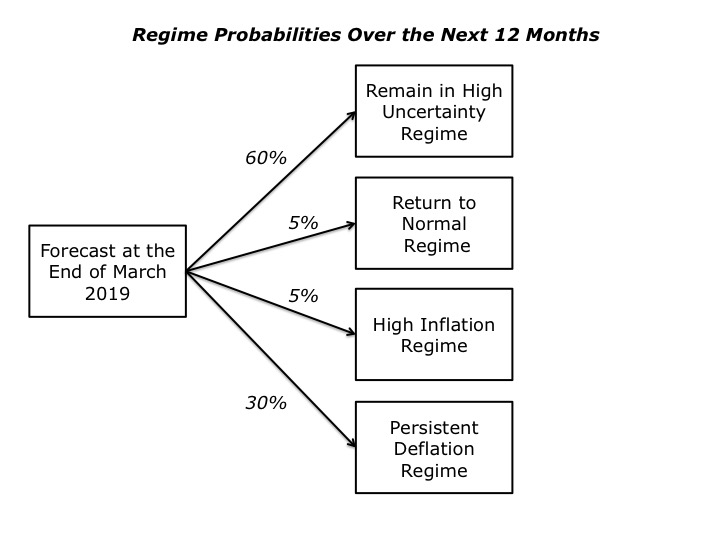
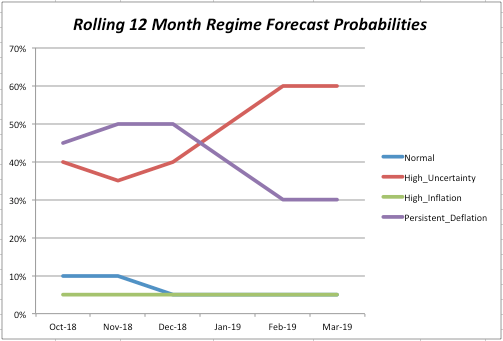
We have not changed our estimated probability that 12 months from now the macro system will still be in the High Uncertainty Regime (60%) or the Persistent Deflation Regime (30%).
We are closely watching housing market developments, given that sector’s 33% weighting in the US Consumer Price Index. Given the weight of additional evidence received this month, further signs of accelerating housing market weakening will cause us to increase the estimated probability that within the next 12 months we will transition to the Persistent Deflation Regime.
This month’s feature article presents Conviction Narrative as a complement to Bayesian forecasting methods. We present four different narratives that argue why, in 2022, the macro system will be in each of our four possible regimes.
Asset Class Valuation and Momentum Indicators (@29March19)
| Asset Class (ETF) | Valuation | 1 Month Return | Conclusion |
| US Real Return Govt Bond (TIP) | Likely Overvalued* | 1.98% | Increasing Overvaluation |
| US Nom Return Govt Bond (GOVT) | Likely Overvalued* | 1.98% | Increasing Overvaluation |
| US Investment Grade Credit (LQD) | Close to Fairly Valued* | 2.96% | Close to Fairly Valued |
| US High Yield Credit (HYG) | Very Likely Overvalued* | 1.29% | Increasing Overvaluation |
| US Commercial Property (VNQ) | Likely Undervalued* | 4.21% | Decreasing Undervaluation |
| US Equity (VTI) | Likely Overvalued* | 1.21% | Increasing Overvaluation |
| Foreign Developed Mkt Equity (VEA) | Likely Undervalued* | 0.60% | Decreasing Undervaluation |
| Emerging Markets Equity (VWO) | Almost Certainly Overvalued* | 2.31% | Increasing Overvaluation |
| Timber (WY) | Very Likely Undervalued* | 1.90% | Decreasing Undervaluation |
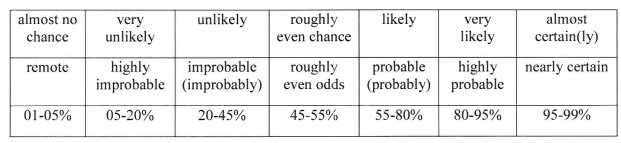
Note: The language we use to describe our estimated likelihood of asset class over or undervaluation is based on US Intelligence Community Directive 203 on Analytic Standards, which includes the following table:
Market Stress Indicators (@29Mar19)
| Market Stress Indicator | This Month vs Last Month |
| Asset Class Returns Autocorrelation (this month versus last month). Higher autocorrelation is an indicator of higher market stress. | .26 vs .28 vs last month. Indicates a low level of market stress. |
| Economic Policy Uncertainty Index (how many days over the last 30 was index in top quartile of values since 1985?) | On 5 days the index was in the top quartile of daily values since 1984 (the 48th percentile of all rolling 30 day counts). This is a significant fall since last month, when this indicator was in the 89th percentile. |
| AAA Rated Bonds Spread over 10 Year Treasury Yield (month end). Higher spreads indicate rising concern about market liquidity. | 1.13% (44th percentile since 1983) vs 1.16% last month. |
| BB Rated Bonds Spread over 10 Year Treasury Yield (month end). High spreads indicate increasing credit risk. | 2.39% (21st percentile since 1996). No change from last month. |
| Gold Price per Ounce in US Dollars (month end). Rising gold prices are an indicator of increasing market uncertainty and stress. | $1,291 vs.$1,325 last month. Down (2.59%). |
Market Stress Indicators: Forecast Discussion
We view financial markets as a complex adaptive system. The size of changes generated by such a system follows a power law rather than a normal (Gaussian) distribution. The critical point is that large changes are much more common in complex adaptive systems than most people’s intuition leads them to believe.
While predicting the behavior of complex adaptive systems remains far more art than a science, various researchers have found that large changes in such systems are often preceded by subtle warning signs, as stress accumulates within them. While this research is not definitive, we believe that five warning signs are worth monitoring as potential indicators of growing stress within financial markets that could suddenly give rise to large changes in asset class valuations.
Our first indicator is the month-to-month autocorrelation of broad asset class returns (i.e., the relationship of this month’s returns to last month’s). A system under increasing stress loses resiliency, causing it to take longer to recover from perturbations; hence, autocorrelation increases as it approaches a critical transition (see, “Early Warning Signals for Critical Transitions” by Scheffer, et al).
The one-month autocorrelation of returns for the broad asset classes we monitor was about unchanged from last month. This indicates that financial markets remained less ordered in March, and thus potentially further away from a critical transition point (which would most likely be accompanied by sudden and substantial changes in asset class values) than they were last month.
The second market stress indicator we monitor is the Economic Policy Uncertainty Index published by the Federal Reserve Bank of St. Louis (via its FRED economic database), which is based on research by Baker, Bloom, and Davis (see their paper, “Measuring Economic Policy Uncertainty”). The index is based on automated text analysis of leading newspapers and magazine publications, to identify the frequency with which words and phrases are used that indicate uncertainty.
In humans’ evolutionary past, when uncertainty increased the probability of survival was enhanced by staying close to a group. All of us still have that instinct. Research has found that as uncertainty increases, we have an unconscious bias towards higher conformity of our own views with those of a larger group (i.e., reduction in cognitive diversity). Behaviorally, heightened uncertainty induces more “social copying” of others, likely due to both conformity bias and the rational belief that others may be acting on the basis of superior information. This increase in conformity and copying makes a social system more ordered as uncertainty increases, and also reduces its responsiveness to perturbations (i.e., increases autocorrelation) because of delays in the social copying process.
The key point is that increasing uncertainty induces more, not less order in social systems, and in so doing primes them for sudden non-linear change.
Based on our continued research into the insights this index can provide, in 2019 we are focusing on the number of days, in the previous 30 days, that this index was in the top quartile of all values since the index series begins at the start of 1985. We then compare this statistic to the full set of rolling 30-day periods, and calculate its percentile at the end of the most recent month. At the end of March, our rolling 30 day count of top quartile values was in the 48thth percentile – a slight increase from last month, which indicates the macro system is still not strongly primed for sudden, non-linear change.
Our third market stress indicator is the spread between the yield on AAA rated bonds and the 10-year US Treasury. This is a proxy for the level of investor concern about financial system funding liquidity. At the end of March 2019, this spread stood at 1.21%, (the 48th percentile since the series began in 1983), up only slightly from last month’s 1.13% spread. This indicates essentially no change in market stress.
Our fourth market stress indicator is the yield spread between speculative BB rated bonds and the ten-year US Treasury. Throughout history, excessive credit growth has been a root cause of many financial crises. An indicator of such growth is falling credit spreads, particularly in the case of riskier borrowers. In contrast, rising BB spreads indicate growing investor concern about the consequences of such growth, and the financial distress lower rated companies could experience in an economic downturn. At the end of March 2019, this spread was 2.39% (21st percentile since the series began in 1996), unchanged from last month. This is a very low level for this late in what is already an exceptionally long period without a serious economic downturn. As such, it likely indicates the further buildup of hidden stresses in credit markets.
Our fifth market stress indicator is what we term the “political risk premium” that is implicit in the price of gold. Our starting point for estimating this premium is the three different roles that gold plays. First, gold is a store of value in a world of fiat currencies. When the rate of money supply growth exceeds the growth of nominal GDP, gold’s price should increase to maintain its purchasing power. Between 2007 and 2017, the US money supply (M2) grew by about 86%, while nominal US GDP grew by 35%. The stock of gold grew by 18%, based on mine production over this period. We therefore infer that 33% of the increase in the price of gold represented the maximum potential gold price change that could be attributed to a desire to hedge inflation risk (86% less 35% less 18%).
Second, gold is a unit of account. We take this to mean that the annual change in GDP expressed in terms of physical gold (i.e., nominal GDP divided by the price of gold) should equal the change in real GDP calculated using the GDP price deflator to account for actual inflation over the period. A key challenge is the point at which to start this calculation.
We chose the price of gold in 1995/1996. In that period, the change in real global GDP measured using the IMF’s price deflator just about equaled the change in GDP measured in terms of physical gold. We interpret that coincidence as indicating that at that point in time, concerns about future inflation and political risk were minimal, and the change in the price of gold was mostly driven by its role as a unit of account. We calculated a subsequent series of gold prices that would produce the same change in “gold GDP” as the actual real GDP as calculated by the IMF. Between 2007 and 2017, “gold as a unit of account” warranted a 21% increase in its price.
Gold’s third role is as a hedge against inflation and what we term “political disaster” risk. We subtract the 21% estimated compensation for actual inflation from the 33% “gross” inflation risk hedge to derive an apparent 12% increase in the gold price that reflected the true risk premium to hedge against possible future inflation. However, between 2007 and 2017 the price of gold actually increased by 81%. This implies that 48% of this (81% less 21% less 12%) represented a premium for some other type of uncertainty at the end of 2017. The interesting question is the nature of the uncertainty for which gold is believed by some investors to be a superior hedge than traditional ports in a storm like short-term US government securities, or similar securities issued by other developed countries.
The logical inference is that the uncertainty in question must reflect a situation in which short term US Treasuries would be a less effective hedge than gold. This could be a world of widespread hyperinflation, capital controls, and/or radical changes in nations’ governments (of course, this would also imply a preference for investing in gold coins rather than bullion, as while the latter may be a store of value, it is far less convenient as a means of paying for transactions).
To put this in further perspective, this gold price “disaster risk” premium sharply increased from 2008 to 2012, then declined before sharply increasing again after 2016. Arguably, a significant part of the former increase reflects concerns about the potential inflationary consequences of dramatic quantitative easing by central banks. But this is not likely to be the case after 2016.
Over the last month, the price of gold fell by (2.59%). Since the end of 2017, it is now down by (0.41%). Therefore, on a rough approximation, the political uncertainty premium at the end of February 2019 stood at about 48% (48% - .41%) compared to a low of about 39% at the end of August 2018. On balance, this is another indication of falling market stress.
To conclude, four of our indicators – asset class return autocorrelation, top quartile values for the Economic Uncertainty Index, the AAA spread over Treasuries, and the price of gold – point to a relatively low level of underlying market stress this month. Our metric for the BB spread is also consistent with this conclusion, but seems exceptionally low for this late stage of what has bee an extended, if relatively weak, recovery.
Macro Regime Forecast and Implications for Asset Class Values
Macro Regime Probabilities: Forecast Discussion
Perhaps the wisest insight I’ve come across in 40 years of forecasting is this quote by the late economist Rudi Dornbusch: “Crises take a much longer time coming than you think, then happen much faster than you would have thought.”
While there were certainly new pieces of high value information this month (as you can see later in this report), their cumulative weight was not sufficient to cause a change in our forecast regime probabilities this month. To be sure, there are more indications that the global economy’s three demand motors (the US, EU, and China) are simultaneously weakening, which is a distinctly negative sign. Moreover, new articles by Larry Summers and Claudio Borio of the Bank for International Settlements made the case, respectively, that “secular stagnation” is well-underway in the private sector, and that it’s negative impact will likely be amplified by financial market conditions, including high leverage and rates that are near the zero lower bound.
Finally, and perhaps most importantly when it comes to the persistent deflation regime, Daniel Alpert published a new paper arguing that house prices are once again above levels that have historically proven to be sustainable. Together, these information inputs would seem to argue for an increase in the probability that we will be in a persistent deflation regime 12 months hence, and a decrease in the probability of remaining in the current high uncertainty regime, which was once again supported by many new pieces of high value information. On balance, we decided to wait for another month of new evidence before changing our current regime probabilities.
Forecast Methodology
The focus of our monthly macro forecast is twofold. First, the probability of a change in financial market regime that causes changes of 20% or more in asset class valuations over the next year. Second, contingent on such a change taking place, the probability of a subsequent transition to other regimes.
Our analysis focuses on four possible macro regimes: (1) Normal Times, where equity asset classes perform well; (2) a High Uncertainty regime that is usually short and transitory, where asset classes like short-term government bonds perform best and equities suffer significant declines; (3) High Inflation (which we deem 5% or more, year-on-year), where commercial property, real return bonds and other traditional hedges are favored; and (4) Persistent Deflation (a year-on-year decline in the US CPI), which up to now has only been seen in Japan, and in which the relative performance of different asset classes remains uncertain, but will likely favor high quality bonds and the consumer staples equity sector.
Our forecasting methodology is derived from our experience on the Good Judgment Project, as described in the book, “Superforecasting” by Gardner and Tetlock, as well as a range of other sources, from the intelligence community to systems dynamics and complex adaptive systems to statistics and political economy.
We start with base rate/reference case data about the historical probability of large changes in equity and bond valuations. We then analyze the current situation from both a quantitative and qualitative perspective. In the latter, we focus on the key endogenous drivers of macro regime change, including technological, economic, national security, social, and political trends and uncertainties. We also focus on three potential sources of exogenous shocks that could also produce a macro regime change, caused by environmental, disease, and cyber related events.
While most of our attention typically focuses on various flows (e.g., economic growth, change in the price level, sales, earnings, job creation, etc.), endogenously caused regime changes result when those flows push key stocks beyond a critical threshold or tipping point, often setting off non-linear reactions across multiple areas. As noted by Hyman Minsky and others, a classic example is the steady accumulation of outstanding debt until it reaches the point where it can no longer be serviced and triggers a crisis.
Base Rate Data
Since the end of World War Two, there have been fifteen months where a downturn in the US equity market began that eventually reduced asset class value by 20% of more. That is a hazard rate of about 1.75% per month. Put differently, in any given month there is a 98.25% probability that a 20%+ downturn won’t occur, or, in a given year, an 81% probability.
However, as the time without a 20%+ downturn extends, the compound probability that one will not occur shrinks. At the end of August 2018, it is more than nine years since the last equity market decline of 20% or more. The probability of that happening is only 15%.
To estimate the base rate for a 20% fall in bond prices (which historically has been caused by a sharp increase in inflation, as we saw in the late 1970s and early 1980s), we analyzed monthly historical AAA bond yields since 1919. For consistency, we used them to calculate the price of a ten-year zero coupon bond. We then calculated the probability of a price decline of 20% or more over three different holding periods: 12, 18, and 24 months. In any month, the annualized probability of a decline of 20% or more over the subsequent 12 months is 12%; over 18 months, 20%, and over 24 months, 25%.
The Current State of Quantitative Regime Predictors
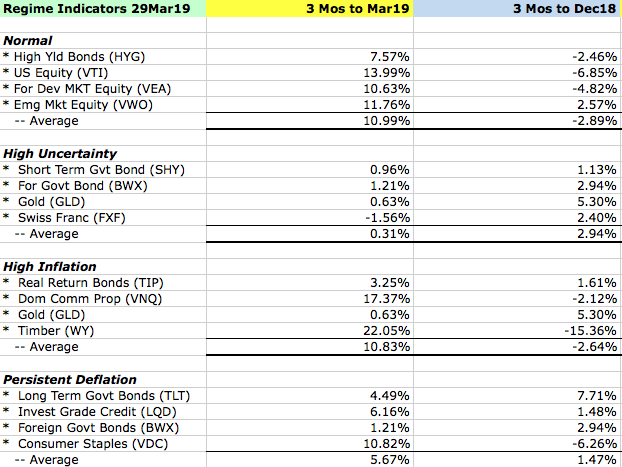
Our quantitative methodology focuses on the level and change in three-month returns, over the most recent and previous three-month periods, for those asset classes which should perform best under different regimes.
As you can see in the following table, based on three month returns to the end of last month, this analysis indicates that the balance of expectations across all four regimes was in rough balance, which we consider to be another indication of high underlying uncertainty.
That said, comparing the change between the two three month periods, positive momentum is strongest for both the Normal and the High Inflation Regimes.
Like Professors Andrew Lo, Doyne Farmer and others, we regard financial markets as a complex adaptive system (CAS), that exist as part of a larger macro system comprised of other CAS between which there are multiple feedback loops. These other systems include those that produce technology innovations, and economic, environmental, national security (including cyber), social, demographic, and political outcomes.
We also find that these systems tend to operate and generate effects in a rough chronological sequence, albeit with many feedback loops between them. The following chart highlights that the changes we observe in different areas at any point in time are actually part of a much more complex evolutionary process.
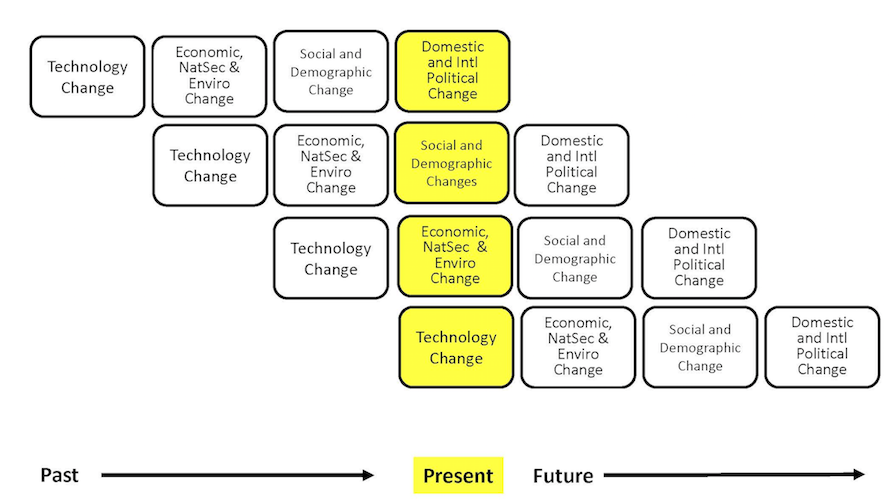
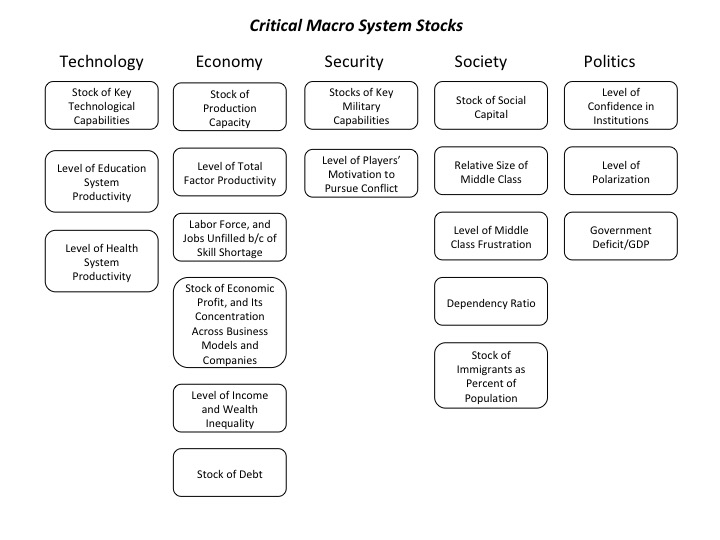
While most media coverage of these systems focused on flows (e.g., the size of the government deficit), rapid non-linear change in complex adaptive systems is often caused by a key stock (e.g., the amount of outstanding government debt) exceeding a critical threshold.
The next table highlights the key macro system stocks that we monitor.
In the next section, we will discuss information received over the past month that is related to these stocks, and which we believe is significant to our assessment of the probabilities that a critical threshold will be reached and a regime change will occur. We will conclude with our estimate, at the end of this month, of how close the macro system is to these critical thresholds, and the implications for financial market regime change probabilities.
In our methodology, we classify new information as significant and highly valuable if either it (1) is an “indicator”, which reduces or increases our uncertainty about the value of a parameter in our mental model for making sense of the dynamic macro system, or (2) it is a “surprise” which increases our uncertainty about, and causes us to revaluate the structure of our mental model.
| New Technology Information: Indicators and Surprises | Why Is This Information Valuable? |
| “Rigorous Agent Evaluation: An Adversarial Approach To Uncover Catastrophic Failures”, by Uesato et al from Deep Mind | Surprise This paper details how generative adversarial networks can be used to identify catastrophic failure modes in complex adaptive system. As this technology is further developed, it has potentially very important applications, in both the national security and economic sectors. |
| “The Neuro-Symbolic Concept Learner: Interpreting Scenes, Words, And Sentences From Natural Supervision”, by Mao, et al from MIT, IBM, and DeepMind | Surprise The authors describe a potentially very powerful new approach to AI, which combines symbolic concept learning with a deep neural network. This leads to a substantial reduction in the amount of training data required, as well as a sharp improvement in the speed of concept learning, and thus, potentially, improvements in transfer learning (i.e., the application of concepts to novel situations). |
| “Tackling Europe’s Gap in Digital and AI” by the McKinsey Global Institute | This report’s discouraging conclusions about the state of digitization and AI adoption in Europe has important implications for the region’s future economic growth, national security spending, social conditions, and political conflicts. “Digitisation is an important technical and organisational precondition for the spread of AI, yet Europe’s digital gap—at about 35 percent with the United States—has not narrowed in recent years. Early digital companies have been the first to develop strong positions in AI, yet only two European companies are in the worldwide digital top 30, and Europe is home to only 10 percent of the world’s digital unicorns...” “Europe has about 25 percent of AI startups, but its early-stage investment in AI lags behind that of the United States and China. Further, with the exception of smart robotics, Europe is not ahead of the United States in AI diffusion, and less than half of European firms have adopted one AI technology, with a majority of those still in the pilot stage.” |
| “Informed Machine Learning – Towards a Taxonomy of Explicit Integration of Knowledge into Machine Learning”, by von Rueden et al | One of the constraints on the development and application of artificial intelligence technologies has been their need for large amounts of training data. We have previously noted the development of generative adversarial networks which generate artificial training data to speed the learning process. Another approach is the inclusion of domain knowledge to speed learning. This approach also potentially facilitates the development of abstractions by AI, which in turn facilitates “transfer learning”, or the application of conceptual abstractions to new situations, as is the case in human learning. This paper provides a useful taxonomy that helps you to understand this knowledge application process, and thus to develop different indicators as to its progress. |
| “The Algorithmic Automation Problem: Prediction, Triage, and Human Effort”, by Rahu et al | As we have noted in past issues, the deployment of AI technologies is proceeding more slowly than some had expected. This paper describes how one of the underlying problems – determining whether an AI or a human being is best suited to perform a given task – can be more efficiently addressed. It thus provides another indicator that can be used to improve estimates of the speed of AI deployment, and thus their future impact on the economy, society, and politics. |
| “How Aligned is Career and Technical Education to Local Labor Markets?”, by the Fordham Institute | Surprise As we have noted before, both education and healthcare provision are two critical enabling “social technologies” that have profound “downstream” impacts on economic, national security, social and political issues. This depressing report highlights the surprising extent to which CTE programs in the United States (usually known as Vocational and Technical Education in other nations) are not providing students with competences and credentials that are highly valued in private sector labor markets. If not corrected, this will contribute to weaker economic growth, more demand for social safety net spending, and probably higher levels of social and political conflict. |
| “Causal Effect Identification from Multiple Incomplete Data Sources: A General Search-based Approach”, by Tikka et al | This is a very technical paper, but highlights use of Judea Pearl’s do-calculus in automated search for causal relationships in a large data set. As such, it is a key indicator of AI progress in the critical area of causal (and counterfactual) modeling. |
| “How China tried and failed to win the AI race: The inside story”, by Alison Rayome in Tech Republic | Surprise The author claims that, “China fooled the world into believing it is winning the AI race, when really it is only just getting started.” However, a close reading of the article leaves us with a less smug conclusion, based on the distinction between a snapshot of a situation and how fast it is evolving over time. A more accurate conclusion seems to be that while the US is currently ahead of China in key areas of AI (including the chips on which AI software runs), in some areas the pace of improvement in China seems to be faster than the pace in the US (e.g., how lack of privacy concerns is enabling the creation of very large training data sets). In sum, the claim that “China has tried and failed to win the AI race” seems very premature. |
| “Once Hailed as Unhackable, Blockchains are Getting Hacked” by Mike Orcutt in MIT Technology Review | Surprise “A blockchain is a cryptographic database maintained by a network of computers, each of which stores a copy of the most uptodate version. A blockchain protocol is a set of rules that dictate how the computers in the network, called nodes, should verify new transactions and add them to the database. The protocol employs cryptography, game theory, and economics to create incentives for the nodes to work toward securing the network instead of attacking it for personal gain. If set up correctly, this system can make it extremely difficult and expensive to add false transactions but relatively easy to verify valid ones.” “That’s what’s made the technology so appealing to many industries…But the more complex a blockchain system is, the more ways there are to make mistakes while setting it up.” “We’ve long known that just as blockchains have unique security features, they have unique vulnerabilities. Marketing slogans and headlines that called the technology “unhackable” were dead wrong. That’s been understood, at least in theory, since Bitcoin emerged a decade ago. But in the past year, amidst a Cambrian explosion of new cryptocurrency projects, we’ve started to see what this means in practice—and what these inherent weaknesses could mean for the future of blockchains and digital assets.” |
| | |
| | |
| | |
| | |
| New Economic Information: Indicators and Surprises | Why Is This Information Valuable? |
| “World economy lurches from uneven recovery to synchronized slowdown”, Brookings Institution, 7Apr19 | Based on the latest update to the Brookings/Financial Times “Tracking Indexes for the Global Economic Recovery (TIGER)” Eswar Prasad of Brookings concludes that, “the drumbeat of warnings about a looming worldwide recession is rising. Although such concerns seem premature, major advanced and emerging market economies are all losing growth momentum. The nature of the slowdown has ominous portents for these economies over the next few years, especially given present constraints on macroeconomic policies that could stimulate growth.” |
| March saw a rising number of articles that noted indicators of a slowing economy and looming recession. | “Bain Boss Warns Over Private Equity Debt Levels”, FT, 1Apr19 “German 10-year bond yield slips below zero for first time since 2016”, FT, 22Mar19 “Euro and stocks hit after bleak data stokes slowdown fears”, FT, 22Mar19 “Global Debt: When is the Day of Reckoning?”, FT, 16Mar19 “U.S. Debt: Is It the Calm Before the Storm?”, Knowledge@Wharton, 15Mar19 |
| “US Corporate Debt is High, But Not Yet Dangerous” by Gavyn Davies, Financial Times, 25Mar19 | Surprise In contrast to commentators warning about the potential negative consequences of high corporate debt levels, Davies notes that corporate profit margins are still high, and interest rates are still low, which makes the current stock of debt easier to service. That said, he also acknowledges that there are pockets of concern, such as leveraged loans. |
| “On Falling Neutral Real Rates, Fiscal Policy, and the Risk of Secular Stagnation”, by Lukasz and Summers | “This paper demonstrates that neutral real interest rates would have declined by far more than what has been observed in the industrial world and would in all likelihood be significantly negative but for offsetting fiscal policies over the last generation.” “We start by arguing that neutral real interest rates are best estimated for the block of all industrial economies given capital mobility between them and relatively limited fluctuations in their collective current account. We show, using standard econometric procedures and looking at direct market indicators of prospective real rates, that neutral real interest rates have declined by at least 300 basis points over the last generation.” “We argue that these secular movements are in larger part a reflection of changes in saving and investment propensities rather than the safety and liquidity properties of Treasury instruments. We then point out that the movements in the neutral real rate reflect both developments in the private sector and in public policy.” “We highlight the levels of government debt, the extent of pay-as-you-go old age pensions and the insurance value of government health care programs have all ceteris paribus operated to raise neutral real rates.” [However], “we suggest that the private sector neutral real rate may have declined by as much as 700 basis points since the 1970s” [due to a wide range of trends, including aging, declining total factor productivity growth, rising inequality, and increasing concentration in many industries]. The authors conclude that their “findings support the idea that, absent offsetting policies, mature industrial economies are prone to secular stagnation [weak demand relative to potential supply]…Policymakers going forward will need to engage in some combination of greater tolerance of budget deficits, unconventional monetary policies and structural measures to promote private investment and absorb private saving if full employment is to be maintained and inflation targets are to be hit.” |
| “Why markets should get set for QE4” by Michael Howell, 19Feb19 | SURPRISE Minsky would love this paper, as it describes our continued progression towards the “Minsky Moment” when the full nature of the debt crisis we face will become widely appreciated. “To better understand the risks, we must think of western financial systems as essentially capital redistribution mechanisms that are used to refinance existing positions, rather than capital-raising mechanisms to obtain new money. This refinancing role means that quantity (liquidity) matters more than quality (price, or interest rates). Liquidity derives from balance sheet capacity and, in America, this is closely linked to the size of the Fed’s QE operations. Liquidity can be measured based on the funds that flow through both the traditional banking system and the wholesale money markets. The latter have taken on huge importance in recent years, eclipsing banks as sources of lending. They have been fueled by vast inflows from institutional cash pools, such as cash-rich companies, asset managers and hedge funds, the cash-collateral business of derivative traders and foreign exchange reserve managers. These pools have outgrown the banking systems, and their size typically exceeds the deposit insurance thresholds for government guarantees. “It is why these pools need to invest in other secure short-term liquid assets. In the absence of instruments provided by the state — in the form of central bank lending facilities and Treasury bills — the private sector has had to step in. This has happened largely through short-term loans known as repurchase agreements, or repos; and asset-backed commercial paper. “The credit system increasingly operates through these repo markets, and often with active central bank participation. The repo mechanism bundles together “safe” assets, such as government bonds, foreign exchange and high-grade corporate debt, and uses these as security against which to borrow. While credit risk is to some extent mitigated, the risk of being able to roll or refinance positions remains. The search forever more collateral encourages the issuance of higher quality private bonds, which, in turn, allows for greater issuance of lower-grade bonds. A deteriorating economic backdrop and tight market liquidity can compromise this poorer quality debt because the heightened risk of default often means that demand dries up and prevents their refinancing. This kind of shock could reverberate and trigger a rush from investors into high-quality, short-term instruments, such as government-backed Treasury bills, central bank reverse repos and banks’ reserves. So is another crash coming? Much depends on the central banks. Whereas the global financial crisis was caused by too much private sector leverage, our concern today is a growing shortage of central bank liquidity caused by the deliberate unwinding of the QE policies put in place to replace the private sector funding that evaporated in 2007/08. The bottom line is that liquidity matters hugely, and modern financial systems cannot function without large central bank balance sheets. In short, we expect to see another round of central-bank asset purchases — “QE4” — far sooner than many expect.” |
| “What Anchors for the Natural Rate of Interest?” by Borio et al from the Bank for International Settlements | Similar to the Lukasz and Summers analysis, this paper also takes a critical look at the conceptual and empirical underpinnings of prevailing explanations for low real (inflation-adjusted) interest rates over long horizons and finds them incomplete. The authors’ perspective “differs from the standard narratives put forward to explain the trend decline in real interest rates. Invariably, the presumption is that an excess of ex ante saving over investment has driven equilibrium real interest rates down. In this narrative, monetary and financial factors play at most only a cursory role, if any. For instance, in his secular stagnation hypothesis, Summers (2015) contends that chronically weak aggregate demand together with the zero lower bound have kept desired saving above investment and pushed the natural rate below market rates…” “The role of monetary policy, and its interaction with the financial cycle in particular, deserve greater attention. By linking booms and busts, the financial cycle generates important path dependencies that give rise to intertemporal policy trade-offs. Policy today constrains policy tomorrow. Far from being neutral, the policy regime can exert a persistent influence on the economy’s evolution, including on the real interest rate…” “The interest rate is of immense importance in today’s highly financialised economy. It underpins borrowing and lending, thus acting as a speed regulator for activity… “There is a growing recognition that the financial cycle exerts a powerful and potentially long-lasting influence on the economy, not least when it implodes. To the extent that monetary policy, which sets the price of leverage, can influence the financial cycle, it too may have a persistent impact on the economy’s long-run path, and hence also on real interest rates… “The underlying theme is that booms usher in busts. The fragilities that emerge during the bust build up during the preceding boom and cannot be analysed without reference to it. This contrasts with popular approaches that view crises as the result of (exogenous) shocks amplified by financial frictions in the system… “These features introduce an intertemporal policy trade-off. Easier policy today boosts output in the short run but accommodates the build-up of financial imbalances, which generate large output losses in the long run when they implode. Depending on the monetary policy rule, the economy’s fragility to boom-bust cycles may be high or low, with significant implications for the long-run evolution of output and real interest rates.” |
| “The Real Effects of Zombie Lending in Europe”, Bank of England Working Paper by Belinda Tracy | “Around 10% of European firms were in receipt of subsidized bank loans following the peak of the European sovereign debt crisis in 2011. To what extent did such forbearance lending contribute to the subsequent low output growth experienced by the euro area? In this paper, we address this question by developing a quantitative model of firm dynamics in which forbearance lending and firm defaults arise endogenously. The model provides a close approximation to key euro-area firm statistics over the period 2011 to 2014. We evaluate the impact of forbearance lending by considering a counterfactual scenario in which firms no longer have access to loan forbearance. Our key finding is that aggregate output, investment and total factor productivity are higher in the absence of forbearance lending than in the benchmark scenario that includes forbearance lending. This suggests that forbearance lending practices contributed to the low output growth across the euro area following the onset of the sovereign debt crisis.” This echoes a similar point made by Raha Foroohar in the FT: “Low interest rates have papered over myriad political and economic problems, not just for 10 years, but for decades.” |
| “What the Federal Reserve Got Totally Wrong about Inflation and Interest Rate Policy: Getting Real About Rents”, by Daniel Alpert | Surprise Alpert argues that the Fed “has failed to appreciate the changes to inflation dynamics changes that have persisted over the past 15 years. In particular, the nature of inflation in the housing sector and the extent to which it has dominated the entire subject of price inflation. In short, this is not your father’s inflation.” He notes that, “since the end of 2013, housing – and, particularly, rents and owners’ equivalent rents of primary residences (Aggregate Rent) – has dominated both the core and all-items measure of CPI in a manner never before experienced (even during the housing bubble of the 2000s) and has distorted both measures considerably… “The reasons for the vast impact of residential housing rent inflation relate not to the classic demand-push inflation that would be characteristic of a post-recession recovery in employment and economic growth – but are to be found in the dramatic changes in the nature of housing demand, the supply of new housing, and slowed residential mobility since the Great Recession… “An unprecedented contraction in the inventory of owner-occupied and for sale residential housing, together with a dramatic fall off (especially when adjusted for the number of U.S. households) in the availability and sales of owner-occupied housing, has produced pressures on both residential rents and prices that are not consistent, from a causal perspective, with any period of economic growth in modern U.S. history… “Fed policy rate and quantitative easing during and for most of the decade since the beginning of the Great Recession sparked growth in owner-occupied home prices that, while not as dramatic of that during the housing bubble of the 2000s is once again inconsistent with the growth in prices of housing construction inputs, meaning that it represents a speculative increase in the price of land itself. [Housing prices] have again risen above the level to which home prices have traditionally been anchored. This is proving to be unsustainable, and housing price growth is decelerating.” |
| “Why Does Everyone Hate MMT?” by James Montier, from Grantham, Mayo, van Otterloo | Surprise James Montier is one of the macro commentators whose work I have eagerly read for years. As always, his latest note is thought provoking. Montier believes that Modern Monetary Theory has been unfairly maligned by many mainstream economists. He notes that “understanding a nation’s monetary environment is vital…Any country that issues debt only in its own currency and has a floating exchange rate can be thought of as being monetarily sovereign, and cannot be forced to default on its debt (i.e., the US, Japan, and UK, but not the Eurozone or most emerging markets)… “Even in a monetarily sovereign state, private debt matters. The private sector cannot print money to repay its debts. As such, it has the potential to create a systematic vulnerability. Think Minsky’s financial insability hypothesis: stability begets instability…[Rather than excessive money supply growth], hyperinflations are generally characterized by three traits: (1) a large negative supply shock; (2) big debts denominated in foreign currency; and (3) distributive conflicts, which provide an inflationary transmission mechanism via mandated wage increases and/or indexation” [see Montier’s article on “Hyperinflations, Hysteria, and False Memories, as well as “World Hyperinflations” by Hanke and Krus]. |
| “Why ‘Japanification’ Looms For The Sluggish Eurozone”, by John Plender, Financial Times, 12Mar19 | “ECB president Mario Draghi described the Eurozone as being in ‘a period of continued weakness and pervasive uncertainty.’” Plender also reviews the argument for whether the Eurozone is heading for “Japanification” – a prolonged period of population aging and shrinkage, weak demand growth (in absolute, but not necessarily per capita terms), and low inflation or deflation, in which government deficits are critical to maintaining output, and government debt/GDP continues to increase. Plender concludes that “the eurozone will continue to be overdependent on the rest of the world for demand stimulus; Japanification will become a more familiar word in the European vocabulary; populism will advance; and interest rates may remain lower for much longer than most people now expect.” |
| “Digital Abundance and Scarce Genius: Implications for Wages, Interest Rates, and Growth”, by Benzell and Brynjolfsson | Surprise The authors ask, “Why, if emerging technologies are so impressive, are interest rates so low, wage growth so slow and investment rates so flat? And why is total factor productivity growth so lukewarm?...If digital labor and capital can be reproduced much more cheaply than its traditional forms. But if labor and capital are becoming more abundant, what is constraining growth? We posit a third factor, `genius', that cannot be duplicated by digital technologies.” “Our model can explain why ordinary labor and ordinary capital haven't captured the gains from digitization, while a few superstars have earned immense fortunes. Their contributions, whether due to genius or luck, are both indispensable and impossible to digitize. This puts them in a position to capture the gains from digitization.” The authors’ definition of “genius” includes not only superstar individuals (estimated to be 3% of all employees), but also digital and organizational assets that are distinct from superstar workers and their creations. These include intellectual property, natural monopolies or oligopolies, and organizational capital, in the form of processes that are hard to understand and imitate, including the creation of cultures that give them an advantage in attracting and retaining superstar employees. The high returns to genius, and the additional economic growth and reductions in inequality that would result from producing more of it, cast the failure to substantially improve the productivity of the education system in a particularly harsh light. |
| “The Rise of Corporate Market Power and Its Macroeconomic Effects”, Chapter 2, IMF World Economic Outlook, April 2019 | With political opposition to growing concentration in many industries, while at the same time M&A activity continues to increase it, the IMF has entered this debate with a powerful analysis. “This chapter investigates whether corporate market power has increased and, if so, what the macroeconomic implications are. The three main takeaways from a broad analysis of cross-country firm-level patterns are that (1) market power has increased moderately across advanced economies, as indicated by firms’ price markups over marginal costs rising by close to 8 percent since 2000, but not in emerging market economies; (2) The increase has been fairly widespread across advanced economies and industries, but within them, it has been concentrated among a small fraction of dynamic—more productive and innovative—firms; and, (3) Although the overall macroeconomic implications have been modest so far, further increases in the market power of these already-powerful firms could weaken investment, deter innovation, reduce labor income shares, and make it more difficult for monetary policy to stabilize output. Even as rising corporate market power seems, so far, more reflective of “winner-takes-most” by more productive and innovative firms than of weaker pro-competition policies, its challenging macroeconomic implications call for reforms that keep future market competition strong.” |
| New National Security Information: Indicators and Surprises | Why Is This Information Valuable? |
| “Future of War: Not Back to the Future”, by Lt. General Mike Dana, USMC, in WarontheRocks.com | Surprise This is a short but content rich article by a career Marine approaching retirement. It is well worth a read. Like most Marines, Dana doesn’t mince words. He states his conclusion at the outset: “The rhythm of 21st century warfare is accelerating…We are ill prepared for the next war, because we are not fully adapting to the changing character of 21st century warfare.” Key elements of his argument include the following: “The information evolution will bring extraordinary complexity and lethality to the next war.” “In World War II we primarily fought a three-domain fight — sea, air, and land. American factories ensured we had the mobility and mass to overwhelm our enemies in these three domains. Today, and in the future, we will be fighting adversaries in seven domains — sea, air, land, space, cyber, as well as two “new-old” domains: perception and time. Space and cyber operations hold the potential to have more of an impact on future war than the bombs and bullets in wars past.” Artificial intelligence — better described as augmented intelligence — has the potential to create man-machine teams that will establish overmatch at every level and function of warfare. All of this is new and foreboding.” “Artificial intelligence has the potential to accelerate John Boyd’s observe-orient-decide-act loop to cognitive speeds never before seen in the history of warfare — across every capability area, every domain of warfare, and all levels of war.” “We need to recognize that our Napoleonic staff" structure and processes will not keep pace with the demands of the future operating environment…Twenty-first century war will not be a war of mass. It will be won by whoever best takes advantage of information and connectivity” “Tomorrow’s foes may defeat or destroy us before the first kinetic round is fired, because cyber attacks will render our systems inoperable or unreliable. On the other hand, if we go “kinetic” and start destroying targets, man-machine teaming has the potential to deliver precision lethality and decapitate leadership, literally and figuratively.” |
| Two recent articles highlighted the accelerating development of hypersonic weapons. | In “Gliding Missiles that Fly Faster than Mach 5”, the Economist notes that, “A new generation of hypersonic missiles [that travel at Mach 5 or more] is changing all that. Some might be capable of gliding across continents at great speed, their target unpredictable until seconds before impact. Russia claims to have a hypersonic glider on the cusp of deployment; others are redoubling their efforts. Many are likely to start entering service in the 2020s…What is different about the hypersonic weapons in the pipeline is that they are designed to sustain such speeds over long distances, manoeuvre as they do so and, in some cases, hit targets with pinpoint accuracy…All this opens up new military possibilities—and problems.” In “Hypersonics Are Speeding up Great Power Competition”, Lyle Goldstein, in the National Interest, notes that “China is deploying or on the cusp of deploying a hypersonic weapon (DF-17), joining Russia in possessing that novel capability. It is worth emphasizing that, despite ample research in this area, the United States is yet to field any equivalent military capability. It may be true that hypersonic threats do not require hypersonic responses, but the argument that these weapons are not significant is not persuasive.” |
| Release of the “Electromagnetic Defense Task Force Report” was followed by issuance of a new Executive Order by President Trump, “ordering federal government agencies to harden the nation’s infrastructure against potentially devastating attacks by a nuclear-bomb-produced electromagnetic pulse, or EMP.” | Surprise Co-authored by former CIA Director James Woolsey, the Task Force’s conclusion was sobering: “At present, the United States and its allies are at an EMS crossroads. In some areas, if timely actions fail to advance allied EMS capabilities, there is a likelihood adversaries can achieve parity or even dominance of the spectrum in a matter of years. “Communications and data and a myriad of essential military and economic functions—including precision navigation and timing and banking— are maintained in and through the EMS. The EMS may be described as a “Super Domain.” While the only internationally recognized domains are land, sea, air, space, and cyber, electromagnetic activities operate in and through all domains regulating the most critical functions therein. EMS is arguably the one domain that can rule them all. “Failure to maintain technological dominance or freedom of operations in EMS can diminish or stop a modern nation’s broad civil and defense activities… “While EMS vulnerabilities and threats have matured, national and even international capabilities to deny or mitigate such threats and vulnerabilities remain highly dispersed or incomplete. “In some areas, there is a complete absence of strategy. In other cases, traditional deterrence efforts afford little to no utility in preventing adverse enemy action in the EMS. In many respects, this is not dissimilar from deterrence activities in cyber space—which are almost completely ineffective… “Based on the totality of available data, the task force contends the second- and third-order effects of an EMS [electromagnetic spectrum] attack may be a threat to the United States, democracy, and the world order…The prospect of oppressive control of communications and information represents not only a capability to dictate how mankind may access information, but in an world increasingly run through the internet of things (IoT), it may disparagingly allocate or deprive individuals, groups, or societies of elements required for their survival, such as food, water, and sanitation. Therefore, the ways and means relating to EMS activities must be safeguarded.” |
| “China Building Long-Range Cruise Missile Launched From Ship Container” by Bill Gertz, Washington Free Beacon, 27Mar19 | Surprise “China is building a long-range cruise missile fired from a shipping container that could turn Beijing's large fleet of freighters into potential warships and commercial ports into future missile bases. The new missile is in flight testing and is a land-attack variant of an advanced anti-ship missile called the YJ-18C, according to American defense officials.” “The missile will be deployed in launchers that appear from the outside to be standard international shipping containers used throughout the world for moving millions of tons of goods, often on the deck of large freighters….” “The YJ-18C container missile also is being developed as China is engaged in a major global program called the Belt and Road Initiative that will provide Chinese military forces and warships with expanded access through a network of commercial ports around the world.” “China operates or is building deep water ports in several strategic locations, including Bahamas, Panama, and Jamaica that could be used covertly to deploy ships carrying the YJ-18C.” “Other locations include Pakistan's Gwadar port near the Arabian Sea and in Djibouti on the Horn of Africa close to the strategic choke point of the Bab el Mandeb at the southern end of the Red Sea…” “Retired Navy Capt. Jim Fanell, a former Pacific Fleet intelligence chief, said a containerized YJ-18 anti-ship cruise missile would add a significant threat to the Navy given the volume of Chinese container ships that enter U.S. ports on the west and east coast, well within range of the vast majority of the U.S. fleet.” |
| “The Strongmen Strike Back” by Robert Kagan in the Washington Post, 14Mar19 | Surprise Kagan argues that, “Authoritarianism has reemerged as the greatest threat to the liberal democratic world — a profound ideological, as well as strategic, challenge. And we have no idea how to confront it… “In this new battle of ideas, we are disarmed, perhaps above all because we have forgotten what is at stake. We don’t remember what life was like before the liberal idea…” Kagan provides an excellent history of the long contest between the liberalism of the Enlightenment, and various forms of authoritarianism. Consistent with a theme in the articles noted abode, Kagan observes that, “Humans do not yearn only for freedom. They also seek security — not only physical security against attack, but the security that comes from family, tribe, race and culture. “ “Liberalism, [with its focus on individual freedom] has no particular answer to these needs… Liberalism’s main purpose was never to provide the kind of security that people find in tribe or family. It has been concerned with the security of the individual and with treating all individuals equally regardless of where they come from, what gods they worship, or who their parents are. And, to some extent, this has come at the expense of the traditional bonds that family, ethnicity and religion provide…” When economies cease to provide broadly distributed improvements in living standards, and uncertainty increases, it is deeply ingrained in human nature to seek security by hewing more closely to one’s own tribe, whether defined by nationalism, group identify, or in some other manner, usually by a strong leader. As Kagan notes, “authoritarians are succeeding, but not only because their states are more powerful today than they have been in more than seven decades. Their anti-liberal critique is also powerful. It is not just an excuse for strongman rule, though it is that, too. It is a full-blown indictment of what many regard as the failings of liberal society, and it has broad appeal.” He also observes that, “the United States has been experiencing its own anti-liberal backlash. Indeed, these days the anti-liberal critique is so pervasive, at both ends of the political spectrum and in the most energetic segments of both political parties, that there is scarcely an old-style American liberal to be found.” |
| Another new article highlights the dangers posed by the combination of advanced technology and authoritarian governments. | In “The Autocrat’s New Toolkit”, Fontaine and Frederick claim that, “a sophisticated new set of technological tools – some of them now maturing, others poised to emerge over the coming decade – seem destined to wind up in the hands of autocrats around the world. They will allow strongmen and police states to bolster their internal grip, undermine basic rights, and spread illiberal practices beyond their own borders. China and Russia are poised to take advantage of this new suite of products and capabilities, but they will soon be available for export, so that even second-tier tyrannies will be able to better monitor and mislead their populations.” |
| “The Asian Century is Set to Begin”, Financial Times, 26Mar19 | “Economists, political scientists and emerging market pundits have been talking for decades about the coming of the Asian Age, which will supposedly mark an inflection point when the continent becomes the new centre of the world.” “Asia is already home to more than half the world’s population. Of the world’s 30 largest cities, 21 are in Asia, according to UN data. By next year, Asia will also become home to half of the world’s middle class, defined as those living in households with daily per capita incomes of between $10 and $100 at 2005 purchasing power parity (PPP)…” “Leaders in the region are beginning to talk more openly about the shift. “Now the continent finds itself at the centre of global economic activity,” Narendra Modi, prime minister of India, told the last annual meeting of the Asian Infrastructure Investment Bank. “It has become the main growth engine of the world. In fact, we are now living through what many have termed the Asian Century,” he said.” “So when will the Asian Age actually begin? The Financial Times tallied the data, and found that Asian economies, as defined by the UN trade and development body Unctad, will be larger than the rest of the world combined in 2020, for the first time since the 19th century. The Asian century, the numbers show, begins next year…To put this in perspective, Asia accounted for just over a third of world output in 2000…Asia’s recent surge, which began with Japan’s postwar economic surge, represents a return to a historical norm. Asia dominated the world economy for most of human history until the 19th century.” |
| “China Military Power 2019”, by the US Defense Intelligence Agency | The subtitle of this report says it all: “Modernizing a Force to Fight and Win”. The report contains a rich amount of unclassified detail, covering threat perceptions, national security strategy, and military doctrine, capabilities, and strategy, all of which help readers to better understand and assess the potential threat China could pose in a range of future scenarios. |
| In the US, The Committee on the Present Danger has been reformed, with a focus on China. This is a significant step in institutionalizing a much more competitive and conflict laden relationship between the United States and the PRC. | Surprise The Committee’s predecessor played a critical role during the Cold War with the Soviet Union. It’s press release said the “the independent, nonpartisan group will seek to educate and inform the American public and government policymakers regarding the threat from China ruled by the Communist Party of China.” Its first act was to issue a warning about the expected trade deal the Trump administration is negotiating with China: “"The trade deal is expected to address its Communist Party's longstanding practice of stealing American intellectual property—the lifeblood of our information-based economy and a key component of our national security. It remains to be seen whether any new commitments from the Chinese to end this practice will be honored since past ones have not." |
| Three articles and reports provide further indicators of China’s mounting economic problems – some of which could also have negative implications for the United States | In “A Forensic Examination of China’s National Accounts”, Chen et al from Brookings observe that, “China’s national accounts are based on data collected by local governments. However, since local governments are rewarded for meeting growth and investment targets, they have an incentive to skew local statistics.” As a result, they conclude that growth in Chinese GDP between 2008 and 2016 was overestimated by 12%. The Economist notes a critical change in China’s economy (“China May Soon Run Its First Current Account Deficit in Decades”) and the Financial Times notes one of its possible consequences (“Chinese Appetite for US Assets Imperiled at Worst Possible Time”). A nation’s current account balance reflects the difference between its aggregate domestic savings and investment. In the case of China, its rapidly aging population is saving less, and in a growing number of cases drawing down accumulated funds. This has pushed domestic savings below investment, leading to the nation’s first current account deficit since 1993. This will potentially create at least two problems. Nations running current account deficits must import savings from abroad. However, given deteriorating relations with the west, as well as an uncertain legal environment for foreign investors, this is likely to prove challenging, and may act to constrain China’s behavior in ways we do not yet fully understand. On the other hand, the United States is forecast to run very substantial government deficits in the coming years, and China, when it ran a current account surplus, has been a major purchaser of those bonds (as well as private sector debt) as its foreign exchange reserves increased. With China now poised to begin drawing down some of its foreign exchange reserves to cover its current account deficit, challenges will increase for borrowers around the world. |
| Two new reports analyze the tactical and strategic aspects of Western conflict with Russia. | Surprise In “Deterring Russia in the Gray Zone”, McCarthy et al from the US Army War College argue that the United States (and by extension its allies) lack a coherent strategy for deterring Russia in what have become known as “gray zone” conflicts. As the authors note, the gray zone includes “those areas of state competition where antagonistic actions take place; however, those actions fall short of the red lines that would normally result in armed conflict between nations. The lines between war and peace in the gray zone are blurred, and competition occurs across all instruments of national power. By leveraging a creative strategy and hybrid tactics, Russia attempts to achieve its strategic objectives without compelling the United States to respond using military force…” “Examples of gray zone tactics include cyberattacks, information operations and propaganda, deception, sabotage, proxy war, assassinations, espionage, economic coercion, violations of international law, and terrorism.” At the strategic level, in “Russian Challenges from Now Into the Next Generation: A Geostrategic Primer”, Zwack and Pierre from the Institute for National Strategic Studies (part of the US National Defense University) note that “Russia remains driven by a worldview based on existential threats—real, perceived, and contrived… However, time is not on Russia’s side, as it has entered into a debilitating status quo that includes unnecessary confrontation with the West, multiple unresolved military commitments, a sanctions- strained and only partially diversified economy, looming domestic tensions, and a rising China directly along its periphery.” The authors conclude that, “rebuilding atrophied conduits between key American and Russian political and military leadership is imperative in order to calm today’s distrustful and increasingly mean-spirited relations, to seek and positively act upon converging interests, and to avert potential incidents or accidents that could potentially lead to dangerous brinksmanship… Yet in recent months, the relationship has only continued to weaken on multiple fronts too numerous to summarize.” |
| | |
| | |
| | |
| New Social Information: Indicators and Surprises | Why Is This Information Valuable? |
| Demographic change was in the news in March, with a number of articles reinforcing the message that it is just as important a macro driver as others that are more frequently discussed, like technological and climate change | Surprise Writing in The American Interest, Larry Diamond presents an excellent summary of “The Coming Demographic Disruptions.” He notes than in many industrialized countries, fertility rates are now below population replacement rates, with the US, UK, France, Sweden, Canada, and Australia faring somewhat better than many others. The critical problem declining birth rates will create is “that there will be fewer and fewer workers to support rapidly aging populations, while life expectancy continues to lengthen.” Writing in the Financial Times, Richard Milne reports from Helskini about “Finland Sends a Warning to Europe” about the consequences of this “demographic time bomb.” Milne notes that, “The lesson from Finland may be that trying to make health and elderly care costs sustainable involves the types of political choices few governments are willing to make, raising questions about long-term economic growth and the health of public finances for increasingly cash-strapped governments across Europe… “It is a painful lesson for the rest of Europe as political fragmentation is increasing across the continent, making government formation in many countries highly difficult and complicating the chances of changing such sensitive policy areas as healthcare. Diamond notes that one obvious answer to the drag on growth created by rapidly aging societies is to increase immigration, while also acknowledging the many nations’ limited cultural and political capacity to absorb more immigrants. Yet he also notes that rapidly increasing populations in African nations with weak economies is likely to drive even more migrants towards Europe in the future. Spiegel also takes up this issue in “What to Do About Massive Population Growth”, noting that, “In the next 30 years, the population of the African continent will more than double, from 1.2 billion people today to 2.5 billion. The result will be a population of which 50 percent will be younger than 30 years old and won't have much of a future to look forward to if the continent's economic outlook doesn't change drastically. The threat of conflict over scarce resources, land, food, water and work is very real.” Spiegel’s conclusion is not optimistic: “There is no clear prescription for countries facing demographic explosion. A decisive factor will be whether governments finally take the demographic challenges seriously and invest in the education and healthcare sectors, in comprehensive sex education campaigns and in family planning programs. At the same time, they will have to create jobs to provide millions of young people with at least a modicum of prosperity. That is much easier said than done, particularly given the incompetent and corrupt regimes in many African countries.” David Frum tackles the immigration issue from a US perspective in a long and excellent analysis in the Atlantic, despite its unnecessarily inflammatory title: “If Liberals Won’t Enforce Borders, Fascists Will.” Frum concludes, “Reducing immigration, and selecting immigrants more carefully, will enable the country to more quickly and successfully absorb the people who come here, and to ensure equality of opportunity to both the newly arrived and the long-settled—to restore to Americans the feeling of belonging to one united nation, responsible for the care and flourishing of all its people.” In "From Managing Decline to Building the Future: Could a Heartland Visa Help Struggling Regions?” Ozimek et al present very detailed county level demographic data, and find that “86% of counties now grow more slowly than the nation as a whole, up from 64% in the 1990s.” Moreover, “population loss is hitting many places with already weak socioeconomic foundations”, and thus perpetuating their economic decline. Their key idea is to reinvigorate these counties via a new “place-based” visa program for skilled entrepreneurial immigrants. |
| Four new analyses provide further insight into both the current and projected future impact of rapidly improving labor-substituting technologies on society and politics | Surprise In Demographics and Automation, Acemoglu and Resptrepo “argue theoretically and document empirically that aging leads to greater (industrial) automation, and in particular, to more intensive use and development of robots. Using US data, we document that robots substitute for middle-aged workers (those between the ages of 21 and 55). We show that demographic change—measured by an increase in the ratio of older to middle-aged workers—is associated with greater adoption of robots and other automation technologies across countries and with more robotics-related activities across US commuting zones.” “We also provide evidence of more rapid development of automation technologies in countries undergoing greater demographic change. Our directed technological change model predicts that the induced adoption of automation technology should be more pronounced in industries that rely more on middle-aged workers and those that present greater opportunities for automation. Both of these predictions receive support from country-industry variation in the adoption of robots.” The authors also find that these industries are experiencing faster productivity growth and a greater decline in labor’s share of income relative to other industries. In a related paper, “Automation Perpetuates the Red-Blue Divide”, Muro et all from Brookings conclude that data “confirms both a stark history of automation in [states won by Donald Trump in 2016] and substantial future exposure to it”, that “points to more job uncertainty and potentially more political disruption.” In “America at Work”, Walmart (with support from McKinsey) takes a very detailed look at county level data in the United States to gauge their resiliency, and capacity to respond to change, especially increased automation. They define 8 archetypical county types, and identify six types of responses to automation: (1) Creating new jobs; (2) Retraining and upskilling workers; (3) Boosting mobility within labor markets, for example, through greater use of certified competencies; (4) Improving infrastructure to foster economic development; (5) Modernizing social safety net programs; and (6) Improving education, including apprenticeship programs. Counties are differentiated on the basis of their economic models, exposure to automation risk, and capacity to respond to its impact. The report also notes the many challenges in translating analysis into effective action. It is also important to recognize the extent of uncertainty in analyses like those noted above. These are highlighted in another new paper, “Toward Understanding the Impact of Artificial Intelligence on Labor”, by Morgan Frank and an all-star team of co-authors. They find that these critical uncertainties include, “the lack of high-quality data about the nature of work (e.g., the dynamic requirements of occupations), lack of empirically informed models of key micro-level processes (e.g., skill substitution and human–machine complementarity), and insufficient understanding of how cognitive technologies interact with broader economic dynamics.” Forecast accuracy will only improve if and when the barriers described in this paper are overcome. |
| “Digital Abundance and Scarce Genius: Implications for Wages, Interest Rates, and Growth”, by Benzell and Brynjolfsson | Surprise The authors as, “Why, if emerging technologies are so impressive, are interest rates so low, wage growth so slow and investment rates so flat? And why is total factor productivity growth so lukewarm?...If digital labor and capital can be reproduced much more cheaply than its traditional forms. But if labor and capital are becoming more abundant, what is constraining growth? We posit a third factor, `genius', that cannot be duplicated by digital technologies...” “Our model can explain why ordinary labor and ordinary capital haven't captured the gains from digitization, while a few superstars have earned immense fortunes. Their contributions, whether due to genius or luck, are both indispensable and impossible to digitize. This puts them in a position to capture the gains from digitization.” |
| “The Wrong Kind of AI? Artificial Intelligence and the Future of Labor Demand”, by Acemoglu and Retrepo | Surprise “Artificial Intelligence is set to influence every aspect of our lives, not least the way production is organized. AI, as a technology platform, can automate tasks previously performed by labor or create new tasks and activities in which humans can be productively employed. Recent technological change has been biased towards automation, with insufficient focus on creating new tasks where labor can be productively employed. The consequences of this choice have been stagnating labor demand, declining labor share in national income, rising inequality and lower productivity growth.” Could this have anything to do with K-12 education systems in different nations failing to improve at anywhere near the same pace as automation and AI technologies? Unfortunately, I think so. Given the poor results achieved over the past decade from initiatives intended to substantially improve US K-12 education performance, there is no reason not to expect the trends identified in this report to continue, with increasingly negative social and political consequences. |
| The OECD’s “Risks that Matter” report summarizes the results of a 2018 survey covering 22,000 people in 21 OECD countries. | Key findings include: (1) “Falling ill and making ends meet are the biggest short-term concerns.” (2) “When thinking about the longer term, most people list financial security in old age, as well as worrying about their children reaching levels of status and comfort similar to their own.” (3) “Many people are dissatisfied and disillusioned with social policy. Across countries, large numbers of respondents believe that public benefits and services are hard to reach and many lack confidence in the government’s ability to provide adequate support should they lose their income. Many respondents also express strong feelings of injustice in benefit receipt. They believe they are not receiving the benefits they should get relative to the taxes they pay, and that many others are picking up more than they deserve.” (4) “People want more from government, with better public health care and pensions the priorities.” A critical uncertainty is whether government structures, processes, system, and/or staff can be sufficiently changed to meet these expectations. |
| “Looking to the Future, Public Sees an America in Decline on Many Fronts”, by Pew Research | Surprise This is not an uplifting report. But it is an important one, as the United States heads into the 2020 presidential election campaign. Pew sums up its findings like this: “When Americans peer 30 years into the future, they see a country in decline economically, politically and on the world stage. While a narrow majority of the public (56%) say they are at least somewhat optimistic about America’s future, hope gives way to doubt when the focus turns to specific issues…Majorities predict a weaker economy, a growing income divide, a degraded environment, and a broken political system.” “In the face of these problems and threats, the majority of Americans have little confidence that the federal government and their elected officials are up to meeting the major challenges that lie ahead. More than eight-in-ten say they are worried about the way the government in Washington works, including 49% who are very worried. A similar share worries about the ability of political leaders to solve the nation’s biggest problems, with 48% saying they are very worried about this. And, when asked what impact the federal government will have on finding solutions to the country’s future problems, more say Washington will have a negative impact than a positive one (55% vs. 44%)…” “Roughly four-in-ten Americans (43%) say they are very worried about the nation’s morals, while another 34% are fairly worried…” "Only 38% of Americans say the public education system will improve over the next 30 years, while 52% say it will get worse…" “When Americans predict what the economic circumstances of the average family will be in 2050, they do so with more trepidation than hope. More than four-in-ten (44%) predict that the average family’s standard of living will get worse over the next 30 years, roughly double the share who expect that families will live better in 2050 than they do today. About a third (35%) predict no real change…” “About three-quarters of all Americans (73%) expect the gap between the rich and the poor to grow over the next 30 years, a view shared by large majorities across major demographic and political groups…” “When asked what the federal government should do to improve the quality of life for future generations, providing high-quality, affordable health care for all Americans stands out as the most popular policy prescription. Roughly two-thirds (68%) say this should be a top priority for government in the future.” |
| | |
| | |
| | |
| | |
| | |
| | |
| | |
| New Political Information: Indicators and Surprises | Why Is This Information Valuable? |
| “The Geography of Partisan Prejudice” by Ripley et al | Surprise This is another piece of excellent and insightful county level analysis. Ripley and her coauthors find that “the most politically intolerant Americans, tend to be whiter, more highly educated, older, more urban, and more partisan themselves. This finding aligns in some ways with previous research by the University of Pennsylvania professor Diana Mutz, who has found that white, highly educated people are relatively isolated from political diversity. They don’t routinely talk with people who disagree with them; this isolation makes it easier for them to caricature their ideological opponents.” |
| “Europeans Credit EU With Promoting Peace and Prosperity, but Say Brussels Is Out of Touch With Its Citizens”, by Pew Research | “Across 10 European nations recently surveyed by Pew Research Center, a median of 74% say the EU promotes peace, and most also think it promotes democratic values and prosperity.” “However, Europeans also tend to describe Brussels as inefficient and intrusive, and in particular they believe the EU is out of touch – a median of 62% say it does not understand the needs of its citizens.” “Many are also worried about the economic future. Across these 10 nations, a median of 58% believe that when children in their country grow up, they will be worse off financially than their parents; only 30% think they will be better off.” “There are also strong concerns about immigration in some countries. Majorities or pluralities in most nations want fewer immigrants allowed into their country. Many believe that immigrants tend to remain distinct from the broader culture and that immigration increases the risk of terrorism.” |
| Two recent articles provided very interesting and useful insights into the painful political realignments that are likely underway in the US and UK | Surprise In “The End of the New Deal Era – and the Coming Realignment”, Frank DiStefano succinctly presents the history of the five previous political realignments in the United States. He notes that, “American parties are temporary coalitions forged as tools to govern our republic at specific moments of crisis. They bind fractious collections of people who disagree about many things but agree on how to solve the biggest problems of their age…Once formed, these new parties wage a great national debate over the problems facing the country. That debate goes on for decades, until Americans almost forget those parties and their ideologies weren’t always there…When the issues America designed those parties to debate were finally resolved or faded away, the parties turned into weak institutions coasting on old ideas. Eventually, they crumbled in what scholars call a realignment…” “This is why American politics seems so troubled. This is why there’s increasing disorder and chaos. This is why the political world we’ve always known seems to be decaying before our eyes...Our parties are dying because one great debate [between New Deal Liberalism and modern conservatism] that emerged out of the Depression and World War 2] is passing away, and another is being born…the country now faces an onslaught of new problems our parties were never designed to address [as] we stand at the cusp of a global social and economic transformation – from and industrial to a global information economy – as significant as the transformation from the agricultural world to the industrial…” “Through everything that has happened over the many decades since 1932, the Democrats have continued to be the party of populists and progressives [in the 1920s sense of the latter term] dedicated to the ideology of New Deal Liberalism. The Republicans have remained a party dedicated to protecting liberty and virtue according the ideology of modern conservatism… “The Democratic and Republican parties have nothing important to say about the next set of problems facing America…all of which come back in some way to one issue: the perceived decline of the American Dream… [The parties] lack even the language to think about them…America is facing a realignment whether we want one or not.” I don’t quite agree with that last statement, as there are a few people – admittedly who are not mainstream in their respective parties, who have directly addressed restoring the American Dream. An excellent example of this is Oren Cass, and his outstanding essay, “The Working Hypothesis”, which is well worth a read. In “Welcome to the Hard Centre – and the Future of British Politics”, Paul Collier concludes that the Conservative party has to move beyond Brexit, ideally in the direction “healing capitalism.” He notes that, “Capitalism is the only system that is capable of delivering mass prosperity, but it cannot be left on autopilot. Once every few decades it veers off track and requires active public policy…Yet there has been little serious rethinking in either party. Labour became so intellectually lost that it got hijacked by Marxists. Meanwhile, the Conservatives flirted with good ideals, like David Cameron’s Big Society, but none became dominant.” Pithily, he observes that in the face of the increasingly obvious and socially damaging problems of financialized capitalism, both parties retreated “into their equally unviable intellectual comfort zones: the Conservatives wanted a nation without the state, and Labour the state without a nation…” “Meanwhile, ordinary people facing new anxieties seized their opportunities to mutiny. In Scotland, they voted for the SNP; in England for Ukip, Brexit and Corbyn. Given the travails of Labour, [Collier argues that] recovery of the intellectual confidence of the Tory party has become essential for the country...” “So what are the options facing the Tories? The American right was lured by libertarianism: ‘neither state nor nation’. This is manifestly ridiculous: I tell my libertarian friends that they do not need to wait in America pining for nirvana. They can breathe the air of freedom from government right now by moving to Somalia…Turning the Conservative party into the Libertarian party would be the royal road to political suicide…” “The remaining choice is state-and-nation. For Conservatives, it implies taking seriously Cameron’s lone voice speaking up for society… Labour’s roots in society are the cooperative movement; the equivalent for the Conservative party is one nation made manifest by the firm with social purpose. It is Cadbury and John Lewis…” “Embracing state-and-nation means restoring the ethics of the firm, enhancing the skills of the less-educated and recognising the importance of belonging to place. Each requires tough changes in policies that will outrage vested interests: welcome to the hard centre…” “Conservatives are quite right to recognise that the left-driven agenda of redistributing consumption (aka ‘equality’) misses the point. People need the dignity of being sufficiently productive to earn a decent living but to be productive, people need massive investment in training, and a cluster of skill-intensive firms in their city. The ideology of leave-it-to-the-market encounters its nemesis in training and in the revival of broken cities: market forces drive firms in the opposite direction…” “New anxieties need to be addressed by new solutions, not old ideologies. This is the intellectual rebirth that the Conservative party needs. Labour will at some stage go through an equivalent rebirth. The party that gets there first will dominate the next two decades.” |
| “The Six Wings of the Democratic Party” and “The Five Wings of the Republican Party” by FiveThirtyEight.com | These two guides to the subdivisions within the Democratic and Republic parties make for an interesting read in light of the two articles noted just above. In particular, two points stand out. The first is that, as DiStefano and Collier note, no party today has a compelling answer to the social and political challenges posed by the powerful forces of financialized capitalism, rapid improvement in multiple technologies, aging, and climate change. The second is the risk of another deeply unsatisfying US election in 2020. While a number of Democratic policy proposals (e.g., around healthcare and more progressive taxation) have wide popular appeal, many aspects of their social agenda poll in the 20s, if that. For Republicans, the opposite often holds true. As more than one commentator has noted, neither major party seems willing or able to seize what appears to the most attractive high ground in American politics today – more aggressive and effective government action on healthcare, progressive taxation, competition, data privacy and other issues, combined with a less strident and intolerant social agenda. This positioning is the opposite of the neoliberal approach (relatively conservative on economic issues, and progressive on social issues) that was a winning strategy for both Bill Clinton and Tony Blair. The lack of enthusiasm for it today is well summarized in Uri Harris’ article in Quillette on Howard Schultz’ campaign for president, “The Sudden Unpopularity of Neoliberal Centrists.” |
| The ever-readable Joel Kotkin published an insightful article that argues, “Understanding Democratic Socialism is the Key to Defeating It” | “Conservatives, in or out of the White House, underestimate the intrinsic appeal of the resurgence of neo-Marxism at their own peril…[Moreover], the rise of ‘woke progressivism’ represents a threat both to the right as well as the super-affluent gentry left.” “Socialism’s appeal stemmed [in the past] as it does today, from the failures of capitalism…What many conservatives deemed ‘socialism’ in the fifties – social security, the GI Bill, the New Deal infrastructure program – was seen by the working class as helping them become middle class…” “Generally, today’s socialists pitch European welfare states as their model, with much higher taxes and greater regulation of private businesses…With rampant inequality and a shrinking middle class, the case for socialism should be stronger than any time since the Depression…” “Today socialism’s leading messengers, reared in the ideological hot houses of elite universities, also constitute the wealthiest and whitest of America’s political tribes. Not surprisingly, these neo-socialists carry attitudes ill-suited to capitalizing, as did Donald Trump, on the mass middle and working class disaffection…” “But those on the right, with all their fulsome defense of capitalism, also need to be reminded that free markets need to create increased opportunity as well as better living conditions. Our increasingly hierarchical and feudal capitalism all too often fails this test.” |
| | |
| | |
| | |
| | |
| | |
| | |
| New Financial Markets and Investor Behavior: Indicators and Surprises | Why Is This Information Valuable? |
| March saw more articles highlighting market structure and conduct issues that could rapidly generate non-linear negative effects in the case of a market downturn. | On 16Mar19, the FT’s Robin Wigglesworth titled his column, “Liquidity is the Scary Absentee in Stocks’ Rebound.” He notes that, “Wall Street has long complained that liquidity has deteriorated across markets in recent years.” Perhaps his most worrisome observation referred back to a previous column he wrote on 28Feb19 (“Markets Must Adjust to a New Type of Sudden Shock”), in which he quoted Robert Hilman of Neuron Advisors, who has “calculated that between 1960 and 2015 there were 14 significant shocks, which he defines as one-day returns being five standard deviations away from the daily average return of the preceding 33 days… “However, between 2016 and today there have been four such five-sigma “sudden shocks” in the S&P 500: the market turbulence triggered by the Brexit referendum in 2016, fears over rising US interest rates in the autumn of 2016, the “Volmageddon” blow-up of VIX funds in February 2018, and renewed concerns over US monetary policy last October… We have to go back to the 1940s to find a three-year period where there have been four shocks or more, according to Neuron.” Why is this worrying? Because due to human beings tendency toward social learning/copying, particularly when uncertainty is high, the distribution of outcomes produced by complex adaptive systems is not normal/Gaussian; rather it follows a power law. Moreover, the distribution of returns also tends to be fractal (i.e., self-similar) over different time horizons. To use an analogy, back in 2006-2007, we observed a similar series of “small earthquakes” in different indices (e.g., credit default swaps) which indicated to us that dangerous pressures were building up within the global financial system, that at some point it would no longer be able to contain on a small scale. That led to our May 2007 warning and recommendation to move a substantial amount of assets into cash. The FT’s John Dizard and Gillian Tett have repeatedly warned about another way that small shocks can rapidly generate substantial negative effects across global financial markets, via the exposure of centralized derivatives clearninghouses to failed margin calls, combined with the unclear division of responsibility between national and multinational regulators should such a crisis occur. See, for example, Dizard’s “A Clearinghouse Crisis will Pose a Particular Threat to Europe” (FT 28Feb19) and Tett’s “A Transatlantic Front Opens in the Brexit Battle Over Derivatives” (FT 20Mar19). A final potential amplifier of small shocks is the dependence of global bank and non-bank financial institutions on dollar funding, which is higher now than it was before Lehman Brothers failed in 2008. In that case, the Federal Reserve functioned as the global dollar lender of last resort, by creating and then expanding currency swap lines with other central banks, so that they could provide dollar funding to their national banks. Whether those swap lines will be adequate, or whether an increasingly politicized Fed will be able to act quickly enough the next time in a much more contentious international environment is a critical uncertainty. |
| We also have a keen interest in new research on the impact of changes in perceived uncertainty, and how these translate into asset pricing effects. | Surprise In “Ambiguity Aversion and the Variance Premium”, Miao et al from the Federal Reserve Bank of Atlanta find that about 96 percent of the average variance premium can be attributed to ambiguity aversion (to be clear, the authors are using ambiguity to refer to Knightian Uncertainty – situations where some combination of the range of possible future outcomes, their impact, and/or their likelihoods cannot be estimated). In general, people are more averse to ambiguity than to risk, and thus require a higher premium to bear exposure to the former than to the latter. In “The Time Variation in Risk Appetite and Uncertainty”, Bekaert et al find that credit spreads and corporate bond price volatility are highly correlated with measures of time varying economic uncertainty (which is inversely correlated with subsequent demand growth), while the variance premium on equity is informative about the time varying price that investors require for bearing exposure to it. In “ Deep Learning in Asset Pricing”, Chen et al use a combination of machine learning tools to estimate a Stochastic Discount Factor (i.e., pricing kernel) that can explain expected returns on all assets. For financial economics, the quest for the SDF has been akin to the search for the Holy Grail, and the authors have made very impressive progress. However, for our purposes, what we found most interesting was that the authors’ solution not only required the inclusion of macroeconomic factors to accurately estimate the SDF and its complex dynamics over time, but also that the multiple macro time series first had to be transformed based on a deep low dimensional factor structure that described four distinct macro state space processes. Or, in English: the authors found that there were four deep drivers of multiple macroeconomic time series data. The four drivers (which are statistical artifacts and don’t correspond to specific macro variables) visually vary over time (like business cycles), with two peaking during times of recessions. Intuitively, these seem likely to correspond to aggregate demand/supply conditions, the state of interest rates and the financial system, the extent of uncertainty (or its converse, confidence), and perhaps the rare disaster/catastrophe risk identified by Robert Barro’s research. |
| Two other recent papers confirmed what investment professionals already know (but too few investors have yet to realize). | In “Passive in Name Only: Delegated Management and ‘Index’ Investing” Adriana Robertson documents a long held and frequently repeated complaint from The Index Investor: Many “index” funds are low cost active wolves in sheeps’ clothing. Robertson notes the very narrow base of many indexes, and finds that “the overwhelming majority of the indices in [her] sample are used as a primary benchmark by only a single fund.” She concludes that the vast majority of “index” products are just another form of active management, delegated to the designer of the index rather than a traditional investment manager. In “A Census of the Factor Zoo”, Harvey and Liu bluntly conclude that “the rate of factor production in the academic research is out of control.” They decry what they term “factor mining” and note that many of those discovered “are simply lucky findings.” As Robertson also does, Harvey and Liu note the investor protection issues raised by their findings, because too many “investors develop exaggerated expectations based on inflated backtested results and are then disappointed by |
| | |
| | |
| | |
| | |
| | |
How Close is the Macro System to One or More Critical Thresholds?
As we have noted, the macro drivers of financial market regime changes typically follow a rough chronological sequence, from technology to economic, security, social, and political causes and effects. Yet there are many feedbacks loops between them, creating complex root causes for many of the critical thresholds we have identified.
Understanding the time dynamics in this complex system is critical to avoiding substantial downside investment risk.
We use the UK Met Office Warning Model to communicate our assessment of these time dynamics. We estimate the time remaining before a critical macro system threshold is reached that could trigger a regime change, which is usually accompanied by substantial changes in asset class valuations.
The model uses three increasingly serious levels of warning, from “Be Aware” (condition yellow), to “Be Prepared” (condition orange), to “Take Action” (condition red).
For our purposes, we denote as “Be Aware” (yellow) critical thresholds that we assess to be three or more years away. We estimate that “Be Prepared” (orange) thresholds could be reached within 1 to 3 years. “Take Action” thresholds are very likely to be reached within one year.
Given their nature, we also note that in our three “wildcard” areas (Environment and Energy related; Disease and Human Caused Bioevents; and Cyber and Electromagnetic Events), our forecasts have higher levels of uncertainty.
The following charts summarize our current estimate of the time remaining before different critical thresholds will be reached.
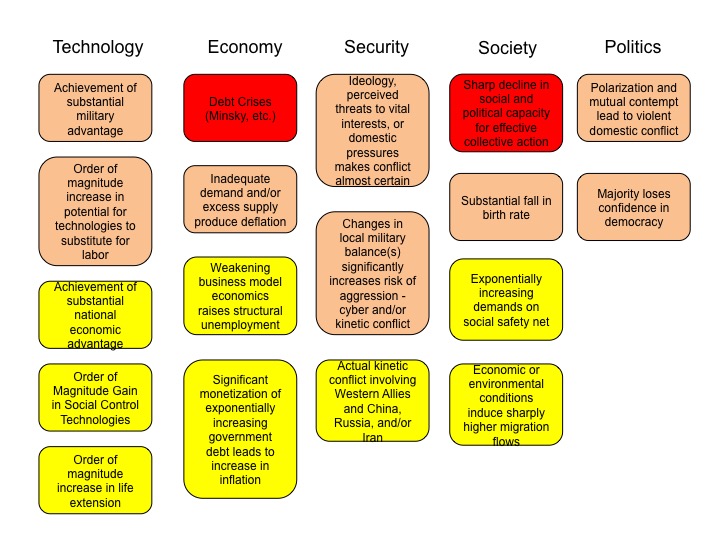
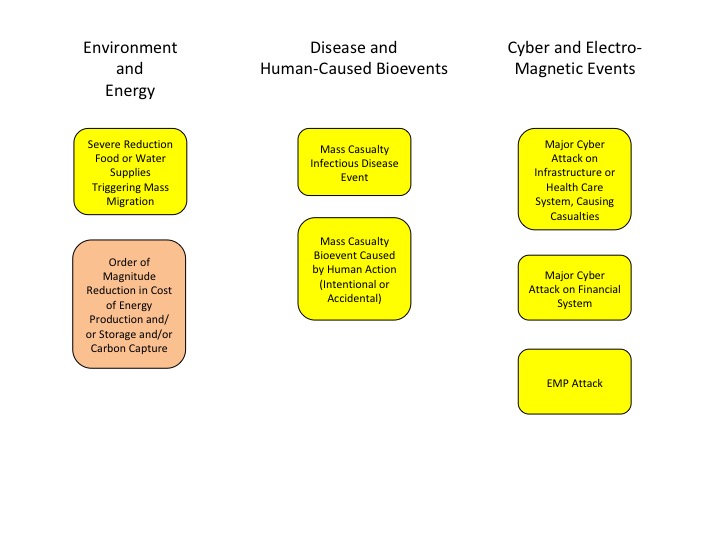
At the highest level, we believe the global macro system can be in one of four states, based on its degree of order versus disorder, and degree of social cooperation versus conflict. A very coarse-grained reading of history suggests that these states evolve in a predictable cycle, from ordered/cooperative, to disordered/cooperative, to disordered/conflicted, to ordered/conflicted.
We believe that the system is currently in its most uncertain state, characterized by high degrees of underlying disorder and social conflict, both domestically and internationally.
Our current forecast question is this: what is the probability we will either remain in the High Uncertainty Regime or transition to another regime over the next twelve months?
We currently estimate there is a 60% chance of remaining in the High Uncertainty Regime over the next 12 months, which will see the commencement of what promises to be a tumultuous US presidential campaign, and, one hopes, resolution of what has become an extended struggle over what form Brexit will take, if it happens at all.
We also conclude that over the next 12 months, the probability of returning to the Normal Regime is slight, at 5%, as is the probability of entering the High Inflation regime over the next 12 months, at only 5%.
We estimate that the probability of entering the Persistent Deflation Regime over the next 12 months is 30%.
While we expect the High Uncertainty Regime will produce declines of 20% or more in equity asset classes, it is unlikely that any other asset class will experience a gain of 20% or more. We estimate there is a roughly even chance that gold could be the exception, with that increase heavily tied to continued global confidence in the US government and economy. While the apparent inflation and political uncertainty premia in the gold price today are high relative to the last 25 years, they are still below the peak reached in 2012, and it is possible that herding in the face of increasing uncertainty could produce 20% price gains.
Pre-Mortem Analysis
One of the most important forecasting disciplines is to ask yourself why your forecast could be wrong. Dr. Gary Klein’s research has shown that a very powerful and insightful way to do this is via a “pre-mortem analysis.” This method asks you to assume that it is a point in the future, and your forecast has been proven wrong (or your strategy or company has failed). You are then asked to look backward from this imagined point in the future, to explain why you failed, what you missed, and what you could have done differently to avoid your fate.
The pre-mortem method takes advantage of the fact that humans reason much more concretely and in more detail when explaining the past than they do when trying to forecast the future.
So let us assume that it is one year from now, and our current forecast has turned out to be wrong.
How did this happen? What developments did we fail to anticipate?
At the end of March 2019, the leaders of the world’s three major powers – Xi Jinping, Donald Trump, and Vladimir Putin are all facing weakening economies and declining political popularity. History teaches us that this can lead to increased “foreign adventurism” to distract the public from worsening domestic conditions, as a nation rallies around its leader in a period of heightened external conflict. Should such a conflict develop between China and the United States, or between Russia and one or more European countries, it would generate a sharp increase in uncertainty that would likely cause an equally sharp economic slowdown and, given high debt levels, speed the arrival of the Persistent Deflation Regime.
As described in this month’s feature article, while remote, a supply side shock of some type could produce a sudden increase in inflation – the most likely scenario being a reduction in oil supplies due to a sudden intensification of the simmering conflict between Iran and Saudi Arabia.
While we believe it is highly improbable, we can envision a scenario in which for a range of possible reasons, both Xi Jinping and Donald Trump leave their current roles, and are replaced by leaders who are more committed to lessening conflicts both between China and the United States and in the international system as a whole. This would likely provide a strong boost to confidence (and thus lead to an equally strong reduction in uncertainty). Whether this would also create an opening for a reduction in domestic political conflict in the United States, and thus progress on policy reforms to address weak growth and rising inequality isn’t clear.
Note: Combining this Forecast with Others and Extremizing the Result Should Increase Predictive Accuracy
Research has found that three steps can improve forecast accuracy. The first is seeking forecasts based on different forecasting methodologies, or prepared by forecasters with significantly different backgrounds (as a proxy for different mental models and information). The second is combining those forecasts (using a simple average if few are included, or the median if many are). The final step, which significantly improved the performance of the Good Judgment Project team in the IARPA forecasting tournament, is to “extremize” the average (mean) or median forecast by moving it closer to 0% or 100%.
Forecasts for binary events (e.g., the probability an event will or will not happen within a given time frame) are most useful to decision makers when they are closer to 0% or 100% than the uninformative “coin toss” 50%. As described by Baron et al in “Two Reasons to Make Aggregated Probability Forecasts More Extreme”, forecasters will often shrink their probability estimates towards 50% to take into account their subjective belief about the extent of potentially useful information that they are missing.
When you average multiple forecasters’ estimates, you are including more information, which should increase forecast confidence and push the mean estimate closer to 0% or 100%. However, this doesn’t happen when you use simple averaging. For this reason, forecast accuracy is increased when you employ a structured “extremizing” technique to move the mean estimate closer to 0% or 100%.
You can download an extremizing model from our website to use when combining the forecasts you use in your decision process.
The extremizing factors in our model are those that the Good Judgment Project found maximized the accuracy of combined forecasts. Note that the extremizing factor is lower when average forecaster expertise is higher. This is based on the assumption that a group of expert forecasters will incorporate more of the full amount of potentially useful information than will novice forecasters.
Human beings, whether individually, in small groups, or in larger organizations, inevitably face the challenge of how to overcome doubt and act in the face of uncertainty.
In point of fact, this is a so-called “dual search problem”, in that it requires the decision maker to simultaneously explore both the external “possibility space” of alternative future environmental trajectories, and the internal “policy space” of alternative courses of action to achieve their goals, with limited resources and usually in the face of constraints and opposition.
Here I’m going to focus on the first challenge – forecasting the different ways the future could evolve, and anticipating the opportunities and threats that could emerge along different paths.
In previous issues of The Index Investor, I’ve discussed one approach to meeting this challenge that is fundamentally based on the 18th century insights of Reverend Thomas Bayes. This is also the approach that underlay the Good Judgment Project Team’s methods. To simplify, you begin the process by establishing your “prior” forecasts (based on some combination of previous experience, deductive theory, intuition, and/or existing evidence), and then update it (to a “posterior” forecast) over time as you obtain new evidence.
The amount by which your prior probability is adjusted should be proportionate to the information value of the new evidence. A proxy for this is the “Likelihood Ratio”, which compares the probability of observing (or not observing) a piece of evidence if a hypothesis is true (e.g., this event will occur) relative to the probability of observing (or not observing) it if the hypothesis is false. The higher its Likelihood Ratio, the higher the information value of the piece of a new piece of evidence, and thus the greater the adjustment that should be made to the prior probability.
As we have noted in the past, we complement this “Bayesian” approach by also taking into account “surprising” evidence, which is not consistent with our existing mental model of a forecasting problem, and its range of possible outcome. Surprising evidence increases your uncertainty about the dynamics driving a system or situation, and should therefore cause you to reduce the probabilities you assign to the possible outcomes you have identified (e.g., by creating a catch-all option of “something else”, or by widening the confidence ranges for the probabilities you have attached to your current set of possible forecast outcomes).
While the Bayesian approach to forecasting is systematic and powerful, it has a major shortcoming: It conflicts with the way homo sapiens have operated for tens of thousands of years. Rather than acting like logical Bayesians, for most of our evolutionary past we have chosen to believe forecasts that were based on the most convincing stories.
Before there was the printed word, and before mathematics was widely understood, valuable information was organized, preserved, and communicated through the act of storytelling. Researchers have found that storytelling was likely a key contributor to the development of cooperative behavior that enabled our ancient ancestors to build larger and more successful groups. And given its importance, superior storytelling abilities probably conferred evolutionary advantage (e.g., “Cooperation and the Evolution of Hunter Gatherer Storytelling”, by Smith et al).
Increasing research into the neurobiology of storytelling is helping us better understand why this is the case. To begin with, we retain more information in memory when we receive it in the form of an effective story. At a more granular level, we are also learning what makes stories effective. Stories with a plot that develops tension hold listeners’ or readers’ attention much better than those that don’t (e.g., “The Emotional Arcs of Stories are Dominated by Six Basic Shapes” by Reagan et al). And character driven stories enhance that attention – and memory recall – still further (e.g., “Why Your Brain Loves Good Storytelling”, by Paul Zak, and “Storytelling is Intrinsically Mentalistic” by Yuan et al).
More broadly, retention of stories in memory has also been shown to be a function of both their emotional valence (positive or negative) and the degree of emotional arousal they trigger (high or low), which are also drivers of human beings’ instinctive “approach or avoid” reactions. As you would expect, stories negative valence with strong arousal have strong memory retention, because of their obvious evolutionary benefits for survival (avoid!). Similarly, stories with positive valence and low arousal also have strong retention. Interestingly, retention is weaker, as are approach/avoid reactions, for the other two types of story: positive valence/strong arousal, negative valence/weak arousal.
One consequences of this is that well crafted stories that contain misinformation are very hard to dislodge from people’s memory (e.g., “Misinformation and Its Correction: Continued Influence and Successful Debiasing”, by Lewandowsky et al). As Daniel Kahneman has found in his research (see his book, Thinking Fast and Slow), much of our cognitive activity takes place subconsciously, driven by what he calls “System 1”, which is based on association and automatically seeks to make new information cohere with existing belief structures (i.e., our internal stories). Only when this proves impossible do we become aware of discrepant information, usually via the feeling of surprise, which triggers much more effortful “System 2” processing to understand its significance and its relationship to existing belief structures.
In recent years, the importance of stories has been recognized in a wider range of fields, including economics and intelligence analysis.
In economics, three of the leading researchers in this area are George Akerlof (e.g., “Bread and Bullets”), Robert Shiller (e.g., “Narrative Economics”), and David Tuckett, whose research team has produced a series of fascinating papers on “conviction narrative theory.” Arguably, John Maynard Keynes predated all of these, and his 1936 discussion in Chapter 12 of “The General Theory of Employment, Interest, and Money” of the importance of what he termed “conventions” to decision making in highly uncertain environments.
Tuckett’s theory of conviction narratives is particularly interesting for our purpose here. As he and his team define them, “conviction narratives contain a few fundamental components, notably a focus on the specific emotional elements of narratives that evoke attraction or approach to an object of investment (broadly conceived), versus emotions that evoke repulsion or avoidance of that object. This emphasis on approach and avoidance in conviction narrative theory focuses the idea of sentiment on its implications for action in uncertain decision-making, thus focusing the often-vague topic of positive/negative sentiment.
In more ordinary language we focus on excitement about the potential gains from an action relative to anxiety about the potential losses. If excitement comes to dominate relative to anxiety, investment will be undertaken. Thus, in the simplest case, the key variables of interest are the aggregate relative difference between excitement and anxiety and shifts in this difference over time…Specifically, we suggest that action in uncertain contexts is possible because the human capacities for emotion and narrative are allied with cognitive processes to create a feeling of conviction” (“News And Narratives In Financial Systems: Exploiting Big Data For Systemic Risk Assessment”, by Nyman et al).
Shiller makes the point that at any time, a larger or smaller number of narratives may be circulating (which Tuckett would note are held by different people with varying degrees of conviction). And as we have noted in our work over the years, researchers have also found that when uncertainty increases, so too does human beings’ desire to conform to the group (which, in evolutionary terms increases the chances of survival), which leads to higher rates of social copying. Paradoxically, as uncertainty increases, this leads to a narrowing of the range of narratives in circulation and likely a weakening of the conviction with which they are held, thus increasing “social fragility” and setting the stage for rapid, non-linear changes in beliefs and behavior.
Researchers in the field of intelligence analysis (like Gary Klein, Robert Hoffman, and Marvin Cohen) have also focused on the importance of narrative, particularly with regard to the construction of causal explanations of past events that are then used to generate predictions about possible futures.
Hoffman and Klein and their co-authors have found that our explanations of causal processes in complex adaptive systems (like economies or financial markets) typically take one of three simplified forms: (1) a simple list; (2) a logical sequence; or (3) a story that incorporates context and complex causal relationships (e.g., “Naturalistic Investigations And Models Of Reasoning About Complex Indeterminate Causation”, by Hoffman, Klein, and Miller, and Hoffman and Klein’s series of papers on “Explaining Explanation”).
Before moving on to a specific forecasting example, we should also discuss the confusing way that different researchers use the terms “story” and “narrative”. Some consider them synonymous – for example, Shiller defines “narrative” as “a simple story or easily expressed explanation of events that engages the emotions of others.”
Others draw inconsistent distinctions between them. For example, one definition says that a story is about people and situations: “a sequence of characters’ motivated actions (i.e., events) and their consequences.” In contrast, there can be multiple narratives for a single story, which vary in the characters and events they contain, and the way they present them (e.g., chronologically, by subplot, by character, etc.). Yet another definition considers narrative to be a “meta” concept: a system of stories and the connections between them.
A Practical Application of Conviction Narrative Theory to Regime Forecasting
Sitting around the conference room table, the organization’s investment committee got ready to hear four different consultants make their best pitch for why four different regimes were likely to exist three years hence, in 2022.
Given currently high levels of macro and market uncertainty, the committee would then weigh them before taking a decision on whether to tactically adjust its investment policy’s baseline asset class weights, and/or take other actions to reduce the risk of a substantial downside loss, while retaining as many options as possible for significant upside returns.
The first presenter was Susan Davis, who was accompanied by a team of younger associates carrying thick briefing books.
“You assigned our firm to make the most convincing case we could that three years from now the macro system will be experiencing persistent deflationary forces, like those that for the past thirty years have battered the Japanese economy. The essence of our firm’s argument is this: in essence, deflation represents a consistent shortfall in demand, relative to potential supply. The evidence I will present over the next hour supports the hypothesis that this is, in fact, the situation we face today, with little hope that it will change over the next three year. In fact, some of the deflationary forces that are at work seem likely to intensify.”
“I’ll begin with a summary of the key points in our case, which we will then review in more depth:
Due to many factors –including offshoring, automation, and the adoption of more efficient business models – potential supply has increased in many industries, from electronics to clothing to energy to food and many others. To be sure, this has not been the case across the board. For example, in many developed markets, increasingly tight regulatory conditions have limited the growth of housing supply, and major sectors of the economy like healthcare and education remain relatively inefficient, in some cases with negative productivity growth over time. But in the main, potential supply has increased.
However, this increase in potential supply has not been matched with an increase in aggregate demand; in fact, quite the reverse has occurred. Growth in demand has been limited by a number of headwinds, include the aging of the population, rising inequality, flat productivity (which, along with rising concentration and corporate power in some key industries has arguably limited labor compensation growth), the poor performance of education systems (which is causing too many well-paying “middle skill” jobs to go unfilled), and for too many young people, the growing burden of student debt. In the future, we can expect to see increased use of rapidly improving labor-substituting technologies like automation and artificial intelligence put further downward pressure on demand.
In the past, we might have been able to look to growth in investment spending or net exports to offset these downward pressures on consumer expenditure. But both of these have weakened too. To begin with, the increasing digitization of our economy has sharply reduced the need for capital investments in traditional plants and equipment. And where it has not – think of Apple’s supply chain – much more of it has taken place in other nations as supply chains have become globalized. And as I noted above, residential fixed investment has been limited by stricter regulation, rising inequality, and potential homebuyers who, in aggregate, are more burdened with student debt than ever before.
But what about exports? The problem here is that we aren’t the only economy that is facing demand headwinds. I would argue that Europe’s are even stronger, while those in China are clearly becoming stronger as the population rapidly ages and overcapacity in many industries reduces investment spending.
Now economic history teaches us that not all periods of deflation are necessarily bad. Falling prices for consumer goods can make stagnant incomes stretch farther and actually produce increases in some people’s effective standard of living – assuming they are still working and earning income.
But history also shows us that some deflations can be very destructive. These are the ones that occur when an economy is highly leveraged. In this case, falling prices mean falling revenues and increasing difficulty in servicing debt, which forces borrowers into bankruptcy, causing more people to lose their jobs and incomes. The bad news is that we live in a world today that has very high debt levels.
Even that might not be so bad if interest rates were in their historical normal range, which would allow monetary policy to be used to reduce interest rates and make all that debt cheaper to service. But today’s interest rates are already at record lows – we’re close to or at the “zero lower bound.” So we may well be facing the bad kind of deflation, where the negative impact of falling prices is amplified by increasing financial distress and rising corporate failures and cutbacks.
To be sure, if we find ourselves in that position, it seems certain that the government will try to ramp up fiscal policy, and expect the Fed to monetize a lot of the new debt that will be issued to pay for it (because the increase in taxes on high income earners that I expect won’t come anywhere close to covering the fiscal stimulus that we’re going to need to keep debt deflation at bay). Whether the current political gridlock and policy arguments in Washington will enable that huge fiscal stimulus to happen is an open question. I’m not optimistic, given how polarized our politics have become.
And even if it passes, let’s not forget what happened to all those “shovel-ready” infrastructure projects that President Obama thought he was funding back in 2009. Regulatory red tape and litigation by activist groups made sure that a lot of them never got off the ground. And even if you get a lot of actual fiscal stimulus, there is also the question – raised recently by researchers – of how much impact it will have. The problem is that they have found that the fiscal multiplier – the demand bang you get for your buck – tends to shrink as the population ages and inequality worsens. So any fiscal stimulus will have to take that into account if it is going to succeed in boosting demand and keeping deflation at bay.
Another question is whether any fiscal stimulus will just be a one time fix – like a tax cut – whose effects will fade away, or whether it will come with structural changes that address many of the root causes of the fundamental deflation problem we face. Maybe it will. I’m sure some of the other presenters today will have a more rosy view of the future that we do.
The next presentation came from professor Nigel Ensor-Gregg from Portsmouth University, who was charged with making the case for why the macro system would be in a period of high inflation by 2022. His remarks were, as always, both colorful and thought provoking.
“Let me start by telling you that many of the arguments I’ve heard for why we’re going to find ourselves in a period of high inflation three years from now are, to be polite, complete bollocks – rubbish to you Yanks. But, as I’ll get to, not all of them.”
“Here are the traditional arguments for how you find yourself in a period of high inflation, and why I think they’re wrongheaded:
While some people think MV=PQ is of the same order of brilliance as E=MC2, it is not. If V and Q are constant, then an increase in the Money supply as big as we’ve seen since 2008 should have produced a huge increase in inflation. But it didn’t. Why? Because V (for “velocity”) has fallen to an all-time low, while Q (real output) has also increased. So we haven’t seen the hyperinflation that some predicted would result from central banks’ quantitative easing (“QE”) policies.
That begs the question, of course, as to why Velocity has fallen by so much. To unravel this mystery a bit more, let’s look at some data. At the end of Q4 2018, the NY Federal Reserve Bank reported that total household debt (e.g., credit cards, mortgages, auto loans, student loans, etc.) stood at $13.5 trillion. That is higher than the previous peak of $12.7 trillion in Q3 2008. Households haven’t been hoarding money.
What about businesses? According to the St. Louis Fed, at the end of Q3 in 2010, there was $460 billion in loans outstanding to non-financial corporate businesses in the US, and $3.9 trillion in debt securities. By Q4 2018, loans outstanding had grown to $1.2 trillion, while debt securities had grown to $6.2 trillion. However, this borrowing has, to some extent, been offset by a large increase in holdings of liquid assets, at least at some companies. Apple, to use an extreme case, has a cash hoard of nearly $250 billion.
That leaves banks – which now hold near record amounts of excess reserves. This is the main reason that velocity has declined so much. But that raises the interesting question of why banks haven’t increased their lending – rather like Sherlock Holmes’ dog that didn’t bark. Is it because regulations about lending or the banks’ credit policies have become stricter? Or is it because there just isn’t that much demand for loans? Whatever the reason, the fact remains that in recent years we’ve learned that velocity can change more than we’d previously thought, so a big increase in the money supply hasn’t led to the high inflation people thought QE would produce.
Another route to high inflation that people have put forth is a loss of global confidence in the US dollar, which would cause it to depreciate, forcing a rise in import prices that would drive other prices across the economy and thus an increase in the Consumer Price Index. A fair argument, as far as it goes. But it rests on a crucial assumption: that all those dollars being sold would have another place to go. And where might that be?
Not China – it surely wouldn’t want to see a sharp appreciation in its currency, which would make its exports more expensive. And how much trust do you have in the Chinese financial markets? What about the Euro? While that market might have more capacity than China, how much confidence do you have in what you’d be buying? It’s not as though there aren’t big variations in risk – and that’s just in the case of sovereign debt. What does that leave? Japan? Where the debt/GDP ratio is the highest among major nations? Gold? Its supply is limited. Would you really pay $10,000 an ounce or more? You get my point. The argument that a crisis of confidence in the US Dollar is going to cause high inflation rests on a very questionable set of underlying assumptions about where those funds would go.
What about good old-fashioned demand-pull inflation? Remember that, from way back when? When aggregate demand was grew faster than supply, and forced prices up? Any takers for that argument in today’s global economy, which is automating its way to ever higher levels of efficiency, and thus lower marginal costs of supply? I didn’t think so.
Now at this point, you are no doubt asking yourselves, ‘I thought we paid this professor to make the best case possible for how we could end up in a high inflation regime in 2022?” Hopefully you won’t be disappointed by what comes next.
James Montier, of the investment firm GMO, has repeatedly made the case that historically, the main cause of periods of high inflation has been supply shocks – that is, a sudden drop in supply relative to demand. In many cases, these were made worse by large amounts of government debt denominated in foreign currencies (which inflation and the resulting exchange rate depreciation made more expensive to service), and political conditions that led governments to introduce indexing as a means of protecting people’s purchasing power. These typically led to exploding government budget deficits that were financed by printing money, which, via the indexing ratchet, caused inflation to increase non-linearly, sometimes to the point of hyperinflation – that is, inflation that is increasing at an increasing rate.
Given this, we need to ask two questions: What types of supply shock could have a powerful impact on the United States? And how likely is one of them to happen between now and 2022?
Let me offer you some possibilities to consider. Another oil shock is perhaps the most obvious candidate – for example, if increased Sunni-Shia conflict in the Middle East, or an Iran-Israel conflict caused Iran to mine the Strait of Hormuz or undertake direct military action against Saudi Arabia. Never forget that most of Saudi Arabia’s Shia population lives close to its main oil fields.
Infectious disease is always a threat – some have said that another global influenza pandemic on the order of the 1918 Spanish flu is just a mutation and a plane ride away. And we’ve also seen how Ebola is making a comeback in Africa, though so far it kills so quickly that outbreaks have burned themselves out. But again, mutations are a fact of viral life. And, like it or not, with increasingly easy access to genetic engineering tools and knowledge, we sadly can’t rule out an intentionally caused pandemic that could close down key supply chains and produce an inflationary shock.
Less likely, but far from impossible, are four other supply shock scenarios – a major crop failure caused by a weather related event, a cyber event or solar storm that causes widespread damage to critical infrastructure – e.g., the electrical grid, pipeline, or communications network, or the eruption of “kinetic hostilities” (probably by accident) between the US and severely disrupts supply chains.
So we have six scenarios that could produce a severe and prolonged supply shock that would likely trigger a sharp rise in prices. How do we estimate the likelihood that any of them will happen? That’s hard, because in many of these cases, the crisis in question would be relatively, and historical frequencies are either unavailable or unreliable guides in a system that is constantly adapting and evolving. We can, however, turn the question around, and ask what is the annual probability that over the next three years, none of these supply shocks will occur? Let’s say you think that probability is 95%. Then over three years, the probability that a significant supply shock will occur is 100% less 95% cubed, or about 14%. If you think the annual probability of non-occurrence is 99%, then the probability of occurrence over three years falls to just 3%. On the other hand, if you think the annual probability that none of these shocks (or one we haven’t anticipated) will occur is actually 90%, then the probability of an inflationary supply shock over the next three years jumps to 27% - or about a 1 in 4 chance.
Peter Fisher, a leading sell-side research analyst at a large investment bank, gave the third presentation. His charge was to make the best case that by 2022 the macro system will have returned to the normal regime, with equity asset classes expected to deliver annual returns in their historical range.
Fisher wasted no time in launching into his argument:
“Are equities today a little pricey? Sure, especially in the US and emerging markets. But we also think there’s a very good chance that events over the next three years are going to catch up to these valuations and make them look much more reasonable, and maybe even cheap. Here’s why:”
We think there’s been an overreaction on the downside. Let me give you some examples. Brexit is either not going to happen, or its impact isn’t going to be a negative as the scaremongers would have you believe. Think, for example, about the possible benefits of a comprehensive trade deal between the US and the UK – that would instantly add 15% to the United States’ GDP. That would be like adding another Canada – and another Mexico.
Now let’s look at China. How happy do you think people are about the growth of the surveillance state, the repression of private companies, a weakening financial system, a slowing economy, and picking a fight with the United States? And how happy do you think all those other leadership factions are in China, whose members have been targeted by Xi Jinping’s relentless purges, sorry, I mean “anti-corruption” drives? We think there is a credible case that sometime in the next three years that Xi is going to be replaced by a new leader who is going to tone down the conflict with the United States, go back to Deng Xiaoping and his successors’ encouragement of the private sector, and get Chinese growth back on track, including cutting some type of managed trade deal with the United States that will benefit both countries’ economies.
We also don’t believe that Donald Trump will be our president after the 2020 election. Maybe it will be a health issue, or maybe he’ll just get tired of their constant attacks. Or maybe he’ll get taken out in a primary by somebody like Nikki Haley, or maybe center right and center left members of Congress will finally band together to pass pragmatic legislation that is opposed by both parties’ radical wings. We just don’t see how the United States can continue down the political path we are on without something giving; there’s just too much stress accumulating in the system.
So think about what happens if we actually get health reform passed that people support, while tax rates get more progressive and rather than an increase in the minimum wage we boost the earned income tax credit that gives people a stronger incentive to work and a decent income when they do, and there’s reforms of the college loan system and maybe some type of national apprenticeship system that starts to get more people into good paying jobs without having to rack up tens of thousands in debt chasing a worthless college degree. And what happens if this center group finally passes immigration reform that people can support – maybe one based primarily on skill-based immigrants, like they have in Canada and Australia? And if the increasing capabilities of automation and AI technologies lead to more reshoring that creates more jobs right here in America?
You know what this adds up to? Faster growth. Reduced income inequality. Restoration of the American Dream. Less social and political conflict. And rising stock prices that will make today’s valuations look reasonable, or maybe even cheap. That’s where we think global macro is going to be in 2022.
The last presenter of the day was Jayne Coombs, from a Canadian risk consulting firm. She was tasked with making the argument for why in 2022 the global macro system would still be in the high uncertainty regime it is in today.
“I guess it’s fitting that I’m the last presenter you’re going to hear from today”, she began, “as I’m here to argue that three years from now we’re still going to be in a regime of high uncertainty, though by then global equity markets will have lost 20% or more in value compared to where they stand today. Let me tell you why the high uncertainty/high anxiety period we’re in today isn’t going to end anytime soon:”
To begin with, the most recent data show that the world economy’s three “growth motors” are all slowing down – fastest in Europe, a bit more slowly in China (the accuracy of whose data is always questionable), and now in the US.
We don’t think this will end up in deflation in the US because the healthcare and education sectors of the economy together have a 10% weight in the Consumer Price Index. Both have growing demand and are highly inefficient with negative productivity growth, so we expect continued strong price rises in both. On the other hand, food and other goods (e.g., food, furnishings, etc.) together make up 34% of the CPI, and both have been under downward pressure because of changing supply and demand dynamics in those sectors. Energy has an 8% weight in the CPI. In the absence of a supply shock, a weakening economy should cause energy prices to decline.
The key variable in the argument whether we will enter a period of deflation is therefore housing (i.e., home ownership and rental costs), which has a 33% weight in the CPI. As the growth of housing supply is increasingly constrained by regulations, the question is whether even as the economy weakens, a combination of population growth and new household formation, along with low interest rates and more quantitative monetary easing will result in continued increases in housing costs. We think they will, and that all these factors, plus a heavy dose of fiscal stimulus will keep deflation at bay. Having seen what has happened in Japan over the last 30 years, we know that most policymakers are deathly afraid of deflation, and will go to extraordinary lengths to avoid falling into the same trap.
Beyond avoiding deflation, however, we see economic uncertainty continuing to increase as a number of forces continue to play out, including the increasing deployment of more capable automation and artificial intelligence technologies and their likely negative impact on employment, the potential for job losses and financial system problem due to high leverage levels as the demand continues to weaken, possible disruptions in Europe due to Brexit, worsening of Chinese-US relations and their potential impact on supply chains and trade, and what are likely to be a fierce debate over the form that any fiscal stimulus will take when economies fall into recession territory. In the US, this could take the form of fights between supporters of progressive initiatives like the “Green New Deal” and supporters of tax cuts (and at which groups they should be targeted). In Europe, a downturn could easily trigger another sovereign debt crisis in the Eurozone (this time with Italy at its center), as well as fights over how fiscal stimulus should be apportioned across nations – specifically, will Germany keep looking out for itself, or stimulate more than its politicians would like in order to support the wider Eurozone?
The next reason we’re forecasting that the current high uncertainty regime will continue for the next three years is that we don’t see the political situation getting any better, as long as the twin economic problems of insufficient demand and worsening inequality remain unresolved. We expect that in the United States and European countries, centrist political parties will keep losing ground to more extreme parties, particularly if worsening global economic conditions trigger much larger migration flows. As a result of all these drivers, political conflict, policy gridlock, and uncertainty will increase.
In the United States, we now think it is at least an even bet that Donald Trump will be re-elected, shocking as that may have seemed six months ago. But in what looks like a repeat of 1972, the Democratic Party seems poised to tear itself apart in a fight between its left and center wings, much as the Republicans did a decade ago when the far right Tea Party arrived on the scene. We doubt that Trump’s re-election will reduce uncertainty.
On the international front, we expect that Vladimir Putin will continue his “grey zone” initiatives against Western Europe, seeking to generate further domestic conflict between factions both within countries and across the continent. A critical question for us is how these efforts, if they succeed, would interact with Putin’s declining domestic popularity. Would he attempt to seize more territory – say in the Baltics this time, under the pretense of protecting threatened Russian minorities in one or more of those countries? Clearly, this dynamic is potentially a major source of increasing uncertainty. And the same is true, unfortunately, for China’s increasingly aggressive activities in the South China Sea, particularly at a time when, because of growing economic problems, Xi Jinping may be feeling less secure in his position. The third big international source of uncertainty that we see is Iran, which is unlikely to slow down either its attempts to foment conflict and expand its influence in the Middle East (e.g., in Iraq, Syria, Lebanon, and Yemen), or its ongoing development of weapons and delivery system that could pose an existential threat to Israel – where Bibi Netanyahu, who has a very keen appreciation of these threats and is a combat veteran of Sayeret Maktal, will still be in charge.
Last but not least, a key reason we expect the high uncertainty regime to continue through 2022 is the recursive nature of uncertainty itself, which is deeply rooted in human nature. As we become more uncertain, we rely more heavily for direction on what we observe others to be doing. Various researchers have different terms for this, like social copying, social learning, or increased conformity. While the definitions of these terms differ, the underlying phenomenon is the same – and in our hyperconnected world, it has now become supercharged. In the 1930s, Keynes noted how, in the face of high uncertainty – and indeed, as he noted, our ignorance about what the future may hold – we adopt what he termed “conventions”, which provide the conventional wisdom that gives us the confidence to act. But he also noted that these conventions ultimately rest on public confidence in their accuracy. The flip side of confidence is uncertainty – and hyperconnectivity now rapidly transmits changes in it across the population, which can cause “conventions” or the conventional wisdom to change more rapidly than ever before – which recursively increases feelings of uncertainty.
Having heard all four presentations, the committee prepared discuss and weigh the relative likelihood of the narratives they had heard, before deciding if any of them were sufficiently convincing to motivate a significant change in their portfolio asset class exposures…
Closing Thoughts
As you can see, the conviction narrative approach to forecasting is quite different from more systematic Bayesian methods. Yet on a very deep (indeed, evolutionary) level, most people are likely to find it more intuitively appealing, as through the use of story it simultaneously engages us on both a cognitive and emotional level.
For that very reason, stories can also lead us astray. One way to protect against that is to systematically critique any conviction narrative before you act on it. In our strategic risk consulting work over the years at Britten Coyne Partners, we have found two methods to be very useful.
The first is Gary Klein’s “Pre-Mortem” technique. Assume that you are at some point in the future, and your strategy or action plan has failed to achieve your goal. Looking backward, write down why this happened, including warning signs you missed, and what you could have done differently to increase the chances for success.
The second is Marvin Cohen’s “Story Critique” approach. Begin by evaluating the assumptions made in the story about “known unknowns”, and the quality and weight of evidence that supports each of them. As the number of assumptions with weak support increases, so too does the likelihood that important “unknown unknowns” are missing from your story and remain to be discovered. Cohen recommends two approaches to help you “forage for surprise.” Begin by teasing out and examining the implicit assumptions it contains. After that, move on to questioning the story’s assumed “known knowns”.
On balance, we believe that both the Bayesian and Conviction Narrative approaches to forecasting are equally valuable. The former forces us to pay close attention to the value of new information that we receive over time, while the latter makes explicit the evolving causal stories that drive our decisions and actions when uncertainty is high.
If you have any questions about anything we have written in this issue, please don’t hesitate to get in touch, at contact@indexinvestor.com